
Editorial
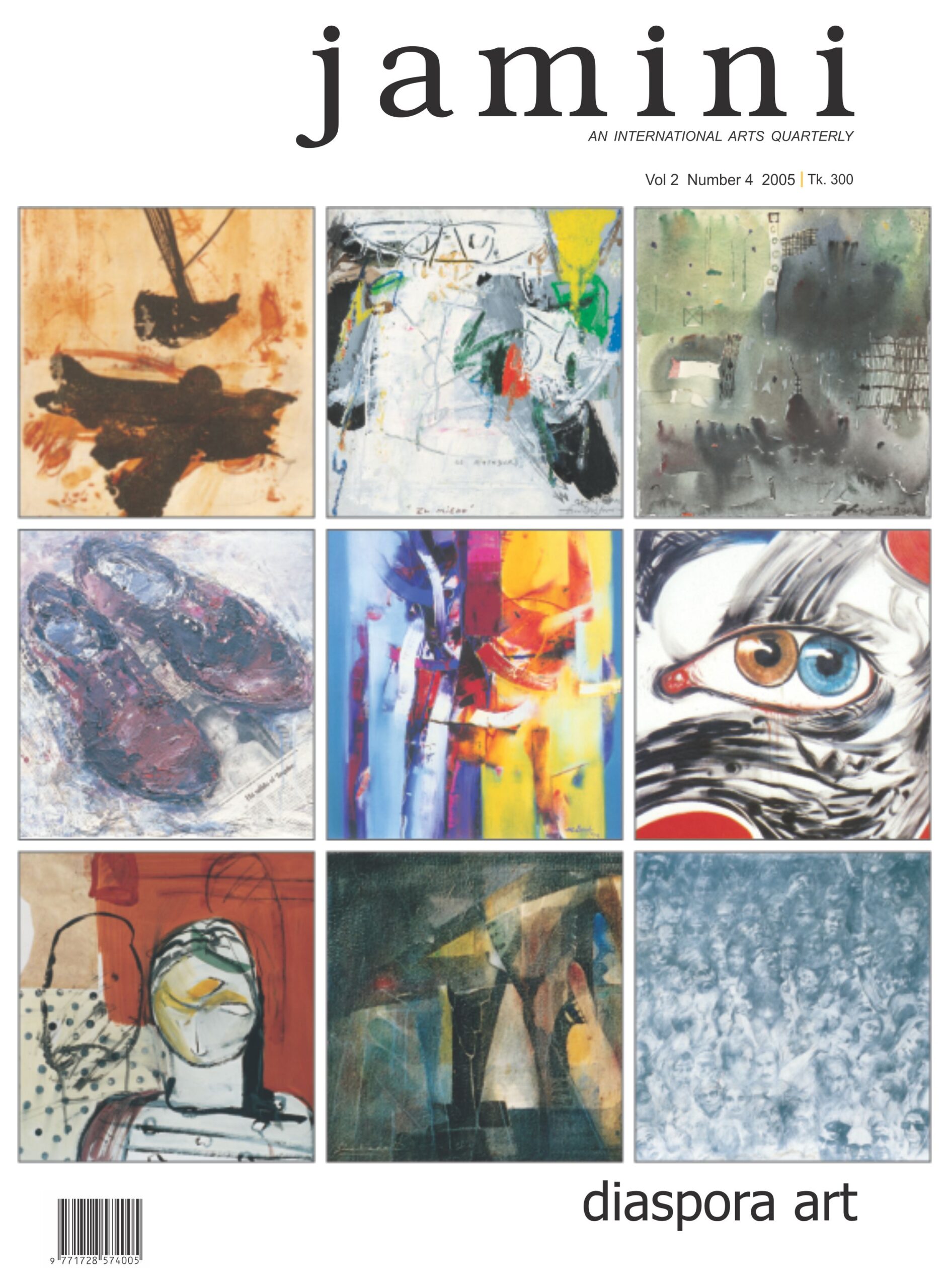
This issue of Jamini trains the spotlight on diaspora art, particularly that produced by expatriate Asians. In course of the discussions the concept of ‘diaspora’ itself undergoes scouting, either explicitly or by implication, and the conclusion seems inescapable that the facile use made of it by certain critics in the not-too-distant past is best relegated to cultural history. For, in an age that permits dual citizenship and brashly trumpets the ideology of globalization, physical displacement does not carry a single, unequivocal significance. Indeed, extrapolating from Syed Manzoorul Islam’s comprehensive survey of Bangladeshi artists abroad, one can interpret expatriation as upward mobility of a peculiarly ambiguous sort. Their audience is largely in their home country, where their foreign domicile endows them with a cachet: they are seen as Bangladeshi artists with an international standing. But in their place of self-exile they are not in the mainstream of art. As for the exceptions to this dismal generalization, readers will discover them as they read on.
Unsurprisingly, India has the largest number of expatriate artists among South Asian countries. Jeet Thayil engagingly describes his personal connection with one of the earliest of them to achieve international recognition–F. N. Souza, who died in 2002 after a chequered career spanning three continents. Peter Nagy focuses on an adventurous installation artist, Subodh Gupta, and Shukla Sawant on ‘a new generation of British artists of Indian origin’. By chance rather than design, the expatriate Pakistanis covered happen to be women–all of them with an innovative approach to fusion. Niilofur Farrukh takes note of Shahzia Sikander, alongside whom Salima Hashmi also considers Nusra Latif Qureshi, Saira Wasim, Talha Rathore, Faiza Butt and Ruby Chishti. Though one may discern common concerns among them, they are actually scattered over three continents.
Since our avowed intention is to deal with all visual (and performance) arts, Zafar Anjum’s ‘tribute to a global talent’–Mira Nair–is particularly comme il faut. So are our two articles on photography–Waqar Khan’s charming resurrection of ‘Early Photography in Dhaka’ and Fakrul Alam’s review of the doyen of Bangladeshi photographers, Noazesh Ahmed–and Timmy Aziz’s critique of a book on Louis Kahn’s work in Dhaka by Kazi Khaleed Ashraf and Saif Ul Haque. Derek Manley reviews an interesting out-of-the-way book, John A. Walker’s Firefighters in Art and Media. Three recent exhibitions are covered by Kaiser Haq (Nazlee Laila Mansoor), Khademul Islam (Rokeya Sultana) and Syed Manzoorul Islam (Murtaja Baseer). A new generation of French artists is introduced by Henry Meyric Hughes on the basis of his experience as chair of ‘the jury for the Diploma examinations for the six-year course at the Ecole des Beaux-Arts in Paris.’ That makes this issue as varied a fare as one can expect from 120 pages. Next time our spotlight will fall on installation art.
This issue of Jamini trains the spotlight on diaspora art, particularly that produced by expatriate Asians. In course of the discussions the concept of ‘diaspora’ itself undergoes scouting, either explicitly or by implication, and the conclusion seems inescapable that the facile use made of it by certain critics in the not-too-distant past is best relegated…