

the manipuri dance tradition
The history of the arts reflects the ever-changing dynamics and flow of cultural metaphors between people and nations. Looking at recent changes in the development of dance in Bangladesh, for instance, we come across interesting exchanges with neighbouring lands. Thus we can trace the effects of Kathak, Bharatanatyam, Odissi, Kathakali, and Manipuri styles on our dance. Indeed, the great Bengali poet Rabindranath Tagore, a patron of Manipuri dance as of so many other art forms, believed that this exquisite dance form best reflected the spirit of Bengal and tried to incorporate it in his own choreography and the curriculum of his dance school in Santinekatan.
Manipur – The People and Their History
The Manipuris are a people who take their name from Manipur, a region located in the northeast of India and bordering the Sylhet division of Bangladesh. ‘Manipuri’ is also a generic term for several forms of dance practiced by the people of Manipur, who themselves are a blend of three races: 1) the native Naga and Kuki tribes; 2) the Bishnupriya Manipuris, considered to be descendants of the Aryans who came to the Manipur valley from Dvaraka and Hastinapura, just after the Mahabharata war in 9th century BC; 3) and the Meiteis of Mongol ancestry who invaded and dominated Manipur around 700 A.D. It is said that the total domination of the Meiteis led to enforced intermarriages, which resulted in the predominantly Mongoloid facial features of the people.
Sylhet in Bangladesh has large settlements of Manipuris. Interestingly, Rabindranath Tagore first came across their dance when he attended the Ras Lila festival at Machhimpur, a Bishnupriya Manipuri locality in Sylhet in 1920. He immediately decided to open a new department of Manipuri Dance in Santiniketan. Consequently, he invited Guru Senarik Singha Rajkumar, a native of Kalijar, Silchar of Assam, and Guru Nileshwar Mukharjee of Kamalganj thana of Sylhet, to come to Santiniketan. Both gurus belonged to the Bishnupriya Manipuri Community.
The Dances of Manipur
One remarkable feature of Manipur dance is that it is woven into the fabric of the everyday life of its people, forming not only the core of festivals celebrating each season but also constituting a large part of social events like births, marriages, upanayanam and shraddhah. The following forms are easily recognisable:
a) Lai Haraoba, an offering of songs and dances to the deities of the early Sanamahi tribal religion, forms the basis of all stylized dances in Manipur;
b) Nata-Sankirtan, which has its roots in the devotional and congregational music of the 15th century Vaishnava ‘bhakti’ movement of Bengal;
c) Ras Lila, which is based on compositions depicting episodes from the life of Radha and Krishna and is said to have been created in the 18th century by Manipur’s philosopher-king, Raja Bhagyachandra;
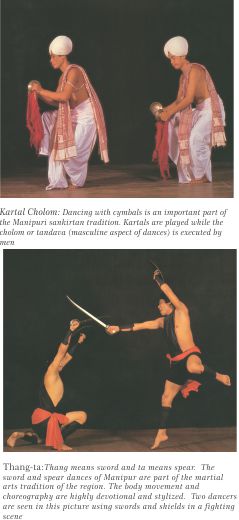
d) Naga and Kuki tribal dances, devotional dances and Thang-ta, a martial dance with its origin in times when man’s survival depended on his ability to defend himself from the vagaries of nature.
Lai Haraoba
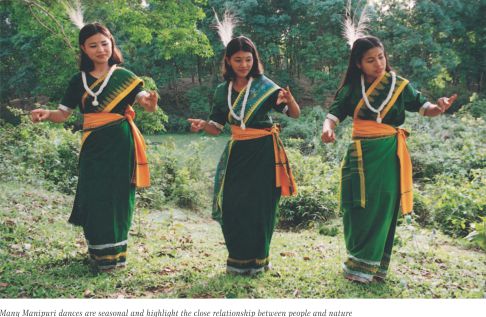
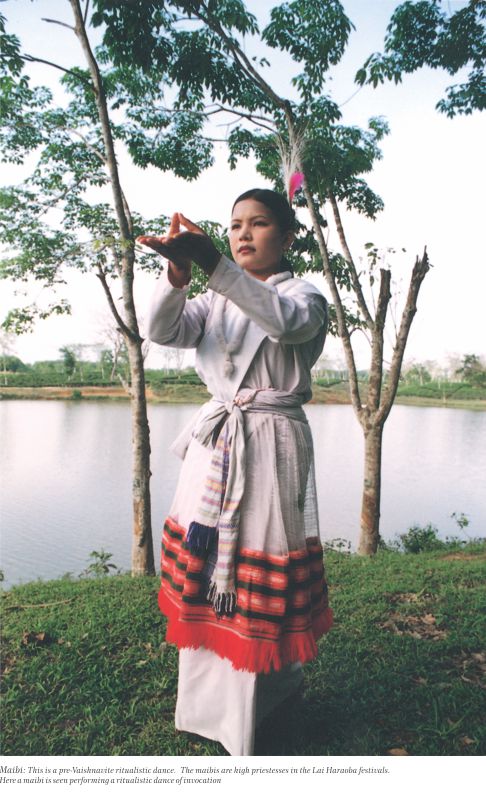
Among these styles, it is the Lai Haraoba alone, if one insists on ethnic verity, which truly has its roots in the land itself. Of unknown antiquity, it is a ritualistic dance enacted by Maibas and Maibis – priests and priestesses – during the month-long Lai Haraoba festival celebrated in all parts of Manipur during the summer months of Boishakh and Jaishtha. It is dedicated to the particular deity of each village, and is a throwback to the earlier tribal religion of the people.
Though Lai Haraoba – literally meaning the ‘merry-making of the gods’ – depicts and celebrates various aspects of Creation, it is essentially a ceremonial offering of music and dances to the gods and is, of necessity, devotional in character.
The predominantly undulating characteristics of all the dance forms of Manipur found their mature form in the Lai Haraoba. This technique of Manipuri dance is based on an interesting principle of compensatory movement that has the objective of achieving rounded movements and avoiding any jerks, sharp edges or straight lines. If the right hand is outstretched towards the right, for example, the body is tilted towards the left in order to offset the right side thrust. The movement towards the right is balanced and subdued by the one towards the left. This contrasts in particular with the technique of Bharata Natyam, in which, in the same example, the effort would generally be to emphasize the movement to the right. It is this aspect which imparts to Manipuri dance an undulating and soft appearance. However, this impression of softness actually hides a very tough regimen of body control. Similarly, the feet never strike the ground with a sound or impact, as this would interfere with the delicate flow of the body movements. The knees and ankles cushion the landing so that no sound ensues. Manipuri dancers do not even wear ankle bells, whose purpose is, after all, to accentuate the beats tapped out by the feet.
To digress a bit, the shastras recognize four ‘modes of expression’ or vrittis. They are: bharati vritti or vocal expression, satvati vritti or emotional expression, kaishiki vritti or delicate expression, and arabhati vritti or virile expression. Pravritti, on the other hand, is regional identity recognized through costume, dialect, habit, tradition, custom and occupation. Four types of histrionic expressions, too, have been identified: aharya abhinaya or expression through make-up and costume, angika abhinaya or expression through movements and gestures, vacika abhinaya or expression through voice and speech, and satvika abhinaya or expression through responsive emotional reactions.
Although in most classical dance forms kaishiki vritti and arabhati vritti are integrated and exploited according to the exigencies of vocal or emotional expression, a distinctive feature of Lai Haraoba is its well-defined demarcation into the distinct kaishiki vritti or lasya, graceful feminine, and arabhati vritti or tandava, virile masculine, movements of the female and male dancers. In Bharata Natyam a dancer would use the lasya and tandava movements equally in one single dance, whereas in Lai Haraoba the lasya and tandava are not just vrittis or modes but, in fact, two distinct forms of the dance performed independently by female and male dancers, respectively.
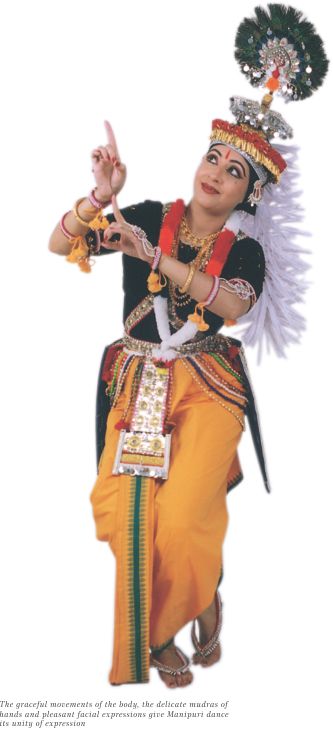
Furthermore, in keeping with the subtleness of the style, in Lai Haraoba histrionic expression does not play up the angika abhinaya. Its forte is sarvangabhinaya, or the use of the entire body to convey a certain rasa or emotion, in substitution of the exaggerated and unnatural use of mukhabhinaya or facial expression.
The bhakti rasa or devotional character of Lai Haraoba gives it its sublimity and subtleness, while a prudent and balanced use of theatrics necessary for sarvangabhinaya gives it a ‘unity of expression’ devoid of superfluous ornamentation. These features of Lai Haraoba dominate even in all later Ras Lila and Nata-Sankirtan form of dances.
The Lai Haraoba includes in its repertoire dances such as:
1) Maibi, which is the dance of creation;
2) Khamba-Thoibi, a duet dance which is performed either as part of the Lai Haraoba festival or independently. This dance typically represents the tandava and lasya aspects of Lai Haraoba movements The Khamba -Thoibi tells the story of Khamba, a poor but brave lad of the Khumal clan who fell in love with Thoibi, a princess of Morang ancestry;
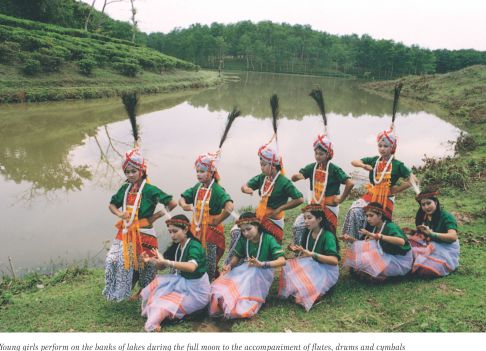
3) Thangbol Chomba, literally meaning ‘the light-jump of the moon,’ is the most beautiful and seductive dance of the Meitei Manipuri. The youth of the village flock together in hundreds for every full moon. As soon as the moon rises over the hills, flutes, drums and cymbals start playing. Boys and girls form a circle and clutch each other’s hands rhythmically to music that can be slow and fast, high and low, or up and down. If the number of participants is large they may form two or three rows so that everybody and anybody can participate in the dance. In all probability, this dance has its origins in a mating ritual.
Influences from Bengal
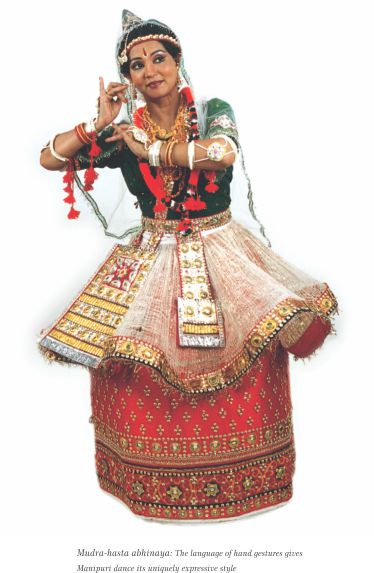
With the advent of the Bhakti movement of Sri Chaitanya Mahaprabhu’s Vaishnavite cult in Bengal in the 15th century AD, the secluded and verdant valley of Manipur saw a vibrant influx of ideas, which was to bring about dynamic changes in the life and arts of the people of Manipur. Of importance for us is the manner in which new ideas were not just readily accepted but absorbed and indigenized to bring forth a new fecundity in art and culture. Not only was the Bangla script appropriated for Manipuri texts, in the arts we see the birth of two new forms of song and dance: the Manipuri Ras Lila and the Nata-Sankirtan. Under the inspired guidance of Maharaja Bhagyachandra Singha (1763-1798), the ancient body language of Lai Haraoba dances appropriated new concepts from Bengal to reach newer heights of creativity. The notion of ‘story telling through dance’ with the use of mudra-hasta abhinaya or ‘hand-language’ was incorporated into the older Lai Haraoba form to create a fusion of forms, which enacted new literary texts like Jayadeva’s Geetagovinda. With great devotion, the Maharaja, historians tell us, assembled the best dance and music gurus in his court, sat with them, and guided them through the new concepts of philosophy and art that were evolving in the region. The consequence was the emergence of what can be said to be a stream of music and dance forms that though essentially new still remained true to the spirit of Manipuri traditions.
Nata-sankirtan
Vaishnavism was hailed as an inclusive form of theosophy. Devotion was open to one and all. In the arts it took the shape of congregational music or sankirtan. In Manipur, a land where dance was an inextricable part of the community, it was transformed into the Nata-sankirtan, or congregational dances.
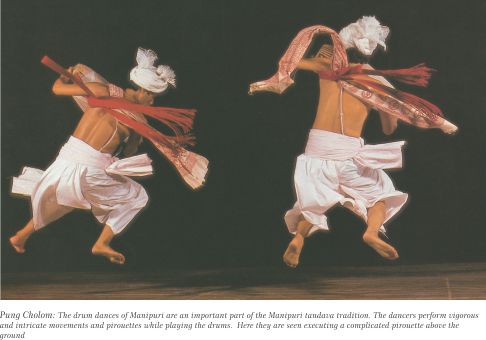
The male dancers used their age-old musical instruments, the Pung, or drum, and Kartal, or cymbal, to dance out their devotion. However, they did not stop at incorporating the concept of sankirtan – the Nata-sankirtan indeed went further and enriched itself by adopting various choloms, or movements, from nature.
The whispering of the wind, the sound of the thundering clouds, the walk of the gaja, or elephant, the gliding of the swan – and much more – were all incorporated to form the Pung Cholom and the Kartal Cholom dances which continue to fascinate us because of their highly stylized and acrobatic nature.
Ras Lila
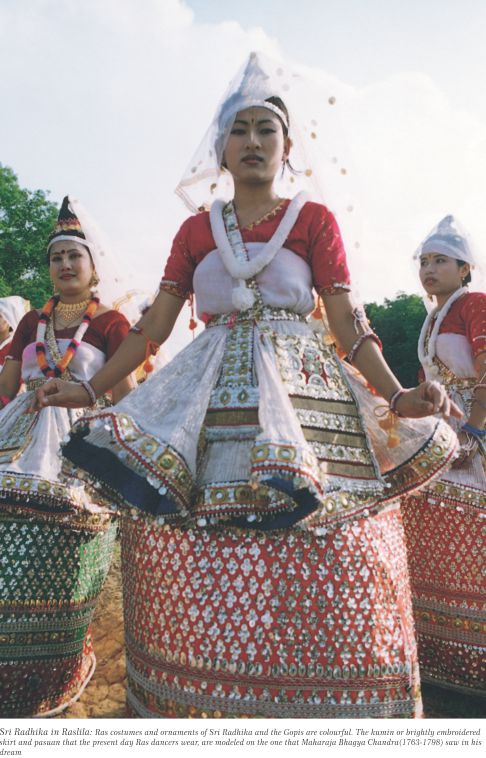
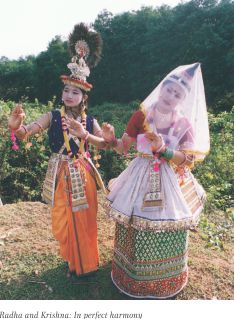
It seems the Maharaja was also a dreamer, for in his dreams he envisioned the ultimate dance of the celestial lovers, Radha and Krishna – the Rasa Lila. The scriptures say: ‘Rasyate iti Rasah’ – that’s to say, that which evokes rasa, or emotions is, verily, Rasah. The truth of this adage is proven by the deep sense of devotion with which the Ras dances, generally performed in an enclosure in front of the temple throughout the night, are danced and looked at by the people of Manipur.
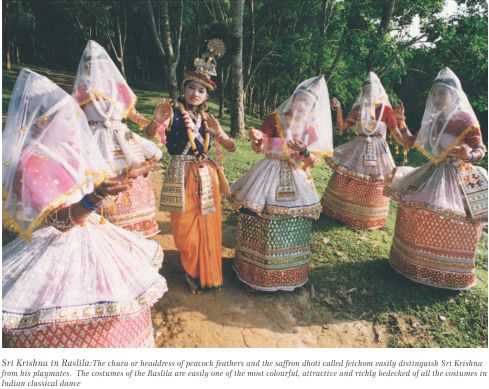
Incorporating new concepts like the use of the mudra-hasta abhinaya, or the language of hand gestures into the earlier dance forms of Lai Haraoba, and making prolific use of the Padavali Kirtans from Vaishnavite texts like the Bengali poet Jayadeva’s Geetagovinda, Maharaja Bhagyachandra introduced the Manipuri Maha Ras Lila in the Manipur valley. His patronage and guidance ushered in a new era in the development of this style. The Ras Lila, the epitome of Manipuri classical dance, is interwoven with the celestial and eternal love of Radha and Krishna, as described in the Hindu scriptures. It reveals the sublime and transcendental love of Lord Krishna and Radha and the Gopis’ devotion to Krishna. Legend has it that when Krishna, Radha and the Gopis danced the Ras Lila, Shiva made sure that no one marred the beauty of the dance. Parvati, the consort of Lord Shiva, expressed her desire to dance the Ras with her lord. To please her, Shiva chose the beautiful land of Manipur and re-enacted the Ras Lila, while Ananta, King of the Naga serpents, illuminated the valley with the light of his ‘mani’ or jewel, thus giving the land its name – Manipur.
In Manipuri dance, the Ras Lila can be divided into four types:
Vasanta Rasa, performed during the Purnima Tithi (full moon) in the spring months of Falgun and Chaitra and based on the Govindalilamrita.
Kunja Rasa, performed during Purnima Tithi in the summer month of Baishakh and based on the Brahmavaibarta Purana.
Maha Rasa, performed during Purnima Tithi in the late autumnul month of Kartika and based on the Shrimad Bhagavat Gita (panchadhaya). Nitya Rasa, performed any day on any month of the year and based on the Govindalilamrita. Nitya Rasa is performed on occasions such as marriages.
While there is the bhava (emotion) of Radha’s surrender to Krishna in some ras lila dances, others have the theme of Radha-Krishna sringar, and some depict the viyoga (separation) of the lovers. These themes derive from the Geetagovinda, Govindaliamrita and other Vaishnava literary works.
The themes of Ras Lila, shown through dances, include: a) Krishna Abhisar – Krishna’s trysts; b) Radha-Gopi Abhisar – Radha and the Gopis’ trysts; c) arrangement of Mandap – The decoration of the stage d) Rag-Alap of Gopis – The dalliances of the Gopis; e) Achouba Bhangi-pareng which describes the beauty of Lord Krishna with its lasya movements (parengs are various movements of Manipuri dance codified after the reforms of Bhagyachandra).
Other dance forms include Krishna Nartan (Krishna’s Dance); Radha Nartan (Radha’s dance); and different kinds of dances of the Gopis.
Ras Performances are seasonal and varied and take place at the temple of Shree Shree Govindajee in Imphal, Jura Mandap at Moulvibazar, Bangladesh, on the nights of Basanta Purnima, Sarada Purnima, and Kartik Purnima, and at some other local temples in areas inhabited by the Bishnupriya Manipuris in Assam and Tripura.
Also part of the Rasa Lila dances is the Goshtholila, which is a group dance performed by boys wearing colorful dresses and ornaments. The themes of the dances associated with Krishna’s pastoral boyhood are Yasoda’s love for her son; the coming of the sage Narada to the palace of Nanda and his teaching Krishna and Balaram to milk and graze cattle; and Krishna and Balaram at play.
Goshtholila celebrates the Krishna story through dance and is obviously derived from the older forms, but is more stylized. It has been altered considerably over the years by the wearing of colorful dresses like feichooms or dhutis, churas, koknaams, leitrengs and khobols.
This highly stylised form of dancing is characterized by sublimity, subtlety and grace.
The above, along with the tribal dances and Thang-ta, the martial dance, form the bulk of what is understood as Manipuri Dance.
New Challenges
Fortunately, the arts know no boundaries, and do not usually fall prey to stagnation. To stand still, in fact, is to fade into oblivion. Today what the urban rasika sees on the modern stage is yet another step in the history of an art form that has undergone unceasing modifications and alterations to keep up with the flow of time.
It was left to visionary teachers such as Guru Bipin Singh to sensitively transform Manipuri dance into its current sophisticated form. He was greatly supported in his work by able disciples like the Jhaveri sisters and Kalavati Devi. Guru Amobi Singh was another great teacher who spread the art through his collaboration with Uday Shankar.
Guru Atomba Singh and Guru Nabakumar Singh are renowned for their work with Rabindranath Tagore. Although Tagore’s was an experiment in fusion, he undoubtedly chose the Manipuri style as the main weave of his creations. It is the equipoise in the use of histrionic expression in Manipuri dance that struck a sympathetic chord in Tagore. Always an advocate for ‘restraint’ in the use of alamkara, or ornamentation in the arts, Tagore found Manipuri dance in consonance with the musical heritage of Bengal, so rich in its lyrical content without being overtly ornamental.
Exchanges between
Bangladesh and Manipur
The years between the partition of India and the emergence of Bangladesh were not very happy times for dance in East Bengal (today’s Bangladesh). The rich tradition of the Bishnupriya Manipuris of East Bengal, too, waned. A very corrupt and inferior quality of dance was then in evidence, all the gurus having left for greener pastures elsewhere.
It was not till the early 1980s that Manipuri dance in Bangladesh witnessed a resurgence. The stimulus came when Shantibala Sinha, a disciple of Guru Bipin Singh, and one of the brightest exponents of Manipuri dance, migrated to Bangladesh after her marriage. Then, with the support of Chhayanaut, one of the leading music schools of Dhaka, she started the disciplined training in Manipuri of young Bangladeshi dancers. Later, Shantibala’s students Tamanna Rahman and Sharmila Banerjee were awarded scholarships to India for higher training in Manipuri dance at the Manirpuri Nartanalaya, Kolkata, under the able guidance of Guru Bipin Singh himself and Smt. Kalavati Devi.
Today, Bangladesh can pride itself in having several extremely capable young exponents of Manipuri dance. While it must be conceded that it is still a growing art form in the country we can nevertheless say that what one day Bengal had given to the people of Manipur is aptly being returned to it wrapped in delicate rhythms and dance styles.
The question, however, is: do we accept it as it is? Or do we dare to experiment and assimilate, to come up eventually with a dance form of our own?
Lubna Marium is a leading exponent of classical dance in Bangladesh
The history of the arts reflects the ever-changing dynamics and flow of cultural metaphors between people and nations. Looking at recent changes in the development of dance in Bangladesh, for instance, we come across interesting exchanges with neighbouring lands. Thus we can trace the effects of Kathak, Bharatanatyam, Odissi, Kathakali, and Manipuri styles on our…