

revisiting tradition
In the work of Abdus Shakoor the rich tradition of Bangladeshi folk art comes alive in all its vibrant colour schemes and design patterns. Shakoor has closely studied traditional art forms. His interest in old ballads and his intense curiosity about life in rural Bengal have shaped his art language. Refreshing and riveting, Shakoor’s canvas reflects his subtle blending of the old and the new. Currently Professor in the Department of Craft at the Institute of Fine Art, Dhaka University, Shakoor has over 20 international and ten solo exhibitions to his credit. He has won a number of national and international awards including Best Prize at the Lalitkala Academy in Gujrat in 1977, Excellence Award, Tokyo, Japan in 1991 and Runner-up Prize at the International Noma Concours (ACCU) Competition, Tokyo in 2000. Recently Shakoor talked at length to Jamini executive editor Ziaul Karim about his art, his interests and his vision.
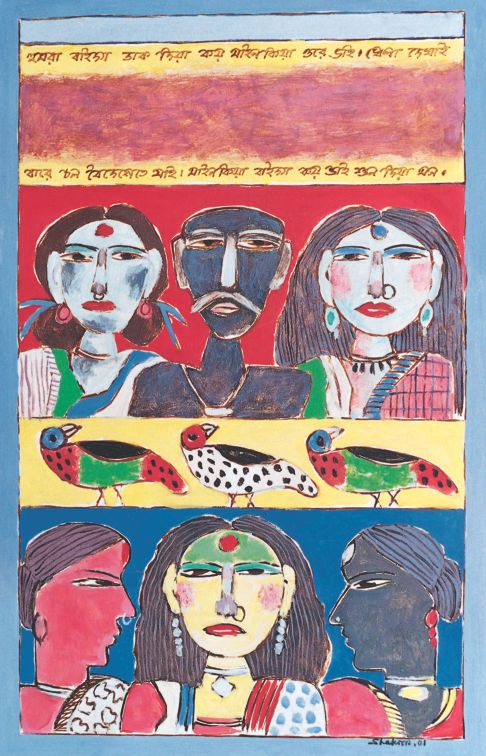
Ziaul Karim: In your recent work, you seem to have gone against the grain. For too long Bangladeshi art was, and to some extent still is, under the sway of western abstraction, particularly American abstract expressionism and angst-filled European expressionism. But you sought your inspiration from Bengal’s indigenous/folk art to construct your artistic vocabulary. As an artist it must have required a lot of courage to do so. How did you gather such courage?
Abdus Shakoor: I was born in Bogra district of northern Bangladesh. I grew up soaking up its rich cultural ambience and its breathtaking natural beauty. I reveled in traditional fairs and religious festivals such as puja and moharram and the colourful atmosphere associated with them. The colour schemes and designs of traditional dolls, artifacts and household objects always attracted me. I suppose these were somehow ingrained in me from my boyhood. Later, and as a student of the Fine Art Institute in Dhaka, I had the opportunity to see Zainul Abedin’s sinuous drawings. His powerful famine sketches and particularly the drawing of a bullock cart took my breath away. I wondered: how was it possible to infuse so much passion in an art work? But what really inspired me to study traditional and indigenous art was Satyajit Ray’s Apu trilogy. It was in the early 70s that I happened to watch these films. And the impact of the films on me has been immense.
For me, the seventies was also a time for soul searching. I was groping for a personal style and diction where I could peg my thoughts and dreams. I was also looking for a way out from western influences. What Ray’s films made me realize was that you could use local elements to make universally accepted art. That led me to search for folk and indigenous traditions. So, it was Ray who opened my eyes and taught me to treasure what is there in my own tradition, and to focus on my own immediate surroundings.


ZK: The time that you are talking about was also a tumultuous period in the political life of the country. The people of East Pakistan, now Bangladesh, were demanding freedom from Pakistani rule as the decade began. The spirit of the independence struggle must also have inspired you to search for your own cultural roots and look for a language through which you could express yourself artistically.

AS: Absolutely. The pictures that I drew during our war of independence in 1971 reflect what I was going through at that time. My canvas featured sad, dark faces. My heart was bleeding. The freedom struggle was not only about the freedom of our people from the subjugation and repression of the Pakistani regime but was also about our search for a cultural identity. The movement made us conscious about our heritage and our roots. The ideals cherished by the freedom movement gave us pride in becoming Bangladeshis and helped focus our eyes on our indigenous art traditions. ZK: Still in the early years of the decade, you went to MS University of Baroda in India on a scholarship programme and studied under the legendary K G Subramanyan. Was Subramanyan a major influence in guiding you in your quest for your own style?
AS: The first thing that Subramanyan said was not to try anything in the Cubist vein. Cubism, he told us, was dead. He inspired us to try something different that would be truthful to our own experience. His understanding of modern art was truly formidable. He talked with amazing clarity about the spirit of modern art. It was Subramanyan who first sensitized me about the frontiers of abstract art. He also inspired me to look beyond the frontiers of traditional realism. He used to say that abstraction could be used in various ways to deal with emotions and feelings and give expression to them.

ZK: You used to practice abstraction earlier in your career.
AS: Yes. I did abstractions for a while after returning from Baroda. Inequality, political hypocrisy, deceit and debauchery in a society like ours were my themes in that phase of my career. I found that abstract patterns suited me as I tried to express my indignation. I also wanted to portray the pain and suffering of our people through my images of broken huts and windows. But it was particularly through colour that I tried to depict these people and their distress. Unfortunately for me, critics, and my own artist friends did not seem to be interested in my work of the time.
ZK: When did you decide to break away from abstraction? Or to put it somewhat differently, when did you conclude that abstraction was not the road to artistic freedom?

AS: I now feel that my detractors did me a great service by criticizing my early efforts. Sad and alienated at that period, I searched for newer forms of expression. I began by resolving not to follow the path of my senior artists and started visiting folk museums in Bangladesh and in Kolkata. It was a strange feeling: a voice inside me was guiding me to locations I did not know anything about till then. At one point I rediscovered Jamini Roy and remained engrossed with his work for a while. Quamrul Hasan was also a great inspiration for me. Reviewing the work of our senior artists reassured me that I was heading in the right direction. You could say that they lifted my spirit. I began to realize that it was possible to move my art away from western modernism. My childhood memories of the colours of our world and folk artifact patterns started coming back to me in shards of images. And soon I was prepared mentally to reach newer frontiers of expression. ZK: Your new canvases were crowded with characters drawn from ballads and folk tales from the Mymensingh region of Bangladesh. These characters are depicted in a style and pattern inspired by folk art. No doubt you were trying to seek inspiration from outside the western paradigm. But this idyllic portrayal of life as shown in old ballads — is it not a form of escapism? Or are you trying to take refuge from the sufferings of everyday life?
AS: I would say no to both. In searching for a new art language for myself, I was also questing for the rich reservoirs of our traditional art and culture. These reservoirs were important to nourish ourselves and resist inane westernization in art. What I was attempting was neither escapism nor a retreat from everyday life.
ZK: When you are dealing with traditional design and pattern can you ignore their decorative aspect?

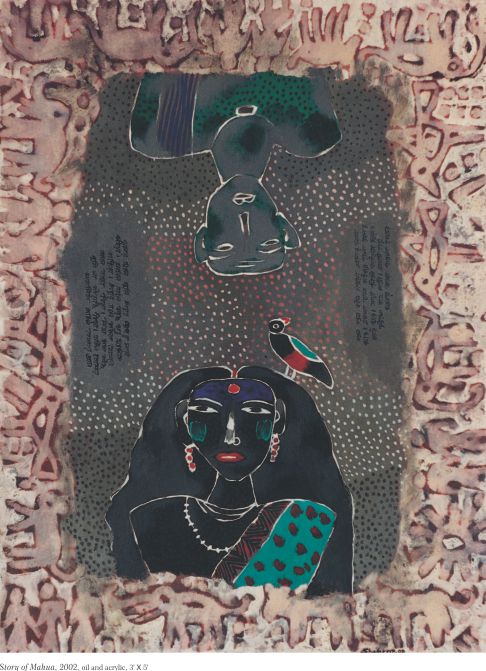
AS: Yes indeed. Look at Matisse’s work; the strength of his painting is its decorative aspect. However, dealing with the decorative element in a painting is like walking on a tightrope. The result may either be an excellent work of art or just another decorative piece! Visualizing the narratives from the ballads of Mymensingh was a challenge. I had no model before me when I started to use them. It was a lonely journey, a journey through a foggy road. To come back to the question of ‘escapism’ again, I will say that the life I have portrayed is not far removed from our contemporary life: the pain and suffering of our rural people are being shown through their burned faces, and the melancholy shades that I have chosen. So, my concern for my people is still strong in my paintings, only it has now assumed a new expression. I also wanted to depict the beauty and grace of Bangladeshi rural women.
ZK: But it could be said that the decorative opulence of your canvas prevents the viewer from feeling the misery of our rural people. How do you respond to this observation?
AS: Well, my primary concern is to portray our people with all their cultural richness and show the beauty and elegance that they have – something which we usually fail to note or admire. Reading our ballads in particular and our folk literature in general opened my eyes and I wanted to transmit what I was beginning to see through my paintings. I am thus ready to face criticism for my supposed insensitivity to the plight of our people.
ZK: However, success at times compels artists to stick to a style and resist change. Then there is what we can term ‘gallery pressure!’

AS: Yes I have always felt the pressure. Art collectors can act as a pressure group too. I had to go past the intense heat generated by their pressure. I’d often give in to their pressure by duplicating my own work according to the demands of the galleries and collectors, but now I know better. I have decided to listen to my heart rather than my head. I think that is one way to ward off monotony. Working under any form of compulsion certainly can choke your creative energy.
ZK: One striking feature of your work is that though they are inspired by the stories of the ballads, they do not tell stories. They are rather snapshots of the characters in the ballads, and focus on the psychology of the people that inhabit the narratives.
AS: My observation of the faces of the people in rural Bengal is that they are intensely expressive; only they have never been made the subject of paintings. Artists have painted them with a tourist’s eye. I believe their striking visages tell stories of their dreams and toil. But then what I paint are not mere portraits. I inhabit a no-man’s-land between abstraction and realism. I use traditional motifs and indigenous patterns and styles to draw my characters and to organize my composition. And then I add what I think are my personal observations and interpretations of their life.
You always live in a particular time and space and are born in a language and a culture. As a Bangladeshi, I feel my painting should speak about my culture, people, and language.
ZK: That certainly explains why you use extensive quotes from old ballads in your paintings. And I must say they do give interesting design patterns to your canvas.
AS: I like the characters of the Bangla alphabet and they provide excellent design elements for me.
ZK: Old Bengali manuscript illustrations have a deep influence on you. Right?
AS: Right. But from the very beginning I wanted to avoid narrating the plotline of the stories in my painting. I wanted to focus more on the psychology of the characters and bring them closer to our reality. I was quite conscious of the qualitative differences between illustration and painting.

ZK: What are the traditional folk art objects you have studied closely to evolve your style?
AS: I have studied closely the forms and patterns of nakshi kantha (embroidered quilt), alpana ( floor decoration), Gazir pata (scroll painting) , old manuscript illustrations, traditional dolls, shakher hadi (decorated lids of clay pots) and such other items. I have used their forms and patterns to depict the people who inhabit my canvas.
ZK: Where do you like to see yourself in the future? Is it not a problem with using traditional motifs that after a while your paintings look predictable and repetitive?
AS: Let me tell you that I turned to folk art for both sustenance and survival. And I have found in folk art the strength to revive my belief in myself and reconstruct my art language. I am enjoying my rendezvous with folk and indigenous art. I do not see any reason to move from here and look for newer grounds for inspiration. I am for experiment, and I feel that my journey into the folk terrain is not over. My artistic goal is to take folk design and patterns onto even higher planes of fine art.
In the work of Abdus Shakoor the rich tradition of Bangladeshi folk art comes alive in all its vibrant colour schemes and design patterns. Shakoor has closely studied traditional art forms. His interest in old ballads and his intense curiosity about life in rural Bengal have shaped his art language. Refreshing and riveting, Shakoor’s canvas…