
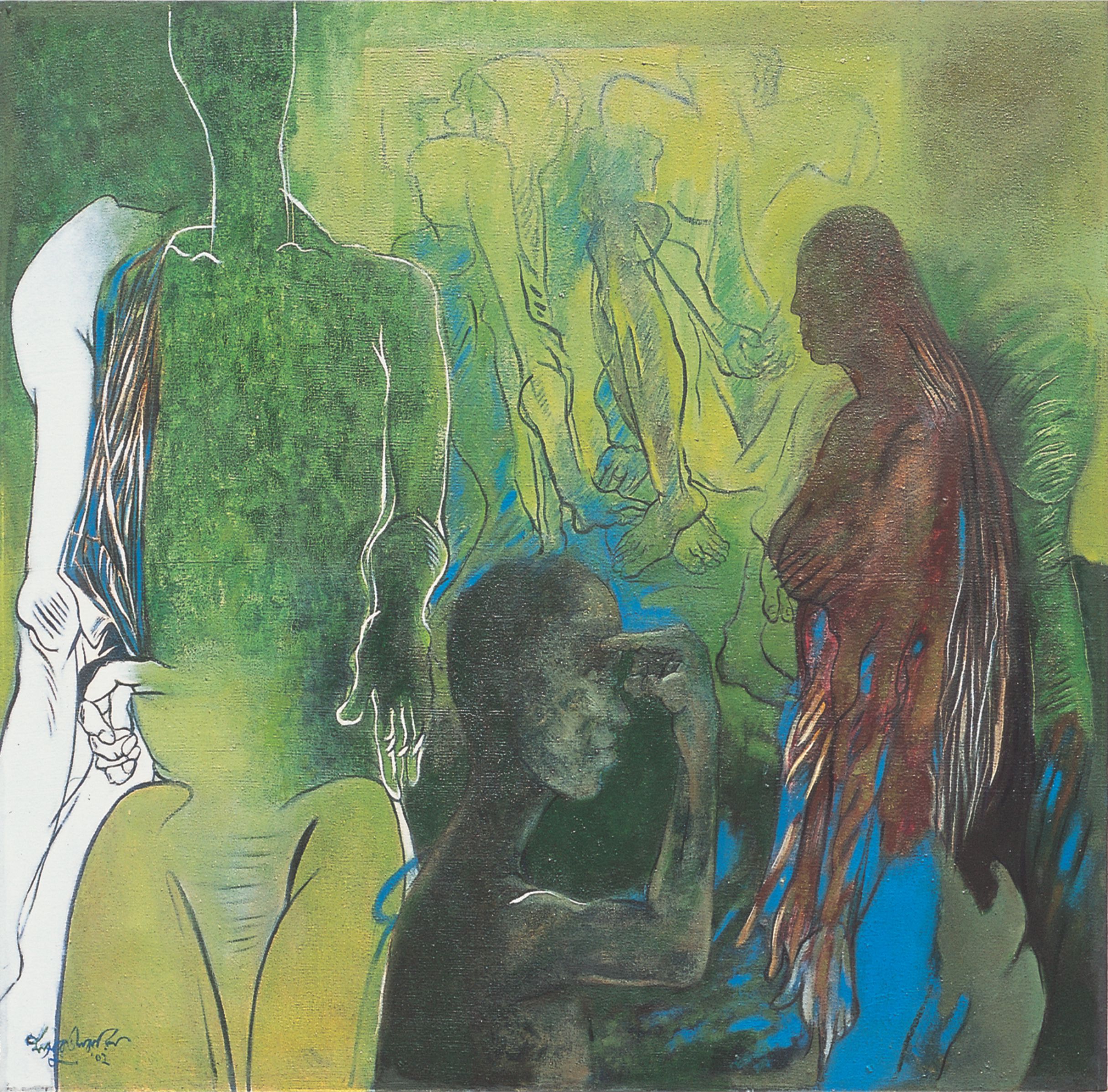
in tune with nature
Monsur Ul Karim’s canvas celebrates what Kandinsky calls the ‘inherent spiritual value of colour,’ and by extension the spiritual value of everyday life. Born in 1950 at Rajbari, Monsur Ul Karim did his Master of Fine Arts from Chittagong University in 1974. He has 12 solo shows and over 20 international exhibitions to his credit. He was the first Bangladeshi to win the Grand Award at the 8th Indian Triennial International in 1994. He has also won the Grand Award at the 6th Asian Art Biennale, Bangladesh. Monsur Ul Karim spoke to Ziaul Karim about the influences on his work and his philosophy of art
Ziaul Karim: You always use the word ‘organic’ when talking of your work. Would you please explain what exactly you mean by it?
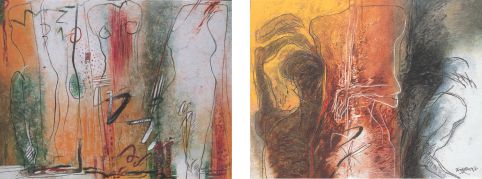
Monsur Ul Karim: I prefer organic forms to geometric forms in my composition. Organic forms are what you may see if you look at primitive art. In nature, too, I only see organic forms. Nature provides wonderful examples of them. What is most interesting about natural forms is that they are unique. And to my mind nature abhors repetition of forms.
ZK: By the phrase ‘organic’ are you referring to living things?
MUK: Yes indeed. Geometric forms are man-made, that is to say, creations of the human intellect. In other words, geometric forms are artificial. I study natural forms closely and my artistic self gets nourishment from them. To me a human being is an essential part of nature. Therefore, organic forms come naturally to me.
ZK: Interior spaces are hardly present in our work. You are, it seems, more comfortable in the outdoor world.
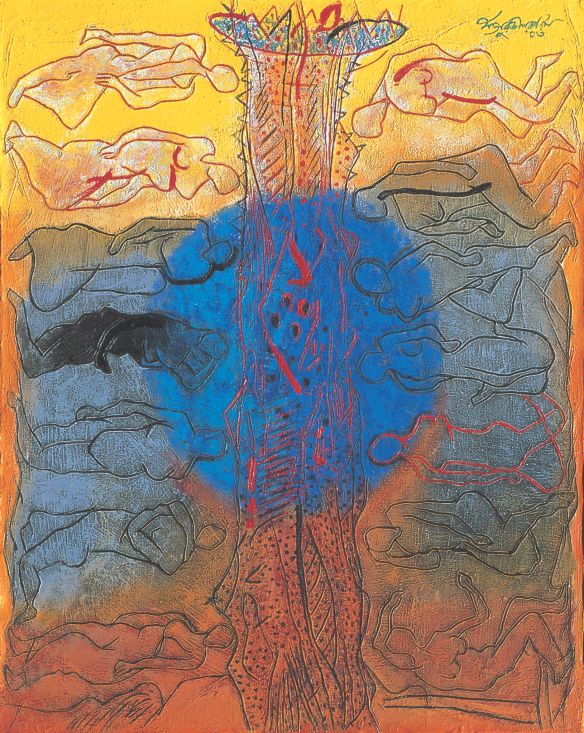
MUK: Yes, and the reason is that I’ve always been fascinated by nature and its diverse manifestations. I lost my mother when I was very young. My childhood was spent in a sleepy little village in the lap of nature and in the company of my grandmother. Very early in life, I had a revealing experience. One day when I was observing the vast blue sky while lying down on a field, I was overwhelmed with the thought of the greatness of the universe and the insignificance of my own existence. Nature and its place in the universe have always fascinated me. I always marvel at the mystery of creation. To understand it I feel I have to go to nature again and again.
ZK: How is it then that you appear to be such an introvert? You seem to be most happy in the intimate space of your home.
MUK: Well, yes. The familiar surroundings of my home prevent me from worrying. But my artistic self always wanders in the fields of my childhood, and I keep looking for the images that once so overwhelmed me. I still roam the countryside looking for the forms that are basic to my composition. I should say that my eyes were trained to take in these varied forms when I became a student at Chittagong University. I came close to artist Rashid Choudhury there. He has been a major influence on my work. When I looked at his intimate studies of nature I had a sense of déjà vu. He made me explore the forms of nature and also sensitized me to their beauty.
ZK: Tell us why there is such an abundance of light and shade in your work. Is there an inner compulsion that drives you in this respect?
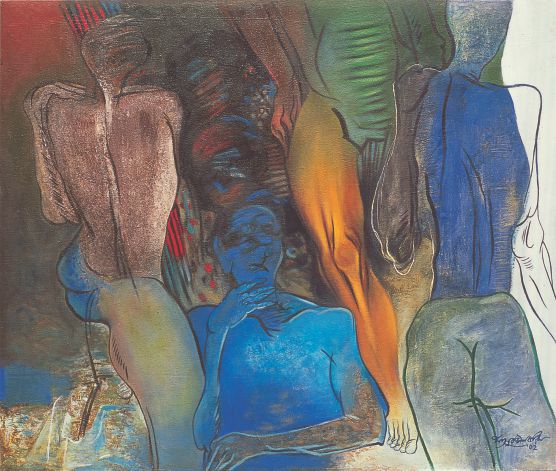
MUK: The tension or the synergy between light and shade is a key element in my painting. When I sit before a white canvas, the issue that I have to settle first is the relationship between light and shade. That relationship is a key to our moods. A delicate balance or tension between light and shade, I think, is very important in winning the heart of the audience. So, I begin my composition with the thoughts of light and shade.
ZK: Abstraction has not been a staple in your work as it has been for some artists of your generation, although there was a phase when you practiced it. Why did you move away from abstraction?
MUK: What is the final destination of an artwork? What does an artist try to achieve? I believe that the ultimate goal for any artist is to communicate with his or her audience, and they must be able to relate to the artist. Yes, I’ve done abstraction, but I feel I have to move away towards more expressive forms, towards figures. This is because I like to capture the life that we live and not just the impressions it leaves behind. All great artwork in the history of human civilization centres on the human being.
ZK: What is behind your intense urge to communicate with people?
MUK: A sense of loneliness has always oppressed me. This is perhaps because I lost my mother early. Quite naturally, I crave for love and compassion all the time. The concern that I show in my work about people is possibly a reflection of my longing for human company to ward off my loneliness.
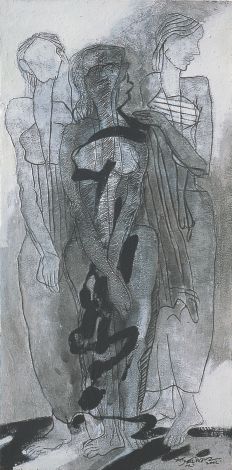
ZK: Though you say you avoid geometric forms, your compositions show your fondness for geometric shapes such as triangles. What does a triangle signify to you?
MUK: What you see as triangles become, if you follow them closely, organic forms when seen from a different perspective. I grew up in a village; to me hay stakes are triangular; winnowing rice or corn too takes triangular shapes. When we walk we also assume different triangular forms, but these are really only extensions of organic forms.
ZK: There is a certain naïveté–a childlike simplicity of forms and images, if you will, in your work. How do you explain this aspect of your work?
MUK: There is a child in every one of us. The bright colour and the bold expression of children’s paintings inspire me. I mix with children and follow them as they give expression to their imaginings. This is a liberating experience for me. What I find most fascinating about children’s painting is that unlike us grown-ups, children use colour and form without any inhibition.
ZK: Do the memories of your childhood recur in your work? Do you try to relive your childhood through your painting?
MUK: Whenever I close my eyes I go back to my childhood days. I feel the breeze swaying on the paddy fields, the blue sky kissing the meandering river. The unadorned life of rural people beckons me all the time. The images and the vision that I had in childhood in the country reappear in my painting.
ZK: Has any artist, other than Rashid Choudury whom you have already mentioned, influenced you in any manner?
MUK: In my formative years Picasso was the biggest influence. And still I go back to Picasso whenever I am in a crisis.
ZK: What does the Nabanna series celebrate?
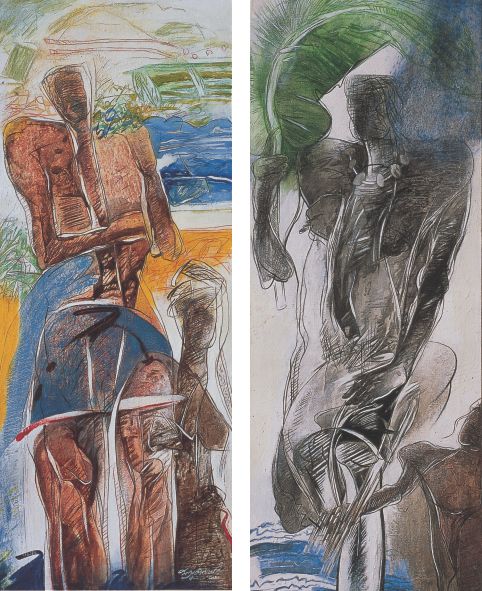
MUK: It celebrates the most elemental and enduring of all festivals in our rural communities; the harvest which inaugurates, even today, a time of plenty, and a feeling of happiness and security, however short lived. It is festival that still brings people together, and fills up the spaces between them with goodwill and love. Nabanna celebrates a truly secular festival that is one with the spirit of our land.
ZK: And what about the Source series?
MUK: Well, it attempts to record a return to our roots, and a return to the great moment that marked our emergence into order out of chaos.
ZK: How would you sum up your philosophy as an artist?
MUK: The urge to express oneself is inherent in every human being. It is also human to try and prove one’s individuality. In that sense every human being is unique. I paint because I am different from others and because I have my own world of colours and images that I want to share with others. Colour and line have the power to move people in any art form, in intense ways.
Ziaul Karim is the executive editor of Jamini
Monsur Ul Karim’s canvas celebrates what Kandinsky calls the ‘inherent spiritual value of colour,’ and by extension the spiritual value of everyday life. Born in 1950 at Rajbari, Monsur Ul Karim did his Master of Fine Arts from Chittagong University in 1974. He has 12 solo shows and over 20 international exhibitions to his credit.…