
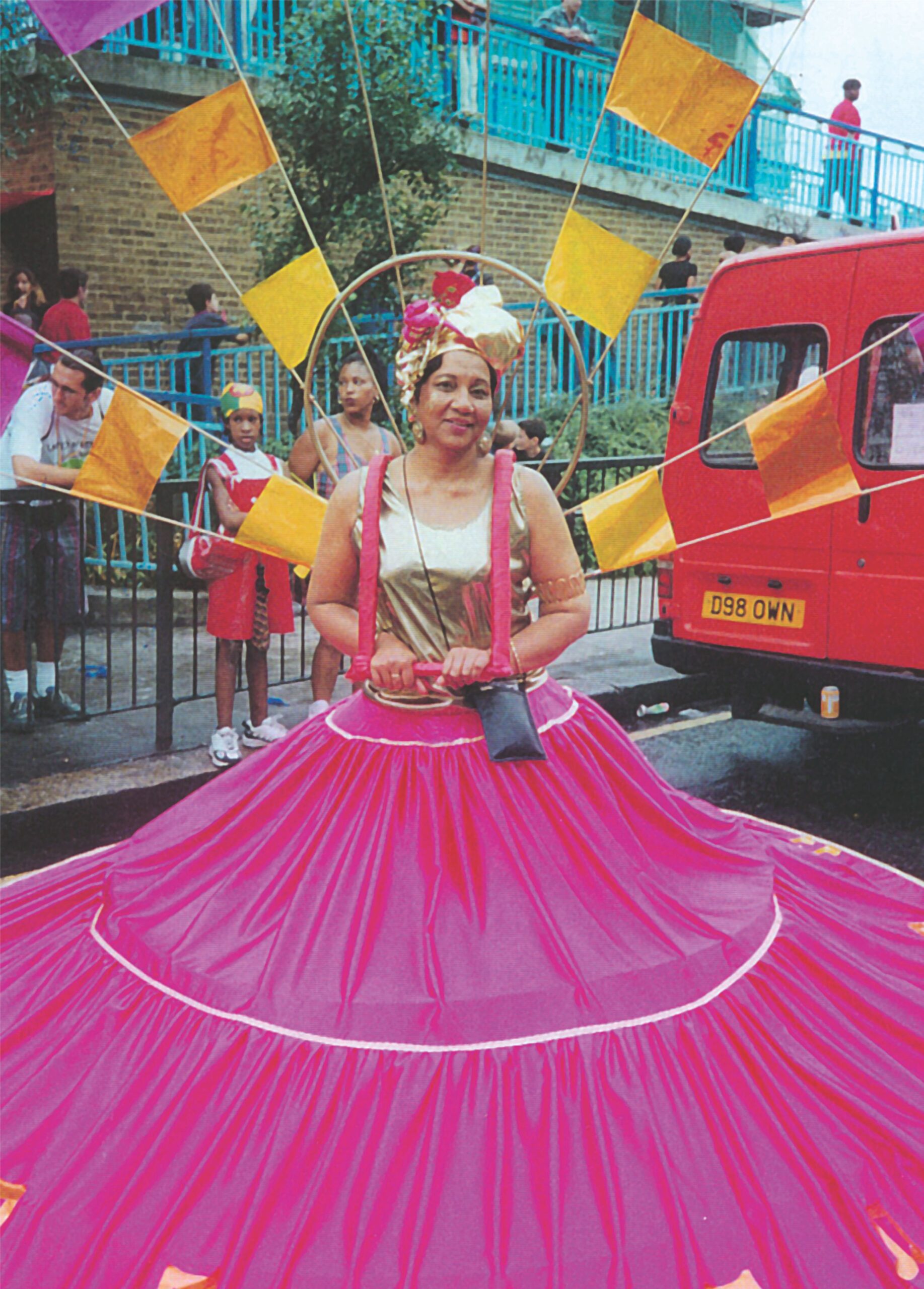
carnival on the global trail from trinidad to london
Transatlantic carnivals are one instance of a globalising cultural reality. Born in Europe but reinvigorated by the New World encounter between people from four continents, carnival at the start of the twenty-first century articulates much of the hybridised musical and visual cultures thrown up by and in turn feeding globalisation
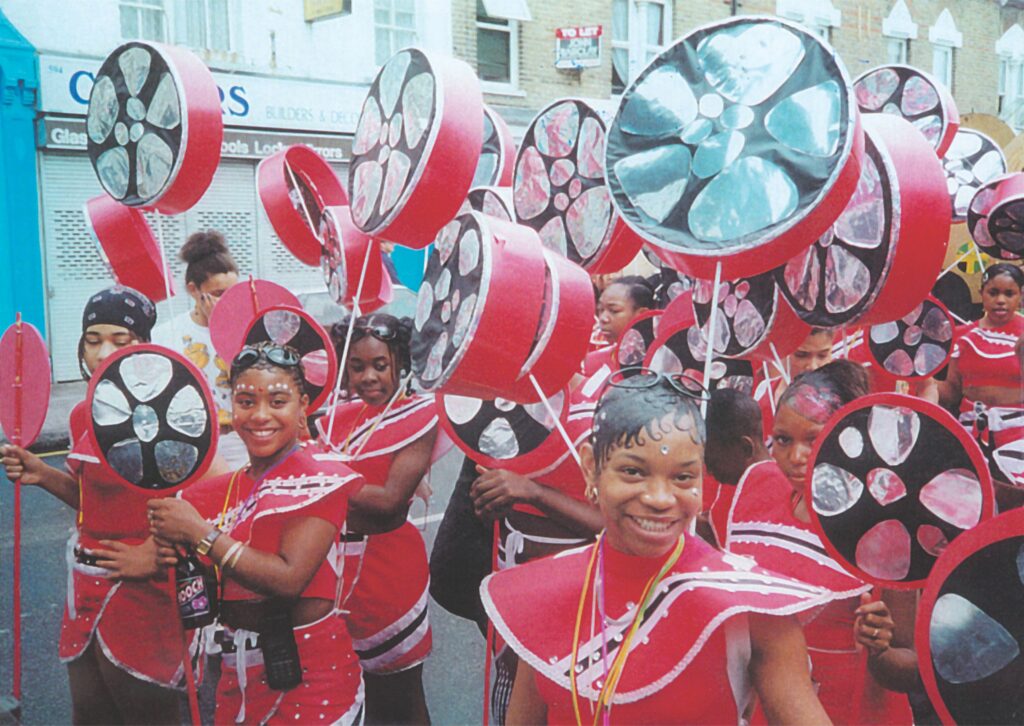
Though Brazil’s Rio carnival is the world’s best known, it is the much smaller Trinidadian version of carnival that spread in the latter half of the twentieth century. To North America and across the Atlantic, moving through the Anglo-Caribbean diaspora, driven initially by Trinidad’s migrants, it has become part of the festival calendar in the major cities of the English-speaking First World where Anglo-Caribbeans have settled in considerable numbers: London, New York and Toronto.
The historical origins of Carnival in Europe are pagan and then Roman Catholic. Carnival in medieval Europe was a public, stylised portrayal of passions that Church doctrine held should normally be strictly controlled. Carnival was a period when the world was metaphorically turned upside down: gender polarities were reversed, the poor dressed in the normally exclusive style and colours of the rich, the rich dressed as the destitute, merchants became jesters and clowns. A period of revelry encapsulated the Carnival, which then culminated in a parade through the streets of the town or city.
The Spanish, Portuguese and French colonizers took their pre-Lenten festival with them to what would become known as the New World. In Brazil, New Orleans, Trinidad and Cuba are found the most significant New World carnivals; in each place a Catholic white European civilisation interwove with an African derived counter civilisation, resulting in a new Creole reality.
The festival was introduced by French settlers to Trinidad in the eighteenth century; they brought with them the practice of masquerade on the Monday and Tuesday that marked the start of the Lenten season in the Christian calendar. These French settlers tended to be lenient to their slaves at Christmas and Carnival, allowing them some free time and even encouraging them to make their own masquerade bands. The black slaves inserted themselves into the turning-the-world-upside-down-for-a-day that was Carnival: they dressed in the cast-off clothing of their masters and whitened their faces. At the same time many whites portrayed the Nègre Jardin–the field slave or ‘garden Negro’–in rags and blackface.

From the nineteenth century to the present, the Trinidad Carnival has been a space of cultural innovation and hybridisation, of political satire and protest, and lately of constitution of national identity. These sedimented layers would inevitably form a part of the cultural apparatus that the Trinidadian segment of the West Indian migration to Britain would bring with them in the post-war period.
London met the Trinidadian carnival in 1951 with the arrival of the Trinidad All Steel Percussion Orchestra (TASPO) to perform at the festival of Britain in 1951. TASPO, a steel drum band, introduced the British public to this new instrument and its distinctive sound. At this time ordinary Trinidadian migrants in London were re-articulating the cultural forms that had grown out of carnival. Those with artistic training and access to cultural apparatus in Britain were presenting the folk dances and drama from Trinidad and the wider Caribbean. This was the beginning of what would become the Notting Hill carnival.
Notting Hill has a special meaning for postwar Caribbean migrants and their descendants. Especially for those of Trinidadian heritage, it is the place where they reproduced their most important festival in their adopted country. Today there are two Notting Hills. One is that represented by the recent film of the same name, starring Hugh Grant and Julia Roberts. This is the Notting Hill of quirky English people, all middle class and white. It is a representation of England in the mode of Four Weddings and a Funeral, intended for consumption by WASP Americans in comfy cineplexes; it evokes for them the lily-white Old Country. In this Notting Hill there are no Black or Brown faces.
The other, real, Notting Hill is more complex. It is part of a wealthy Royal Borough and so meets the expectations of the suburban US audience, but is also plebeian and carries the memory of its Caribbean migrants. This is the Notting Hill of Sam Selvon’s Lonely Londoners and of Colin Macinnes’s London trilogy.
From the late 1950s, the Notting Hill carnival has been about politics as much as about culture in the strictest sense. There are debates around the ‘origins’ of the Notting Hill carnival; these turn on whether it drew on an existing ‘English’ festival tradition or whether it was a West Indian import. What is clear is that Claudia Jones played a critical role in the first West Indian carnival in 1959. Born in Trinidad, she moved to the USA as a youngster; there she would go on to become an activist in the US Communist Party. She eventually fell victim to the post-war backlash against communism there and was deported to Britain in 1955. A tireless campaigner against racism and colonialism, Jones was a leading figure in West Indian cultural politics in England until her death in 1964. She started the West Indian Gazette in the wake of the 1958 unrest that saw West Indian migrants pitted against white racists in ‘race riots’ in Notting Hill. The 1958 unrest was a political awakening for West Indian migrants. Notting Hill was one place where they organized to fight back against racist attacks and was therefore a fitting venue for replanting the carnival festival, with its own long tradition of cultural resistance to race and class domination.
In London, the carnival re-figured the hybrid inter-mixture that had characterised it for two hundred years in Trinidad, but now its human raw material was pan-Caribbean. In 1950s London, Jamaicans and Guyanese and Barbadians came to realise that to many of the native English they were all alike in their otherness. Through awareness of their common lot London became for them a space where a pan-Caribbean identity was made.
Since its 1950s inception, the Notting Hill carnival has undergone a series of mutations, coming more and more to reflect the complex mix of post-imperial London. Notting Hill carnival began as a mainly Trinidadian-derived festival, featuring the musical and other art forms invented in that island’s festival the steelband, costume masquerade bands, and the calypso. It is the calypso that makes the strongest link between Trinidad and the earliest Notting Hill carnivals. As an art form, the calypso had long made insightful commentary on the relationships between English metropole and the colonies. One of the pioneering calypso singers, going by the sobriquet of Lord Kitchener (itself an intriguing reference to Britain’s military history) was a passenger on board the Empire Windrush, the steamer that brought hundreds of West Indians to London in 1948, marking for many the symbolic beginning of significant West Indian migration to Britain.
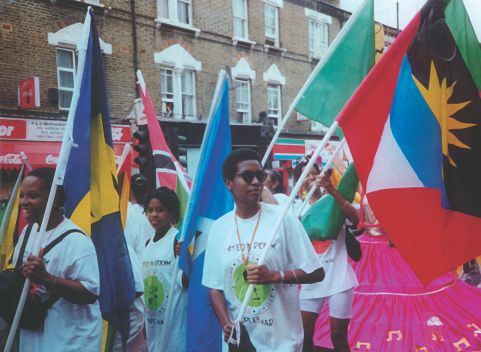
As it became established, Notting Hill carnival could not, however, escape the cultural influence of the largest national group of West Indian migrants Jamaicans. In musical terms, theirs were from the late 1960s, and remain, the most significant Caribbean musical forms in England, from ska to reggae through to dancehall. These forms would become part of the musical apparatus of the Notting Hill carnival. The music of carnival has recombined with other urban musical cultures to form a new trans-Atlantic and pan-European musical conglomeration. This reformulation has brought with it considerable commercial interest and has meant the carnival overlapping with London’s rave culture. This has, in turn, further widened out the ethnic composition of the carnival. The German rasta and the Italian raver are now established parts of the Notting Hill carnival cast.
The Notting Hill carnival was always seen as threatening by the English establishment. The wealthy residents of Notting Hill have frequently tried to have the festival of their plebeian neighbours moved altogether. It does appear now that the Notting Hill carnival is settled in place, despite recurrent talk about moving it to some other venue.
The interplay between culture and politics in the Notting Hill carnival, as well as its trans-Atlantic roots/routes is seen clearly in the experiences of one long-established London carnival band and sound system, Peoples War. Michael La Rose has been involved in the carnival movement since the 1970s; one of the founders of the People War sound system and masquerade band, he is an activist whose political involvement in the carnival spans a wide area. The Peoples War Carnival band was formed in 1983 by Michael and his brother Keith. Through family and friends in Trinidad, they had access to calypso records and kept abreast of musical developments there. In London, the La Rose boys were part of a milieu where carnival traditions were being reconstituted. In 1973 the idea of producing a masquerade band on the streets of Notting Hill first occurred to them.
Different musical traditions divided Jamaicans from Trinidadians and others from the South-east Caribbean in 1970s London. More than 60 percent of black people of Caribbean heritage in Britain trace their roots to Jamaica; Jamaican speech patterns and popular music in the form of reggae were dominant at that time. This situation would impact on the Carnival. As Michael explained it:
black youth were attracted to carnival not as a mas [masquerade] thing but as a place where a lot of black people could gather. The carnival movement failed to come to grips with the coming of these black youth – who were chauvinist to [i.e. against] calypso, but still wanted to be part of the carnival; but it was those same youth who fought back and defeated the police in 1976.
In 1976 there were major confrontations between black youth and the police during the Notting Hill carnival. Around that time Michael and Keith decided to form their own sound system, which they named Peoples’ War ‘because we wanted to identify with some of the struggles against oppression that were going on around the world, like in South Africa, in the Caribbean, and here in Britain.’ A sound system or ‘sound’, with origins in 1960s Jamaica, is a blending of equipment, records and operators that moves to different clubs and parties.
In 1989 Michael La Rose was part of a group that started the Association for a Peoples Carnival (APC), which seeks to criticise the existing arrangements of the carnival, to make public participation and that of masqueraders more enjoyable, and to have some of the revenue generated by the event channelled into supporting masquerade bands and steelbands. The APC advocates the preservation of more traditional (i.e. rooted in Trinidadian carnival) aspects of carnival, like steelbands and masquerade bands, in the face of the growing presence of giant concert-type sound stages catering to a taste for forms of popular music like garage and techno which draw a different audience from that for steelbands and masquerade. The Notting Hill Carnival has grown beyond its Trinidadian migrant origins, but for someone like Michael, the Trinidadian dimension remains central to the festival in London.
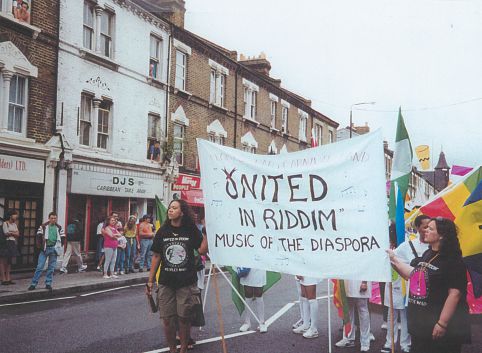
Mainstream English media reports on the Notting Hill Carnival tend to open with a statement of the law and order aspect of the event. The commentators know little, or perhaps care little, that the carnival is a cultural event. Against this narrow view, the hybridity of the London Notting Hill carnival may be seen in the combination of Trinidadian-derived masquerade representation with pan-Caribbean, wider black diaspora, and transatlantic urban musical forms. The festival has come to symbolise a time and space of self-organisation and celebration by a minority in the face of an indifferent and sometimes openly hostile majority. To gather for a day, to articulate and re-imagine the evolving Black Atlantic cultural forms of the Carnival is a collective exercise of affirmation. That it is largely symbolic does not detract from its political meaning.
The Trinidadian carnival like its transatlantic offspring has undergone major changes over the past four decades. The most significant change has been the increased corporate participation. Over the past ten years the Trinidadian economy has enjoyed a period of petrochemical fuelled growth that has fed into the festival there. This has been accompanied by an almost complete shift in costume parade, most clearly marked by the increasing presence of women as masqueraders in Rio-style costumes. This change has seen Brazilian representations of carnival femininity as scantily clad women take the stage, in turn leaving an ever-smaller space for other forms of carnival masquerade. In this sense the Trinidad carnival has been influenced by the global dominance of the forms of the Rio festival. This influence is even greater now that Trinidadian corporate interests wish to sell their festival to a global media, whose expectations of New World carnival are mostly shaped by images from Rio.
With greater corporate sponsorship has come greater employment for carnival designers and craftspeople in Trinidad, and this has in turn created a viable industry with huge export potential. It has also had the effect of making masquerade in the popular bands very expensive for ordinary Trinidadians, and is constituting a new class divide, with middle and upper-class Trinidadians and tourists, overwhelmingly female, taking part in the masquerade, while the surrounding party scene is frequented by the urban black working class, who show a marked preference for Jamaican dance hall music and the bodily representations associated with it. Ironically, in Jamaica this division also holds true, except that the relation between social class and indigenous form is reversed there: it is the Jamaican middle and upper classes who go for the imported Trinidadian carnival forms, while the urban black lower classes favour the indigenous forms.
In the use of urban space in Trinidad and London we see another example of the political aspect of carnival. The Notting Hill carnival has always been viewed with suspicion by the authorities. Some carnival activists attribute this to the unease caused by many thousands of black people assembled in a self-organised activity. This is partly the case, as the crowd has always caused anxiety for the powerful. When that crowd is made up of a socially excluded minority then clearly there is potential for conflict. But the London Notting Hill carnival draws in many thousands of middle class white British and other Europeans; its crowd is multiracial. Yet, there remains a collective institutional memory of clashes in 1976 between black youth and the police. Black disorder and carnival are apparently closely associated in the minds of many white Britons. Even after many years of commercial growth into Europe’s biggest street festival, with massive commercial input, the mainstream English media still see the Notting Hill carnival as primarily a public order issue. Their representations are of a mass with the ever-present potential to turn into riot. Virtually none of these media have made any serious attempts to engage with the Notting Hill carnival as culture.
For much of its history the Trinidadian carnival was seen by the colonial authorities as a gathering of undesirable elements. The stick fighters, jamette (‘loose’ women), jesters, cross-dressers, and percussion bands parading through the centre of Port of Spain would have caused many an English-born colonial-era governor or police chief sleepless nights.

The Trinidad carnival has always existed in an ethnically diverse society, with persons of African and Indian descent constituting about 40 percent of the population; with the douglas, persons of African and Indian ancestry, the third largest group. There are also small numbers of whites and people of middle Eastern heritage. There is a significant element of the population who trace the descent to all of these groups; and they are often the most enthusiastic proponents of carnival as a symbol of national unity, perhaps because its hybridity mirrors their own. The Trinidadian carnival has both represented and emerged from the island’s ethnic diversity. Initially a symbolic levelling of social distinctions between a small white elite and a black plebeian majority, the Trinidad carnival in the twentieth century yielded up a sometimes contested space for the Indian-heritage population there. Even though it involves all Trinidadians, it remains the case that some feel that carnival’s official portrayal as the national festival marginalises Indo-Trinidadians. One way in which tension has been resolved is in promoting an expanded inclusive festival calendar in Trinidad, with the Muslim Hosay, the Hindu Phagwa and other festivals being officially and popularly promoted as part of the national heritage along with carnival. Hosay, in particular, has come to share much with the carnival and like it has become a multi-ethnic festival, helped by the fact that Hosay is based in a suburb of Port of Spain where Muslims and Christian Trinidadians have long coexisted. The dominant state and media representations of Trinidad would seek to present its population as defined collectively through these shared festivals. And while that representation is a contested one, there has indeed been some festival sharing in Trinidad, as a way of mediating ethnic tensions.
The Notting Hill carnival too has come to carry some of the representational burden of ethnic hybridity and perhaps even transcendence. It is a key element in an emergent urban culture in London (as in some other of England’s large cities), where different ethnic groups share a public space shaped in large measure by musical and visual culture. This space of everyday encounter is both political and banal at the same time. It is partly brought into being symbolically by the Notting Hill carnival, which in turn reflects an emergent and often troubled hybridity back into a wider urban reality of race, space, and class differentiation.
Despite their political undercurrents, the Trinidadian and Notting Hill carnivals remain essentially festivals and thus appeal to the playful and creative side of our humanity. Though they are, in a sense, also political events they cannot be expected to do mainly political work. Still, the collective human creolised and hybridised endeavour of carnivals is that festivals are themselves a political pointer to our complex globalised futures.
Brian Alleyne teaches Sociology at Goldsmiths College, University of London
Transatlantic carnivals are one instance of a globalising cultural reality. Born in Europe but reinvigorated by the New World encounter between people from four continents, carnival at the start of the twenty-first century articulates much of the hybridised musical and visual cultures thrown up by and in turn feeding globalisation Though Brazil’s Rio carnival is…