
Looking for alternatives
Leading Indian painter Gulammohammad Sheikh visited Dhaka last January to participate in the 11th Asian Biennale as a member of the Jury Board. The editorial board of Jamini asked him to comment on the Indian art scene as well as his own work.
Your career spans half a century. Looking back, how would you trace your development?
Fifty years! Not really! But even forty-five sounds so strange! There have been so many things, changes, shifts, and ups and downs during these decades, but looking back it all seems part of a single story.
I left the town of my birth and schooling, Surendranagar in 1955 to study in Baroda, which became home. Apart from three years spent in England (1963-66) I have lived here witnessing its transformation from a university town dotted with banyan trees into an industrial city with a rapid growth of high rise buildings and pollution. In the years before independence the erstwhile Baroda State was known for its liberal ethos and progressive ideas. Aurobindo taught here, B.R. Ambedkar worked here, Ustad Faiyaz Khan served as a court musician. Since the late sixties, however, it has got the dubious distinction of having the largest number of communal riots! Yet, despite the painful episode of our forced relocation for a brief period in the wake of the post-Godhra carnage, it remains home.
The Faculty of Fine Arts where I studied and taught until 1992 has been an island of creative and academic endeavour retaining the multi-cultural, liberal and secular character formed by its pioneers. I edited a book Contemporary Art in Baroda (published in 1996) that deals with these issues. The institution provided an ambience congenial to the development of the heart and mind, and of skills and concerns. We learnt to look at the national and international art scenes and our own work from multiple perspectives: aesthetic, social and political. The task of teaching art history for which I was not trained was demanding. In the initial years I did more than twenty lectures a week, teaching a dozen diverse subjects—from Chinese and European art to Indian Aesthetics! Accepting the challenge to continue painting through this helped to demonstrate that academics need not be perceived as being antithetical to creativity. My mentors the artist K.G. Subramanyan and the writer Suresh Joshi also combined teaching with their own creative pursuits.
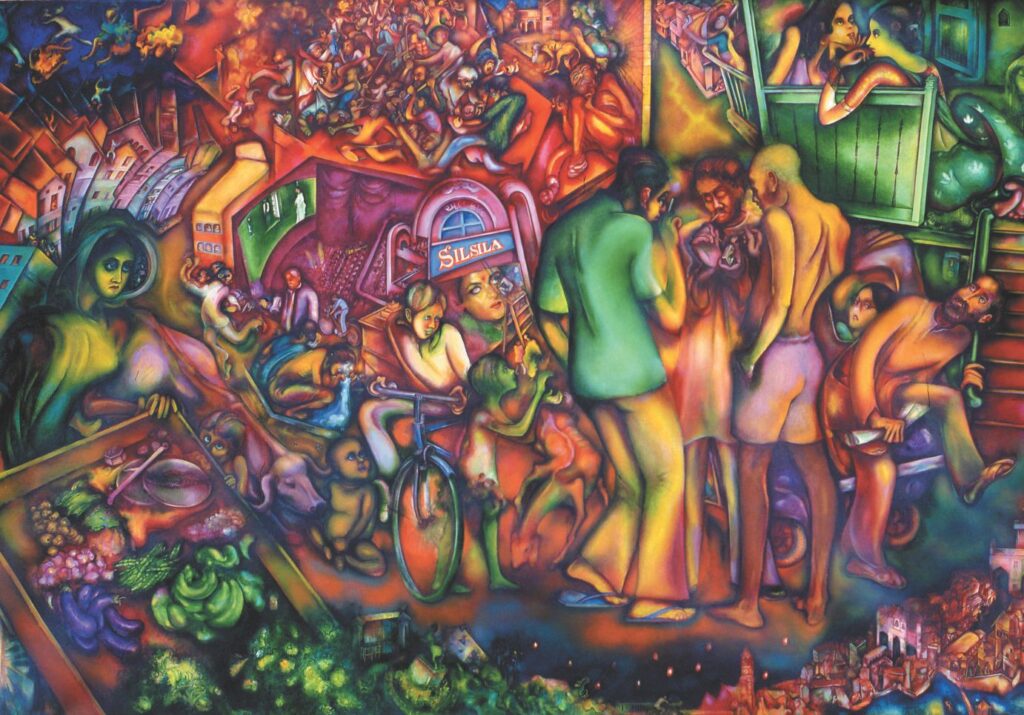
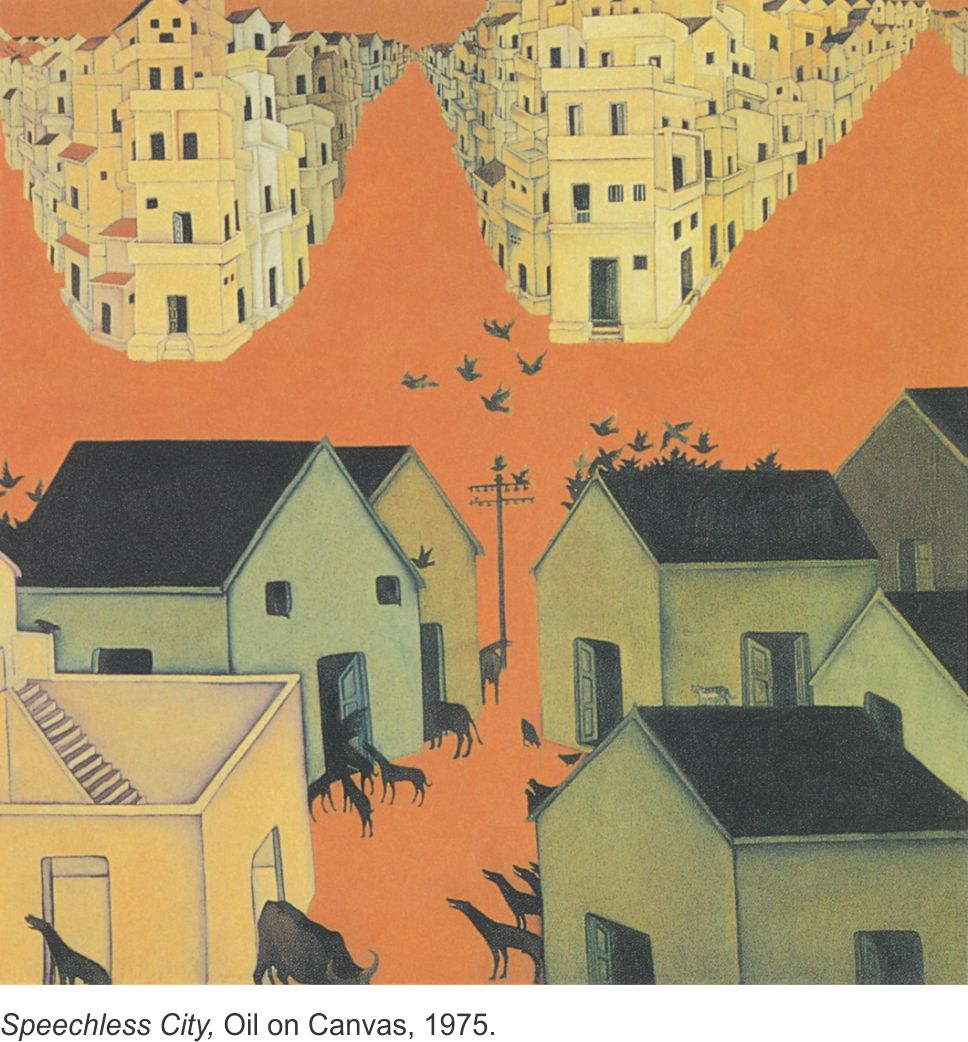
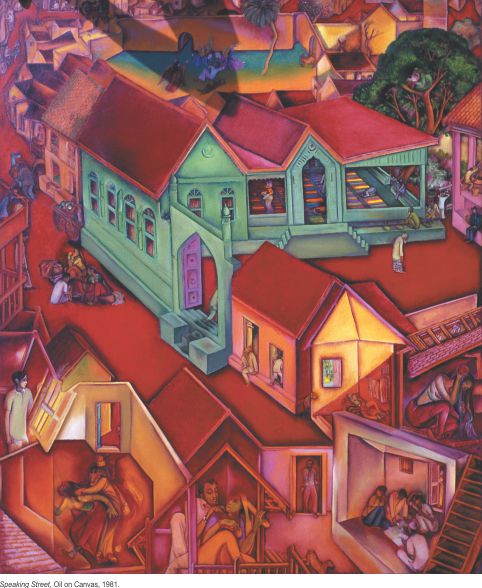
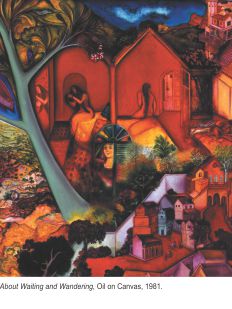
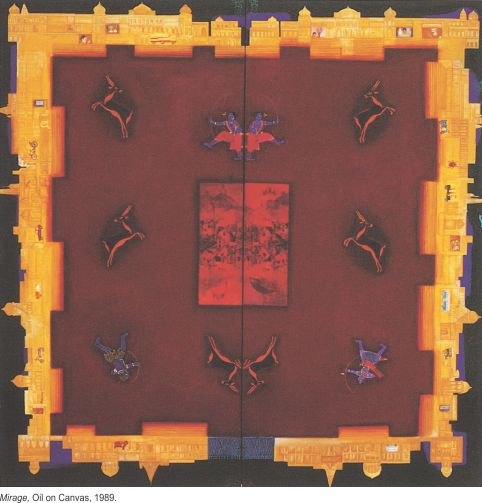
In my own work, my interest has been to look for alternatives to the Euro-centric, modernist parlance and worldview taught all over the world as an exclusive category and to explore an Asian-Indian alternative language of the modern, both linguistic and thematic. The figurative option in a polyvalent or eclectic mode came first. I found a precedent in the experiment conducted at the Mughal studios during the Akbari times (1). Interpreting art history to gain personal perspectives provided impetus to experiment. ‘About Waiting and Wandering’, ‘Speaking Street’, ‘Revolving Routes’ (all painted in1981) are attempts to include diverse modes of articulation including quotations. ‘City for Sale’ painted around the same period (1981-84) deals with the juxtaposition of multiple situations including communal riots.
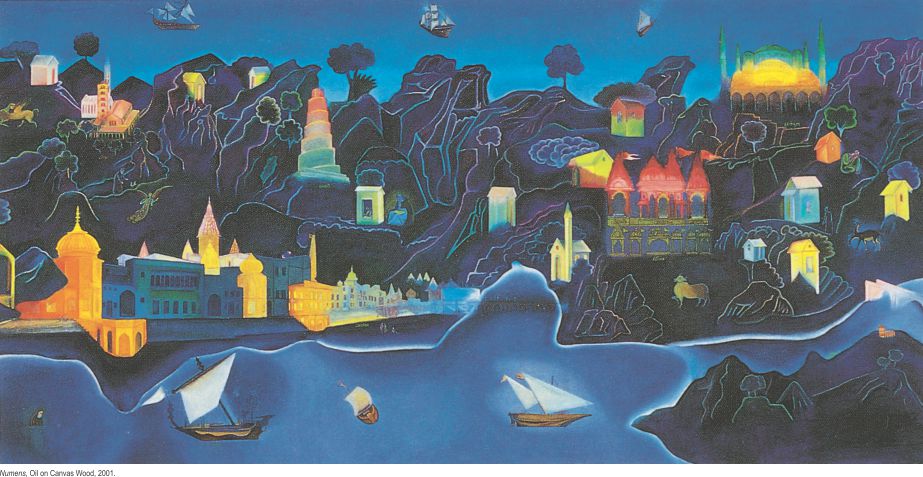
Of late I have dabbled in computer/digital collages, which offer new ways to smoothen the process of combining multiple images of diverse origins. The series on Mappamundi incorporates sites and spaces drawn from Persian, Indian and Italian paintings into a 13th century European map of the world. To overcome the element of cloning that digital technology promotes I individualize each inkjet print by painting upon it.
My latest works, a series of folding boxes called ‘Shrines’, are based on the traditional portable shrines of Rajasthan called ‘Kavad’. These are meant to be personal ‘shrines’, to be opened and closed, and to allow one to meditate upon images contained therein.
Would you reflect on your inspirations and influences?
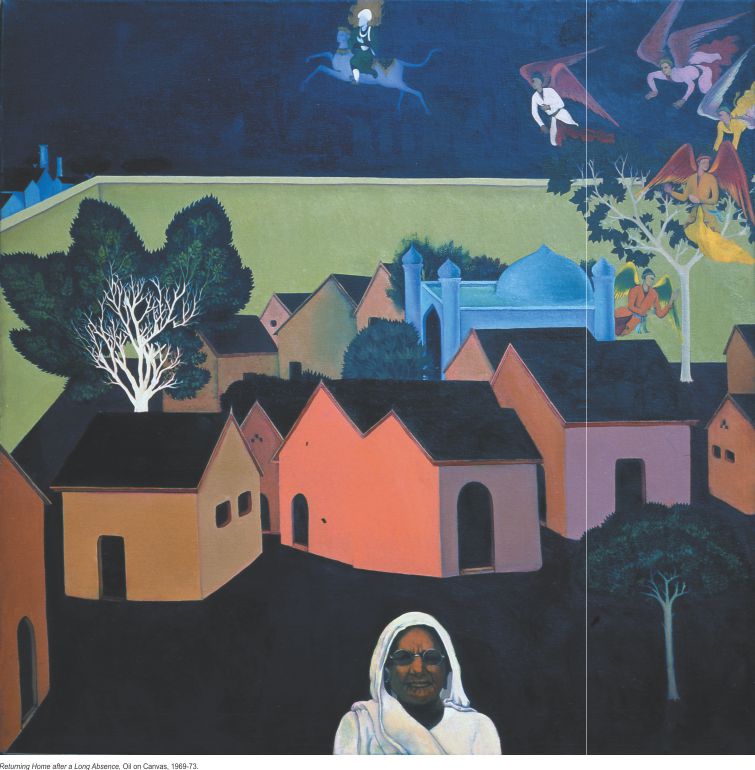
I think I have learnt a lot, in the course of time, from the work of artists of the past and present and have incorporated much of that experience in my work through quotations. I began to use photographs I took of friends and places I had visited and combined them with picture postcards while I was in England in the sixties and used images from reproductions on my return (‘Returning Home after Long Absence’ (1969-73)). Teaching provided me the opportunity to discover the diverse traditions of the world. The images drawn from Indian miniatures and murals, the Sienese painters, Giotto, Piero della Francesca, the great Safawi masters, Siyeh Qalem, all became part of my working vocabulary. Of artists from modern times who provided impetus are Magritte, Beckmann, Balthus and Kitaj… the list would be long were I to draw more names. Closer home Bhupen Khakhar and I shared ideas and similar sources in the sixties and seventies but went our independent ways in our work. Nilima and I continue to share these sources even today both in our ideas and our work. Geeta Kapur and Vivan Sundaram have been catalysts in many ways. The presence of K.G. Subramanyan in Baroda was equally inspiring both work-wise and intellectually.
Did you have any interaction with Husain and Progressive Artists Group?
A search for alternatives to what was produced in Baroda made me seek out artists of that generation from my student days in the late fifties. I would visit Bhulabhai Memorial Institute in Bombay frequently, where Husain, Gaitonde, Bal Chhabda, Tyeb Mehta and others had their studios. This gave me a first hand glimpse into their world. Over the years, I have observed with interest the evolution of their work and concerns and at a personal level there exists a very cordial relationship.
You are probably best known for your promotion of narrative painting otherwise known as the Baroda School. Could you tell us something about the theory behind this trend?
No, that is not true. I have never championed any cause of ‘Narrative’ painting—or for that matter, any brand of painting—something which is often erroneously attributed to me. Timothy Hyman curated an exhibition called ‘Narrative Painting : Figurative Art of Two Generations’ in England in 1979 where he had included the work of Bhupen Khakhar. The term ‘Narrative’ found currency here around the time of the group exhibition entitled Place for People (1981) which included Bhupen Khakhar, Vivan Sundaram, Jogen Chowdhury, Nalini Malani, Sudhir Patwardhan and myself and was curated by Geeta Kapur. Perhaps some of the artists who participated in the show found it useful to promote it under the ‘narrative art’ label. To my mind this was unnecessary and in many ways a simplification of a complex issue. Narrative Art, if we are to use the term, in South Asian art has a much wider history, which has been tapped at various times by artists ( like the mural painters of the Bengal School, Subramanyan, or Bhupen Khakhar) to develop the language of contemporary art. This issue has an art-historical portent and for me was never about labels or slogans. My interest was in the figurative articulation of multiple spaces and themes and in evolving a personal language using diverse sources and devices, which continues to occupy me till today.
How do you relate to the trends in other regions of India, the South for instance, or in Bengal and the rest of Eastern India?
There are common as well as diverse concerns among contemporary modern artists of the sub-continent. Jogen Chowdhury’s work continues to attract my attention. So does Arpita Singh’s, Nalini Malani’s and Nilima’s; they live in Santiniketan, Delhi, Mumbai and Baroda respectively. I am equally interested in the work of the younger artists of Kerala like Surendran Nair who lives in Baroda or V. N. Jyothi Basu who has now shifted to Mumbai and sculptors like Ravinder Reddy and N.N. Rimzon who are in Vishkhapatnam and Thiruvananthapuram, respectively. I also wrote a monograph on Laxma Goud who lives in Hyderabad.
How would you evaluate contemporary painting in India? Which names would come to you first?
Painting seems to have remained a valid alternative in an age of installations and new media in India. K.G. Subramanyan, Jogen, Arpita, Nilima, Nalini, Atul and Anju Dodiya, Surendran Nair and Vasudha Thozur are prime examples.
What is your opinion of the postmodern trends in Indian art ( fusion/ cross art/installation etc.)?
There is a very impressive group of artists engaged in installation and new media. Vivan has experimented with large installations and archival collages, Nalini has used video most effectively. Her work on Toba Tek Singh and installation at the recent Istanbul Biennale has been most impressive. Both these artists have made strong political statements through their work. Navjot, Subodh Gupta, Sheba Chhachhi and even younger artists like Shilpa Gupta have also produced an impressive array of work. Pushpamala N. has been very inventive in the genre of photographic impersonation. Anita Dube’s sculptures like Blood Wedding made of human bones wrapped in embroidered velvet and her wall ‘drawings’ made of artificial eyes are very moving.
You spent most of your working life in academia. Are you happy with the state of art education in India?
Unfortunately, the education scene has not changed very much although there are more institutions of art now. The art schools need to liberate themselves from the clutches of curricular stereotypes and academic insularities, do away with examination systems and degrees and diplomas. The time has come to open doors to all aspirants, irrespective of age, academic qualifications etc. It was heartening to know that some young artists have started such an experiment in Colombo in Sri Lanka. Workshop situations like what ‘Khoj'(2) provide could be incorporated in the educational system. It is also essential to take a larger view to include rural, tribal and urban popular practices, which have remained outside educational arenas. Baroda and Santiniketan seem to be comparatively better, but these too need fresh air and new blood.
Which of the recent trends in Western art do you find relevant to your concerns?
I do not find much nourishment in western art these days, despite some attraction to the work of artists like Clemente, Kitaj or Kiefer. The works of Chinese and Indonesian artists fascinate me far more than what one sees on the western art scene.
Notes:
(1) It was an international experiment where art and artists of diverse origins and orientations interacted to evolve a composite language for the times. Akbari painting incorporated linguistic parameters of regional Indian ‘schools’ with devices of Persian and European origin to portray themes as diverse as epics like Ramayana and Mahabharata, the Hamza stories, Khamsa poems and historical chronicles. (2) An artists’ collective based in Delhi which organizes month-long international workshops and provides residencies to young artists.
Leading Indian painter Gulammohammad Sheikh visited Dhaka last January to participate in the 11th Asian Biennale as a member of the Jury Board. The editorial board of Jamini asked him to comment on the Indian art scene as well as his own work. Your career spans half a century. Looking back, how would you trace…