

Re-visiting Bikash Bhattacharjee’s Paintings
Bikash Bhattacharjee (born: Calcutta, 1940) has had the rare courage to defy the accepted norms and standards that ruled the theory and practice of art in the mid-twentieth century. That defiance has essentially been an assertion of his own understanding of the here-and-now in an idiomatic language all his own. The result has been an art that speaks directly to the viewer.
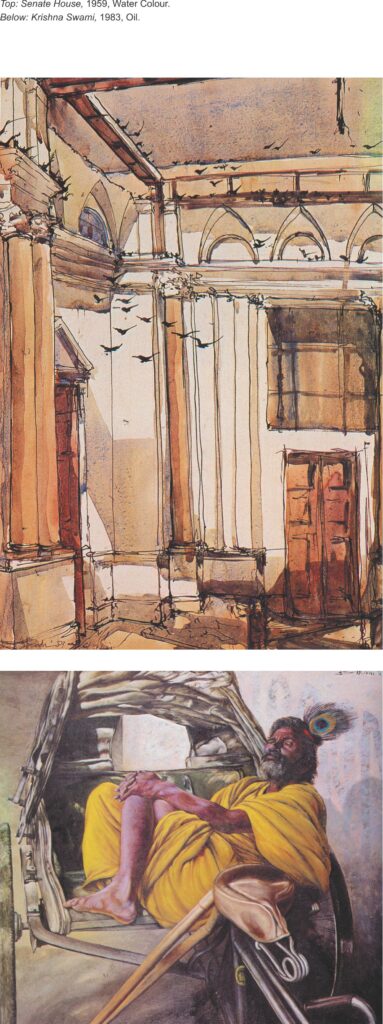
Bikash Bhattacharjee’s convictions reflected the consciousness of an individual who belonged to a decaying colonial metropolis. The fragmentation of the traditional way of life and the consequent loss of a sense of security created strong feelings of disquiet and frustration among the people, particularly the middle class. There was no respite from the harshness of reality—although there were occasional illusory promises—even for an individual with strong familial ties and obligations, such as Bikash. For him, an escape into the imagination or intellect, that is to say, to a constructed parallel world of art was inconceivable. Bikash was convinced that he had the language of art at his command, and that it had its genesis in a will to deal with phenomenal reality. The visual language which foregrounded traditional concerns, or transformational systems of formal construction were not for him. Bikash’s conviction was rooted in the belief that to question the phenomenal reality in art one has to invoke the commonly perceived reality. This gave him the courage to negotiate visual reality, armed with the language of optical illusion. Bikash’s ability to produce illusions of visual reality, with a built-in error detection mechanism, gave him the confidence and courage to bypass the traditions both of indigenism and modernism, which were the main currents in mid-twentieth century art. Bikash’s work reminds us that it is not the language-frame but an individual’s use of a language—his capacity to forge an individual idiom out of it to objectify a concept of some relevance—which is more important. A corollary proposition also emerges from Bikash’s life-long experiment with the language of illusionistic representation—of retinal sensation—a language that fell into disfavour after four hundred years of overuse. The proposition is that contemporaneity, or for that matter modernity, is less a quality of the surface and / or semblance to set standards, than of content.
In spite of the surface resemblance of Bikash’s language-frame with the ‘obsolete’ language of the illusionistic representation of sensory reality, his individuality is to be traced to the very use of the illusionistic linguistic device to interrogate the phenomenal reality of the postcolonial polity where drowning traditions have been pulling down modernizing forces to their watery graves. This assertion of individuality of conception, through bringing on to the surface the contradiction between reality and its linguistic representation, reveals a rational mind at work. And what a brilliant mind it is, to cogitate about the on-going process of modernization of a tradition-tied society, with all its antecedent pitfalls. Especially noteworthy has been Bikash’s visual objectification of the human effect / meaning of the largely impersonal historical process.

Bikash first attracted the attention of serious viewers with a series of Calcutta cityscapes, in which the jungle of asphalt, brick, mortar and iron looked derelict. The streets of the city were desolate, their turns so crooked that it seemed invisible assassins lurked in every corner and the sun-drenched, moss-coloured walls with peeling plasters only offered a dirty dampness to touch. The sub-text of forlorn bygoneness was carefully crafted with the spacing of negative and positive areas and colour tonalities to impart feelings beyond description laid out on the surface.
Bikash, however, has been more concerned with the larger human drama than just the human meaning of a situation to remain involved with landscape as a genre. From the mid-sixties to the end of that decade, we find Bikash engaged in seeming portraitures of characters in focal centres, occupying large spaces, in all conceivable media—oil, watercolour, pastel, contè, charcoal and even collage; on canvas, board and paper. In these apparent portraitures (in his student days Bikash had established his credentials as a brilliant portrait painter) his focus is on revealing the personalities by unmasking them. He would give only that much attention to the construction of a situation/event as would indicate the bizarreness/absurdity that had caused the difference between the personality and the persona. In portraying the characters, Bikash would play with human anatomy, fuse youth with old age, generate confusion regarding sex differences and give bestial morphology a human form.
In quite a few of his works, physical deformities suggest causative mental maladies. Towards the end of the phase, he would use colours and tonalities to subtly impart the feeling of deformity, rather than represent the deformities imagistically. With these he touched a new high. In these apparent portraitures, while he would be merciless in his revelation of the characters of the persons in power, he would write sub-texts of compassion for the men and women caught up in situations beyond their control. Bikash would describe the absurdity of a situation by counter-positioning images of objects in unusual sequences, and allowing the photo-morphic images of the characters portrayed assume unexpected dimensions. This body of work catapulted Bikash to the front rank of the Indian painters of the time and earned him the sobriquet of surrealist. However, while in some of the works his engagement with the macabre and the mode of visualization can be interpreted as surrealistic, in most of them the turns and twists in the representation of visual reality are too subtle, and the pictorial situation/event too near the phenomenally possible to be called surrealistic. He would never stray very far from where his work would start to lose reference to phenomenal reality. His work remained an objectification of his reflection on experienced reality, to which he never failed to refer.

However, as Bikash’s gaze was focussed on discovering the motivating factors of thuman behaviour in a postcolonial society with entrenched traditions, he would get increasingly more concerned both with the commonplace and the unusual, and occasional stirrings in the everyday life of the people. The tumultuous seventies of left radicalism created such a situation for Bikash to assess the here-and-now reality and its human impact. Bikash’s gaze would turn to the human drama involving inspiration and repression, enthusiasm and exhaustion. Taking sides was impossible, but repression disgusted him while inspired action kindled his hopes. The result was two remarkable series of paintings, with which his career peaked.
The first, the earlier She series of paintings, features a bronze-statue-like young woman in all her physical glory (surprisingly, she has hardly any sexual or erotic appeal), in all kinds of probable but uncommon situations/events, as an unmoved but keen observer. Bikash had spent his childhood in the proximity of clay-modellers and idolmakers, and later in life would make his own representations of Puranic divinities. His familiarity with iconology helped him devise his own icons without taking recourse to religious iconography. Bikash would conjure up a pictorial situation or an event in which he placed the woman, taking care to make her tonally differentiated from the situation/event so that she looked a bit distant and detached. And yet, she would be in the focal centre of each painting. Some of these paintings, like the Deathless Antique, have the appeal of great iconological art. His singular contribution has been to bring to the fore the contradictory co-existence of serenity and turmoil in the human situation.
Bikash’s involvement with icon took a sharp turn and acquired a new dimension in the Doll series of the early seventies. In these paintings too, he would conjure up an urban situation, either indoor or out of doors. But unlike the often crowded She series, the only actor in the scene would be a chubby, four-year old girl child. Doll-like in her countenance, the girl is nevertheless more alive and agile than her living peers, yet her face remains emotionless and immobile. Negotiating herself cleverly in desolate spaces, she appears, at the same time, to be crafty but extremely vulnerable. She roams through deserted Calcutta streets after a violent clash has subsided, and rummages for leftovers in an empty apartment. At times she seems to be a metaphor for a lonely individual searching for answers to existential questions thrown up by happenings around her. At other times she appears to have all the answers that a divine icon is supposed to possess. The enigma the woman in She, who is both a living being and a statue, and the doll-like girl in Doll posed, enhanced the meaning of both the series of paintings. The enigma opened up the possibility of multiple interpretations of the painted texts. The creation of these enigmatic iconic images/characters was an extension of Bikash’s concern about the relationship between appearance and reality.
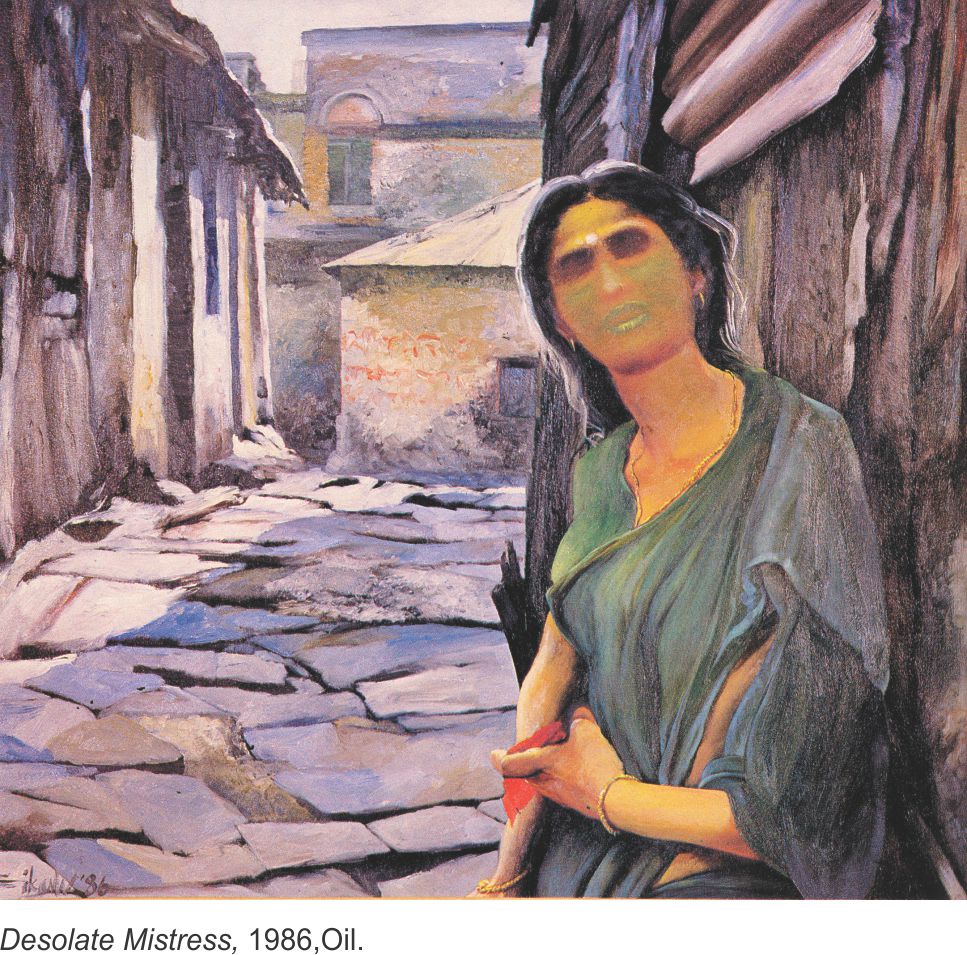
Later in his career, Bikash would often construct an iconic image as the motive force of his visual narration. But unlike the first She or the Doll series, the invoked icons would be Puranic, usually some manifestation of Shakti or Vishnu. In most cases, the iconographic attributes of his human characters would resemble those of known icons; at other times the deities with their iconographic attributes would behave like human beings. More often, however, the image of a single woman, in socially accepted conventional roles, presiding alone over the surroundings, tended to become iconic, glorifying her roles. In fact, Bikash’s concern later in his career with feminine situations tended, on the one hand, to glorification of socially conventional roles of women, and, on the other, to the expression of anguish at the tragic predicament of such role playing. This is, however, not to say that Bikash has been unmindful of the social canonization of male roles which also can be visualized through iconological metaphors. He did quite a few such paintings where there was an interchange of roles between man and god through some sort of morphological transformation.
With the passage of time the situations and events that Bikash conjured up tended to attain a visual objectivity and become more descriptive than tell-tale. His characters appeared more as representations of individuals than as chunks of humanity at certain junctures of time and place.
Bikash Bhattacharjee has successfully objectified the contradictions of contemporary life, in an idiom that he created out of a highly communicable language which had long gone out of fashion. It is a great achievement to have sustained a high level of creativity for well over two decades. More was expected of him, but a sad paralytic stroke deprived him of his ability to work. He still remains one of the leading painters of India, one who has inspired scores of younger painters, and one who is looked upon as a pioneer by many others following the style he has created. The Lalit Kala Academi, India’s national academy of non-preforming visual arts, conferred upon him the distinction of a fellowship in 2004.
Pranabranjan Rayis an art critic and former editor of West Bengal District Gazeteers
Bikash Bhattacharjee (born: Calcutta, 1940) has had the rare courage to defy the accepted norms and standards that ruled the theory and practice of art in the mid-twentieth century. That defiance has essentially been an assertion of his own understanding of the here-and-now in an idiomatic language all his own. The result has been an…