
experiments in indian classical dance liberating the idiom
Setting itself free from a millenia old linear narrative style, classical dance in India has broken new grounds and is now more and more about describing space through body movements driven by an inner impetus. Interestingly, this change has been spearheaded mostly by women, all of them dancers trained in the strictest of traditions. An inner freedom has empowered them to unshackle their chosen art form
Early beginnings: An aid to drama
In Tandavalakshanam — the chapter on the ‘Characteristics of Dance’ in Natyashastra — Sage Bharata gives a lively account of the drama Tripuradaha being staged amidst the snow peaks of Mount Himavant solely for the pleasure of Shiva, the mighty three-eyed god. So pleased was Shiva with the presentation that he bestowed his favorite pastime of dance on Bharata and his sons, the custodians of Lord Brahma’s newly devised art of theatrics. Shiva, the Lord of Dance, then went on to advise that dance being embellished with different karanas (simultaneous movements of hands and feet) and angaharas (a cluster of karanas) that would assist actors to represent the meaning of songs used in dramas. This entire episode bears proof that dance during its embryonic stage was regarded merely as an ancillary to drama. Bharata’s treatise on dramaturgy is dated between 1 BC and 1 AD. Ten centuries later, in Dhananjaya’s Dasharupaka, dance continues to be termed natakadyupakarakam or ‘an aid to drama’. This again reinforces the conclusion that, even as late as 1000 AD, dance in India had failed to acquire an independent identity of its own and continued to be a part of the theatrical experience. Dhananjaya even describes nritya or dance as merely bhavasraya or ‘grounded in latent emotions’ while he defines natya or drama as rasasraya or ‘grounded in kindled passion’, thus denying to dance and dancers the ultimate capacity of evoking rasa or ‘aesthetic pleasure’ in the hearts of a sophisticated audience.
From traditional mandapas to the
modern proscenium
In India the classical dances, though apparently varied in stance, style and the attire of the dancers, have all developed from a greater cohesive tradition and have also been part of either traditional dramatics or of intricate rituals of devout worship. The dance of the Maibis, or priests of northeastern India, for example, is at the heart of the Lai Haroba tradition of the Manipuri dance. The devadasi or temple devotee tradition of southern India gave birth to the margam or repertoire of the solo Bharatnatyam dancer. Kathak, meanwhile, has been derived from the art of the kathaks or storytellers. After great upheavals in the art of dance, brought about by invasions and other influences, the middle of the last century witnessed even greater changes, but ‘tradition’ continued to remain the operative word. All over India dance was being brought to the proscenium from the traditional mandapas or stages of temples and of ritualistic congregations. In Tamil Nadu in the 18th century the ‘Thanjavur Quartet’—four diversely talented brothers—had successfully created the repertoire of the solo Bharatanatyam dancer through a systematic and gradual unfoldment of the varied nuances of sahitya or literature, music and dance. It was then left to E.Krishna Iyer and Rukmini Devi to not just popularize the concept of solo dance recitals but also to take up formalized teaching of Bharatanatyam for lay students and that too in schools set up for that specific purpose. In Kerala, the great benefactor Mukunda Raja and the visionary poet Vallathol set up Kalamandalam, a nerve-centre for teaching and propagating Kathakali and Mohiniattam. In Orissa, a pact in blood made by a group called Jayantika, comprising Deba Prasad Das, Kelucharan Mahapatra and Mayadhar Mansingh, resulted in the reconstruction of the gotipua tradition into the exquisite Odissi style. In Manipur, Guru Amobi Singh and later Guru Bipin Singh and his disciples, the Jhaveri sisters, with great sensitivity and artistic finesse, extracted from the lengthy Rashleela and other such ritualistic presentations a few portions of dances appropriate for the modern stage.
Interestingly, though these great visionaries were themselves breaking away from convention by restructuring the scheme of the dances, each one of them emphasized the strictest need to adhere to parampara or tradition. Great care was taken to involve musicians, Sanskrit scholars and nattuvanars or dance gurus and even the devadasis themselves. Texts like the Gita-Govinda of Jayadeva, the padams of Swati Tirunal and even the sculpted dance figures in temples like those at Konarak were studied with care and incorporated into the various dances. Though working through a sound methodology grounded in and born out of traditional music, literature and art, their work was destined to bring about a great metamorphosis in the idiom of dance.
Of course, even as early as the beginning of the last century, there were some who were breaking further away from tradition. Uday Shankar, greatly influenced by the ballet of Anna Pavlova and the poet-laureate Rabindranath Tagore in his search for a universal language of art, established schools of dance, both in Bengal. But here too the ambiance was strictly and traditionally Indian while fusion was the key word to their experimentations.
Dance was going through a sea change but centuries of tradition still kept it tied to a very linear narrative form bound to a language of hand gestures and ornamentation, while continuing to fulfill the needs of the storyteller.
The age of change and experimentation
History will forever revere the likes of Rukmini Devi and Kelucharan Mahapatra for not just reconstructing age-old tradition, but also for taking care to record it. However, they will be remembered most for the great work they did in passing on the heritage to their disciples. It can most assuredly be stated that dance in India is now a thriving art form, with great interest among students in learning these traditions. Schools of Indian dance abound not just in South Asia but also in South-East Asia, Europe and Northern America. This global journey of Indian dance has led to many experiments in fusion, especially with western ballet.
The disciples of the older gurus, of course, have proved themselves worthy of their teachers by taking the changes that their mentors had begun a step further by experimenting with the language and content of dance itself. With the task of reconstructing tradition in full swing, experimentation with a fusion of styles, changes in the sahitya or literature, in apparel, in group choreography and thematic alterations were being taken up with great enthusiasm.
Among the many dancers experimenting with aesthetic changes in their dance forms are such stalwarts as Chandralekha, Songal Mansingh, Kumudini Lakhia, Daksha Seth, Madhavi Mudgal, Aditi Mangal Das and Leela Samson.
Chandralekha’s work remains recognizably Indian but is minimalist in approach. Trained in the Bharatanatyam style her re-interpretation of this ancient temple dance rejects the literalism of its hand gestures, its linear narrative structures and its customary ornamentation, while incorporating other schools of movement like martial arts and yoga into her choreography. Sometimes hailed as India’s Martha Graham, the internationally acclaimed Chandralekha, famed for her startling white tresses, has designed works that seem almost like a mystical foray into the language of the body while her quest into femininity and sexuality is ever present in them. Her choreography is not only a test of human patience, but also displays the extent to which the entire human body can communicate through movement and gesture—a reflection of the choreographer’s constant fascination with the body and its secrets, its potential and energy. Hers is a fusion of styles combined with startling thematic changes.
Sonal Mansingh’s journey has been a long one—from Bharatanatyam to Odissi, with forays into Chhau, the martial dance from Orissa, and Paala. Mansigh has produced original choreography based on Indian mythology as well as contemporary issues. Her innovations have affected both form and content. Lately, her work has veered more and more towards issues concerning women, environment, prison reforms and re-interpretation of ancient myths. Through seminars, round- table discussions, writings, workshops and lectures, she shares her perception and concerns with an increasingly involved audience. Hers is an instance of dramatic changes in the thematic content of modern day Indian dances while retaining their traditional form. Here too we see a fusion of styles used to depict contemporary issues.
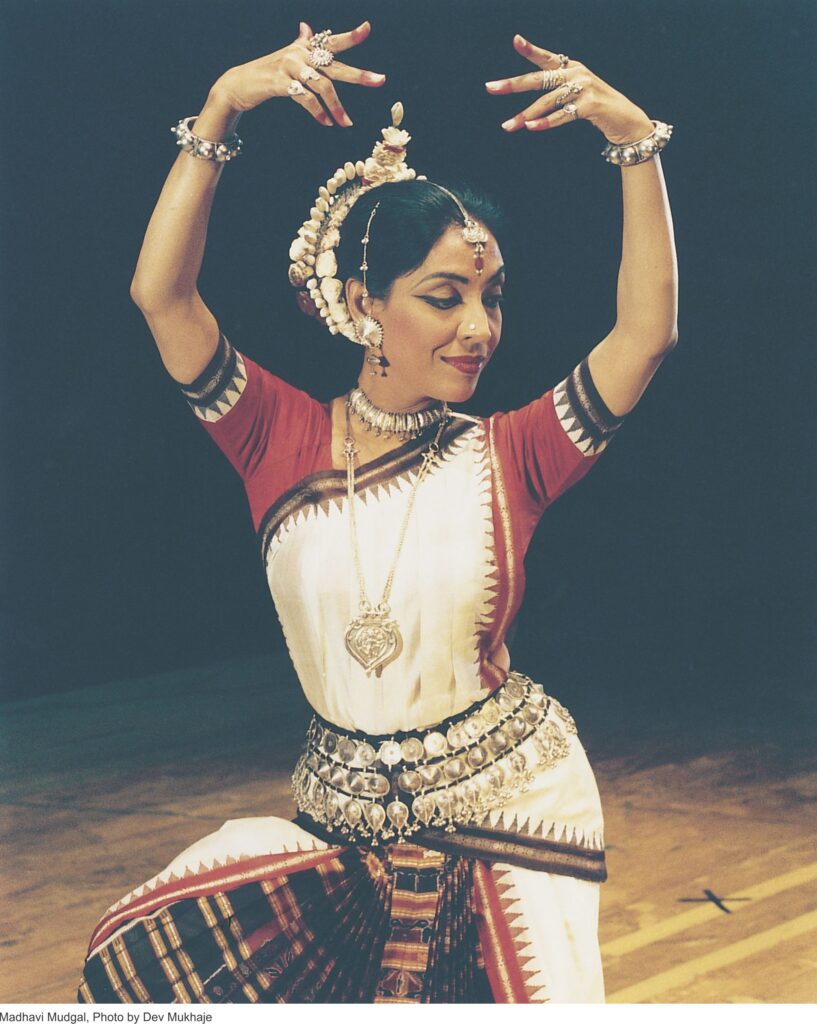
Madhavi Mudgal’s group works are a joy to watch. With her sensitive understanding of the music she works with, and a deep affinity with the spirituality of the Upanishads, Madhavi has designed great pieces like So’hamasmi. However, she remains true to every nuance of the Oddissi style and experiments only within its strict grammar while dealing with deeper philosophical themes.
In Kathak, Kumudini Lakhia of the textile city of Ahmedabad tried to do away with the excess mannerisms and coy-ploy stuff meant to entice royalty when it was a chamber art. She divested the dance form of the court etiquette, the effeminate traits of male dancers, and shaped it into a ramrod straight, clear-cut, precise performance. Her disciple Daksha Sheth ranks today as India’s best creative dancer.
Daksha Sheth also learnt Chhau and Kalari, the martial art of Kerala and revived a dying temple performance tradition in Braj (Mathura-Vrindavan) and moved to Nrityagram in Bangalore before setting up her own centre in Kerala on the outskirts of Trivandrum. She is the only choreographer in India to have evolved a truly wholesome contemporary dance language which while being Indian is also international.
Another Kathak dancer who shows potential in exploring new vistas is Aditi Mangaldas. Aditi, a disciple of Kumudini Lakhia and Birju Maharaj, says of her art, ‘Through my dance I try to understand the relationship of my central core to the space that is within my body. I have a wanderlust. Just like people who roam the whole world, explore its remotest corners and try to fathom what lies beyond the earth, the solar system, the universe. I like to travel through my body and my mind. To explore new places, new routes , diverse avenues. To travel through various parts of my body and to let these parts travel through different parts of space. Would it be possible to watch the space within you, like you watch the space outside of you? As you see a dancer move through space, could you see the space move through you?’
Certainly, age-old notions about Indian dance are giving way to an entirely different vocabulary.
Describing space with inner forces
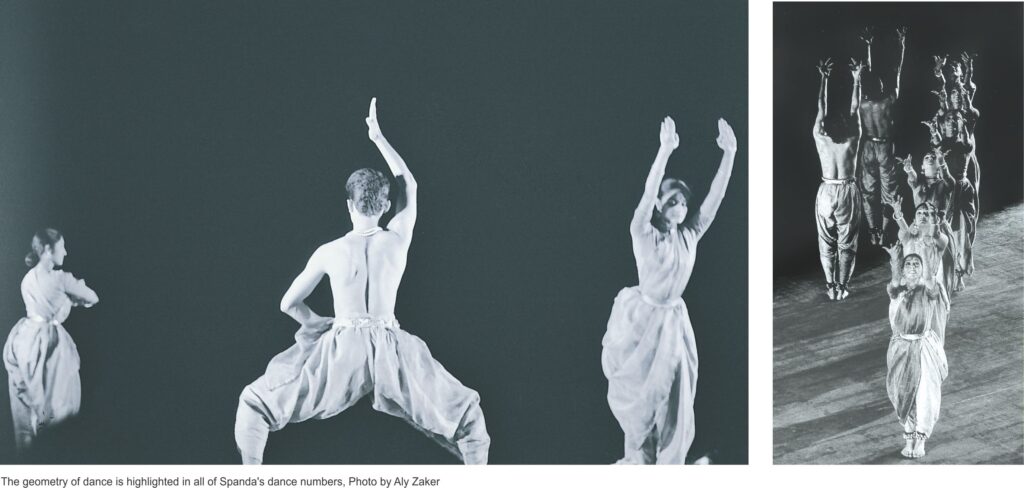
Indian philosophy recognizes an inner, intangible focal point or bindu within the human body which is the core of human existence. The sages of ancient times who designed the dances certainly were aware of the almost mathematical relationship between the inner motivation of movements and the functions of the body. It is only based on this understanding that the Indian classical dances have incorporated some of the most beautiful body movements to be seen in any dance form. Unfortunately, mechanical repetition of movements without a proper understanding of their kinetic relationship had through the centuries submerged the knowledge of the finer relationship between dance and the bindu of the dancer.
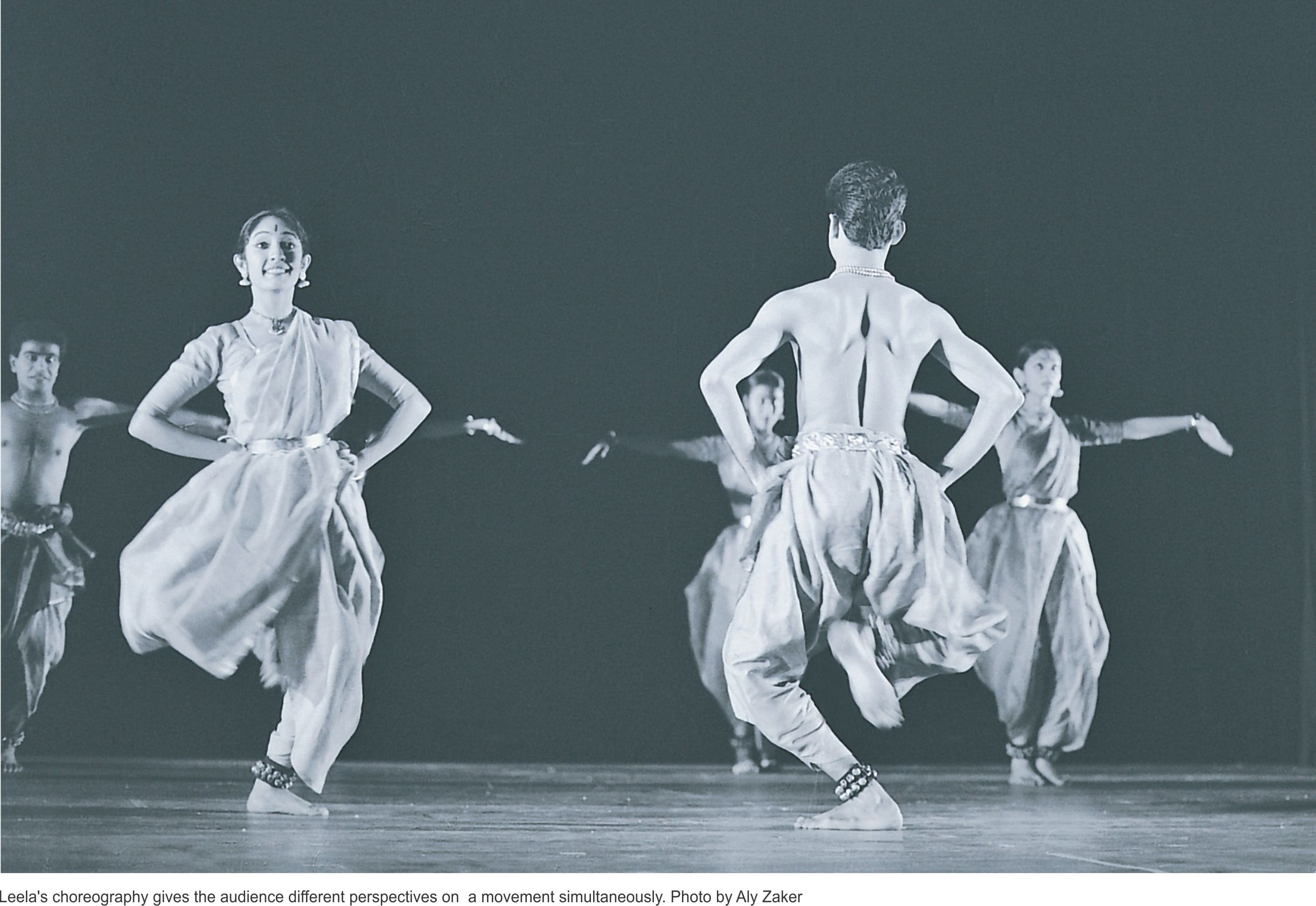
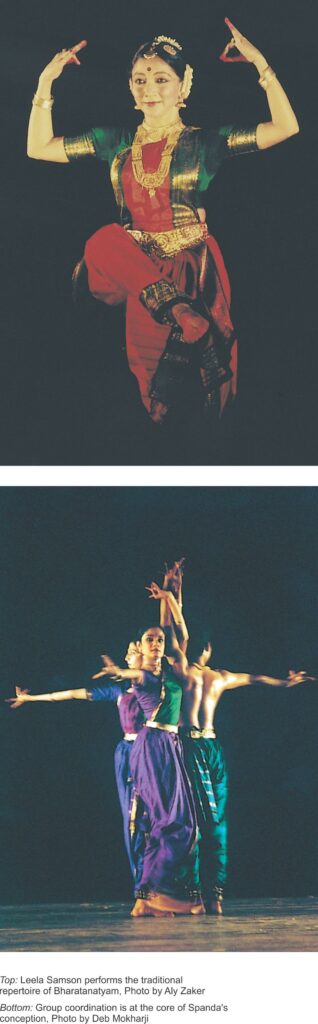
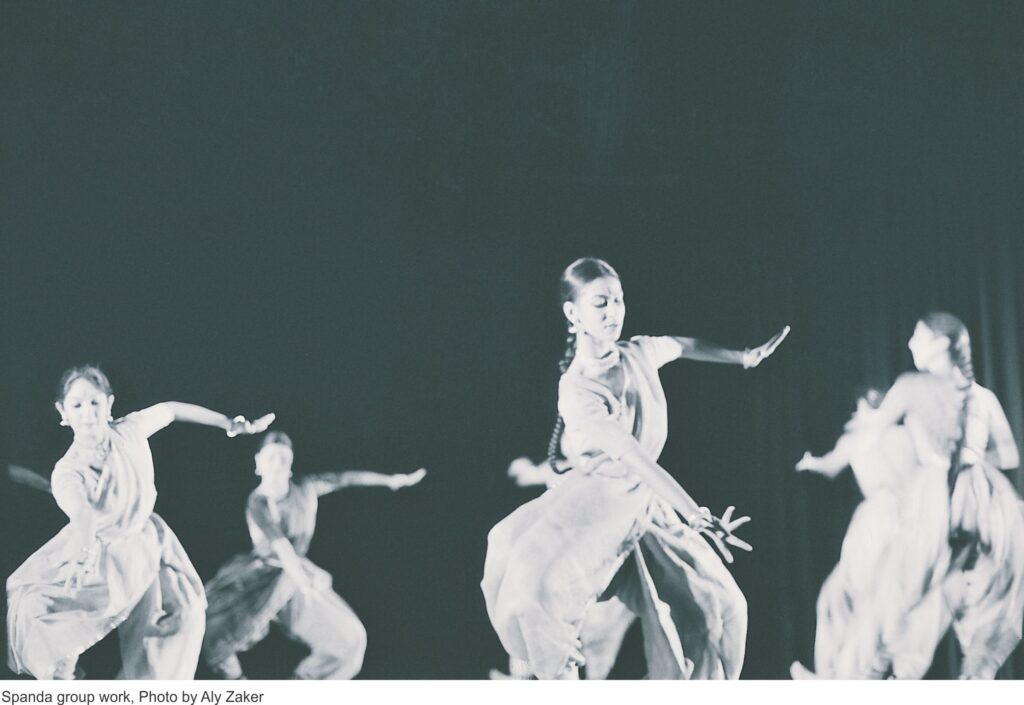
However, there is now noticeably a new awareness, among dancers of the inner forces which manifest themselves through the movements of the body; this has brought about a deeper understanding of the forms themselves. A fine example of this is the work being done by Leela Samson, a much acclaimed dancer of the traditional Bharatanatyam ‘margam’ in the exquisite Kalakshetra style, with her group named ‘Spanda’. Leela herself has this to say about her work with Spanda:
‘Spanda meaning vibration is symbolic of the enduring and perpetual energy that is the life force of the universe. It incorporates the philosophical concept of prithvi, or earth, as the center and source of energy in the universe and equates it with nabham, the womb, as the origin of energy in the human body. Bharatanatyam is an art form that connects directly with Earth taking life from it and returning to it. The focal energy point for the dancer is the abdomen and the discovery of its potential has led to a new dimension in the expression of the form.’
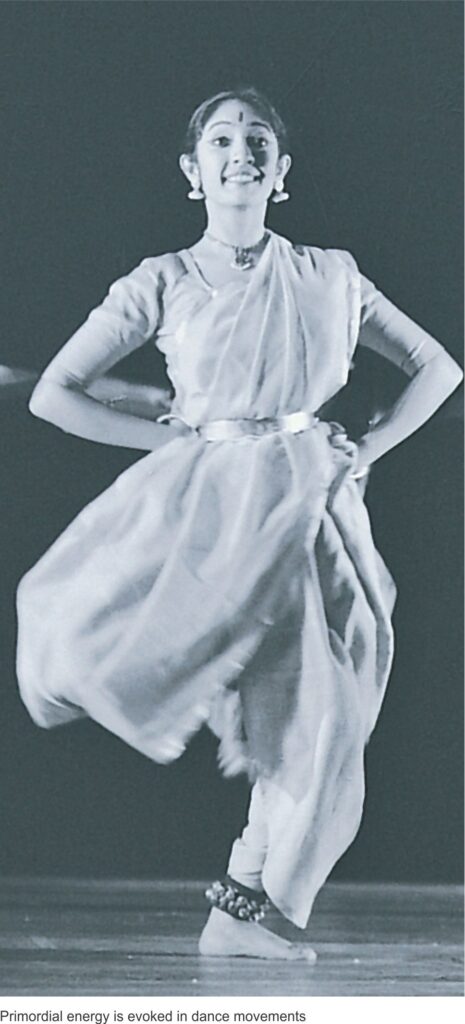
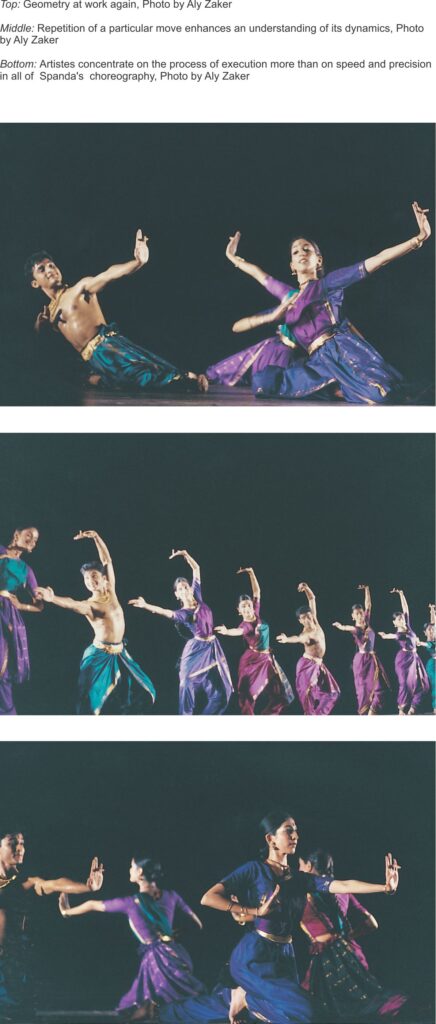
The rediscovery of the basic movements of Bharatanatyam and the need for a reinterpretation of its traditional vocabulary challenges Spanda. While retaining its linear geometry, elasticity and essential variety, movement is reduced to its purest and most basic form with an emphasis on process. Speed, which has come to be considered virtuosity in pure dance passages, has in fact robbed the style of its strength. Spanda reverses this process and deliberates upon movement, thereby exposing the dancer and the viewer to the stillness within the dance. With Spanda, Leela Samson and her talented group of dancers, all her own disciples, have reinvented the Indian tradition of dance while remaining true to its language. The exquisite adavus or basic steps of Bharatanatyam are not here executed with mindless precision or speed. Rather, each dancer is encouraged to understand the entire process itself—the various contractions and extensions of the body combined with the undulating swing of the torso in various talas or rhythms. Leela’s exquisite choreography at times allows the audience to simultaneously view various perspectives of a particular movement; at times again repeating endlessly one movement till its dynamics are palpably relished by the dancers themselves who then transmit this joy to viewers. Also, as Leela says, in Spanda there is no hero-heroine hierarchy among the dancers, and each contributes equally to a marvelously synchronized description of space through an ensemble of body movements. Leela is known to work long and hard with her group before each performance to initiate her dancers into this new perception of dance itself. These intense sessions make for cooperation, for it is together that they achieve the magic. The unornamented grace of the dancers is further heightened by Spanda’s minimalist costumes in vibrant colours shorn of the usual gold embellishments.
How, one wonders, do body movements alone, without the aid of a story to tell, evoke rasa within the audience? The answer is that it is primordial energy itself which Spanda strives to describe. And when this energy is manifested through body movements and is executed in space with the grace and fluidity of Leela Samson’s choreography, the audience can only but feel enthralled by primordial emotions evoked into a passion within themselves.
Though it has taken several centuries to do so, dance in India seems to have finally acquired an independent identity of its own. Now that a few dancers in India have been bold enough to remove the shackles of storytelling and ornamentation and allow Indian classical dance to stand on its own credentials alone, one wonders what newer directions it will take.
Lubna Marium is a leading exponent of classical dance in Bangladesh
Setting itself free from a millenia old linear narrative style, classical dance in India has broken new grounds and is now more and more about describing space through body movements driven by an inner impetus. Interestingly, this change has been spearheaded mostly by women, all of them dancers trained in the strictest of traditions. An…