

excursions into the realm of pakistani popular culture
Figure: The Popular and the Political in Pakistan. by Farida Batool. Lahore: ASR Publications, 2004. Rs. 690

Farida Batool’s Figure: the Political and the Popular in Bangladesh is an important book. Written in a country where religion and politics have been mixed regularly to sustain male power, and where taboos have been imposed on creativity time and again to instill conformity and stifle alternative modes of expression, it shows compellingly, among other things, how “a systematic process of theocratic indoctrination” targeted artistic expression in general and figurative representation in particular in the name of Islam to help “the military establish its legitimacy in Pakistan.” This makes it a timely work too, for in a region where every now and then fundamentalist forces resort to religion to regulate individuality and torment artists and where we are now witnessing renewed attempts to suppress the creative imagination, it is imperative to produce works revealing the human impulse to represent life through art and to get around roadblocks erected in humanity’s path in the name of religion or the state. As Batool puts it: “contemporary Islamic iconophobia is a construction of socio-political interests of the contemporary neo-colonial period rather than an ancient and inscribed tradition.”
Batool emphasizes that while prohibitions on representations of the human figure in art and prescriptions for artists abound in contemporary Pakistan, its people can claim a tradition of image making that dates back to the ancient civilizations of Mohenjo Daro and Harappa and that thrives even now in rituals such as hand-made clay horses offered at the shrine of saints, cinema painting, and dancing, as well as the work of “mainstream” painters such as Sadequain, Salima Hashmi, Anwar Saeed, Ruby Chisti, Jamil Naqsh and Mohammad Ali Talpar. Tracing the roots of the present day Pakistani right-wing fear of figural representation to “the disintegration of the identity of a Muslim self” in colonial India and to “shifts in power around the globe” in recent centuries that fanned the purifying instincts of Wahabbism in the subcontinent, Batool points out that “the notion figure [sic] being ‘forbidden’ … in Islam was perpetuated by varieties of orthodox and fundamentalist groups who sought forms of ‘pure’ Muslim identity to counter the power of contemporary imperialism.” Countering Talibanesque claims made by fundamentalist groups that “figurative representation is forbidden in Islam,” she stresses that the Quran contains verses such as the following: “And do not abuse those whom they [the unbelievers] call upon [the idols] besides Allah, lest exceeding the limits they should abuse Allah out of ignorance.”
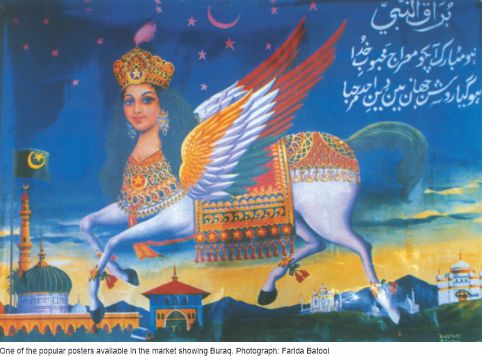
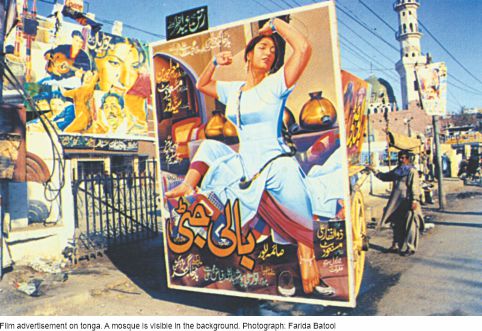
Batool notes that the Quran does not have “a single verse that forbids making representative image [sic] for the sake of pure expression.” Nevertheless, the military regime of General Ziaul Haq attempted to divert the artistic imagination in Pakistan away from figural art to calligraphy. Zealots licensed by him persecuted the artist Colin David for painting nudes as part of the regime’s strategy of legitimizing itself by fanning religious sentiments to stay in power. Batool also observes how Pakistani rulers patronized masculine folk dance forms to perpetuate the image of a virile jihadi tradition even as they did their best to suppress women’s dance traditions by characterizing them as inappropriate to Islamic codes of conduct.
At the heart of Figure are chapters offering case studies of the forms popular culture in Pakistan has adopted to carry on a tradition of image making despite the official injunctions against depicting figures. Batool’s first example of how the human need for figural expression continues to survive despite censorship is a chapter on the practice of offering terra cotta clay horses at the shrine of Ghore Shah, a saint venerated in Lahore for performing a miracle with a wooden horse. She also offers the example of the tradition of people honoring Syed Sher Shah, another saint of the city, by offering lions made of glazed ceramic clay on the fulfillment of their wishes. In addition, Batool showcases the existence of posters depicting members of Prophet Muhammad’s family as well as Buraq, the sacred horse of Islam, and sees them as further evidence of the survival of an indigenous aesthetics despite officialdom and state ideological interpellations. Noting that such image-making persists throughout the sub-continent, she concludes that the similarities between even Hindu and Muslim poster traditions are remarkable and “defy the state’s imposed idea of cultural identity over people of Pakistan, in which the state is ignorant of the subtle influencing factors in each tradition” [sic].
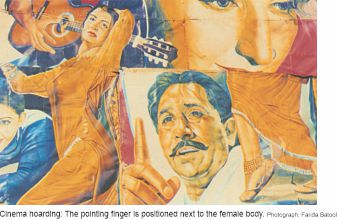
Another chapter of Figure focuses on commercial painters and their production of female forms for cinema billboards and posters. Batool considers this popular art form to be part of Pakistani urban folk culture and uses it as further evidence of the persistence of human figural representation in the country despite official prohibitions. She notes that the ubiquity of cinema posters depicting fleshy female figures not only signifies the ambiguities about depicting women in Pakistani society and about figuring people in art but also reveals how the male psyche is bent on controlling the female in the country. She shrewdly diagnoses the situation thus: “The dichotomy between the designed/religious national identity for women that stresses female morality and ethics, and the ‘inappropriate’ representations of the female form on the cinema billboard, provides enough compelling evidence that all is not as the State and centres of orthodoxy would like to imagine.” In other words, the State is bent on discouraging figural representations in the arts but is ready to overlook the portrayal of women as sex objects in cinema billboards to gratify male fantasies. As Batool puts it: “allowance of cinema paintings further enforce the image of women as the embodiment of sexual desires that need to be tempered and controlled in order to ‘reform’ society.”
Batool believes that the state’s bid to restrict figural representation of women in the arts while turning a blind eye to the overt sexuality of cinema paining and to propagate an ideology based on keeping women in their place and proscribing depiction of women in painting and sculpture has not gone unchallenged by artists and have failed to discourage them. She highlights the work of Salima Hashmi, a woman artist who challenges male authoritarian figures through her paintings and who celebrates female sexuality through them. Batool also discusses the works of the sculptor Ruby Chisti whose creations “reflect in quintessential ways, the status of women in Pakistan where, on one level, they are oppressed, victimized and the centre of male chauvinism and, on another level, they are the centre of romantic endeavors and celebrated as a creative force.” In addition, Batool reminds readers of the way Pakistani “women artists rose along with all the other women and the human rights activists to protest against” General Ziaul Haq’s discriminatory laws. For good measure, Batool also discusses male artists who continue to paint male as well as well as female nudes in Pakistan, despite official injunctions and unofficial frowns directed at the genre.
The final chapter of Figures turns away from painted and sculpted figures to a Punjabi dance form called Gidha which Batool sees as compressing female “desires, feelings and suffering while expressing a subversion of the oppressive instruments in a patriarchal society.” Batool locates the dance in a space that Punjabi women have created for themselves and that they have nurtured away from the male gaze where they can enact a version of the carnivalesque analyzed by Mikhail Bakhtin in his works on medieval festive modes of subversion. By their uninhibited participation in the dance, the women appear to Batool to be parodying authoritarian gesture as well as celebrating their own bodies. In this form of dance, the dupatta or the veil is used in such a way that it becomes “a potential instrument of subversion.” Batool also sees the dance as incorporating movements from Hindi films and in this tendency too finds them challenging the notion of a “Pakistani” identity constructed by the military regime. Ultimately, she concludes that the vitality of the dance form registers the fact that the creative use of the body “has always been a part of Pakistani culture” and the culture of the region “regardless of the official indifference to ignorance and discouragement of its existence.”
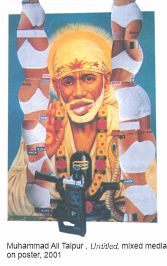
It will be clear from the above that Farida Batool’s analysis of the way the female body has become a site for studying the intersection of the popular and the political in Pakistan makes Figures a thought provoking, timely, and a comprehensive study of the subject. Combining theoretical sophistication with extensive fieldwork, and relying on recent work in Cultural Studies, Feminism, and Art Theory, she has offered readers of her book a fascinating study of the struggle going on between the forces of orthodoxy and the artistic imagination, between the desire to control the impulse to express oneself through art and the desire to articulate one’s imaginings in artworks. Batool has made good use of the works of theorists such as Michel Foucault, Homi Bhabha, Stuart Hall, Laura Mulvey, Colin MacCabe, and others as well as her own excursions into the realm of Pakistani “mainstream” and popular art to make her case for libertarian modes of thinking about culture and society.
It is a pity, then, that one has to conclude a review of Farida Batool’s Figure: the Popular and the Political in Pakistan by pointing out how this theoretically sophisticated analysis is vitiated by sloppy prose, execrable grammar, and poor proof-reading. A work with a thesis as important as the one she has so painstakingly put forward and as relevant to anyone thinking about the survival of art in our climes and times as this one surely needed to be a more carefully edited and produced. One can only hope that future editions of Batool’s work will be free of the mistakes that mar this one!
Fakrul Alam is a member of Jamini editorial board
Figure: The Popular and the Political in Pakistan. by Farida Batool. Lahore: ASR Publications, 2004. Rs. 690 Farida Batool’s Figure: the Political and the Popular in Bangladesh is an important book. Written in a country where religion and politics have been mixed regularly to sustain male power, and where taboos have been imposed on creativity…