
the current state of graffiti and street art
Looking at the clock at the bottom right side of the screen, I read 3:00am. My eyelids feel like soaked tea bags tied to the ends of my eyelashes, and my eyes burn from staring at a computer screen for the past four hours. This is the most difficult part of the night; do I simply crash into bed, or put on my warm clothes, get my gear together, and walk out into the cold early spring night? My mind lazily bounces between the consequences of both decisions. The first situation is the most logical; just turn off the monitor, walk over to the bed, undress, and climb into the inviting warm wonderland of sleep. The second situation is much more complex. I’ve got to convince myself to stand up, then figure out which clothes will blend into the dark urban environment the most efficiently, and then put them on. Then fill my backpack with my collection of tools. This is difficult since I’ve got to find them in the apartment without waking up my roommates. Finally, and this is the easy part, walk out into the cold and dark night air, pick a few prime places hidden from the eyes of the police, shake up the spray paint, and contribute my art to society. I stand up and grab my backpack
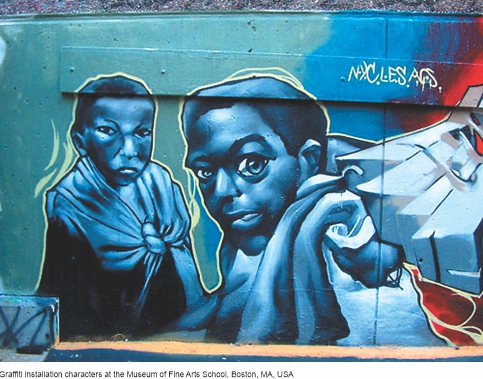
Graffiti has been around for thousands of years; for instance the Romans used to carve names and simple messages into the walls of both private and public buildings; the original inhabitants of Pompeii (before the volcano eruption) used public walls to write signs and messages; and Egyptians and Vikings inscribed symbols and runes onto walls. The term ‘graffiti’ itself is derived from the Greek graphein: to write. Typically, ancient graffiti consists of simple lined one-dimensional etchings of one’s name, or a simple message.
Graffiti as the word is currently used has evolved from the more recent usage of the territorial markings of street gangs in the early 1960s. These gangs established controlled areas of the urban landscape by using spray paint to mark their territory. The preferred method of territorial identification was a simple ‘tag’ of either the gang name or the gang members’ names. Directional markers were usually included to indicate the territory under the gang’s control, ie. ’18th Street Bloods’.
These territorial tags gradually evolved into a quickly written script in order to minimize the time needed to put up the message. As time progressed, gang members (‘taggers’) developed an identifiable style that could be used to indicate which gang they were from.
In the early 1970s taggers began to use the tag specifically for its own sake, which eventually led to even more unique and intricate designs due to a tagger’s desire to be unique. At this point what was previously a system of territorial claims began to evolve into a type of creative expression. Taggers were moving away from the simple single-lined writings by integrating bubble letters and dark outlines. It was around this time that taggers began to pop up outside of the realm of gangs, and referred to one another as ‘writers’.
***
The air feels cold and crisp as I step outside of my apartment building, but I can smell the earthen scent of damp grass as I walk over across a nearby baseball field; spring is just around the corner, but winter still has me firmly in her grasp. The streets are mostly empty save for a taxi cab prowling for its next inebriated occupant. I head for the larger buildings of the business-oriented downtown area, no particular destination in mind, heading vaguely for the deserted expanse of prime artistic real estate.
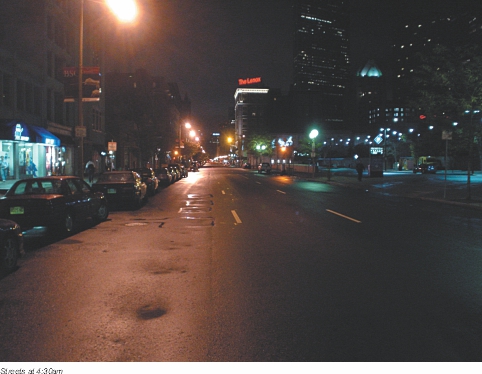
Early Monday mornings are the best time to go writing, since everyone is in bed sleeping in preparation for work the next day. The smallest police presence is on patrol, and the nightlife is also almost dead. This time is best to minimize my chances of getting caught red-handed, in the most literal sense. As I walk down the quiet and lifeless streets, a strange feeling envelopes me. The city has been removed of all human existence, everyone evacuated as if in preparation of an oncoming attack. Traffic lights change for non-existent cars, neon lights blink pointlessly in a call-and-response conversation with each other, stores are vacant and dark. The absence of sparrows and pigeons add to the feeling of a cold and bitter wasteland. I feel totally alone, as if I’m the last person on earth, an empowered anomaly in an otherwise humbling experience.
As I approach the financial hub of the city (as well as the universe), it gets noticeably quieter. I glance at my watch, 4:00am. The sky hints at morning to the far east, but straight up I see only midnight black.
I close in on my target.
***
New York City, Los Angles and Philadelphia saw an explosion of non-gang related graffiti in the 1970s and the early 1980s. What were once single lined ‘tags’ evolved into ‘pieces’ which involved multiple colours, bubble letters, and dark outlines. Two major styles precipitated out of the scene that formed the basis of much of the graffiti on display for the next few years. Philadelphia’s ‘wicked style’ consisted of tall and thin letters with platforms along the bottom, while New York and Los Angles graffiti more commonly exhibited the ‘wild style’ with its characteristic arrow headed and bubble letters, surrounded with cartoon-like black outlines.
Graffiti had graduated from its gang-related roots to a new form of artistic expression and competition. Writers were now competing with fellow writers: whoever could get their piece up the most in highly visible locations, and had interesting and unique styles earned the most respect. This type of direct competition resulted between artists who had never met one another. Conflicts were initiated when one artist would draw a line through another artist’s piece, or simply paint over it. This is how an escalating battle between writers would begin, resulting in better and more audacious pieces being painted. A winner would be proclaimed when either one was caught by the police, or one of the artists would feel that his ability to outpaint the other was inadequate, and sign ‘props’ below the piece, indicating that the other writer had won the battle.
New York City quickly saw graffiti proliferate on its subway trains. The insides were covered in scrawling tags, while the outside was covered in a multitude of pieces, or in some cases a single mural that spanned the entire length of the car. Increased levels of competition drove writers to be more creative. Shadows, backgrounds, multiple colours, and addition of a perception of depth to the pieces effectively turned the city walls into a canvas. Graffiti had finally taken root as a viable form of artistic expression.
As graffiti artists experimented with new techniques, people began to take notice. Cities such as Los Angles and Boston began to pass new laws that would allow for more strict punishment against vandalism. Boston also created a task force named the ‘Graffiti Busters’ to remove any graffiti reported, as well as to investigate and compile information to help track down those engaged in graffiti. One of the major issues opposing graffiti was the quality-of-life argument, which states that the presence of graffiti creates a heightened sense of squalor and adds to fears of crime. Vandalism and trespassing are the common laws cited against graffiti artists, but often the owners of the buildings targeted do not wish to press charges, or the buildings are abandoned and await demolition. Some cities have opened public walls designated as graffiti areas in the attempt to curb illegal writing, but these attempts have largely failed to produce the desired effects.
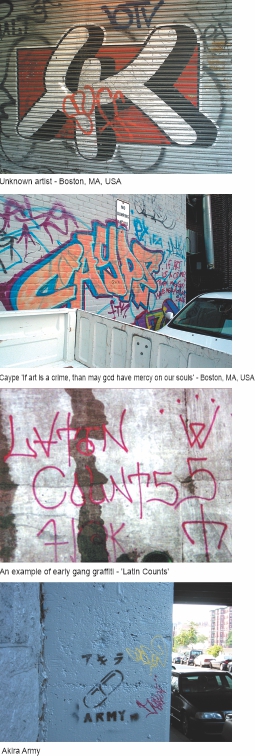
The hip-hop community also began to identify itself with graffiti culture. With both cultures emerging out of a gang-related background, it only took a small jump to reunite the two. In New York City, block parties would involve the four classical aspects of hip-hop culture, including MCing, DJing, graffiti and break-dancing. In 1982 the feature film ‘Wild Style’ emerged to thrust hip-hop culture as well as graffiti onto the mass media. This film acted as a catalyst to promote graffiti beyond the confines of the urban setting in the suburban realm and beyond.
***
I walk through the park in the centre of city. During the day it is filled with men and women on lunch break discussing business things, mothers bringing their children out for air, and people enjoying their free time. At 4:25am, the park takes on a whole new role. As I walk up the hill at the end of the park, I pass two mounds of cloth lying under a tree. I peek out from under my hooded sweatshirt to see smoke undulating out from a bulge at the end of one of the mounds. A slight red glow illuminates the face of a person; he looks tired and weary, as if he hasn’t slept soundly in quite a long time. The other mound moves, and I see another face staring back at me. Obviously I had interrupted a conversation, my hood deftly blocks out the faces, and my view resumes its previous focus on the ground in front of me. What were they discussing?
Once out of the park, I begin to walk among the cobblestone side streets around the outside of the capital buildings. Here the structures sit atop a hill overlooking the city; they are hundred year old three and four story townhouses, filled with expensive furniture and with expensive cars parked out front. I imagine many of the politicians who work in the capital buildings live in this area. This area hasn’t changed in the last hundred years; it has even retained the gas lanterns along the sidewalks.
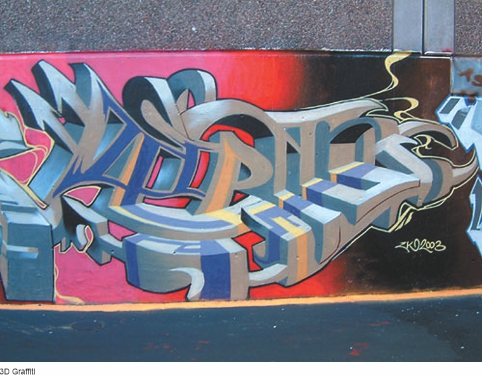
Graffiti quickly began to pop up in galleries and art books. Established artists like Warhol and Basquiat took certain characteristics of graffiti, and gave it the ‘artistic seal of approval’. Graffiti had gone mainstream, and was in the process of maturing. Styles were continually improving, however, and more advanced techniques were being developed. Writing in bubbles letters became a thing of the past, and three dimensional pieces became popular. Some cities even hosted ‘graffiti battles’, where artists would be given a section of wall or canvas, paint, and a limited amount of time to produce something beautiful.
Aerosol art became a competitive field, marked by constant evolution and originality. At annual graffiti contests held in London, the best artists would compete on designated graffiti walls. These contests frequently combined music and art to become cross-cultural events, further establishing the link between graffiti and music culture. Two of the previous winners of these contests went on to become worldwide music stars, one being Goldie the famous drum n bass DJ and producer, as well as ‘3D’ aka Robert Del Naja, who went on to become a founding member of the band ‘Massive Attack’.
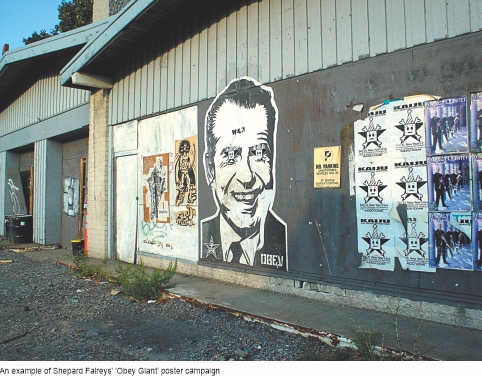
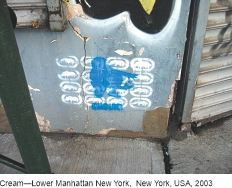
In the early 1990s, a few artists began to experiment with new techniques that didn’t involve spray paint. By using stickers, stencils or wheat pasted posters, these artists discovered that they could more easily mass-produce their work, and get much more public saturation than they could have previously done using the tried and true spray can methods. One of the first artists to break away from the more traditional spray can art form was Shepard Fairey. Then a graphic design student at Rhode Island School of Design, he began posting stickers that he had made all over campus, and all over the city of Providence. Gradually, friends of his as well as total strangers began to post his stickers, and the trend grew to become the largest single street art campaign ever.
***
Arriving at my destination, I notice a statue commemorating the soldiers who had fought in the Civil War. The statue is conveniently placed across the street from both the Fox News television broadcasting station and the State House. The last few days were spent riding my bicycle around the city to scout out good locations that would make an impact on a large number of passers-by before my work was removed. I had settled on the area around the hill because of its close vicinity to many statues and monuments that were my intended target.
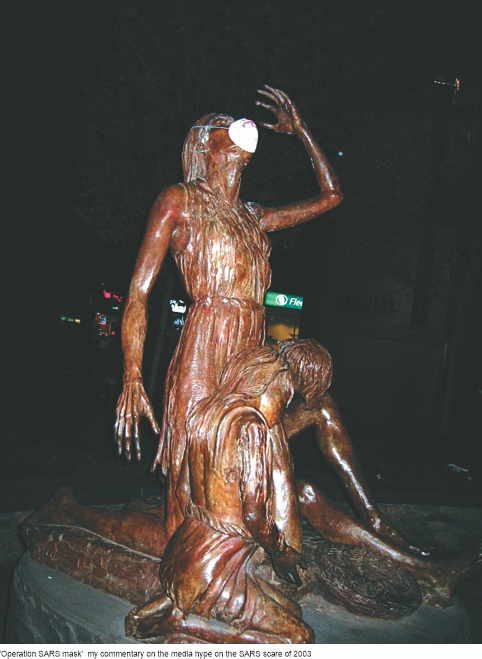
It was almost 5:00am, and light would be breaking very quickly, I had to move fast. I paced up and down the sidewalk for about two minutes before I got the courage required to make my move. Making sure everything was clear. I ran across the street, and jumped onto the marble base of the statue. My foot slipped, causing my knee to bash into the marble. Art always comes at a cost, I thought to myself! Climbing up over the base, I pulled a handful of doctors’ facemasks from my pocket, and carefully placed them on the faces of the statues. Once satisfied with my work, I jumped from the statue onto the pavement, and quickly walked into the shadows of a side street. After securing the perimeter, I snapped a few shots with my camera as evidence.
The idea was simple enough: paint a collection of different thought-provoking logos and phrases on a bunch of face masks, and affix them to some statues. That should generate some interesting looks, or at least some comments. Too bad I wouldn’t be there to see the reactions. Maybe it will get on the 5pm news, the way the media promotes fear these days, maybe they’ll even take it as some sort of terrorist threat of an imminent SARS outbreak.
Hitting the next five targets is easy work, as all are within a mile radius. As the sun begins to rise, I spray one of my favorite logos on a wall under a bridge; this way my competitors will know who pulled off this dastardly deed.
***
What will people think when they see the statues wearing masks? Will people even care? Will it offend anyone? Certainly I hope so! If I can get anyone to think, to divert their attention away from the daily grind, to take a minute and develop their own explanation or interpretation as to what my work may mean to them, then I’ve made a difference, and I’ve won.
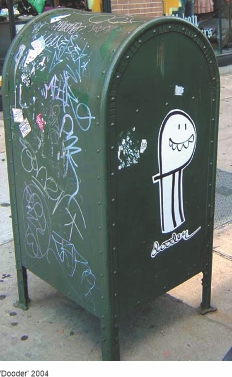
Towards the end of the 1990s, graffiti art was going through a bit of a lull, but street art was booming. Stickering, stencil, and wheat-postering was going through a sort of renaissance. Artists were collectively reflecting on the fundamental elements of their art form, and from this self-examination, a few general ideals emerged as is evident from a discussion I had with another local street artist, ‘Dooder’ who had been engaged in Boston’s street art scene for the last three years. What he said sums up the thoughts of many street artists effectively.
What do you think of the art world?
‘Let me start this off by saying that I think the “art world” is bullshit. I have a Bachelors degree in studio art and I understand artists need galleries to make money, but they are not for me. No one goes to galleries… let’s not kid ourselves. A painting on a wall is just a piece of canvas with paint on it unless there are people there to look at it and enjoy it. That’s why I take my art to the streets. It’s my medium, like a sculpture’s might be clay. I love the fact that I can install something in the city and hundreds of thousands of people will see it. There’s a constant dialogue with the people that see your work (many of whom have never even been to a gallery), the city trying to take it down (leaving you more blank slates to create), and other artists working on the streets (with whom you anonymously compete and collaborate). It’s such a unique and important form of expression that it is absolutely necessary in an urban environment. Cities gain their personalities not only from what their buildings look like, but also from the people that live there. When I put up a piece I am saying to everyone this is me, and I’m a part of this city.’
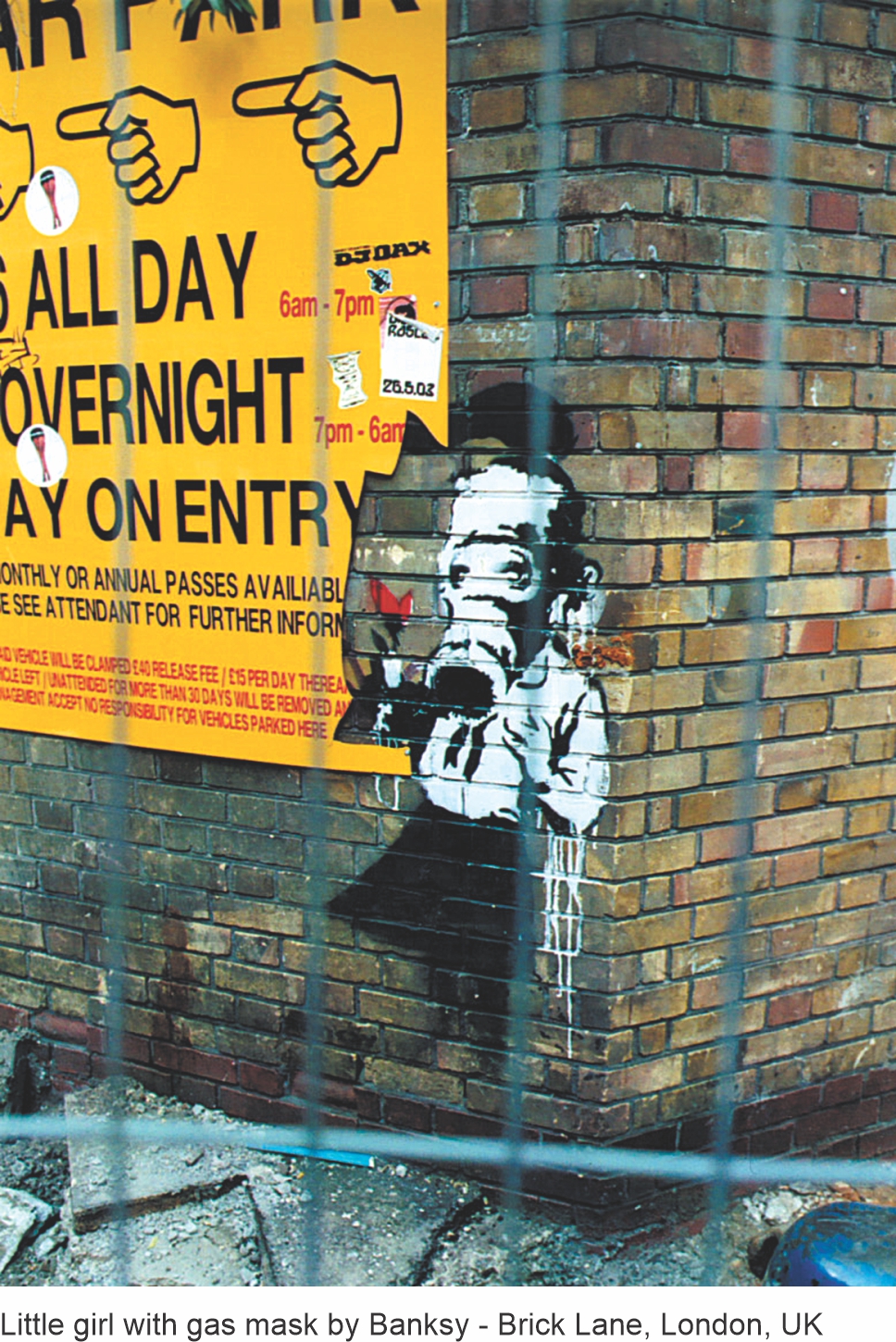
Another major aspect of graffiti and street art that has come out of the past five years is the reclamation of our public space. With the onslaught of corporate advertising in mass media such as television, radio, and magazines, our only sanctuary is our public outdoors. That too has been claimed as an advertising opportunity, with billboards, ads driving by on buses, and even people walking by with logos and advertisements on their clothing. We are inundated with advertising. Graffiti is a means of reclaiming our public space, a way to say ‘This is my space too, and I have something to say’. Such ideals have begun to politicize graffiti, in the process adding more depth to culture. One of the main ideological leaders of the political street art movement is the London-based Banksy. Typically using two-colour stencils, he makes use of juxtaposed images to create powerful messages. Let him, then, have the last word.
‘It takes no money to do it, you don’t need an education to understand it, there’s no admission fee and bus stops are far more interesting and useful places to have pictures in than museums.’ (Banksy. Banging Your Head Against A Brick Wall. Weapons of Mass Distraction 2001. p. 3.)
Ron Adams lives and works in Boston
Looking at the clock at the bottom right side of the screen, I read 3:00am. My eyelids feel like soaked tea bags tied to the ends of my eyelashes, and my eyes burn from staring at a computer screen for the past four hours. This is the most difficult part of the night; do I…