
rolf harris, celebrity artist
Rolf Harris’s art encompasses paintings, murals, cartoons, book illustrations, prints, woodcarving and stone polishing. While there are many pop and film stars who paint as a pastime, what is special about Harris is the way he has combined both art and performance
With some justice, Rolf Harris’s biographer Michael Heatley has called him ‘the most talented man in the world’. The Daily Telegraph also dubbed him ‘a renaissance man’. Harris is an internationally famous popular entertainer—musician, singer, recording artist, comedian, stage and radio performer, television presenter, writer (of songs and books)—and a visual artist. His art encompasses paintings, murals, cartoons, book illustrations, prints, woodcarving and stone polishing. While there are many pop and film stars who paint as a pastime, what is special about Harris is the way he has combined both art and performance. Furthermore, Harris has used his career on British television to disseminate his own art, to encourage people to take up art and to appreciate major artists of the past. Television appearances account for the fact that a poll of 1,000 visitors to the 1992 London ArtMart exhibition revealed he was the best-known artist in Britain. He attracted 38 per cent of the vote, ahead of Constable at 23 per cent.
Of course, this does not mean that his art is taken seriously by Britain’s professional, modern art world, that is, by such figures as Tate director Sir Nicholas Serota, supercollector Charles Saatchi or the dealer Jay Jopling. Leading art critics employed by the broadsheet newspapers generally ignore Harris’s exhibitions and his arts television programmes and, when they do write about them, they attack them. This is because, compared to radical artists, Harris is traditional in terms of his medium, genres, subject matter and style. He has contributed nothing original to the development of art. Of course, the latter criticism implies a progressive conception of art in which revolutions in form and content periodically occur. Another ground of complaint is that he is not a trained art historian and therefore his commentaries on famous artists are simplistic.
At the same time, Harris’s work is exhibited in fine art galleries—most notably the Halcyon Galleries of Birmingham and London—and prints of his paintings are sold for around £300 each via numerous retail outlets. The Halcyon show in Birmingham (December 2000) was entitled ‘Relative Artistry’ because it was a family affair featuring work by himself, his wife and daughter. Harris has his own website, which sells merchandise such as books, CDs, T-shirts, videos and prints. As early as 1956, he was exhibiting at the Summer Exhibition of the Royal Academy. He is the recipient of two British honours: the OBE and the MBE. Furthermore, in 2000, he was made an honorary member of the Royal Society of British Artists. During November and December 2002, a selection of his paintings simulating Monet, Van Gogh, et al for the first and second series of the BBC1 television show Rolf on Art were exhibited at the National Gallery in London (albeit in a basement cafeteria). Evidently, some elements of the British art establishment regard him highly.
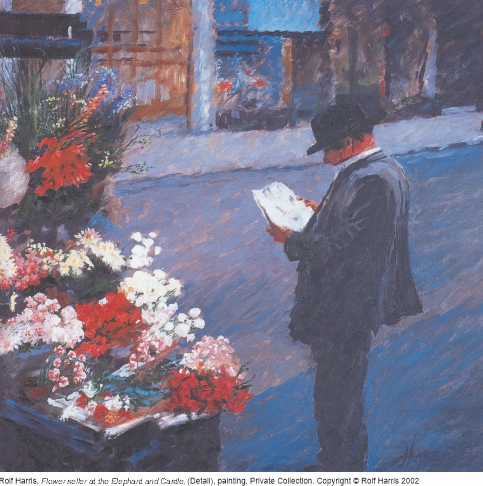
The financial value of his paintings is also rising: in September 2003, a collector paid £95,000 for Harris’s Flower Seller at the Elephant & Castle—a recently executed social realist/impressionistic canvas based on a colour photograph he took in the 1970s—which was exhibited at Harrods Gallery. Since the collector did not know who Harris was at the time, she judged the work on its aesthetic merits alone. Two landscapes by Harris were also sold at Harrods for £15,000 each. Harris was born in 1930 and grew up in Bassendean, a suburb of Perth, Western Australia into a family of Welsh origin a decade after it arrived in Australia. Visual art was already a tradition in the family because his paternal grandfather George Frederick Harris (1856-1924) had been an academic-style, struggling portrait and still life painter in Cardiff and Chairman of the City’s Royal Art Society. Rolf’s father Cromwell was a frustrated artist and amateur watercolourist, and his aunt Rhona (aka Pixie O’Harris, 1903-91) was also artistic and became well known in Australia for her murals, children’s books and illustrations. As a child, Harris enjoyed drawing and discovered he had an aptitude for capturing a likeness. His father encouraged him and so did his teachers at primary and secondary schools, and at teacher training college. He soon experienced com mercial success: many of his early works were portraits – one of his sitters was Sir James Mitchell, the Lieutenant Governor of Western Australia – and sales of his teenage work enabled him to buy a car. Sales from other exhibitions paid for his fare to London in 1952 at the age of 22.
His plan was to train at art school in order to emulate his grandfather by becoming a society portrait painter. He intended to perform as a singer and musician in the evenings to pay for his living and art school expenses. He attended the City & Guilds Art School in Kennington for a year but learned little from its foundation course. To his surprise, he was poor at life drawing and anatomy, disliked etching and found the school exercises boring. However, it was here that Harris met his future wife Alwen Hughes, a Welshwoman who became a sculptor and jewellery designer. (They have a daughter Bindi [b.1964] who trained at various art schools and who is now a painter and sculptor.) He spent a further year at the Central School of Arts & Crafts in Holborn before dropping out of higher education.
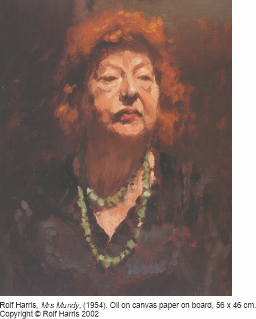
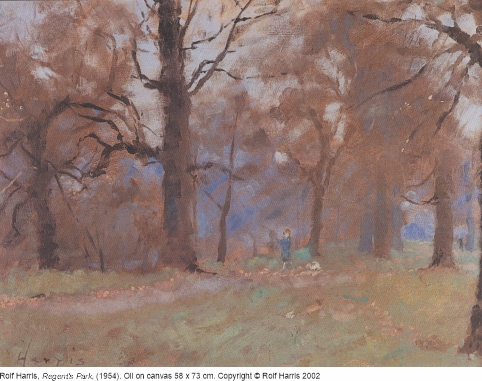
Two paintings dated 1954—a portrait of an art school model and a landscape of Regent’s Park—are effective tonal studies recalling the work of Walter Sickert. In 1959 or 1960, he used the landscape as the basis for a huge painting serving as stage scenery for a play on TVW7, a television channel based in Perth, where he ran children’s programmes for a year.
Much more useful to Harris than the public art schools was some tuition given at the private school The Heatherley, located in Pimlico, by the Australian impressionist-style painter Hayward ‘Bill’ Veal (1913-68) who had been, in fact, Harris’s favourite artist during his formative years in Perth. Veal instructed Harris to paint a still life in monochrome using as little pigment as possible and thinned with turpentine. He then encouraged Harris to tackle all areas of the canvas at once and to sketch the motif rapidly in broad strokes while squinting to generate a blur. The aim was to establish in broad terms the main areas of light and shade. Refinement then followed.
Impressionism was to remain the style that Harris most favoured. Veal also obtained illustration work for Harris from the editor of London Mystery Magazine. The art school experiences and years of practice mean that Harris cannot be dismissed as an amateur or Sunday painter – he is more skilled than the majority of self-taught artists.
A creative, extrovert and genial workaholic with immense physical energy and drive, Harris gradually gained more work as an entertainer in clubs and for the new medium of television. His versatility and stamina were to ensure him a career that has lasted over fifty years. While storytelling and sketching for two German children, he realised that drawing was like ‘a universal language that crosses all borders and cultures, captivating children and adults alike. It could even be called the ultimate form of magic. Staring from the blank page, the options are infinite, and nobody knows what will emerge except the artist.’
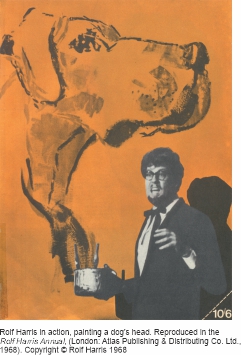
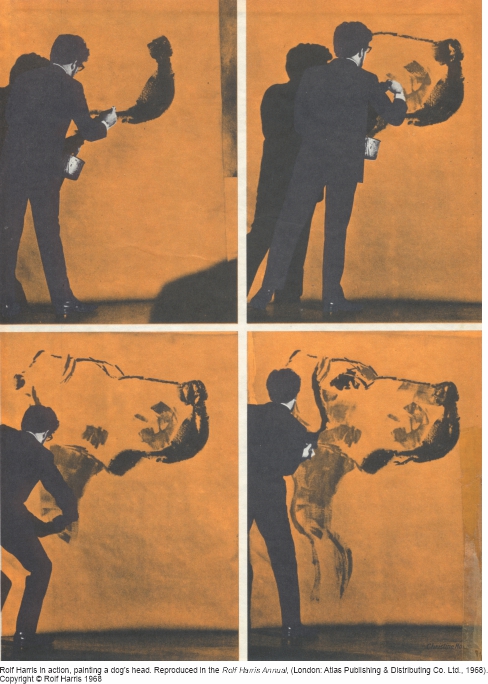
One reason why Harris is popular with so many different generations of Britons and known to them as an artist is that they recall his appearances on television shows for children and adults during which he generated apparently improvised cartoons, drawings and paintings (actually they were planned and rehearsed) in association with puppets or other characters. In other words, drawing and painting became live performances accompanied by a verbal commentary. Millions of viewers watched marks appear on blank sheets of paper or board thereby witnessing the creative process. (As Harris later remarked, ‘Art galleries only show the finished product – not the process’.) They then enjoyed the pleasure and shock of recognition when the puzzling abstract lines and shapes suddenly gelled into an image of a face, an animal or the Houses of Parliament. Barry Booth, Harris’ musical director, has observed:
Rolf ingeniously subverts the whole business of picture painting into a narrative-based performance art form. Each painting progresses through its various stages—exposition, development and diversionary episodes—until the moment of denouement arrives and the audience is invited to speculate and decipher the plot, after which, with a few deft strokes … Rolf gleefully reveals the surprising finale. All the while, during this exercise, he will regale the audience with a continuous stream of comments, anecdotes and hot one-liners.
As he neared completion, Harris would tease audiences by asking: ‘Can you tell what it is yet?’ (This catchphrase was used as the title of his 2001 autobiography.) Speed of execution was clearly important on live television and this suited Harris’s impatient character and the direct, free-flowing manner of painting he preferred and perfected. The invention of felt-tipped, Magic Marker pens during the 1950s greatly facilitated his ability to draw on television.
It can hardly be coincidence that the 1950s were the heyday of action painting and while Harris has remained a figurative artist all his life, he has expressed admiration for the American action painter Jackson Pollock. Films of Pollock, Picasso and European tachists painting were screened in London during the 1950s. Abstract expressionism encouraged many artists to paint on a larger scale and to use house paints and brushes. Harris too began to produce big pictures and to employ house paints and distemper brushes, but he says this was an accidental development. Even so, one can discern parallels in the worlds of avant-garde art and popular entertainment.
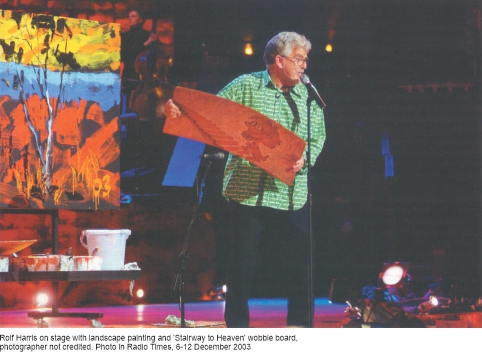
Painting on sheets of hardboard or metal also resulted in the invention of a primitive musical instrument – the so-called ‘wobble-board’—when Harris discovered he could generate strange sounds by flexing the support of a 1975 portrait of the magician Robert Harbin. (This board is now in the collection of TV World: The Australian Museum of Modern Media, Victoria.) Two other instruments Harris popularised were the Aboriginal didgeridoo and the small electronic organ known as the Stylophone. In many performances, Harris exploited his Aussie identity and heritage by singing songs about Kangaroos and painting landscapes of the Australian bush from memory. He has also painted a portrait of an aboriginal girl living in Arnhem Land. For one of his stage acts, he even imported an authentic aborigine to throw spears and play the didgeridoo!
Although Harris insisted that his audiences in South Africa should be racially integrated, political issues were/are generally excluded from Harris’s performances and most of his pictorial subjects are bland and uncontroversial. However, there is at least one exception: a painting derived from a photograph entitled The Dispossessed, which depicts a group of aborigines wearing cast-off white-men’s clothing and looking confused and lost. Harris is now conscious that while he enjoyed a carefree childhood, local tribes were being removed from their own homelands and treated badly by white Australians. The painting, which was exhibited in Brighton in May 2001, was motivated by Harris’s sadness and sympathy for the plight of the Aboriginal people.
By 1953, Harris had grown a moustache and goatee and so he now sported the conventional look of the male artist. In a segment of a television show called ‘Bearded in his Den’ he was required to play the role of a mad artist living in a basement who paints huge pictures and sings songs.
Even as a teenager, Harris based some of his paintings on photographs clipped from newspapers. Around 1960 he bought his first camera and has since taken thousands of slides to use as ‘sketches’. His photographs have been exhibited by Kodak, under the title Rolf Harris Picture Show, and shown to the Royal Photographic Society. He advises novice painters to make use of photographs – not in order to produce slavish copies of the photo-realist kind – but as a source of compositions and inspiration. Like Malcolm Morley, Harris often turns the photographs upside-down while making use of them.
Via the television series Rolf Harris’s Cartoon Time (1979-87) and Rolf’s Cartoon Club (1987-92), Harris involved many children in drawing cartoons and promoted British and American animation. He demonstrated to the children simple animation techniques, such as flick books he had been taught in his youth by his father. He also showed them examples of classic animated cartoons. Leading animators such as Nick Park, John Lassiter and Chuck Jones made guest appearances. Harris has always encouraged audiences to join him in singing choruses and delighted in giving children the opportunity to appear on television and to participate in the creative process. He maintains that audiences at home love to watch people making and doing things.
Always needing to be active in spare moments, Harris drew and painted on any surfaces that were available. For instance, while appearing in the pantomime Jack and the Beanstalk at the Theatre Royal, Plymouth in 1993, he produced a highly detailed mural of the characters and settings in the show on the wall of the star’s dressing room. On another occasion, he painted a bush scene on blue paper that was mounted on the office wall of his record producer George Martin. A photograph of Harris leaning against a tree depicted in the mural appeared on the sleeve of his album Sun Arise (Columbia, 1963).
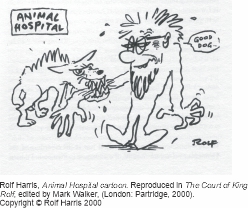
Besides his exuberant personality, another reason why Harris is popular with the British public is his fondness for pets and wild animals. He has written and illustrated books about cats and produced paintings featuring camels, elephants and giraffes. In addition, beginning in 1994, he has presented a highly successful television series about the treatment of injured and sick animals called Animal Hospital in which he seems genuinely caring and concerned. In Britain, these emotional programmes regularly attract audiences of millions.
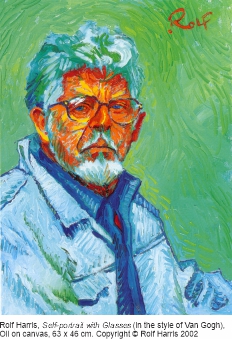
Harris has always been keen to communicate his enthusiasm for the visual arts. This has taken two forms: first, by encouraging people to ‘have a go’ at art and second, by informing them about the art of the past. Among his books is one entitled Draw your own Cartoon with Rolf Harris (1998) and another entitled Rolf on Art: My Approach from First Steps to Finished Paintings (2002). (A deluxe edition limited to 850 copies of the latter book accompanied by a lithograph self-portrait was published, which one book dealer currently values at $900.) His art appreciation books and programmes include: Looking at Pictures with Rolf Harris (1978), Every Picture Tells a Story (1989) and Rolf on Art. What was original about Harris’s three series Rolf on Art (BBC1, 2001, 2002, 2003) was the combination of art appreciation/history and painting on camera, that is, he recreated canvases by the artists Monet, Van Gogh, Degas, Gauguin, Rousseau, Toulouse-Lautrec, Klimt, Lowry, Cézanne, Dalí, Picasso, Chagall and Warhol plus the sculptor Rodin. His aim was to re-enact the creative processes of the artists concerned. Since his personal manner of painting derives from impressionism, it is obvious that he can simulate a Monet more convincingly than a Rembrandt. He also has an affinity with expressionism and was able to generate a self-portrait in the manner of St Rémy period Van Gogh that was plausible. However, when he tried to simulate a Cézanne landscape, his efforts ended in failure because he could not, in a short time, reproduce the structured, architectonic character of Cézanne’s landscapes even when he had reproductions and the motif in Provence to follow. Richard Dorment, art critic of The Daily Telegraph, complained that Harris failed to demonstrate any drawing skills while ‘mauling’ the work of one of the finest draughtsmen ever—Toulouse-Lautrec.
Dorment’s article (filed November 12th 2002) was a comprehensive attack on Rolf on Art. First, Dorment claimed Harris was ‘a grotesque self-publicist’ and ‘a monstrous egotist’ because he boasted about his own work rather than telling viewers about the masters being featured. (The downside of Harris’s mediating presence between major artists and the public is that for many he is more famous as an artist than the masters he is praising. Some even confuse him with the masters: witness the poll conducted by the Encyclopaedia Britannica in October 2003, which revealed that seven per cent of Britons thought Monet’s Water Lilies had been painted by Harris.) Second, what he did say revealed ignorance of the subject and so he burbled ‘a stream of inanities’. (In Harris’s defence, it should be acknowledged that he did include comments by reputable curators and art historians such as Christopher Riopelle of the National Gallery and Professor John House.) Third, Harris’s paintings after the masterworks were ‘bad pastiches, inept copies and variants’. Four, the view that such arts television aimed at the masses is innocent and harmless is wrong because ‘the programme hoodwinks naïve viewers into thinking that there is an easy path to understanding great works of art,’ when there isn’t.
Some of the blame for this rested with the BBC’s commissioning editors. To answer complaints that they had been neglecting the visual arts for years, new series were commissioned but to avoid the charge of elitism and to achieve high viewing figures, they stressed the role of the presenter. Harris was chosen because he was a proven, popular presenter and a man famous for his own art. Harris and the BBC were delighted by the viewing figures—between five and seven million per episode—and Rolf on Art was vaunted as the most watched television arts series ever. Accusations made by several commentators that the series were evidence of a dumbing down of high culture—’Can we now expect Cliff Richard on Beethoven?’ they wondered – were shrugged off. Even if one is critical of the quality and depth of Harris’s instruction and his commentaries on art, there seems little doubt that he has contributed to the widening of the audience for art that has occurred in Britain in recent decades.
At the Royal Albert Hall on September 29th 2003, Harris performed live before a packed house at a Golden Jubilee concert to celebrate his 50 years on British television. His fans were enchanted as he reprised his favourite routines and hit songs. When the event was screened on television on December 6th, it made the cover of Radio Times and was watched by an estimated seven million. In January 2004, an avuncular Harris presented yet another BBC1 television series about art entitled Star Portraits with Rolf Harris (A Hotbed Media Production). Each programme lasted 30 minutes and this time Harris left his brushes at home; however, the focus was again the magic of the creative process. Each week surprise celebrities had their portraits painted by three professional artists in different locations. In the first programme, for instance, artists Sheree Valentine-Daines, Robin Elvin and Amanda Danicic portrayed the talk-show host Michael Parkinson in Bray-on-Thames. This series was lightweight and undemanding. It did not provide any new or deep insights into the genre of portraiture, which some theorists think is exhausted and in crisis. Unlike so many radical artists, Harris does not question conventional assumptions about art and its sub-categories. All twelve portraits resulting from the series were displayed at the New Art Gallery, Walsall from January to March 2004.
Experts on modern art will probably dismiss Harris as a banal, minor, anachronistic painter and as a relentless populariser of figurative art (but not conceptual art, which leaves him cold). Yet, he arouses grudging admiration for his tenacity, accessibility and for his ability to reach so many ordinary people. If series such as Rolf on Art were the only kind of arts television available then we should be worried, but if they are part of a spectrum of programmes, some of which are more demanding, sophisticated and scholarly, then perhaps we should not be unduly concerned.
John A. Walker is the author of Art and Celebrity (Pluto Press, 2002) a book he now realises should have included Rolf Harris
Rolf Harris’s art encompasses paintings, murals, cartoons, book illustrations, prints, woodcarving and stone polishing. While there are many pop and film stars who paint as a pastime, what is special about Harris is the way he has combined both art and performance With some justice, Rolf Harris’s biographer Michael Heatley has called him ‘the most…