
the effect of indian popular art on mainstream art
The term Indian ‘Popular Art’ is a rich and complex one, drawing as it does not only on the connotation of ‘popular’ as opposed to a courtly or elite practice, but one that relates to the heterogeneous mix that constitutes the ‘popular’ in the Indian tradition
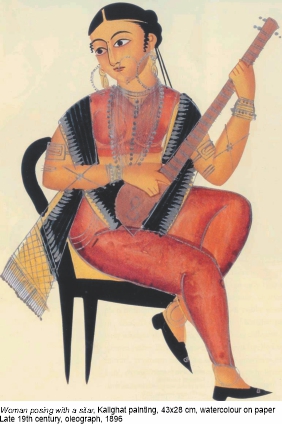
Writing in her introduction to Indian Popular Painting in the India Office Library (UBS 1978, p. 1) Mildred Archer defines popular art objects of the 18th and 19th centuries as ‘products of towns and villages as distinct from courts …for a wholly different public from the feudal aristocracy.’ The production of Indian popular art is from a subaltern social base, usually of anonymous artists. Archer notes that ‘the artists who produced them lived in poverty, painting either as amateurs for domestic and religious purposes or on a professional basis for village and bazaar clients. Their paintings, it might be said, were by the people, for the people, and for this reason they are best described as “popular” ‘. The regional spread and diversity of India, the great variety in methods and materials of art practice, the ritual and mythological base of images and varied community needs resulted in a complex interplay that characterizes Indian popular art. As a consequence, it tends to be enormously diverse.
Popular art was once considered common and did not attract serious attention until the arrival of western modernism and its absorption of primitivism and ethnic traditions. In Bengal the critic Ajit Ghose wrote that Kalighat paintings produced for pilgrims around the temple of Kali in Kolkata, ‘anticipated by a century or more cubism and impressionism’ (quoted by Archer p. 3). Kalighat painting was ostensibly about the gods, but it also reflected avidly the social currents of that time, and in that sense reveled in the spirit of the popular. Similarly, Gurusaday Dutt, an ICS Officer who had traveled extensively in the districts of Bengal, learned to appreciate scroll paintings painted for the purpose of narrative, or recitation. In scroll painting the strong line and colour and the ability to convey only the essence was what excited Dutt’s view of these works as ‘modern’ (Archer, p.4 quoted from The Modern Review, Calcutta, May 2, Nov. 1932). WG Archer had seen Picasso-like affinities in the Kayasth Madhubani wall paintings he had chanced upon during an earthquake in Madhuban in 1932 (Archer p. 6) Archer also emphasized the similarities between Leger and Kalighat.
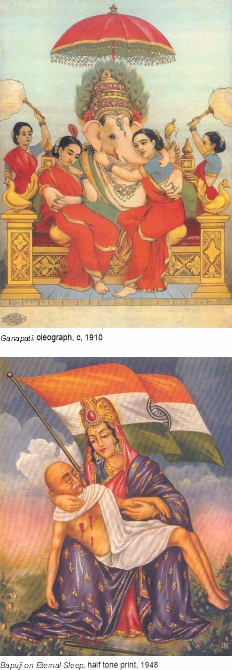
Indian popular painting, however, is only one aspect of popular art that has become influential since the 1850s. The period of British colonial intervention in Indian artistic education through the setting up of four art schools at Madras (1850), Calcutta ( 1854), Bombay (1856) and Lahore ran parallel to other significant changes in broadly mainstream practices. From the 1840s, India avidly received the new technological media that directly confronted and challenged the view that art is sectarian or the result of class privilege. The introduction of printing and chemical inks at a mass level in the 1850s and later photography heralded a significant departure from conventional practice. In the wake of the first war of independence of 1857 and the direct intervention of the British Empire, the patronage of Indian courts and the aristocracy extended to conventional art gradually shrank. The artists who migrated to the ever-expanding city, were exposed to western travelling artists, photographers and even the first newspapers. In the absence of conventional patronage the artist was free to experiment with subject, medium and style. In a sense these experiments which constitute India’s early anonymous oil paintings reveal an exuberant modernity in their absorption of popular elements. Although we do not have any accounts from such artists who for the first time used oils to paint mythological subjects, experimented with perspective and naturalism, there is a degree of rugged confidence in this engagement which served as a precursor of the spirit of experimentation in the contemporary period.
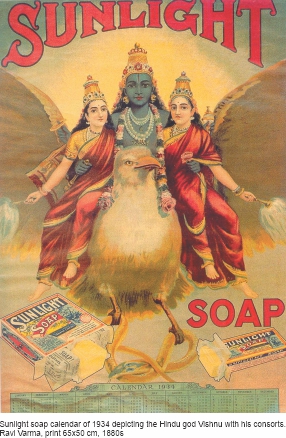
Popular art also yielded an Orientalist image to which modern mainstream artists have responded. Francois Balthazar Solvyns’ Collection of Two Hundred and Fifty Coloured Etchings : Descriptive of the Manners, Customs and Dresses of the Hindoos (1799), and the large works of artists like Tilly Kettle who painted Indian dancers and bazaar scenes in the 1740s formed a base for a caste-wise representation of the people of India. Arguably, it is from sources such as Solvyns and representations by later printmakers that the Indian artists arrive at their figures of representation. In the late 1800s the Indian market was flooded with prints from Germany which heralded a view of Orientalism beyond that of European salon painters. The lithographic process introduced by intrepid Europeans like De Savignac and Charles D’Oyly were already in place in India in the 1820s. For instance D’Oyly, an opium agent and commercial resident based at Patna, produced several periodicals titled The Athenian using the lithographic process (see Popular Art in India: Raja Ravi Varma and the Printed Gods of India by Neumayer and Schelberger, Oxford 2003). German prints satisfied the need for Indian mythological images, although they lacked the dramatic vitality that Indian artists injected into the form.
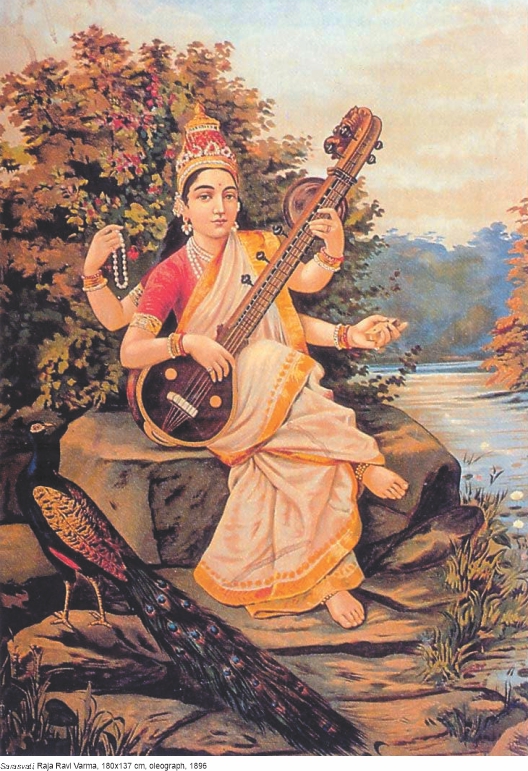
The pivotal figure in revolutionizing the spread of Indian popular art is Raja Ravi Varma (1848-1905) who established the Ravi Varma press in Bombay in 1894 in order to make his images accessible to the greatest number of people. This landmark event marked an important date in India’s popular calendar art industry. The portrait of Ravi Varma, executed by his sister Mangalabai Tampuratty (1904) is very revealing. Ravi Varma stands, his arm resting on a decorative table covered by a velvet drape, as was common in studio portrait convention. He is flanked by gods on either side, both standing on lotuses in the style of the contemporary calendar art that Ravi Varma’s own printing process had done so much to popularize. This is possibly the only half-tone print of an Indian artist ever made and sold in the market. It is in keeping with Ravi Varma’s spectacularly popular promotion of dramatic mythic episodes from Indian Kavya and Puranic literature. Ravi Varma’s essentially hybrid artistic vision became the standard bearer for beauty and aesthetics, , and was seen as a symbol of nationalism. To quote Newumayer and Schelberger, ‘while scenes from mythology replaced German prints, the scarcely dressed European nymphs were mildly Indianised to represent apsaras, goddesses and heroines of the indigenous past’. (p. 43).
The Ravi Varma image of the sensuous theatrical nayika, amorous ascetics and valiant gods became central to the idea of a pan-Indian aesthetic. It is significant that Ravi Varma’s compelling notions of beauty passed into cinema through his assistant Dhundiraj Govind Phalke (1870-1944), India’s pioneering film-maker, who established a trend with a series of mythological films. Beginning with Raja Harishchandra (1914) Phalke embarked on a series of films that emulated Ravi Varma’s ideas of physical beauty. The persistence of these images through cinema, and through the regional painting style is now gaining appreciation as can be seen in recent exhibitions such as Indian Popular Art: Conquest of the World as Picture, curated by Dr Jyotindra Jain in October, 2004 at the National Gallery of Modern Art.
The Contemporary Practice
The first reference to popular art in contemporary practice came with a little preamble in the collages of Bhupen Khakhar. In 1965, Khakhar attempted for the first time to combine ‘high’ and ‘low’ art. Cutouts of gods were pasted on board which was then painted with a gestural style. The images could in the process be partially obscured like the grafitti or posters on city walls. Khakhar’s attempt was double-edged in that it exploded the dominance of abstract expressionism and introduced the art of the street into the gallery. It also showed popular art as a rather tawdry, mass-reproducible image that served as an object of veneration in millions of Indian prayer rooms (see Timothy Hyman, Bhupen Khakhar, Ahmedabad: Mapin, 1998:21)
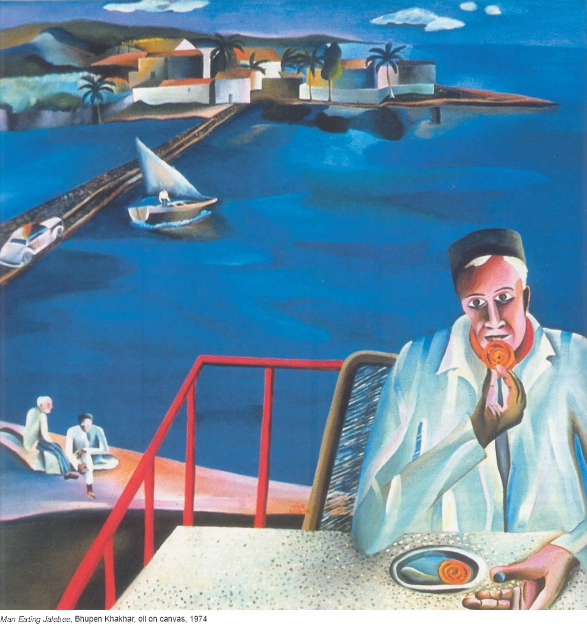
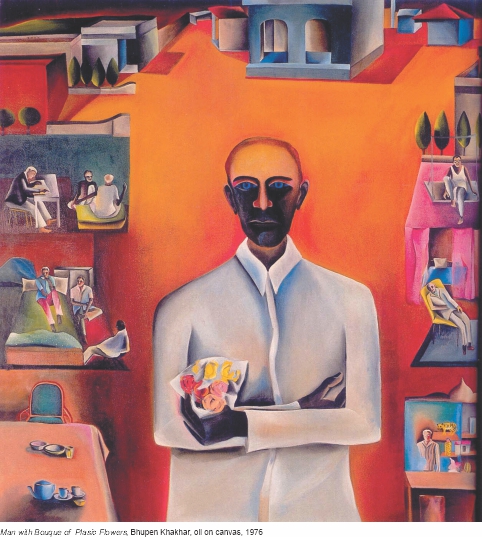
In time Bhupen Khakhar was to use the style of Indian temples, frontal iconicity, narrative border arrangement and the palette of calendar art as signifiers of middle-class taste. In his painting Khakhar was in particular influenced by Nathdwara painting with its central iconic male figure and surrounding architectonic decoration. Khakhar returned to a direct engagement with popular elements in his ‘Pan Beedi Shop’ (Kassel Documenta IX) with its strong street flavour, and in the exhibition, ‘Kitsch Kitsch Hota Hai’ (2003,). Curated by Madhu Jain, it foregrounded the question of popular art as a parallel tradition, cocking a snook in the face of ‘high’ art, and appropriating gallery space. Here Khakhar used the industrial material of thermocole to present glittering gods that mimic the decoration at tent (shamiana) weddings, cutouts of film stars and political leaders at rallies. In 1978, long before he became an iconic gay painter, Khakhar had said ‘Human beings in their local environment, climate, provincial society, this should be the ultimate goal of the artist’ (quoted by Timothy Hyman). His early mock engagement with the popular arts then led to a life-long engagement with the figures of the street, their gestures and nuances, sexual engagements, groupings and little trades. In foregrounding the flaccid bodied middle-aged man of the street, Khakhar locates the marginal within the mainstream, and the covert within the universal gaze. In particular, his ‘impure’ hybridity of style challenges the high-minded position of modernism. In this way, he transgresses and rises above the vernacular and the naïve to create an absorbing and inclusive vision. Khakhar’s watch repairer, barber and jalebi-eater in fact vivify the popular.
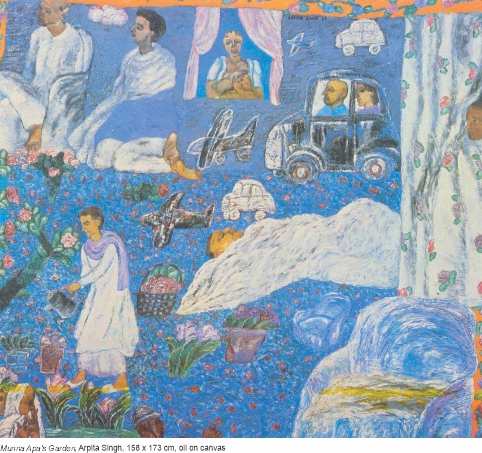
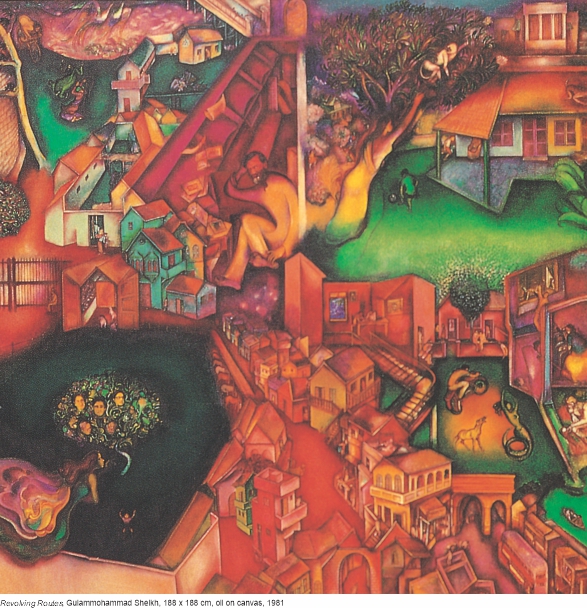
The engagements with the popular in Indian paintings have largely a mounted to a contemporary critique of mythmaking. Artists like Vinod Dave, positioning themselves as witness and commentator, set up transnational dialogues in the locating of myths beyond Indian shores. Krishna, the divine cowherd, with dark glasses on a dashing mobike, placed on a New York street, heralded the interplay of kitsch and neo-conservatism that marks later 20th century engagements with Hinduism. In the case of two other artists of Khakhar’s generation, Gulammohammed Sheikh (b. 1937) and Arpita Singh (b.1937), engagement with the popular expands into political and gender discourse. Sheikh’s inspirations stylistically draw from sources as rich and varied as Siennese mural painting and Persian and Akbari period miniatures. He uses the complex, multi-perspective style derived from classical sources to reflect on pivotal issues. A memorable painting in Sheikh’s oeuvre employs the map of an Indian temple town of the kind seen in calendar art. At its four corners, there is the recognizable Pahari image painting of Rama, bearing a bow and arrow, while at the centre is a photo-realistic image of the demolition of Babri Masjid. Sheikh thus draws on popular and classic images, the media and political events and symbols to highlight some of the sharp contradictions in contemporary India. Sheikh also uses characters drived from primary school vernacular language text-books to interject questions around political issues and religious divisiveness in contemporary India.
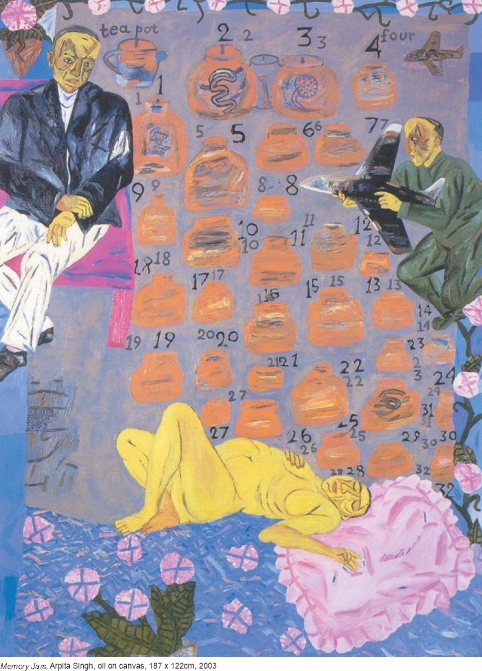
Arpita Singh also uses mythic imagery to create intriguing and deeply subversive images created around the question of gender. In a series titled ‘Feminine Fables’ (1997), Singh makes constant reference to the calendar as a significant site of popular art to subvert the most popular icon of auspiciousness, the goddess Lakshmi. In Singh’s evocative watercolours in this series, the nude ageing woman subject with a visible receding hairline and mark of a caesarian section is seen in isolation, seated on a clumsily structured lotus. In the background the calendar marks out the days of vratas, or fasts, that lend her mundane life significance. Singh’s engagement with her feminine subjects is both sympathetic and deeply ironic. In other works, Singh constantly revisions the street as a site of threatening imbalance and violence, drawing as she does on both popular and classical associations in her art. Among younger painters, it is Atul Dodiya (b.1959) who stands out for his absorption of Indian and world art history which he links with popular traditions. Dodiya paints in a photorealistic style to mimic the art of the calendar, the billboard, the small-time trader or quack advertising healing, mediatic images of power and beauty. Dodiya refers to Ravi Varma and calendar art, Gerhard Richter and the Mughal painter Mansur with fluid ease. He reinvents familiar images as a pastiche which is sufficiently open-ended to allow the viewer to draw her own conclusions.
The history of Indian popular art has followed a course that is as rich as it is unpredictable. In over a hundred and fifty years, popular art has drawn on folk and regional elements, the powerful art of mass reproduction and the moving mage, the stories of gods and the narrative of the nation. In the contemporary context, popular art is vivified through an interrogation of its wit and energy in mainstream fine art in the process setting up a new range of practices that are as rich as they are unpredictable in their final outcome.
Gayatri Sinha is an independent art critic, curator and editor. She has edited Indian Art: An Overview (Rupa, 2003). She has also written Krishen Khanna: A Critical Biography (Vadehra, 2002)
The term Indian ‘Popular Art’ is a rich and complex one, drawing as it does not only on the connotation of ‘popular’ as opposed to a courtly or elite practice, but one that relates to the heterogeneous mix that constitutes the ‘popular’ in the Indian tradition Writing in her introduction to Indian Popular Painting in…