

turning london into a bestiary
Bhajju Shyam’s book, The London Jungle Book , is a depiction of Shyam’s experience of London, where he spent two months painting tribal motifs on the walls of an upmarket Indian restaurant
Bhajju Shyam’s The London Jungle Book is a bit like an earthquake.
All it may suggest is a mild tremor, but deep below the surface there has, most likely, occurred a significant shifting of equations. To begin with, this is one of those creations that acquire relevance as much from their content as from the identity and location of their authors. It is impossible to separate the experience of reading this art book from the fact that Shyam is a tribal artist from the Gond community in central India, who suddenly finds himself in London.
In fact, the book is written and presented in order to draw attention to precisely this – the unique and riveting nature of the encounter between two worldviews which seem to have almost nothing in common.
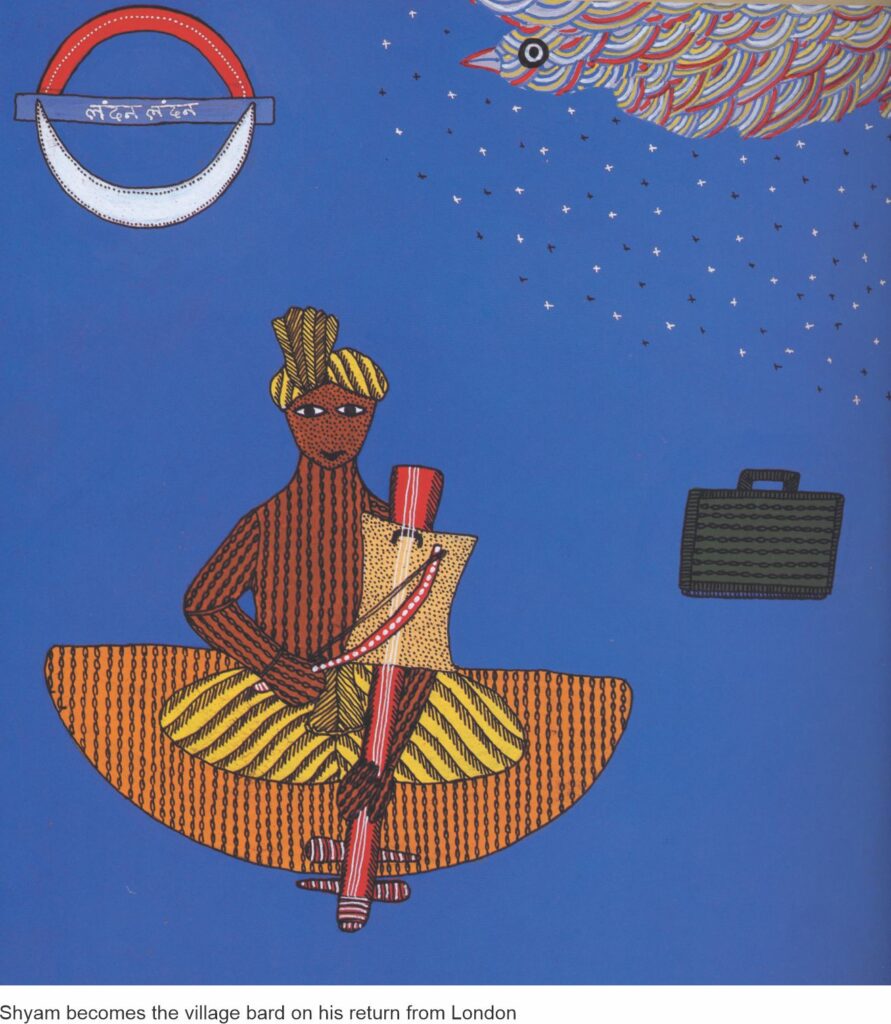
The book is a depiction of Shyam’s experience of London, where he spent two months painting tribal motifs on the walls of an upmarket Indian restaurant. While he was ‘working for the stomach’ (as he calls it), he was also observing the city with the eye of a practised and inventive artist, a city foreign to him in every possible way. On his return to India, Shyam was part of a workshop for illustrators conducted by the publishing house Tara, and Tara’s editors, enchanted by Shyam’s original and humorous take on London, invited him to create a visual travelogue on the city, which would combine his paintings with anecdotes and musings on London, as told to the editors in Hindi, and translated and put down by them in English. The result is The London Jungle Book in which Shyam like some modern day Ibn-Battuta tells the story of a city that becomes by turns mysterious, magical, puzzling and utterly new.
Shyam begins by striding the narrow world like a colossus. In his depiction of the train journey from Bhopal to Delhi from where he will take the flight to London, he shows himself much bigger than the train he is aboard, taking giant steps that the toy-size train cannot keep pace with. ‘This painting is about my train journey, but the train wasn’t important to me at all, so I have drawn it small. This is the Gond way of thinking and painting—what is important should get more space. We are not interested in reality—only how things are imagined in the mind and our paintings try to show what is in the Mind’s eye.’ After this robust start Shyam is in London and discovers he has turned foreigner. It is hard, though, to impose linearity on these images, because even though the book follows a kind of chronology—starting with Shyam taking leave of his village and ending with his return—what happens in between is a kind of hall of mirrors experience for the reader. One moves randomly from one image to the next, increasingly amused and moved and fascinated by what one sees, and all of it is essentially an act of translation from what Shyam has seen or felt in London into the language of Gond art.
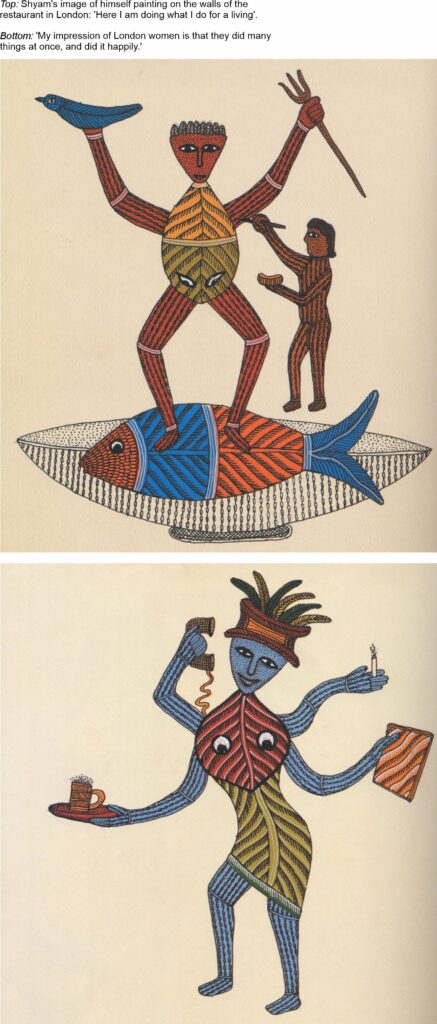
In Shyam’s ‘mind’s eye’ the map of the London tube becomes a vivid image of a nether world where the train is a giant snake burrowing under the earth, the subway routes are earthworms, and the stations are spiders poised on their webs. The London woman is a four-armed goddess simultaneously handling cigarette, coffee cup, menu-card and telephone receiver. The rooster is partially superimposed on the Big Ben because each is a clock—the rooster in Shyam’s village and the Big Ben in the city of London. And Londoners are like bats because, dressed in their perennial black, they only come alive at night in pubs! The narrative that accompanies these paintings is important to decoding them because Shyam’s Gond worldview is the basis of everything here. If he brings in so much of the animal world into his paintings it is because animals are the symbolic carriers of meaning in Gond mythology.

Shyam’s spoken narrative style is consistent with his visual one—both communicate a sense of wonder and curiosity as well as a need to translate an alien world into a personal language. At an art gallery in London he sees a dead cow preserved in ‘some kind of liquid’, and finds this intriguing.
‘I tried to think why the artist had put such a thing in an art gallery, and I guessed that maybe he wanted to say something about death. That much was clear,’ he says. Symbols are important for Shyam; Gond art, like much folk art, is replete with symbolic forms, and the images in this book, while not limited to the traditional repertoire of Gond images, retain its way of making meaning of the world.
One of the reasons we are charmed by this book is that it evokes nostalgia, makes for a throwback to a simpler self. Shyam’s ‘innocence’ works on two levels: he is encountering a culture which strikes him as new in a way that we can no longer experience except vicariously through him, and his art is reassuring because it combines simplicity with insight. Both art and travel have something of the uncluttered, pristine quality that many of us might long for but are too ‘experienced’ to muster. Whereas Shyam’s tribal art as much as Shyam himself, preserved for centuries in ‘some kind of liquid’ called tribal culture, are able to do this: both experience and communicate this sense of being newly-born into the contemporary world. But the introduction to the book cautions us here: ‘The important thing is to resist the temptation to essentialise the Gond imagination as the romantic other of our modern consciousness.’ I think the book is inevitably going to produce reactions that are romantic, and I don’t know if this is necessarily a bad thing—it is a romantic book.
But this is not necessarily to essentialise. What Shyam is trying to do here is become that difficult and restless thing – a modern artist. This has been achieved at the level of interpretation—each image is a recasting of what he saw in London, and thereby becomes his individual statement on it. But to go back to the subject of symbols, it is interesting to ask: to what extent will his Gond iconography be able to sustain the imaginative journey he has started out on in this book? Already this project constitutes a break from tradition for Shyam: he is illustrating personal stories rather than community myths or folk Narratives- he has become an artist in a self-conscious way. ‘I call these “thought” paintings,’ he is quoted as saying in the introduction. ‘Because you don’t do them in a hurry, out of habit. You have to think, otherwise they won’t come to you.’ But the question of how far he can stretch Gond symbols to convey his experience of the contemporary world remains. How, in other words, does a tribal artist become a modern one?
It is clear that each image in this book carries a specific meaning—one that Shyam explains to us or that we might ourselves guess if we know something of Gond mythology. We may, if we choose, appreciate the images purely for their aesthetic value, but ultimately this fixity of meaning is important for what Shyam is trying to do here—which is essentially tell a story, even if one lacking in obvious linearity. If we don’t get the meaning of the symbols,we miss the story. But wouldn’t Shyam’s journey into modernity only be complete when in addition to this expansion of subject matter and this imaginative rather than habitual use of the symbol, his relationship to the very symbols he uses acquires a certain ironic distance? Is it possible that Shyam will one day use symbols in a way that renders them ambiguous in meaning? When modern art has symbolic content, this content is usually semantically fluid or provisional, thereby opening the doors for an audience to engage with such work as bearing more than one possible meaning. This also implies that the artist goes beyond the strict ‘meaning’ of the images to explore their formal aspects, in the manner that Picasso’s first Cubist paintings combined within them the conceptual forms of African sculpture (with their pre-existing semantics)with the realisation of a motif to which those forms were suited. What would this transition do to Shyam’s art? To carry this line of thought further, becoming ‘modern’in intent would also mean that Shyam’s art would have to move into the realm of the secular. Right now, every image in this book is animated by belief. The hedgehog stands for good luck, the tree represents life, the dog is a symbol of the faithful, the snake is earth. The artist is still to some degree part of a collective consciousness, an established belief system. Will he be able to break with this belief system and yet employ traditional images to make modern art, in the way, say, a S.H. Raza abstracts Tantric principles to create paintings that are not exactly Tantric art, yet strongly reminiscent of its imagery? And if he does achieve this self-conscious distance from tradition, will we judge his work any differently from that of any other modern, given his identity as a Gond which even disavowal or irony will not change?
And are such shifts possible or even desirable? Is there some other trajectory a traditional artist can take in his search for the modern, one that need not compel him to abandon his traditional beliefs, but enable him to evolve in his relationship to them and his representation of them? Is there any trajectory at all possible for artists like Shyam without them having to grapple with a continuous sense of loss? For it is hard to evade the fact that there is something very poignant about this book. It was born at a unique moment of combustion between two different world-views, but precisely because this encounter has taken place once, it cannot happen again. Shyam can no longer write another London Jungle Book or any version of it. This is what makes the experience of reading the book a curiously sobering one: Shyam’s innocence and, at the very instant in which we are introduced to it, the loss of that innocence. Already, on his second trip to London, he slept on the plane like everyone else, rather than gawking out through the window at a world turned upside down, he proudly told the audience at the book release function. Already,he is not the Shyam who wrote the book.
So what other Bhajju Shyam can Bhajju Shyam now become? The editors in their introduction compare him to Rudyard Kipling. Like Kipling did in his The Jungle Book to India, Shyam turns London into a bestiary—he ‘reverses the anthropological gaze.’ Perhaps he does, but from a position far more vulnerable than Kipling’s. Besides, Kipling gave animals human qualities, Shyam gives humans (as well as the inanimate world) animal forms. The difference between Kipling and Shyam is the difference between metaphors and symbols. Symbols are often archetypal things, semantically predetermined, while metaphors are individual creations and have poetic force. Kipling’s jungle is a metaphor for India, while Shyam’s bestiary is symbolic of London.
None of this is to reduce the artistic value of this work. Its freshness, originality and courage must be celebrated. I think its greatest achievement is the seeming paradox it presents, something that explodes the provincialism and anxiety, on the one hand, and hegemony and arrogance on the other, that characterise so many readings of ‘other’ cultures. The uplifting paradox is this: out of a confidence in the ‘local’ emerges a view on the foreign that manages to be both clever and kind. It is this that makes one hopeful, that Bhajju Shyam will make it, despite all the possible pitfalls here.Anjum Hasan is a poet, critic and fiction writer. She is based in Bangalore and works at the India Foundation for the Arts
Bhajju Shyam’s book, The London Jungle Book , is a depiction of Shyam’s experience of London, where he spent two months painting tribal motifs on the walls of an upmarket Indian restaurant Bhajju Shyam’s The London Jungle Book is a bit like an earthquake. All it may suggest is a mild tremor, but deep below…