
digging up noah’s ark
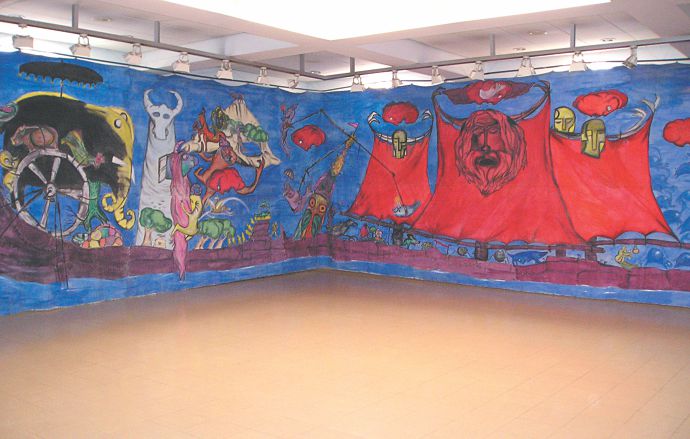
A single piece, 100 feet long and 10 feet wide scroll depicting a postmodern melangé of disparate images, objects, figures and ideas: Noah’s menagerie, domestic animals and birds, Biblical stories, fairy tales, popular proverbs and saws, rickshaw painting and characters from popular fiction and movies, Einstein, Dracula and Batman, to mention just a few— Archaeology of Noah’s Ark, is the most ambitious work Ronni Ahmed has ever attempted. Of late, Ronni has been showing a predilection for the bizarre and the out of the way—his figures are varieties of mutants who emerge from the world of science fiction and his landscape often resembles some scorched moonface; but they help express Ronni’s concern with a world rapidly losing its human touch
A thinking artist, Ronni feels that thought itself is drying up, or is losing clarity because of the invasion of extremist ideologies. His images therefore project a barren and disintegrating world, but one that is also trying to come to grips with its own dysfunctionality. It is a world where individuals are locked up in their own little spaces, unsure of venturing out, while the dark forces of disintegration lie in wait all around. Ronni’s paintings have a reflexive and brooding quality that comes from the individual’s relentless search for meaning. Only the meaning remains elusive, as a technologically driven globalized world—where consumerism is rampant–enforces its own homogenizing logic. The media and the market, two inexorable forces that lurk behind Ronni’s nervous images, are great levellers of everything local and particular.

Ronni has used myth and history before- as creative forces that shape human imagination, and as repertoires of reassuring images. But he has been aware of the divisive and hegemonic roles history, and sometimes, mythology, have been made to play. He therefore interprets myth and history in his own terms, interrogating their hegemonic content, and applying them to local conditions and aspirations. But in Archaeology of Noah’s Ark, myth is made to serve another purpose too: it is now seen as a fertile ground where the present can be rewritten in terms of the past and vice versa. It is one continuous fecund cycle where, at each stage, it can act as a testing ground for human imagination as it attempts to rejuvenate itself. But, given the rather tentative nature of our existence in this day and age, imagination, instead of painting reassuring images, may at best salvage a few broken ones. Instead of a whole picture, therefore, a patchwork; instead of a whole narrative, a babble of disconnected voices.
Archaeology of Noah’s Ark is therefore, not a narrative, nor even a parable. It is a series of disjointed images—more like a collage or pastiche—creating, the semblance of a story. It has a beginning, a middle an end, but they are not fixed points that the story crosses as it progresses, but parodies of such fixity. The centre of the scroll—the giant topsail of the ark—has Noah’s dour face painted on it, flanked by those of his sons, but Noah doesn’t control the story in Ronni’s painting; he is just an onlooker, contributing to the happening of the myth. Indeed, the crazy diversity of the stories, objects etc. makes any such control impossible. And the sheer number of these objects and stories introduce an element of make believe. The audience is invited to bring their own stories and their own interpretations to the picture. This has been indeed, Ronni’s intention. Interpretation of interprations, so to speak.
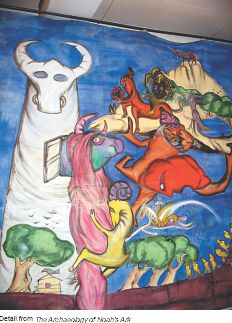
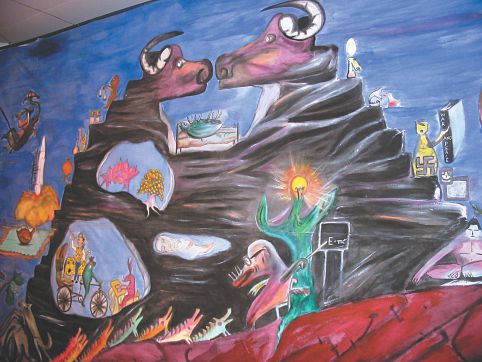
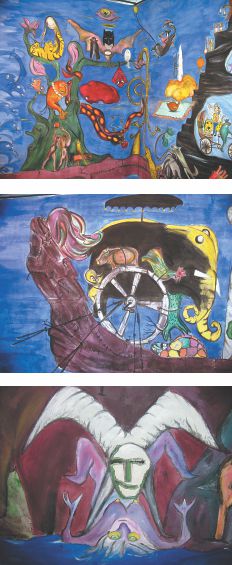
The ark leaves behind a shoreline which appears primordial and unformed, and it arrives at Mount Ararat, tugged home by a parrot. The forty days of the deluge are suggested by seven patches of cloud. The ark itself is a place of refuge—not just of animals and men, but of everything that man is capable of—his sins, for example: greed, violence, rapacity. There are cyclops, who are now composed only of human fingers symbolizing violence. But in the remaining spaces of the ark, Ronni just throws in a plethora of images, and lets the viewers make their own meaning or sense, and come up with their own interpretation. Thus Rapunzel is here throwing down her hair which a unicorn seizes to climb up to her chamber. There are centaurs, and there is Medusa, and Jonah inside a fish, and little Red Riding Hood. There is Sleeping Beauty, and there are mermaids. The Spider Man also finds a place along with Kafka’s Gregor Samsa. Hitler is there and Gautam Buddha is there too. Bangla proverbs and figures from Bangla fairy tales bring some relief to those who feel lost in this disturbing mosaic, but the proverbs and fairy figures, in the end, only reinforce the growing unease—as the viewer progresses from image to image. There is no innocence left in the world, only a simulation of such innocence. Ronni uses Aesop’s fables and nursery rhyme figures, such as Humpty Dumpty—but these too are devoid of their appeal to nostalgia. It is a tumbling world where imagination undergoes violent transformation—such as the flying carpet losing out to the Apollo 11 rocket. Myth expropriated by science and technology!

What Ronni attempts to do in this huge work is to show the oppression of ideology, of political correctness, of the element of falsity that underlies our mythmaking attempts, and comes up with correctives in the shape of violent juxtapositions, sharp incongruities and the exotic that defy both contemporary logic and old world certitude. But, in his anxiety to race through time and history, Ronni has sometimes crowded his canvas unnecessarily. Sometimes, images are just there as a second or third back-up to a leading idea. This has led to repetition and a certain looseness of composition. On the whole, though, the work is witty, new and fresh.
Syed Manzoorul Islam is a member of Jamini editorial board
A single piece, 100 feet long and 10 feet wide scroll depicting a postmodern melangé of disparate images, objects, figures and ideas: Noah’s menagerie, domestic animals and birds, Biblical stories, fairy tales, popular proverbs and saws, rickshaw painting and characters from popular fiction and movies, Einstein, Dracula and Batman, to mention just a few— Archaeology…