

bridging the lives of women through art
Shako, the Bangla word for the makeshift bridges made of bamboo or wood that hang perilously over canals and streams, is also used positively to signify friendship. How aptly, then, has the word been appropriated by the Women Artists Association of Bangladesh to represent their coming together from time to time to popularize women’s art in the country!

In the words of Farida Zaman, Chairperson of the Association, Shako was formed in July 2004 to ‘build bridges of understanding between [women] artists and people through holding workshops and group exhibitions whenever possible’. Adopting the strategy of inviting a few guest artists to join the members of the group on every occasion, Shako has in these two years held five exhibitions. ‘Colours of Shako’, their latest endeavour, was held in Dhaka from March 23 to April 6 and showcased the work of thirteen women artists, three of whom were invitees.
Any visitor to the exhibition could note the variety as well as the vitality of many of the artists. The works ranged from watercolours, oils and compositions in pastel and mixed media to sculpture in wood and brass. The artists themselves range from those who have already acquired a solid reputation in Dhaka such as Ferdousy Priyabhasni and Farida Zaman to those beginning to make their presence felt such as Farzana Islam Milky. The subjects covered also showed considerable diversity: in the two rooms of the Bengal Gallery where the exhibition was held one could travel from the Arcadian world of Laila Sharmeen to the cold and gray vision of Naima Huque.

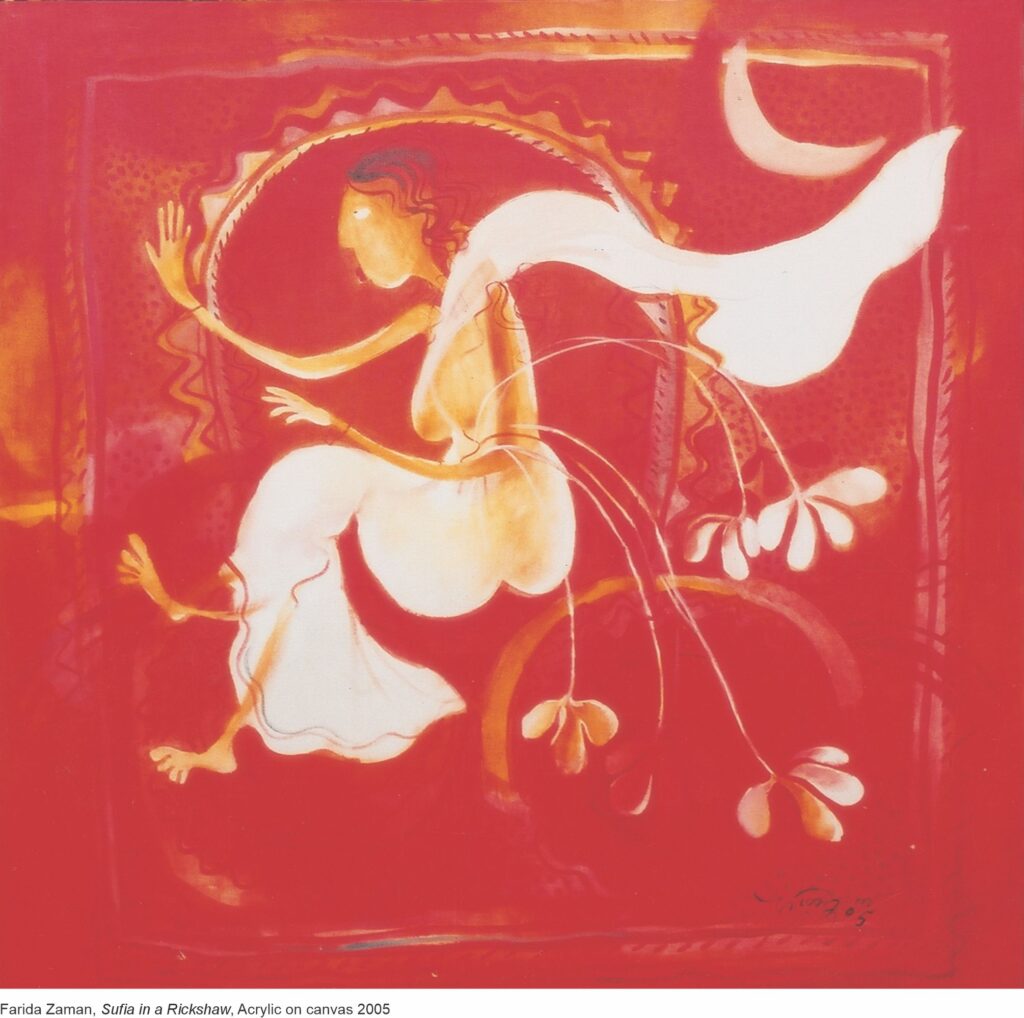
Nevertheless, a few common themes were noticeable. Whether depicted expectantly, as in Selima Sharmin Farjana Ruma’s simple watercolour effort or in Farzana Islam Milky’s delicately sculpted brass piece, or pensively as in Kuhu’s pastel and charcoal work on paper, titled, Girl with Flower, not a few of the artists of Shako appear to be taken with the theme of women waiting. A related concern is that of women alone, even when together, as in Fareha Zeba’s acrylic work, Isolation or incarcerated as in Sulehka Choudhury’s oil on canvas series, My Age. Even the New Zealander Trina Boahn Tyrie’s untitled pastel composition depicts a woman alone looking out ambiguously, as if waiting for a response from the viewer. Other paintings reflect a concern with the everyday life of women. Farida Zaman’s flamboyant Sufia in a Rickshaw (acrylic on canvas), Kanak Chanpa Chakma’s portraits of tribal women in repose (oil on canvas), or Naima Huq’s steely cubist women in Cold Steel reveal that these artists are absorbed in articulating the lives of the members of their sex and have found distinctive ways of looking at themselves through their art.
However, many of the artists went beyond figuring women in their compositions. Ferdousy Priyabashini, endlessly inventive with wood, has almost effortlessly sculpted an abandoned old house in ruins, and two birds on tree trunks, seemingly immobilized by a lazy afternoon. Laila Sharmeen, who has been giving us delicately crafted work for a while now offers in this exhibition a soothing mixed media piece collaged from snatches of verse, imbuing it with a child-like innocence and a lyrical sensibility. Nasreen Begum’s Green Water manages to represent urban life realistically in vivid green hues.

And yet one cannot but be disappointed with many of the exhibits. No doubt allowances can be made for the fact that two of the three guest artists—Selima Sharmin Farjana Ruma and Trina Bohan Tyrie—are amateurs, but the show as a whole represented artists who were refusing to stretch the bounds of art and take risks in revisioning the world of women in Bangladesh. Kanak Chanpa Chakma thus continues to give us likeable images of women in the Hill Tracts, but here as also in her other recent exhibitions the viewer has a sense of deja vu in approaching her creations. Fareha Zeba’s style strikes one as passé and Rebeka Sultana Moly’s work does not have the daring one would like to see in the younger generation of women artists of the country. Some of the established artists, on the other hand, appear to be stuck in a groove, and are on the verge of imitating themselves—a sure sign of exhaustion or lack of stimulation.
One hopes, therefore, that the next exhibition arranged by Shako will have the artists of the group take more risks. Shakos, after all, are flung over our water bodies ingeniously and audaciously and appear in innumerable variations all over our country. Is it too much to ask of the women united under the banner of Shako to show more intrepidity and formal creativity when they organize their next show?Fakrul Alam is a member of the Jamini editorial board
Shako, the Bangla word for the makeshift bridges made of bamboo or wood that hang perilously over canals and streams, is also used positively to signify friendship. How aptly, then, has the word been appropriated by the Women Artists Association of Bangladesh to represent their coming together from time to time to popularize women’s art…