

the art of ganesh pyne myth and poetry
Kolkata is the locale that makes Ganesh Pyne tick. He needs the signs of decrepitude (the darkening horizon, the shabby streets) to create images of gentle melancholy or visceral intensity. The city’s grey smoggy atmosphere, blurred streetlights, street drunks, a lame baul singer, a beautiful woman waiting patiently on a broken balcony, or a holy man, all are elements in the theatre that Pyne blocks on his canvases. Areas of dim shadows are contrasted with illuminated pools of light. Pyne’s images seem to suggest that flashes of insight and understanding make us grasp only a small section of the vast, flowing stream of mysterious experiences that envelops our existence
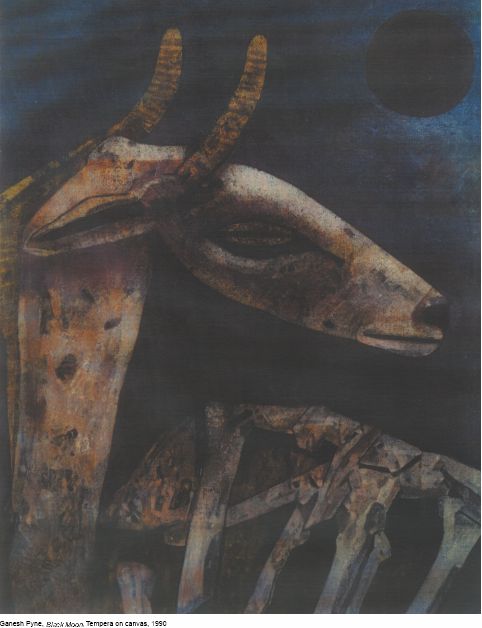
Chased from childhood by menacing thoughts of death and loss, Pyne has confronted and sublimated these private demons in his paintings. The external reality is always transmuted in his mind and emerges in his canvases as the timeless struggle between eternal life and its negation. In the process, he has created an umbral surface for his temperas on which mysterious acts confront us, like a felled tree lying in a forest. Strange creatures, like a composite bird-man talking to an innocent young girl, eerie masks, weapons and other objects float by as in a dream.
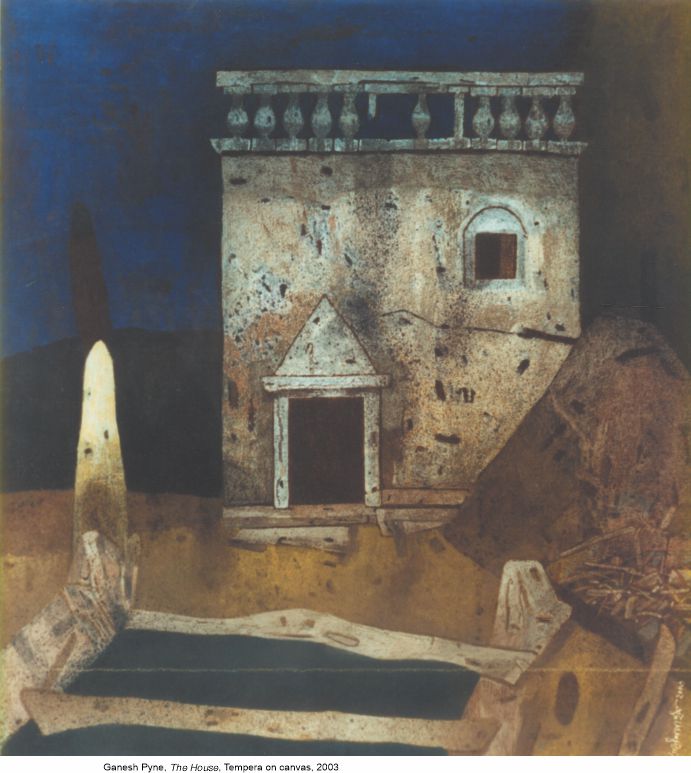
Take ‘The House’, a work which he painted in 2002. It depicts an old, dilapidated house bathed in misty moonlight. It is seen at a distance hiding within its heart secrets of generations like a place seen in a dream. In front of it and towards the right of the painting, there is a small excavation with a pile of stones and debris. Like all mysteries, it fascinates, but to reach it one has to cross a stream over a bridge of bones. On the left of the painting there burns a steady flame countering the shadows. The painting, done in shades of gray, has only the intense blue of the stream running across the canvas. The symbolism of loss and a long hazardous journey for the recovery of a cherished memory is easy to read but is nevertheless beautiful in its execution. Other images of demons, wounded heroes, beautiful princesses in other works, however, are more complex.
The mind behind such images is a unique blend of emotions, experience, intellect and sensibility. It transposes everyday reality into a mythic or oneiric realm where unresolved conflicts find resolution, and where signals of doom are palpably sensed, just as much as the light, which illuminates the dark recesses of unknowing.
Unlike most of his contemporaries, Pyne seldom draws on the quotidian for his images. True, he has only done a few drawings and watercolours of unusual characters seen on the street—a man with a strange Turkish headdress in a roadside teashop, an androgynous person selling eggs, a baul singing on the streets. But he prefers to draw on the memories of his childhood experiences for his image-making. Pyne declares, ‘There is a parallel world which runs through my mind continuously and which has little relationship to the happenings in the mundane world outside.’
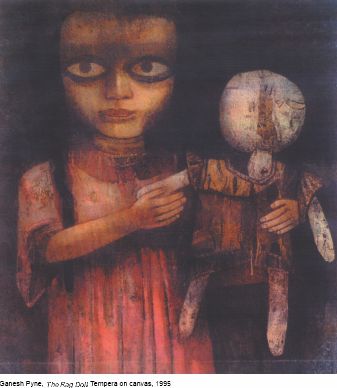
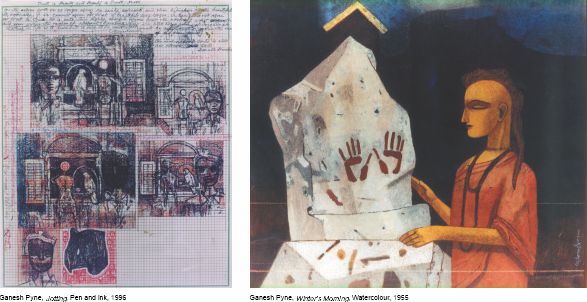
It is from this that he creates his doodles and sketches in his diaries which he juxtaposes with lines of poetry, comments and observations which strike his fancy. The image and the text may not always be correlated. But if one looks closely, one can detect an almost surreal link between the words and the images. Doodling and sketching are daily activities; so is noting down lines of texts he has liked. This bringing together of image and text links him to the once strong living tradition of the art of the book.
The sketching of another reality is not unusual among visionaries and creative persons. Joseph Campbell in his book The Masks of God: Oriental Mythology refers to such attempts to project inner images on to the actual universe as a psychological exercise in ‘archaic cosmological organizations’. Campbell notes that the practice existed in the Jain system of thought and in later religious practices. The scholar of mythology states that its function is psychological. The purpose, says Campbell, is ‘to blot the universe out’. In Pyne’s case, however, the psychological goal may partially be to blot out the universe, but it also appears to be a subconscious device to understand the workings of the world and to negotiate one’s space in it.
The diary sketches are very significant in the context of Pyne’s work. The practice goes back to his childhood and from it emerge a great many of his images. A shy, introvert boy, who compared himself unfavourably with his taller, better-looking, dynamic and extrovert older brother whom he adored and admired, Pyne would often withdraw himself from play with other children in the house and hide himself in a corner to sketch scenes from his inner world on scraps of paper. He would hide these like priceless treasures under the mattress and look at them later, losing himself in these images when doing so.
Childhood has played a crucial role in Pyne’s psyche. The role is even more important in the painter’s case as it forms the seedbed of his fantastic imagination. Memories of his boyhood experiences constantly surface in his imagery in the shape of wooden toy horses or masks or swords in his paintings which look harmless like tinsel wrapped toys but are also sharp, menacing weapons.
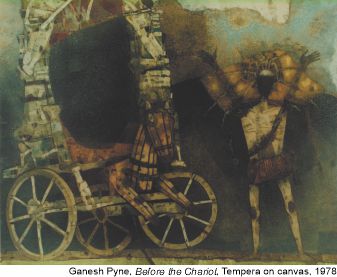
In an interview with this writer, Pyne had said very revealingly, ‘In my mind’s eye, I see things in my own way. I carry my own world within me. And often this world runs parallel to the world of reality in which I live. My inner world is rooted in my childhood. It has been nourished by my childhood associations’.
Pyne was born in June 1937 to Krishnadas and Sakhisona Pyne. He grew up in a large extended family among brothers, sisters and cousins. Pyne’s was the average middle-class family of Kolkata where life ran on an even keel. A major disruption occurred when Pyne lost his father in 1946. For the insecure little boy, his grandmother provided emotional support and sustenance and her presence buoyed him up through much of his life.
A thinking artist and an extremely erudite person, Pyne did not have his heart in academic studies. It was his uncle who decided that he should be admitted to the Government Art College. For Pyne, this was a dream come true. It gave him an opportunity to explore the world of line and colour with a sense of wonder and awe.
The young Pyne was particularly attracted to the works of Abanindranath Tagore. Abanindranath’s personal idiom struck a chord in him. Till the end of the 1950s, Pyne did watercolours in which Abanindranath’s influence is clearly visible. There are paintings belonging to this period in which the influence of another great artist, Gaganendranath Tagore, is patent in the geometric use of light and dark areas.
But even during this phase, Pyne showed an urge to find a visual language of his own. And his skills as an artist began to be increasingly acclaimed by connoisseurs. Nevertheless, finding a job after graduation from art college became an almost insurmountable hurdle.
His frustration was complete when he was rejected for the post of designer in a textile mill. The personnel manager turned him down very gently saying that the job was not for the Nandalal Boses and the Jamini Roys. Returning home, he made up his mind not to waste time looking for regular employment. Instead, he designed book jackets and illustrated texts to earn a living. In 1962, he became a part-time illustrator for animated films at Mandar Mallick’s studio at Cornwallis Street. Long after the studio closed down, Pyne, a creature of habit, would go there for part of the day to draw and sketch.
By the time he began going to Mallick’s studio, Pyne was well on his way to developing a distinctive style. The mysterious, melancholy mood of his paintings deepened gradually. The reality of the world around him began to be transformed into a mythical struggle between good and evil set in a theatrical space and later in a dream space. Certain motifs and metaphors, like the figure of Chaitanya, the boats, the moon, swords and axes and many more, became recurrent.
In trying to understand Pyne’s imagery one must try and appreciate the drives and impulses that activate his mythical imagination. The myths that he draws upon are often embedded in the memory-residues of his childhood experiences. His enjoyment of theatre as a child is just one instance of how his imagination has been tinged. Then again, there are the figures that he depicts in a special way- kings, princes, sages and an icon-like winged figure. Pyne’s imagination, obsessed with the battles between death and life, find expression in dimly lit, recondite metaphors. Pervasive signs of decay, balanced by signs of affirmation of life, create a surreal spectacle of the innocence of childhood memories seen through the distorted prism of adult knowledge of the corruption of the flesh.
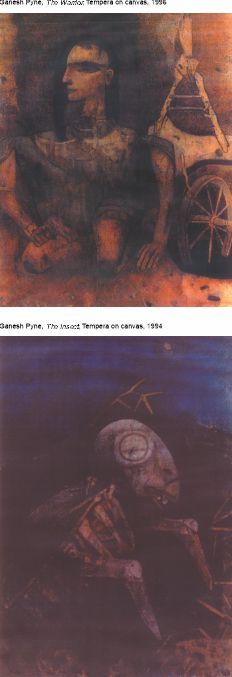
The use of fantasy in Pyne’s painting is one of the most significant aspects of his art. He has instinctively used fantasy as an integral element of his visual language. As a solitary person, the liminal activity of sketching and drawing to articulate many of his subconscious thoughts and fears came naturally to him. Through fantasy, he reflects his aspirations. It is his defence against his sense of inadequacy; his way of overcoming his vulnerability to loss from death; and his strategy for negotiating a contemplative state of mind.
Pyne’s use of fantasy is a very personal response to external reality, unlike its use by many artists who have a social comment underlying the image. In Pyne’s work if ever there is a comment on external reality, it is made in a very oblique manner. The painting that he did after the Gujarat riots shows Chaitanya, man of peace, standing, a mute witness to bloody handprints on an old wall. Pyne’s use of fantasy is more like that of Paul Klee and is propelled by the subconscious.
A sense of mystery pervades Pyne’s images. Located in a twilight zone, the images palpitate with a sense of menace. Angst about the unknown and a foretaste of doom colour his picture-space with a shadow-filled gloom. Many of Pyne’s paintings, including the much-acclaimed ‘Night series’, have mysterious nocturnal settings. Enmeshed with the sense of danger in these paintings, there are also evocations of a dream or a darkened theatre stage. Pyne’s treatment of night has cinematic and theatrical qualities but appear inspired. He has also acknowledged the influence of Rembrandt in his creation of a dark atmosphere.
Pyne’s involvement with the hero-figure is another significant feature of his oeuvre. Pyne has appropriated Chaitanya, the 15th Century Vaishnava leader, not as a religious figure as Nandalal Bose or Kshitindranath Majumdar did, but as a man of mystery, and of peace, a man of tradition, and a man transcending the barriers of reality to arrive at a metaphysical level of being. Besides Chaitanya, Pyne has also painted sages as heroes capable of conquering the travails of life and of man’s innate knowledge of evil, death and loss. The winged figure of Icarus or of princes are occasionally used as hero figures in his paintings.
Pyne’s representation of women and children is distinctive. Curiously, eros has never played an overt role in Pyne’s paintings. Women in his works are almost always symbols of innocence and vulnerability or are romantically perceived figures. Very rarely has he indulged in satire while painting women. A similar innocence informs his depiction of children. There is a joyousness and a sense of wonder in Pyne’s rendering of young boys at play.
Compared to the enigmatic imagery that he uses in most of his works, Pyne’s use of puppets, masks and entertainers as metaphors in his temperas is easier to read. Perhaps the masks present a little more complexity. The notion of pleasing patrons—which is often the lot of creative people, and in a larger context, ordinary individuals dependent on the largesse of the rich—is manifest in such bleak, sad paintings, showing performing monkeys and an expensive, chained dog with a bone thrown in front of him.
Book illustration, which was undertaken by Pyne as an alternative means of livelihood in the early years of his career, eventually became a significant expression of his artistic vision. Interestingly, the three major series of illustrations that he has undertaken—’Mahabharat’, ‘Ardhakathanaka’ and ‘Metiaburuzer Nawab’—are all linked to history. By temperament, Pyne’s imagination blossoms in depicting the past. He often calls himself a medievalist and like one he is concerned with moral issues confronting individuals.
Pyne is considered to be the finest tempera painter of contemporary India. The medium has had a long history in the country, with a subtext of use to register defiance against colonial art education and aesthetic values in the early 20th century. It has also had a long history in the west. Is the choice of medium a reflection of the artist’s brooding personality or does it also thereby convey his sense of history? Pyne builds up the surface with thin layers of paint, achieving depth and intensity in an opaque medium. His palette has a restricted range—ochres and umbers, green, red, blue and various tones of greys—but they are made luminous by the skill with which he applies them. The colours are often coded with associations; for instance intense blue is often linked with death. Says Pyne, ‘Tempera is a very soft medium’. That is why he uses sharp, precise, angular lines to define his forms and offset the softness of the medium. As his language has evolved, he has limited the use of texturisations. But he continues to create his domain of shadows. His experimentations with forms like flowers or textiles or insects also continue. His repertoire of motifs is versatile and diverse, but once commandeered, the motifs reappear again and again.
A brooding, meditative painter, Pyne has mastered an array of metaphors to represent the inexorable cycle of life and death and the individual’s anxiety and insecurity in the face of the vast unknown. That he has brought to these metaphors a poignant touch of poetry and a tragic sense of doom makes him a unique voice in Indian paintings.
Delhi-based Ella Datta is the author of several volumes of art criticism, including Ganesh Pyne: His Life and Times. She is at work on another book on Pyne
Kolkata is the locale that makes Ganesh Pyne tick. He needs the signs of decrepitude (the darkening horizon, the shabby streets) to create images of gentle melancholy or visceral intensity. The city’s grey smoggy atmosphere, blurred streetlights, street drunks, a lame baul singer, a beautiful woman waiting patiently on a broken balcony, or a holy…