

alluvial solution
Over the years, Kalidas Karmakar’s work has added a modernist metaphysical dimension to his art. The influence of the Tantric tradition had something to do with this shift, as a series of exhibitions titled Holy Image and Holy Symbol, beginning in the 1990s testify, but equally important have been his environmental concerns and his search for alluvial roots. For many artists, that search might lead to images of memory and desire; of regret and, perhaps, hope; but for Karmakar it has meant a mystical understanding of the primal forces that had shaped the very topography of the land. His has been a pursuit for the sights and sounds that escape even an astute observer—for that, one has to put a finger on the pulse that beats in the sprawling veins of the alluvial delta which is Bangladesh. In his ‘event performance and environment art’—a category for which there appears to be no second practitioner in Bangladesh, Karmakar has used mud and fire as key elements. He has enacted his performance art in the chars (sand banks) in the Padma, in mudbanks of other rivers and at Heron Point in the Sundarbans. These ‘event performances’ have been his attempt to link up with the spirit of nature, with the lifebeat of mother earth, so to speak. But, increasingly, as the country suffers from ecological devastation—most of which is the result of human intervention – Karmakar feels an anguish that manifests itself both on personal and elemental levels. Alluvial Pain & Salvation, Karmakar’s 60th solo exhibition, mounted at the Alliance Française Gallery in Dhaka from 17 to 30 November 2005, is a narration of that anguish, and a hope for a salvation which might come if people restored the lost contact with the spirit of the land.
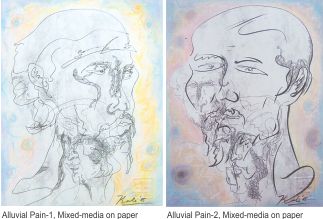
When Kalidas Karmakar explored the representational ethics in his earlier work, he did so with full knowledge that ‘representing’ an object (not merely rendering a figurative replication), an idea or image had no simple formula. It was not the surface that mattered, but the essence—be it a portrait, a natural object or a mood that he wanted to portray. His representation therefore often assumed a symbolic, and, in many cases, a metaphorical dimension. It was clear quite early on—in his paintings, graphics and mixed media work in the late 1970s and 1980s, for example—that Karmakar’s representational ethics is not purely a mirroring of objects but a reconstructing and remaking of them. His use of form, which often appeared layered in swirling lines and fields of overlapping, interactive colours, has, over the years, become more meditative. In Alluvial Pain & Salvation, forms evoke a mood which is generally sombre to sublime. His colours—blue, white, grey, black and an occasional red—actively contribute to the creation of that mood. But the way the colours are applied tells of the tension that continues throughout the series—one that arises from the dual nature of his representation. For Karmakar, pain and salvation, interestingly the title of an earlier exhibition (1989), constitute a dialectic—one that plays on a complex emotional and psychological register. While the pain part of the dialectic allows Karmakar to explore the dynamics of line, and colour code his canvas, often leading to swirling and distorted forms, the salvation part works as a counterpoint, making his compositions meditative, and opening up depths below the surface. Karmarkar’s work is distinguished by an exuberant use of texture—to the extent that his canvas assumes a tactile quality that only heightens the overall impact of the work. One sees the same emphasis on texture and organization, which become formal equivalents of order and discipline in the search for a metaphysical certainty which Karmakar so earnestly pursues but which perpetually remains in the realms of possibility. The dialectic thus remains unresolved and open ended, like many others Karmakar has employed in his previous exhibitions—pain and love, love and lamentation, for example.

Outside the main exhibition hall, on the walls of the narrow corridor leading to the front door, Karmakar hung a number of graphic work and drawings that he had done in the last two decades. These works introduce the viewers to Karmakar’s special abilities to execute neat formal designs and patterns and super sensitive line drawings. One notices the same penchant for design, and drawing in the works for this exhibition. Seen in isolation, each work appears to have been carefully executed. There is nothing sloppy or cameo with Karmakar. But, put together, the works seem to be a bit repetitive, subsuming their individual formal and spatial rhythms to the collective metaphysical even mythical bent of the exhibition. As grimacing and distorted faces are repeated, their inner dynamics soon appears to have been exhausted, except where Karmakar introduces emphatic variations. Alluvial Pain & Salvation does not show much of this variation. I have a feeling that Karmakar got carried away by the symbolic and emotive associations of the term alluvial, and I can see why. ‘Alluvial’ is an emotionally charged description for a whole lot of things in Bangla–from the land to the life of the people to people’s mind. Karmakar had two earlier exhibitions titled Alluvial Faces where his concern was not a realistic or historical even anthropological understanding of these faces, but an emotive realization of their uniqueness. Alluvial seems to be a blanket word for Karmakar, a term that stands for essential Bengaliness of the people, the land and its culture.
The exhibition had space for an installation work , which representd a corpse lying stretched out, covered by a white, transparent shroud. In its dignified acceptance of death and beyond, the corpse represent the country’s war of independence, and all the death and suffering that went with it. A noble theme, no doubt, but not one that engages the viewer’s imagination. The installation work comes fully complete as a statement that does not leave any space for dialogue or interrogation. Not the best exhibit to go with the exquisitely done paintings and mixed media that the exhibition displayed.
Syed Manzoorul Islam is member of Jamini editorial board
Over the years, Kalidas Karmakar’s work has added a modernist metaphysical dimension to his art. The influence of the Tantric tradition had something to do with this shift, as a series of exhibitions titled Holy Image and Holy Symbol, beginning in the 1990s testify, but equally important have been his environmental concerns and his search…