
syed jahangir's 34th solo exhibition, 2005 in search of the sublime
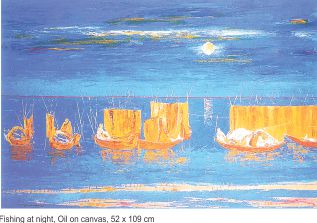
The focus of Syed Jahangir’s 34th solo exhibition, which was held in Saju Art Gallery in Dhaka from 24 September to 4 October 2005, appears to be the land and its people. In the absence of an exhibition theme, this focus strings the works together into a loose series. Displaying a common passion for the varied landscape of the countryside and the life that goes on in and around our rivers, the paintings—mostly oil on canvas and acrylic on paper but also some ink drawings—celebrate the colour and rhythms of nature and the vibrancy of life in nearly idyllic settings. Jahangir’s penchant for yellow, golden and blue is amply matched by his predilection for bold, sweeping brushstrokes and a generous use of space. Looking at his paintings, one discovers a land at peace with itself where people link with each other in a common, sympathetic bond.
Jahangir has of course, other preoccupations: while he explores the sublime aspects of nature, he also attempts to find their correspondence with the subtle changes of an individual’s mood, as he contemplates the beauty of nature. The desire for transcendence, which, in an earlier exhibition, had been subtly expressed by his calligraphies, appears an important consideration in this latest exhibition. This is one reason why Jahangir’s nature is always peopled: men and women, particularly those who daily toil on crop lands or on rivers become an intimate part of his landscape. The paintings in this exhibition show an impressionistic predilection for shimmering light which easily translates into a yearning for the unknown.
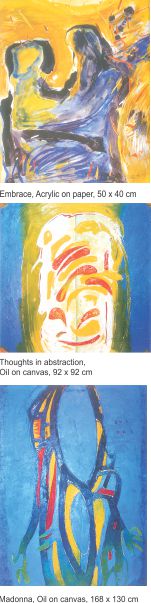
Jahangir, in his earlier works, explored the geometry of forms, but unlike some of his contemporaries, he was not satisfied with a mere exploration of the various geometrical shapes, but in their dynamics. Thus the various angularities of objects in his earlier paintings brought out their essence and their dynamic relationship with each other. Similarly, the angular or semi-cubist representation of human figures helped to reveal their personalities. In this exhibition some paintings show his innovative use of form (as in the elongated, almost cylindrical figures of a group moving in a procession, the pyramidal arrangement of another group of people sharing a mood of piety, or intertwined bird-like figures giving the appearance of flaming ribbons); others are an exercise in abstraction where colour, space and form interact with each other to foreground a particular thought. There are also some works (such as Madonna) where Jahangir’s formal arrangement appears minimalist as colours become emphatic. Sometimes, colours contribute to the creation of a nostalgic ambience.
This nostalgia has a lot to do with his memories of time spent in rural surroundings. He still vividly remembers the rivers and fields bathed by moonlight from his youthful days, and they find a place on his canvas, transformed, in the process of representation into enduring images of fulfillment and joy. In Jahangir’s portrayal of nature, there is no regret, no sadness: there is only a feeling of harmony with the world, and a meditative stillness suffusing the pictorial field. Colours also help Jahangir unify the textures and forms—which are sometimes boldly simplified to add to the mood—and generally open the composition to symbolic depths.

One may not possibly use the word metaphysical or mystical in connection with the paintings in the exhibition, but some of these paintings do appear to be charged with such meanings. One however, would realize that this is in keeping with his recent inclination towards the transcendent and the sublime. Jahangir, in the last few exhibitions, have emphasized the need to go beyond appearance, to explore what lies beyond our visual experience, and to establish a link with the unknown. But in so doing, he has had to depend a great deal on colour and formal arrangement, with the danger that both of these could turn repetitive. In the exhibition under review, his colours repeat themselves, particularly yellow/golden and blue, and forms also tend to cluster in familiar configurations. But Jahangir has avoided being predictable by orchestrating colours for a harmonious projection of feelings. To this has added a sense of value. Nature is not simply the outdoor world of beauty and wonder; it is also a place where one finds freedom, and a correspondence with an aesthetic power strong enough to lift one from the quotidian.
The inclusion of some semi-abstract works in the exhibition adds some variation to his formal arrangement. Over the last few years, Jahangir has used spiral, circular and swirling forms and wavy lines to impart speed and motion to his canvas. This practice is also very much present in this exhibition. But some of the compositions where such forms and lines have been used look forced, and lack an inner cohesion that could bring them together in an effortless manner. Sometimes Jahangir’s canvas looks a bit too crowded, as forms jostle against each others and colours appear high keyed. Despite these occasional distractions, Jahangir’s exhibition is a success. For he is able to create enduring images of both the world of nature and the mind of man as he seeks to rejuvenate the human spirit through a connection with nature. Jahangir has created a personal style that is marked by a thoughtful use of colour, interactive forms and clarity and simplicity of construction. The exhibition is also an indication that Jahangir’s growing involvement with the sublime and soulful aesthetics will continue to provide newer interpretations of nature and the world of man.
Syed Manzoorul Islam is member of Jamini editorial board
The focus of Syed Jahangir’s 34th solo exhibition, which was held in Saju Art Gallery in Dhaka from 24 September to 4 October 2005, appears to be the land and its people. In the absence of an exhibition theme, this focus strings the works together into a loose series. Displaying a common passion for the…