

Berlin down a long street
What associations come to the mind of a person who doesn’t know Bangladesh at all when she or he encounters the word “Dhaka”? Of course, the answer is that different people will have different associations and mental pictures, however vague. So too with “Berlin” to those who haven’t visited Germany. But, given modern history, it will not be surprising if some didn’t associate “Berlin” with militarism and war, culminating with Hitler and the Nazis. Germany launched two world wars within a quarter of a century, the first from 1914 to1918; the second, from 1939 to 1945. The intention here is to draw attention to a few public monuments relating to the subject of war in Berlin. One must point out that almost all countries have sculpture relating to war. For example, England’s cathedrals, churches and public squares have numerous statues in honour of war heroes, many of whom fought in the service of British imperialism: in other words, without provocation, they invaded and conquered, ruled and exploited other countries for the commercial benefit of Britain. Our “walk” will be limited to one street, that is, if we see Strasse des 17. Juni and Unter den Linden, though under different names, as a continuation of each other.
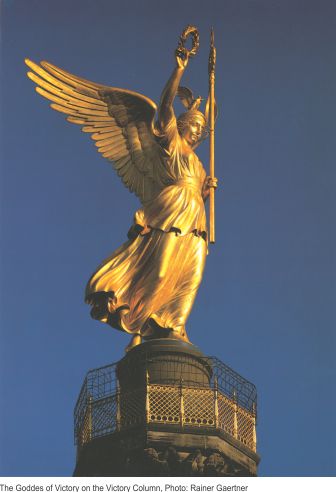
It is appropriate to begin our walk with the Victory Column, since it is one of the major landmarks of Berlin. On 18 January 1871, many small German states, hitherto sovereign, came together and recognised the Prussian king, Wilhelm 1, as the German Emperor. So the Column, inaugurated on 2 September 1873, can be seen as the first nationally conceived German monument. (The aspiration to form nation states—seen not only in Germany but also in other countries such as Italy, Belgium, Spain and Greece—was given impetus by the French Revolution and the Napoleonic wars, 1792-1813.) Originally, the Column stood on what is now known as the Platz der Republic, but under the plan of the Nazis to change Berlin’s name to Germania and make the city the capital of a world empire—with appropriately grandiose architecture—the Column was shifted to where it now stands, at the Big Star (der Grosser Stern), a junction fed by five broad roads. (Hitler’s planned “Reich” of a thousand years lasted barely twelve: that much for the vanity of despots.) The Column is 67 m high, and the figure on top is of Victoria, or Borussia, the Prussian goddess of victory. In one hand, she grasps a military standard with the Iron Cross; in the other, a victory wreath. She wears a helmet adorned with the proud Prussian eagle. What appear to be gleaming vertical stripes (see Fig 1a) are in fact the barrels of guns captured in wars against the Danes (1864), the Austrians (1866) and the French (1870-71). Its four reliefs depict scenes from war and, if death and injury are also depicted, the overwhelming impression is one of martial heroism and triumph. The mosaic shows Germania keeping watch (Wacht am Rhein). French imperialism threatens and teutonic figures give her sword and shield so that she can fight for, and defend, the country. After World War II, the inscription, “The grateful fatherland pays tribute to the victorious army” was removed.
The Column miraculously survived the war and the massive bombing Germany in general, and Berlin in particular, experienced. However, though “objects” may seem fixed and permanent, the world around them changes—not only physically, but in terms of values and attitudes. Perception is of paramount importance: indeed, some would argue that perception is everything. For example, in various countries, we see children playing on old cannon, perhaps in some park or by the sea; romantic couples lean on it, the former unaware of history; the latter, indifferent to the terrible destruction that that gun once caused. As far as the children are concerned, the once terrible cannon is a toy to be climbed on, affectionately petted, made use of as a slide. So too, Berlin’s Victory Column, originally built to celebrate political power and military success, is for most Berliners today just a familiar landmark: they probably pay more attention to the traffic swirling round the Column than to the structure itself. The gleaming “stripes” of the captured cannon have become shiny decoration. Berliners now know it not boastfully as ‘the Column of Victory’ but simply and affectionately as “Goldelse”: “Else” is a (female) proper-noun.
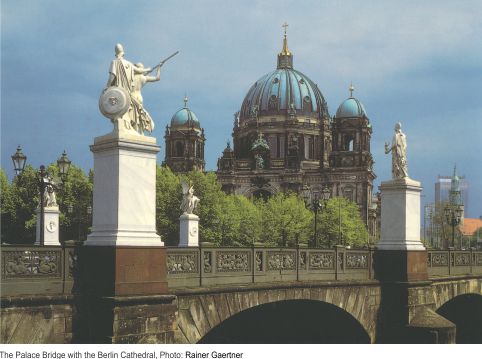
Leaving the Column and walking down the Strasse des 17. Juni, we come to the Brandenburger Gate (Tor). 17. Juni, continues but now under the name Unter den Linden. Walking down it, we pass the Island of Museums (die Museums Insel) and come to the Palace Bridge. Built in 1854, the bridge has eight statues, four on each side, all celebrating.
In Fig 2b, which draws inspiration from the Western classical tradition, a young warrior fearlessly strides forward, sword at the ready, at once both urged on, and protected by, the goddess of war. As is well known, representation has to do not only with subject matter but treatment: art manipulates, conditions, our response. For example, infidelity can be the theme of great tragedy (Anna Karenina, Madame Bovary) or of hilarious comedy, the latter usually in light drama or opera. We sigh over the one, and laugh at the other, though the subject—in this case, infidelity—is the same.
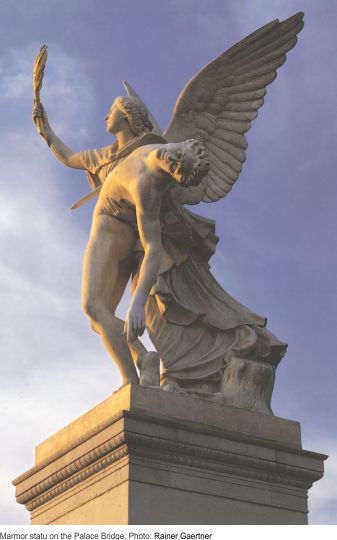
Fig 2 c, rather than denying that war leads to injury, death and sorrow, re-presents and confronts death. However, the warrior killed in battle is in the arms of an angel who lifts him up and upwards. If the angel is seen as Victoria, then to be killed in battle becomes not tragedy but a culminating glory. This death is not a waste of young life, but a triumph to be celebrated. Rather than protesting against war, the sculpture glorifies it: such a death, it suggests, is not a cruel curtailment of life but its supreme fulfilment. It’s as if the dead young man is to be envied, and not pitied. Sculpture and architecture have, on the one hand, to do with the material (and, therefore, with the laws of physics); on the other, with aesthetics, that is, with the abstract. But, as we see in the above, aesthetics is inscribed with ideology; ideas and taste influence each other.
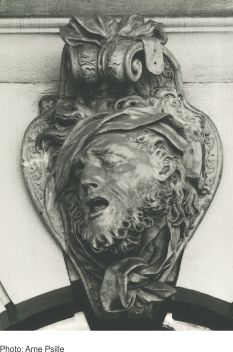
Walking just a few steps from the bridge, back in the direction of the Brandenburger Gate, we come to the German History Museum (Deutsches Historisches Museum.) Once the arsenal (Zeughaus), it has now been expanded and modernised. Walking through the entrance hall, we come to a spacious, open, square, empty except for twenty-two heads based on models created by Andreas Schlüter between 1696-
Both these heads are titled, “Dead Warrior”. Though a place where military equipment was stored, unlike with the figures on the bridge, there is no glamour in death. On the contrary, the faces express great pain and anguish. One notes yet again that the perception of, and attitude to, war is complex, contradictory and changing. In other words, there is no permanent progression, as Hegel suggested in his Philosophy of History, no steady improvement through a dialectic idealism of thesis, antithesis and synthesis. Apart from the changing and complex attitudes to war, there is also the question of the effect (if any) that art has on these perceptions. With this last in mind, we walk yet a few steps back in the direction of the Brandenburger Gate, and come to Berlin’s central war memorial, what could be seen as the city’s equivalent of London’s Cenotaph.
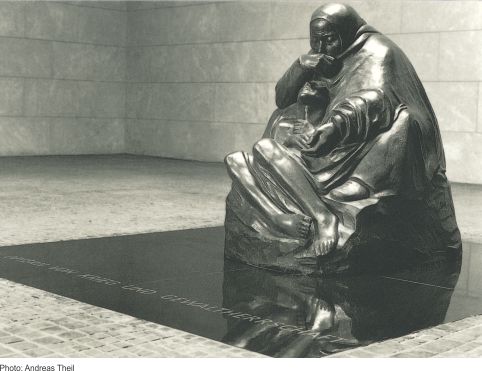
We find ourselves standing before a fairly small, stylized, Roman temple, originally built for the royal palace guard (die Wache). We climb a few steps and enter a somewhat grey, almost square, room. A circular opening at the top lets in the sun and the rain. In the middle of the otherwise bare room is “The Grieving Mother” (Trauernde Mutter).
Originally, a small sculpture by Käthe Kollwitz, what we see before us is the enlarged re-working of it by Haacke in 1993. The granite slab covers the tombs of an unknown soldier, and of an unknown concentration-camp victim. The writing on the floor reads in German, “For the victims of war and tyranny.” In the opinion of the present writer, it is far more eloquent than London’s Cenotaph; indeed, it must rank as one of the most moving of war memorials. Kollwitz (1867-1945) was passionately opposed to war. One of her lithographs shows a woman with upraised arm, fiercely protesting, “Never again war” (Nie wieder Krieg). Another depicts a mother embracing her three children, trying to protect them from the danger of war. We recognise the maternal instinct, respect the impulse but, at the same time, see it as pitifully ineffective: two arms and a body cannot protect children from bullets and bombs. The children stand there, innocent and vulnerable, helpless and terrified. As Kollwitz wrote (echoing Goethe) seeds meant for sowing should not be milled. During the night of 22 October 1914, her son, Peter, was killed in action in Flanders. Her grandson (also named Peter) died in Russia in 1942. In peace time, children bury their parents; during war, in an unnatural reversal, the old bury the young. Many in Germany did struggle to prevent war, but failed. It is estimated that, world-wide, more then fifty-five million people, soldiers and civilians, lost their lives during the Second World War. And so one wonders again, what effect does art have on politics? Words from one of Shakespeare’s sonnets (65), though taken out of their original context, are apposite:
How with this rage shall beauty hold a plea,
Whose action is no stronger than a flower?
And yet, throughout the ages, those in power have burned books, destroyed sculptures, obliterated paintings, banned certain kinds of music and songs. Though surely of interest to Jamini readers, the topic is outside the scope of the present article.
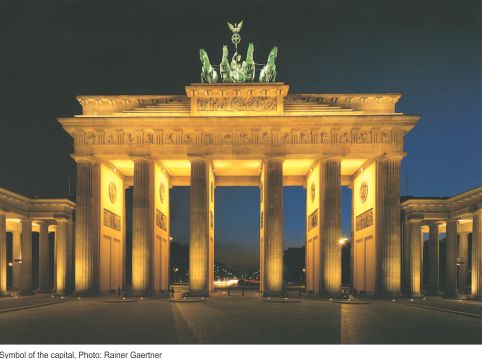
Finally, we walk back to the Brandenburg Gate (1789), the symbol of the capital city, with its Quadriga.
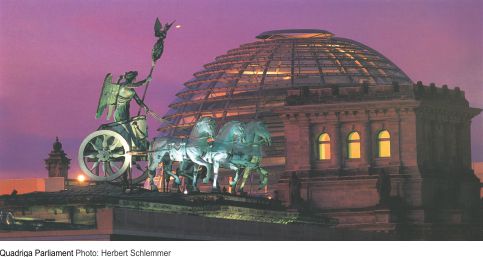
From here, one sees the Victory Column, and notices that though it is men who usually declare and wage war, both the Gate and the Column are “crowned” with female figures. The Quadriga represents the goddess of peace driving four horses. But with ensign in hand, with the eagle and the Iron Cross, the impression is one of military power, rather than of peace—within the Western tradition, one of the symbols of peace is not the eagle but the dove. Perhaps, peace is of two kinds: the peace of the victor, and the “peace” of the defeated?
However, the claim can be made that no nation has been quicker to acknowledge its historical responsibility and guilt than Germany. It can be argued that no nation has transformed itself more than Germany has, adjuring war not only in mere words but in the essence of its being. In Fig 5b, behind the Quadriga, we see the new German Parliament (der Reichstag), the centre of German political power—with its glass dome designed by a British architect. The structure is open and spacious, the glass giving light and access, attractive rather than dominating, symbolic of the new (that is, the present) Germany.
Charles Ponnuthural Sarvan, a retired professor of Commonwealth Literature, is now (un) settled in Berlin
the lure of glittering art prizes
By John A. Walker
Art prizes appear to be with us for the foreseeable future–despite the fact that the more there are, the less special they become—because they are now an entrenched form of cultural practice
‘Prizes are divisive, but that is the whole idea.’
—Sarah Craddock, ‘Open to the possibility: How to submit yourself to an art prize,’ The Artist’s Yearbook 2006, ed. Ossian Ward (London: Thames & Hudson, 2005).
A striking recent phenomenon of the art world has been the proliferation and popularity of art prizes, especially prizes for the fine art of painting. Indeed, in Britain there seems to have been a concerted effort to promote the latter medium to challenge the dominance of so-called ‘conceptual art’. Of course, such prizes are not unique to the art world: there are similar prizes in other cultural fields such as architecture, literature, cinema, television, the music business, sport and even pornography. In a recent book, James F. English, an American Professor of English, supplies a nuanced analysis of what he calls the ‘economy of cultural prestige’. Following the work on art, taste and distinction of the French sociologist Pierre Bourdieu, English argues that prizes are not simply financial capital (cash) but also cultural or symbolic capital (they confer prestige value, they are ‘instruments of consecration’). James F. English, The Economy of Prestige: Prizes, Awards, and the Circulation of Cultural Value, (Cambridge, MA & London: Harvard University press, 2005).
In some competitions, the cash value may be low but the prestige value high, while in other competitions the reverse may be true. Prestige value varies from prize to prize; there are major and minor ones—international and national ones tend to be of greater significance than local ones. (English devotes a chapter to the impact of globalisation and the vogue for prizes for ‘world’ music and literature.) Those associated with national museums tend to be of greatest value to visual artists.
Here are some examples of British art prizes: The annual Turner Prize/exhibition organised by Tate Britain, London and sponsored by Gordon’s Gin with the final award ceremony transmitted live on Channel 4 Television (£25,000 1st prize).
The John Moores Biennial exhibition for painting held at the Walker Art Gallery, Liverpool (£25, 000 1st prize, plus four further prizes of £2,500. The winning painting enters the Walker’s permanent collection).
The Chichester Open Painting and Drawing show (£3,500 1st prize, £1,500 2nd prize).
The Lynn Painter-Stainers Prize (£15,000 plus a gold medal).
The Sovereign Art Foundation Prize for painting (25,000 euros).
The Celeste Painting Prize (£15,000 1st prize for the artist winner, £5,000 for the student winner).
The Mostyn Open Exhibition 2006 organised by the Oriel Mostyn Gallery in Llandudno, Wales (£6,000).
The Singer & Friedlander (an investment management company)/Sunday Times Watercolour Competition (£15,000 1st prize, £7,000 2nd prize plus other smaller prizes).
The Jerwood Drawing prize sponsored by the Jerwood Charitable Foundation and managed by Wimbledon School of Art and the University of Gloucestershire (£5,000 1st prize, £3,000 2nd , £2,000 3rd ; Jerwood have also sponsored prizes for painting–£30, 000–sculpture, photography, the applied arts, etc.).
The BP Portrait Award mounted by the National Portrait Gallery, London (£25,000 plus a £4,000 portrait commission).
The Cartier Award 2006 sponsored by the Fondation Cartier pour l’Art Contemporain, Paris, Arts & Business and Delfina Studio Trust, London. (Artist’s fee of £1,000, plus £10, 000 towards costs for the production of a large-scale work for exhibition at the Frieze Art Fair in 2006, plus a three-month residency at the Delfina Studio Trust).
The Beck’s Futures award/exhibition sponsored by Beck’s Bier and held at the Institute of Contemporary Art, London (in 2005 six artists shared £60,000).
The Royal Academy of Arts Charles Wollaston Award for the most distinguished work in the annual summer exhibition (£25,000). The MaxMara Art Prize for Women funded by the MaxMara Fashion Group with an exhibition held at the Whitechapel Art Gallery (prize is a six-month residency in Italy to make a work to be purchased by the Maramotti Collection).
Several of these competitions are managed by the agency Parker Harris Partnership located in Esher, Surrey. Some competitions have existed for decades; for example, the John Moores began in 1957. (In fact, if one counts the Grands Prix de Rome awarded by the French government, art prizes can be traced back to 1666.) But many others are recent. As their names indicate, competitions are organised by public and private galleries, and funded by charitable foundations, wealthy philanthropists and business firms. The benefits to the latter are obvious: free publicity and enhancement of their corporate image as supporters of culture. However, businesses can fail or alter their marketing policies; consequently, some cease funding prizes after only a few years; in other words, they cannot be relied upon for continuity.
Artists can learn about competitions via advertisements that appear in the arts press and would be wise to subscribe to A-N Magazine (artists’ newsletter) and its accompanying website service because they regularly list awards, opportunities, residencies, jobs, etc. While some competitions are open to all artists, others involve artists being nominated by art world insiders. In the case of the Turner prize, anyone can nominate an artist to be considered for the shortlist of four (no one I have nominated in the past has been selected) from which the final winner is chosen but the actual selectors consist, as in most competitions, of art world notables, that is, well known art critics and historians, museum directors and curators, art dealers, editors of art magazines, heads of art colleges, artists and even famous rock music stars such as Bryan Ferry (of Roxy Music fame who was once a fine art student). In the case of the Sovereign competition, for example, the chair of the judges was the veteran British pop artist Sir Peter Blake and he is also a selector for the next John Moores (2006) along with the not so Young British Artist and media celebrity Tracey Emin. (As English explains, the prestige of a prize often relies on the prestige of its judges over the years.) Exceptionally, the Sovereign competition and the John Moores also had smaller prizes that were awarded by votes cast by members of the public viewing the final exhibition. (Thus indicating that the people’s choice was not considered as important as the experts’ choice.) In the case of the Celeste prize, the judges consisted of staff from the Curatorial Programme of the Goldsmiths College of Art in London (where Damien Hirst, a Turner prize-winner, studied).
Naturally, one wonders: ‘Who selects the selectors?’ According to English, they are generally administrators little known to the public but such individuals often exercise considerable power behind the scenes. One also wonders what criteria the panels of judges employ when selecting works for inclusion and choosing the prize-winners because their deliberations take place in private and the vast majority of artists who submit work only receive rejection slips with no reasons given; therefore, it is impossible for them to learn from their failures. In certain competitions the entries are judged anonymously—with the name of the artist being concealed so that works can be evaluated on artistic merit alone—but, of course, knowledgeable judges will recognize the styles of currently fashionable or established artists and it is normally they who emerge victorious. To many observers it seems pointless to reward famous and successful artists because they do not need the money or the honour. (As English explains, there is a winner-takes-all syndrome in which the same artist is rewarded by the judges of different prizes.) Prizes seem more worthwhile and interesting when they reward young or unknown artists because they need the encouragement and exposure.
The attraction of art prize competitions to unknown and so-called ’emerging’ artists is obvious: the prize money; the prestige value; the display of one’s work in a well advertised exhibition; a reproduction and statement in an accompanying book or catalogue; the attendant press coverage/publicity; and the enhancement of one’s curriculum vita and reputation. Even if an artist does not win a prize, the inclusion of a work in a prominent exhibition could result in publicity, a sale, and a commission or attract the attention of a dealer.
Some competitions, such as East International 2006, run by Norwich School of Art and Norwich Art Gallery, do not offer a cash prize but inclusion in an exhibition plus a fee for the artist. Certain competitions run by small provincial galleries, such as the Aspex Gallery in Portsmouth, award the winner a solo show at that gallery. One drawback for artists of competitions that are held simultaneously is that it makes it difficult to submit the same work for several shows or prizes because each one will insist that the work or works be available for its display. It would be embarrassing, therefore, if the artist won two such competitions. Committing a work for a future competition may preclude it being shown or sold in the meantime.
Of course, the entry conditions or rules for each competition vary and produce many exclusions. Normally, there are limitations as to the size of the work; consequently, a monumental canvas or a large-scale installation might well be ruled out. Some prizes are medium specific: for oil paintings or watercolours or drawings or photographs only; some exclude artists above or below a certain age; some are for artists of a particular gender (women only) or a particular nationality—Welsh or Scottish—or who live in Wales or Scotland or in a certain region of England; some ask for work that concerns a particular genre (such as portraiture or landscape), or theme/subject matter (such as ‘global life’). Some competitions stipulate that a painting must be original—based on direct observation or imagination—in order to exclude copies of existing images (examples of photorealism would thus be inadmissible). Hence, the opportunities for artists are more limited than at first appears.
Increasingly, competition organisers ask artists to submit photographs, digital images or slides rather than original works of art,; therefore, artists often have to pay professional photographers to ensure high quality images. Slides facilitate a preliminary weeding out process so that a final selection can then be made from originals. Most artists will welcome this development because of the expense of transporting originals to and from a designated destination or collection point such as the Mall Galleries in central London. The Mall Galleries are the headquarters of the Federation of British Artists, a charity and umbrella organisation for nine artist societies such as the New English Art Club and the Pastel Society. These societies hold annual exhibitions which are open to non-members and which present a variety of prizes as incentives. (Sending and retrieving a large painting via a specialist art moving company from even the outskirts of London to the Mall Galleries will cost the artist £300—unless the artists undertake the transportation themselves—and can be very frustrating because, if the work is not selected for exhibition, there is no chance of sales or publicity.) In addition, the artist normally faces insurance costs on top of studio rent, living and material costs. (Today, a large tube of good quality oil pigment can cost £50.) Transporting large sculptures is even more expensive and sending works abroad to Europe or the United States for entry into international competitions is beyond the income of most British artists unless they already have the support of a leading gallery that is willing to organise the packing/shipping and pay the bills.
To submit work also requires artists to fill in forms and pay an entrance charge that normally ranges from £10 to £35 to cover administrative costs. (One sometimes wonders: ‘Are these prizes money making scams?’ If 1,000 artists enter and send a £20 fee that totals £20, 000. If the prize itself is £5,000 and the costs of the final show £10,000 that leaves the organisers with a profit of £5,000! ) One competition included a condition that all final selected works unsold by the end of the exhibition would be auctioned off and 50 per cent of the proceeds would be given to the artist with 50 per cent being retained by the organisers—another source of revenue for them. Such an auction could be damaging for the artist if the price fetched was very low.
Art prize competitions are popular with those running the art world because they attract business sponsorship and mass media coverage. They are popular with public museums because they add glamour and excitement to their exhibition programmes (the pop star Madonna presented the cheque to the winner of the 2001 Turner Prize), increase visitors numbers, raise the public profile of contemporary art, and may be a way of adding to their permanent collections. As Michael Glover has pointed out, ‘Art prizes exist in order to fill the spaces of museums that sponsor them.’ (Michael Glover, ‘Arts: behind the scenes at the museum,’ The Independent, September 20, 2000. )
In his view, museum-sponsored art prizes help to nurture a ‘strange world of artspeak, trickery, secrecy and topsy-turvy values’. Art prizes have prompted many such criticisms and much disdain because it is widely believed that dividing artists into winners and losers is not appropriate to art. When award ceremonies are screened on television, the artists and their art works often seem incidental to the entertainment spectacle. Sometimes the prize-winner even refuses to attend such ceremonies. (This was the case with the British-born painter Malcolm Morley, a resident of the USA, when he won the Turner Prize in 1984. In his view, such ‘horse races’ were ‘disgusting’. ) Prizes have also spawned alternative, mock or anti-prize prizes such as the K Foundation’s prize of £40,000 for the ‘worst’ artist in the Turner Prize competition of 1993. (The K Foundation was established by the successful pop musicians Bill Drummond and Jimmy Cauty.) Sculptor Rachel Whiteread won both prizes. As English points out, such booby prizes and the controversies and scandals of all kinds associated with prizes are now part of the art game and only contribute more publicity to them.
Art prize competitions are popular with most artists—in 2005, as many as 2,600 submitted work to the Jerwood Drawing Prize competition—because they appear to offer a shortcut to success. But, as we have seen, such competitions are expensive to enter and since there can be only one or a few winners, the majority of artists will be disappointed. Prizes may have increased in number but so has the number of artists emerging from art schools. Although the prize monies add to the income of a few artists, they do little to solve the economic problems faced by the rest. The competitions, which are a manifestation of the increased power of market forces and the influence of the advertising and marketing industries, the bureaucratisation of art and a survival-of-the-fittest mentality and a struggle-to-win ethos characteristic of sport, intensify the existing rivalry between artists and thereby weaken their potential solidarity. Many artists in the past (and many still do) have collaborated and cooperated with one another to share studios, mount exhibitions, establish self-help societies, and so forth. For young artists especially, this could be a more fruitful and rewarding way forward than entering art prize competitions. One such self-help group in Britain—the Stuckists—regularly mount ‘clown protests’ outside Tate Britain on the day the Turner Prize winner is announced.
Nevertheless, art prizes appear to with be us for the foreseeable future—despite the fact that the more there are, the less special they become—because they are now an entrenched form of cultural practice. English, who sees no reason why prizes cannot proliferate indefinitely, remarks: ‘The prize is cultural practice in its quintessential contemporary form. The primary function it can be seen to serve–that of facilitating cultural “market transactions,” enabling the various individual and institutional agents of culture, with their different assets and interests and dispositions, to engage one another in a collective project of value production—is the project of cultural practice as such.’
A critique of prizes is now difficult, English maintains, because ‘critique … is itself a fundamental and even in many circumstances, an obligatory part of the game, a recognisable mode of complicitous participation’. His excellent book surely merits a prize.
John A. Walker is a painter and an art historian
What associations come to the mind of a person who doesn’t know Bangladesh at all when she or he encounters the word “Dhaka”? Of course, the answer is that different people will have different associations and mental pictures, however vague. So too with “Berlin” to those who haven’t visited Germany. But, given modern history, it…