

new sculpture in pakistan breaking the mould
Today a whole generation of artists in Pakistan has dispensed with ‘received’ notions of ‘sculpture’ and they are in the process of assembling an idiom of ‘work-in-the-round’ which will be dramatically different from anything which preceded it
This ‘new wave’ of sculpture sparkles with ideas; it is witty, insubordinate and ebullient. Ranging from the intensely personal ‘craft’ objects of Ruby Chishty and Masooma Syed, to the overly political statements of Duriya Qazi and Jamil Baloch, the works of the new wave artists grow out of their engagement with life.

Sculpture itself has been a site of contention during most of Pakistan’s six decades. Religious ideologues have vociferously rejected both its presence and its practice. This, in spite of Pakistan’s extraordinary sculptural heritage dating back to pre-history. While museums and archeological sites are repositories of objects of great beauty and historic significance, the teaching, learning and professional practice of sculpture have often been arduous. This is not surprising, considering the fact that the State has interpreted and re-interpreted the relationship between religion and art practices over the last sixty years. Multiple issues involving national ideology, religious dogma and artistic canons have been debated in both private and public domains. Sculpture has often occupied centre stage in these discussions.
After Independence in 1947, many artists preferred to skirt the problems involved in making sculpture, and opted to work with two-dimensional surfaces. Not that painting escaped disapproval or disparagement from the orthodoxy, but the teaching and practice of painting proved too well-entrenched and widely accepted to be curtailed. Nevertheless, Pakistan’s social and political uncertainties, especially during the military regime of General Zia ul Haq (from 1977 to 1988) transgressed into every sphere of cultural expression.
It was during this decade that sculpture came under severe scrutiny. The newly set up Council of Islamic Ideology considered banning sculpture in educational institutes and there was a call for removal of antiquities from museums. This was accompanied with much nitpicking about the study of the human figure in classrooms and studios, resulting in diminishing private and public patronage for art works incorporating the figure. Not surprisingly, the ranks of artists, especially sculptors, thinned fast to the point of becoming almost invisible!
There were of course significant exceptions–there were artists who steadfastly taught and practiced the relevant skills keeping the activity alive and in the public eye.Among such teachers were Anna Molka Ahmed, Naseem Qazi, Taufiq Ejaz, Anwar Afzal and Jalees Nagi in the first decade after 1947. They worked in the Fine Arts Department of Punjab University, the National College of Arts and the Lahore College for Woman, all in Lahore. While adhering to the curriculum, they were able to introduce modelling in clay, plaster casts and molds and the mysteries of carving in wood, gypsum and marble. In Karachi, Ozzir Zuby dabbled in portraiture, rendering well-known faces for collectors and patrons. At the Karachi School of Art, founded by Rabiya and Hajra Zuberi in the 1960s, a more sentimental academic regimen was followed. Sculptors Saghir Ahmed and Anjum Ayaz worked intermittently at their craft.
The first sculptor to make a significant contribution to the development of the Bangladeshi truly contemporary idiom of sculpture was Novera Ahmed. An influential, though fleeting presence in the 1960’s, Novera made her mark with the award-winning piece titled ‘the Child Philosopher’ in the National Exhibition held in Lahore Museum in 1961. Her solo exhibition held at the Lahore Arts Council shortly afterwards was riveting for the younger generation of artists and art students of the city, who had yet to encounter the materials and vocabulary she employed. Novera disappeared from Pakistan as if she was a meteor and it was not until Shahid Sajjad appeared on the scene a few years later that sculpture in Pakistan found a profound and individual voice once again.
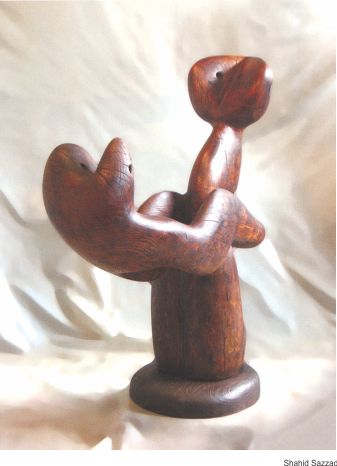
Sajjad’s first solo exhibition in 1964 at the Karachi Arts Council was the outcome of three years spent living in the forests of the Chittagong Hill Tracts in what was then East Pakistan. Living in isolation, he worked with materials, i.e wood, found around him. His subject matter was drawn from the gentle tribals who inhabited the hill tracts. The simplicity of those who lived on the periphery of civilization stirred Sajjad, who had an affinity for what was the ‘essence of humankind’. It was here that Shahid Sajjad found his vocation and made an unflinching commitment to his craft. His work encompasses a lifetime of meticulous practice with bronze and wood, and is tethered to an equally unwavering exploration of life’s many avatars. His recent works in wood (mostly yew and mulberry) are monumental in scale, and are imbued with both the sweetness and the poignancy of human relationships. The sensuousness of the surface camouflages the strenuous process of carving out interlocking forms from a single log. The wood is smoked and polished, revealing veins and often testimonies of age. The technical virtuosity, however, never intrudes into the poetry of form or detracts from the palpability of the feelings embodied in the work.
Shahid Sajjad’s artistic career has been a gruelling and lonely one. With little or no patronage, he has struggled to survive without compromising his aesthetic principles.
However this absence of discerning patronage has impacted on the urban landscape in curious ways. The attitude to sculpture being ambiguous, the approach to public monument design becomes even more complicated in the Pakistani context.
While public monuments in cities and town have received a great deal of attention, their execution has been erratic, their forms haphazard and frivolous. Fabricated and financed by both public and private money, these edifices are designated to reflect national aspirations and reveal aesthetic norms of officialdom. Public monuments in Pakistan have been overwhelmingly militaristic in nature, and sparkle with calligraphic flourishes. Fighter planes, bombers, anti-aircraft guns, missiles, submarines and tanks occupy traffic islands, railway stations, parks and city squares. The piece-de-resistance some years ago, was the huge fibre-glass replica of the mountain at ‘Chagji’, the site of Pakistan’s first nuclear test. Lit from within, the simulated rock glowed pink at night, presumably inspiring exultation at Pakistan’s arrival in an exclusive comity of nations. Each city once had its own ‘Chaghi’ monument! However these ‘markers’ of membership of the world’s nuclear club were surreptitiously removed from public view in many places as a result of an equally mysterious change in State policy. The longevity usually associated with public monuments are not necessarily guaranteed in Pakistan since they are often subject to the vagaries of political circumstances!

Nevertheless, calligraphic monuments have a longer shelf life and have grown in number consistently. Some of these display technologically advanced features, for instance lighting up and flashing while rotating.
Since these two kinds of monuments- the militaristic and the calligraphic- are prevalent, it is tempting to dwell on the interconnections, subliminal or otherwise.
The urban landscape being occupied by such works, the professional sculptor who wants to share his or her work with others, falls back into a narrower space, i.e the art gallery or any extension of the domestic arena. The sculptor who desires to address a wider audience is compelled to be adventurous and occasionally audacious.
Against this backdrop a new generation of sculptors has emerged. Surrounded by the incongruities of living in a volatile environment on the one hand, and an archaic social order on the other, the artist has a fertile territory to work for. For him or her, conventions are there to be challenged, formal modes to be transformed and a new direction to be constructed.
Duriya Qazi and Jamil Baloch comment with insight on the growing violence inside and outside the country. Jamil refers to the menace of the hardware which appears from heaven to maim and kill before it becomes part of the landscape. This is a far cry from the eulogy to invincible aircraft in visible public spaces. Duriya Qazi comments on the silence of those dying daily—victims of conflicts, internal and global. They die unsung, unnamed, these unknown citizens of our world, in Palestine, Lebanon, Afghanistan, Iraq or closer home, and it is for them that she sculpts.
The span of current sculptural practices highlights not only political issues, but social, environmental and personal concerns as well. The lively popular visual culture throws up oddities of image, belief and behavior. Artists engage with urban phenomena, like art on vehicles, posters, billboards, the culture of the Sufi shrine and the wrestling arena. They relish both texts and images, striving to reinvent and reshape their intent. As subliminal texts are explored, many facets of the social fabric are revealed.

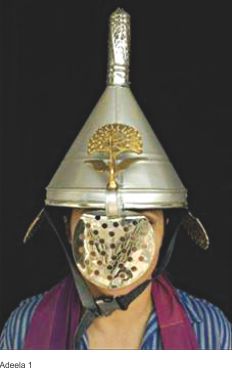
Adeela Suleman looks at the needs of the city housewife, perched precariously on the back of her husband’s/brother’s motorbike. In her installation ‘Salma Sitara, Behnen Workshop’ Suleman designs motor cycle ‘gear’ for the woman. Helmets, child seats and travelling armour, are crafted out of tiffin boxes, stoves and cooking pots. A tongue-in-cheek humour is an ongoing ingredient of the work of many artists.
It is only recently that the boundaries between the two and three-dimensional have blurred and overlappings have become common in studios. Traditional definitions of ‘sculpture’ have become obsolete, as art works are enlivened by time-based media. Objects are painted, embossed, or even vaporized!
Site-specific works take advantage of the environment. Munawer Ali’s ‘paper boats’ refer to childhood memories and the fleeting surface offered by moving water. Distance gained when residing in the Diaspora can work to the sculptor’s advantage, providing him or her opportunity to explore materials and ideas in an altered context. Khalil Chishty uses the lowly plastic bag or ‘shopper’ as it is known in the bazaars at home. Studying and working in California, he returns regularly to share his work with his compatriots. The plastic carrier bag by its very nature is peripatetic and achieves materiality in any given space shaped by the sculptor’s hand.
If one is willing to allow art to act as the ‘scrim’ through we can sensitize ourselves to both our inner and outer worlds, it can be a profoundly enriching experience. In Roohi Ahmed’s ‘Lifeline’ a figure made of delicate textile fibres undulates and moves across our field of vision. We too, soar with the image of the suspended figure.
Art in any society reflects multiplicity and the dense layerings of life, which hopefully is a testament to its vitality and range. Surely, the diversity in sculptural practice in Pakistan today provides an insight into the elusiveness of our many existences.
Today a whole generation of artists in Pakistan has dispensed with ‘received’ notions of ‘sculpture’ and they are in the process of assembling an idiom of ‘work-in-the-round’ which will be dramatically different from anything which preceded it This ‘new wave’ of sculpture sparkles with ideas; it is witty, insubordinate and ebullient. Ranging from the intensely…