

brian catling's scripted sculpture the stumbling block
This essay is a critical commentary on British artist Brian Catling’s celebrated work The Stumbling Block
A ghost is being built from the more solid things.
-Brian Catling (Vorticegarden)
The Stumbling Block is a written sculpture. The Stumbling Block is sculptured writing. Put simply, it is a book that stood on a pedestal to pose as a sculpture; and it is a piece of a poem that continues to shape and generate its own spatial structure in its recto-verso form. In other words, it is a strategic confrontation of tangible substance and intangible ideas. Its existence in both three dimensions and two dimensions redefines what we deem as sculptural space. It signals the end of sculpture in tune with Mallarme’s famous utterance, ‘Everything in the world exists in order to end up as a book’. Concurrently, in a post-Mallarmean world, it announces the beginning of sculpture by redirecting our position regarding all its regular attributes: form, process, material, scale, meaning and so on.
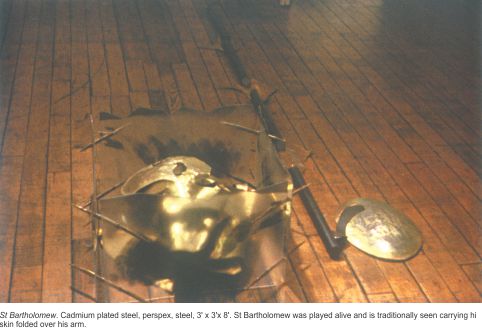
The maker of The Stumbling Block is Brian Catling. He is a poet, sculptor and performance artist. He is professor and head of the department of Fine Art at The Ruskin School of Drawing & Fine Art, University of Oxford. Catling leads an international performance group, ‘The Wolf’, and he has been commissioned to make solo installations and do performances in countries like Spain, Japan, Iceland, Israel, Holland, Norway, Germany and Greenland. Recently, one of his sculptures was installed at the site of execution in London Tower. This resume indicates Catling’s influence on the contemporary art scene. However, he is not what you would call, if I may suborn the bogus label, a ‘mainstream’ British artist. (Hear and judge for yourself. Catling posits, ‘The history of British art has been founded on a lot of boring people who did one thing continually. Very good and interesting people are looking over their shoulder, and becoming more neurotic than they’ve ever been’). In the early seventies, Catling, along with his sparring partner, the novelist Iain Sinclair, was involved with the British Poetry Revival (BPR). The BPR was helped by the appointment of the radical, and avant-gardist Eric Mottram, a Professor at King’s College, London, who was briefly made editor of the Poetry Society’s magazine Poetry Review in 1971. During his short stint, Mottram gave a platform to the underground small presses, promoting the oral, spoken, performance of poetry. Poets of BPR experimented with the various potentialities of audience involvement, mixing various art forms with poetry. Sculpture was one such form.
It is no surprise then that Catling describes his work, The Stumbling Block as ‘a direct attempt to write sculpture, to focus on an invisible shape-shifting mass, to try to see its contours, its material, its volume, in the different light of its manifestations.’ The poem as a scripted sculpture informs Catling’s fascination with language and suggests the materiality of his works and his treatment of writing as a strategy to produce and enhance conceptual resonance. As a literary piece, true to its title, the poem opposes the idea that a text can be consumed like any other commodity. The title makes a direct reference to the Bible, momentarily opening up a possibility for a hermetic discourse. But the idea soon gets entangled in a series of Gnostic references and occult rationality mentioned in the text. Catling situates himself at that juncture of time where both past and future can be made visible. In fact, like his other works, the text stretches the limit of knowledge to such an extent that apocalypse becomes visible. Apocalypse, for Catling, is not millennial hype; it is an acknowledgement of the end of the beginning. He suggests this idea through invoking not only the past but also the future by assuming occult powers that can be described as shamanic. But Catling’s shamanism does not include the primitive as was the case with artists of Picasso’s generation. It does not treat magic as something exotic and distant. It makes magic an act of will, a matter of intention. The intention of the poet-sculptor is clear: he wants to use magic to counter the magic of capitalism, the grand spectacle of modern time. It’s a homeopathic process of curing like with like. So Catling’s ultimate objective is to free art from its fetishtic connotations and reveal the human relationships involved in the creation of his work.
What is The Stumbling Block anyway? It is a book, and the hard cover of it is made out of letterpress reject. Even by the look of it you get the feeling that if you touch it the murky ink will get to your hand, if only to remind you of the work that has gone into its making. This 125 x 255mm scripted sculpture has 48 pages bluish waxy paper that renders a series of definitions of what Catling considers to be the stumbling block. Bound in a hard cover with graphite boards, the book/sculpture looks like a solid metallic block: the block here does not stop the thought process; instead, it goes on to evoke a series of other thoughts. The title indicates that it is only an index of a stumbling block. Its use of carbon from office waste in solid grafted form alludes derisively to another form of carbon, diamond–the prime symbol of consumer culture. As a piece of sculpture, this can be a luxury item or trash, depending on your definition. When shown at the 1991 exhibition in Rutland, UK it was titled by the curator Iain Sinclair famously as ‘Shamanism of Intent.’ Sinclair described the work in terms of potlatch in an indigenous community where the excess is abandoned as a gift or a sacrifice. The exhibition catalogue, included in Sincalir’s Lights Out for the Territory, is now considered a ‘retrospective manifesto’ for shamanic artists. Catling’s sculpture is not merely recycling office waste; he is also restating the reject as a work of art. And he is presenting it as a generic hybrid: a mixture of sculptural and poetic forms.
Catling’s sculpture is intent on its process-based outcomes. It does not represent or model the stumbling block.The Stumbling Block is not a physical manifestation of an obstacle. It simply reverses art’s relationship with words. When we go to an exhibition or a museum and look at the brief text that is attached to a work of art, we expect the brief label to tell us what to expect from the particular work in a linear chronological fashion. But here it is the other way round. The text has replaced the visual form. Instead it has become an event for unleashing a fluent artistic process. It is an artist’s studio in itself, and the audience is invited to join in. Here, as Aaron Williams posits, ‘questions of chronology, of the temporal structure between what is presented or represented, does not necessarily apportion a traditionally separate role for writing. Instead, the material act and resulting text are also made subject to an exploration of the dynamics between presentation and representation.’ In addition, it defies the idea that art can be consumed like any other commodity and resists immediate gratification.
Catling’s political commitment aligns him with Marxism. The Stumbling Block thus becomes a statement against the idea of commodity exchange and fetishization of art. The index claims:
The Stumbling Block is not a coffer, disguised by a wig of artifice. […] it will not simper for admiration or love, it will not beg blind or inert for ownership. It has no hollow to be filled by promise or paper. Its currency is elsewhere. It offers itself in totality, without a price; an obstinate gift to the imagination, a curve from the seclusion of possession.
We are dealing with the emperor’s new clothes then. We are dealing with a sculpture that does not exist. (But surely you can buy it through the internet. In fact, search the Amazon.com and you are likely to find some limited availability of it for £25. Trust me though, after a few days you will be told that they could not find the item!). Or maybe it exists like a ghost that is made out of solid things, to borrow a phrase from one of Catling’s poems. The imagery in the sculpture poem is surrealistic. For example, the stumbling block is described ‘as an atlas swallowing its tongue’ or as something that ‘dreams from its impossible paper heart of the forest of his origin.’ Admittedly, Catling plans to have clashing ideas that will startle his audience/reader. In an interview Catling mentioned, ‘You cannot have one sentence like that, with a lot of grey drivel on each side. You have to listen to what it’s saying, […] like a sounding board, to bring out the rest of the poem.’ He aligns with another British artist, Wyndham Lewis, in his ideas of vorticism: image opening the floodgate of other ideas, and text becoming the source of energy.
The poetic merit of ‘The Stumbling Block’ is justified by its inclusion in Keith Tuma’s Oxford Anthology of 20th Century British and Irish Poetry (2001) and also in Sinclair’s Conductors of Chaos (1991), published by Picador. As already mentioned, the title alludes to the Bible. Both Old Testaments and New Testaments make frequent references to the stumbling block, generally to refer to something that people put between themselves and God, or that God put before the disobedient. But the most likely source for Catling’s title is Ezekiel (7:19):
‘They shall cast their silver in the streets, and their gold shall be as an unclean thing; their silver and their gold shall not be able to deliver them in the day of the wrath of Yahweh: they shall not satisfy their souls, neither fill their bowels; because it has been the stumbling block of their iniquity.’
The allusion evokes a possible connection between the Bible, the canonical book and Catling’s book. The Book (the Bible) is at the heart of western culture. It is the centre of the Logos. If God is the grand sculptor, according to the gospel of Saint John, he made the world from words: ‘In the beginning was the Word, and the Word was with God, and the Word was God.’ The flesh of Catling’s work is the word, the carbon-made cover is its fossilised bone. In conventional sculpture, the world is perceived through a direct correspondence between the observing eye and the observed object. But in Catling’s wor[l]d, the connection is indirect. The words in the poem are signs prompting a series of signifiers. There cannot be any fixed meaning then. There is no affirmative meaning of the world that can be foretold from a divine authoritative tone. In contrast, Catling’s word-sculpture captures the dynamics of language, and records how it mediates the perceiver and the perceived, the audience and the work of art. Catling does not want to represent the stumbling block: he wants to start the process that will start a dialogue between what the perceiver thinks as the stumbling block and what is conventionally perceived as the stumbling block.
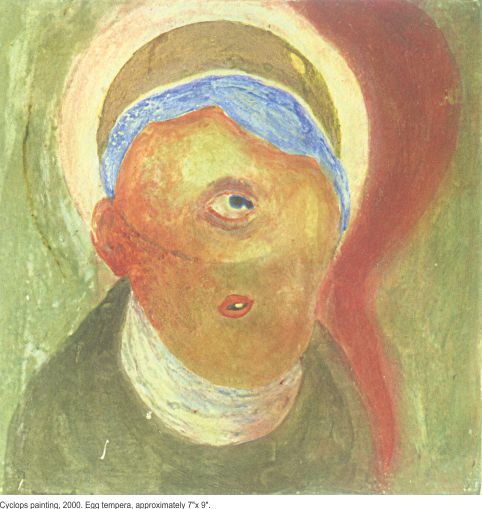
Instead of following the Bible literally, Catling does it ‘letterally.’ It seems he is trying to ambush the sacred. His works are not devoid of spirituality though. In order to address the loopholes in the western logic of rationality, of which the Bible is an icon with its link to Renaissance and Reformation, Catling has formed his own book. This formation of a book is more out of a paranoia and fear than anything else. Etymologically, the book (bok) stands for a tablet. There is one Jewish legend in which a Rabbi in Germany created a creature to protect the community from the Christian miscreants who were smuggling dead children into the Jewish village to taint the Jews with ritual murder during the Passover. The Golem, a prototype of Frankenstine, was created with the word ’emeth’ written on his forehead. The Golem knew if the Rabbi removed the first letter from his forehead it would mean ‘meth,’ his death. The Golem had no inclinations, either good or bad. Whatever action he performed he did under compulsion and out of fear lest he should be turned again into dust and reduced to naught once more. The Golem is not just a matter made of form, but a materialization of spiritual disturbance in the community. This cabbalistic idea informs much of Catling’s works. His works are a reaction to social disturbances. He is like the Golem who acts out of fear and paranoia against capitalist machinery that is going to usurp every little bit of us that is humane. The Golem is the Other of the western man, the Frankenstein of its own making. This is related to his most known performance, the Cyclops cycle, where Catling rediscovers the Homeric pariah at the heart of the British Library and goes on to project him in Japan, Leipjig, Paris and other metropolitan cities. Thus in Catling’s scripted sculpture we stumble across a site of intertextuality that deals with the economics of meaning, the production, consumption and distribution of art in society.
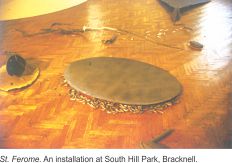
In his other works also, Catling tends to eschew the boundaries between genres. His installations accompany written hints that become part of the sculptural space. For example, for his installation in Soundings, A Tractate of Absence in Matt’s Gallery, London, 1991 he describes ‘a misshapen mass on the floor This object was made at the Trollhaugen … it was deep winter, the lake locked solid, the dark ice steaming in the night. The lead was cast on the peak of the full moon, poured into its frozen reflection, the heat biting into the ice, the cold reforming: the exchange of heat and solidity. Dug from the stiffening water and returned to the gallery, it bears the violence of its change, a paradoxical object, alien.’ The detail here is ritualistic, transporting the reader for an alternative source of knowledge. The tone is sombre, and it does not pretend to casually throw a ‘found object’ into the gallery as a work of art.
Because of his closeness to the conceptualists, Catling is often dubbed as the English Beuys. He is really interested in the Fluxus and their actions. But it needs to be mentioned here that ink is not the only medium of Catling’s work. In fact he uses every form of organic and mineral material to give shape to his sculpture. But what prompted him to defy the traditional boundary of sculpture? Let us hear it from the horse’s mouth. In an interview with Simon Perril, Catling contends that the problem with sculpture, in its strictest sense of course is that it is not willing to accept its failure.
‘This is why sculpture started to wear down. They were always much more about frailty and translucency than about solidity or the monument. I never made those. Even though I used steel, they were never about their own solidity, their own form. One of the problems I have with sculpture is that there’s a tremendous amount of fundamentalism about. I don’t believe in sculpture. I don’t believe in writing. I’m not interested in proclamations that the clinical manipulation of any language is any greater than the idea, or than what may come about unexpectedly. To make something without a balance of existence, that just sits there inert and dead, is of no interest at all. And then when people stand on their pedestals and soapboxes and say what can’t be made, I get really angry. As if there’s anything called sculpture that can’t be trespassed and diluted, as if it means a shit.’ (Tending the Vortex p 13)
Catling is challenging one of the conceptual roots of classical sculptures as it was conceived by Leonardo da Vinci in Paragone. Leonardo goes on to assert that sculpture is worthier than painting because of its permanence and due to its better resistance to the elements. Modern man cannot afford to relish such durability. At the same time, Catling’s reservation for the permanence of art foregrounds issues involving the autonomy of an artist. After all a sculpture, like its sister genre painting, is possessed. In an insightful essay William Tucker sums the situation up brilliantly: ‘This inevitable characteristic of being and belonging has thrown doubt on the genuine capacity for freedom of the sculptor or painter in the modern western society. The greatest artist can be depicted as servants of the rich and powerful, implicitly supporting the social and political structure in which they lived, however much they protest it in their work.’
Catling’s venturing out for a new mode of expression and new materiality is ultimately an exploration of failure. Consequently, his work insists on an urge to transform and transmutate. Having said that, I must point out that the connection between poetry and sculpture is not entirely new. In works of poets like Holderlin, Rimbaud, Yeats, and Rilke, we find vocabulary and imagery that verge on being sculptural. Rilke’s ‘Archaic Torso of Apollo’ (1906) is a notable example:
We knew not his unheard-of-head
Wherein the eye-apple ripened
But his torso still glows like a street lamp
In which his gaze merely turned down low
Persists and gleams. Or else the curve
Of the chest could not bind you, and in that twist
Of the loins there’d be no smile, returning
To the centre of virility,
Or else the stone would stand short, disfigured,…
You might as well remember Shelley’s ‘Ozymandias’ or Yeats’s ‘Sailing to Byzantium.’ It is not uncommon for poets to resort to the idea of carving, design, outline and relief of the sculptors, and graft them in their own works. But Catling the poet is not approaching the imagery in sensual term. His repository is entirely conceptual and he shapes his ghostly sculpture purely out of ideas.
Let me end with two lines from the Italian sculptor Arturo Martini. After a long 40-year career, Martini derided his own works in ‘Sculpture Dead Langue’ (1945). His final lines were:
‘That I should not be an object, but an extension
That I should not stay three dimensional, for death can hide within.’
Maybe, Catling is driven by the same desire to transmutate the dimension and change the scale and form of his work. His use of letter as the material ultimately manifests a process that makes The Stumbling Block a sculpture. Catling’s work does not want to be an object, but an extension that will plug in with the audience and exist in the matrix of the mind of his audience/reader. In other words it will become a part of an energy network, which is at the heart of Catling’s vorticism.
The writer is Chairman, Department of English, Jahangirnagar University. He is currently working on his doctoral thesis, ‘The Shamanic and Bardic Traditions in Contemporary British Poetry,’ at Birkbeck College, University of London
This essay is a critical commentary on British artist Brian Catling’s celebrated work The Stumbling Block A ghost is being built from the more solid things.-Brian Catling (Vorticegarden) The Stumbling Block is a written sculpture. The Stumbling Block is sculptured writing. Put simply, it is a book that stood on a pedestal to pose as…