
satyajit ray
“The most distinctive feature of my films is that they are deeply rooted in Bengal, in Bengali culture, mannerisms and mores. What makes them universal in appeal is that they are about human beings.”–Satyajit Ray, interviewed by Time magazine in 1992 on receiving an Oscar for lifetime achievement
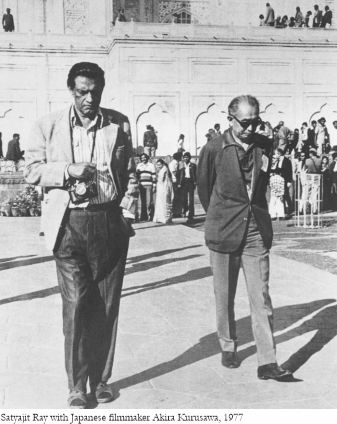
When I was writing a biography of Satyajit Ray in the 1980s, I received a magnificent letter about him from the great Akira Kurosawa. “The quiet but deep observation, understanding and love of the human race which are characteristic of all his films, have impressed me greatly… They can be described as flowing composedly, like a big river. Mr Ray is a wonderful and respectful man. I feel that he is a ‘giant’ of the movie industry.” Many years earlier, in an interview in Moscow Kurosawa even went so far as to say: “Not to have seen the cinema of Ray means existing in the world without seeing the sun or the moon.”
And it is true: Ray’s films really do illuminate our ordinary existence and mysteriously make us feel more alive. When the National Film Theatre in London screened the first complete retrospective of Ray’s work in the summer of 2002, there was a palpable buzz of excitement–both among audiences who had seen the films several times before and among those who were new to Ray. David Robinson, veteran critic and biographer of Chaplin, wrote aptly in his introduction to the season: “To discover or to revisit the world of Satyajit Ray is one of the supreme pleasures of the cinema. The ten years since his death give us the perspective to see more clearly that he was by any reckoning — not just for the cinema — one of the world’s great artists.”
The Hollywood Academy — pushed by Martin Scorsese and Ismail Merchant — recognised Ray just before his death in April 1992 with an Oscar for lifetime achievement. Three decades earlier, Time magazine, in a survey of world cinema in 1963 (when directors like Kurosawa, Bergman and Fellini and many others were at the height of their powers) asked:
“Will Ray redeem his prodigious promise and become the Shakespeare of the screen?” Some of us, and I include myself, would say that such a comparison is not far-fetched, when one looks at the whole span of Ray’s thirty-plus feature films.
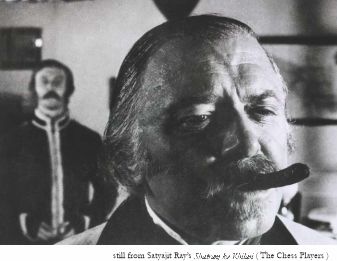
First, there is the depth and subtlety of his probing of human relationships. For Scorsese, “Satyajit Ray’s ability to turn the particular into the universal was a revelation to me. I had grown up in a very parochial society of Italian-Americans and yet I was deeply moved by what Ray showed of people so far from my own experience. I was moved by how their society and their way of life echoed the same chords in all of us.” For Mike Leigh, “coming back to Ray’s cinema has been like returning to a succulent banquet, or experiencing a series of clairvoyant flashes. I emerge from each of his films with a newly sharpened view of the world.” And for the writer and Nobel laureate V. S. Naipaul, a severe critic indeed, Ray’s period film about the ‘clash of civilisations’ during the British Raj, The Chess Players (Shatranj ke Khilari) is “like a Shakespeare scene. Only three hundred words are spoken but goodness! — terrific things happen.” In my view, there is no director in cinema who can express what is going on inside a character’s head — his or her psychology — more acutely than Ray.
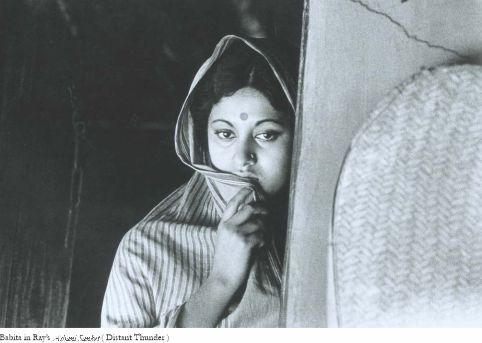
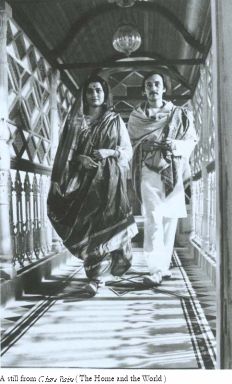
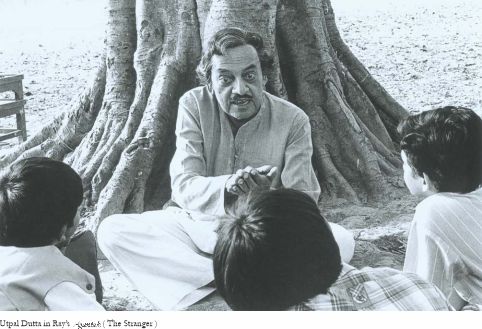
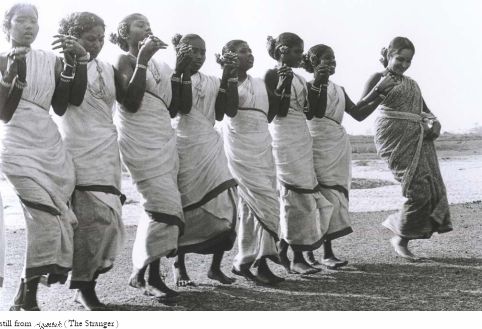
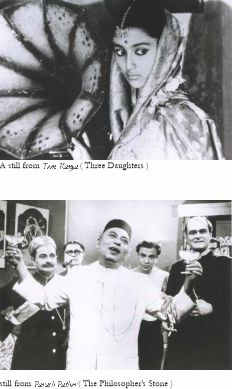
Second, the exceptional range of milieu, period, genre and mood in Ray’s work, from the Apu Trilogy of the 1950s to his swansong film, The Stranger (Agantuk), completed in 1991, recalls that of Shakespeare. There are films about almost all strata of society and walks of life: the upper class (Kanchenjungha and The Home and the World [Ghare Baire]); the middle class (The Big City [Mahanagar], Days and Nights in the Forest [Aranyer Din Ratri]); and the illiterate working class (The Postmaster, one of the Three Daughters), Deliverance [Sadgati]). Films about the village (Pather Panchali and Distant Thunder [Ashani Sanket]);
about small-town life (The Expedition [Abhijan], An Enemy of the People [Ganashatru]); and about the metropolis Calcutta (Pratidwandi [The Adversary], The Middle Man [Jana Aranya]). And films about the distant past (The Goddess [Devi], Charulata [The Lonely Wife]);
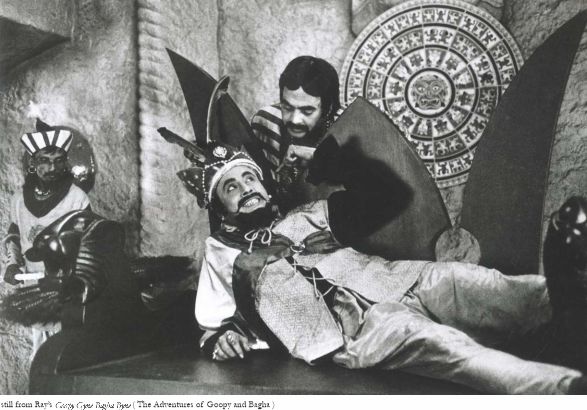
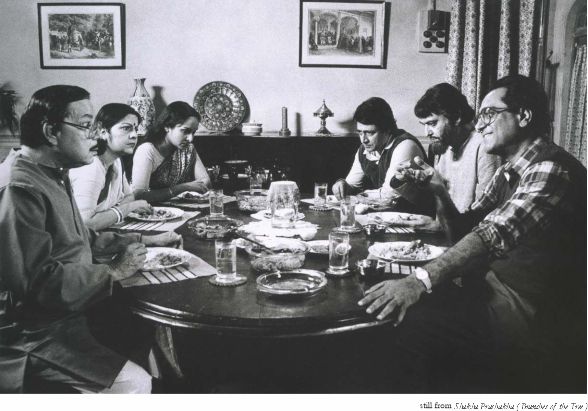
the past within living memory (The World of Apu [Apur Sansar], The Music Room [Jalsaghar]); and the immediate present (Branches of the Tree [Shakha Prashakha], The Stranger). There are also comedies (The Philosopher’s Stone [Parash Pathar], The Holy Man [Mahapurush]); fantasies (two musicals with songs also by Ray, The Adventures of Goopy and Bagha [Goopy Gyne Bagha Byne] and The Kingdom of Diamonds [Hirak Rajar Deshe]); a ghost story in the Three Daughters (The Lost Jewels [Monihara]); and detective stories, mainly but not only for children, set in Rajasthan and Benares (The Golden Fortress [Sonar Kella] and The Elephant God [Joi Baba Felunath]). And this is not to mention Ray’s five documentary films, one of them on his legendary artistic mentor Rabindranath Tagore. Taken together, Ray’s films seem to encompass a whole culture — that of the Bengalis: an achievement no other film-maker can match.
Most of his trademark qualities are visible in the Apu Trilogy, which follows the boy Apu’s growing up from early childhood in a Bengali village to marriage and maturity in Calcutta. The first film Pather Panchali focuses exclusively on the village and the first responses of a child to the mysteries of life around him: the doings of his small family, the neighbours and visitors to the village; the histrionics of an itinerant theatre troupe; a steam train that blackens the sky beyond the fields; and the insects that swarm on the ponds just before the monsoon. There is also death to be seen, if not completely grasped: the mute passing-on of an ancient aunt, and the slow fadingaway of a lively sister through fever. The family must leave the village and seek a living in Benares, on the banks of the sacred Ganges. In the second film Aparajito, we follow Apu as he freely wanders the city’s bathing ghats, lanes and temples, instead of the forest paths, fields and village fairs of the first film.
His curiosity drives him on — and eventually apart from his traditional mother, following the early death of his father, when mother and son return to village life. She thinks Apu should become a village priest like his father; he yearns for education and a bigger world — and as the film ends, he leaves the village forever, heading for a new life in Calcutta as a struggling novelist. The poignant clash between mother and son is perhaps the finest portrayal of this relationship in the cinema. Although Aparajito is not as lyrical as Pather Panchali, nor as moving as the third film The World of Apu where the exquisite story of love and loss in Apu’s marriage transfixes even the most hardhearted of critics — the second film has the richest characterisation in the trilogy and is the part most admired by Ray’s fellow Bengali directors, Ritwik Ghatak and Mrinal Sen.
In the Apu Trilogy, and in all of Ray’s films, the worlds of art, the intellect, commerce, politics and religion (especially in The Goddess) are intertwined with a gamut of moods, often in one and the same scene, ranging from tragedy to farce. “Satyajit Ray’s films can give rise to a more complex feeling of happiness in me than the work of any other director”, wrote the New Yorker critic Pauline Kael reviewing Days and Nights in the Forest, a Renoir-like farce with ironic twists and serious undertones about four young men from Calcutta on a spree in the ‘jungle’. Of course critics differ about which are the major and minor Ray films, but most agree that there are virtually no duds by Ray — unlike the films of even classic names like Kurosawa, Bergman and Fellini.
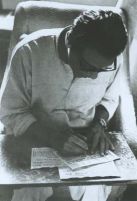
As if this were not enough, Ray has a strong claim to be the most versatile of film-makers. He was personally immersed in every aspect of production.
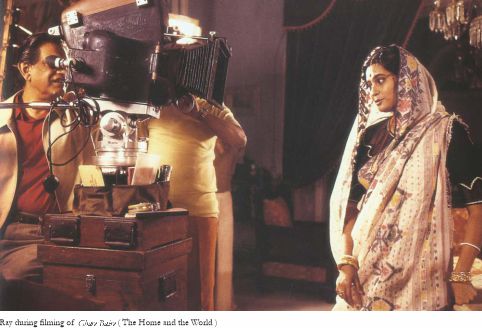
He wrote the scripts of all his films, which were often original or near-original screenplays. He designed the effortlessly convincing sets and costumes down to the smallest details. He acted out the roles for the actors and actresses with consummate nuance. He operated the camera throughout the shooting (after 1963). He edited each frame of the film. He even composed and recorded the music after scoring it in a mixture of western and Indian notation, for all but his earliest films. The songs he wrote for The Adventures of Goopy and Bagha in 1969 are as well known on the streets of Calcutta as the best of Lennon & McCartney. The only activity he avoided — despite invitations from Hollywood producers like David Selznick — was acting in front of the camera, because “it would be too tedious”, as he told a mildly offended Marlon Brando.
Thus Ray was the very model of a film auteur — something which amused him, given the studious distance kept from his work by the Nouvelle Vague critics and film-makers like François Truffaut who first promoted the auteur concept in the 1950s. Ray liked to work the way he did, not mainly because it helped to keep his budgets within manageable limits — though he had always to be keenly conscious of costs, given his comparatively small home audience — but because then he could truly call his films his own, in the same way as a painter, a composer or a novelist.
So why, if he was so astonishingly gifted, are Ray’s films not more widely seen? One reason is the lack of high-quality prints, clear and accurate subtitles and promotion by their original producers in India: a situation gradually being rectified. The Academy Archive has restored many of Ray’s films since his death; some of these new prints have been released
on video in the United States by Sony Pictures Classics. And the 2002 London retrospective, which showed these prints for the first time in Britain, undoubtedly stimulated new interest. High-quality Ray DVDs are at last appearing, beginning with the Apu Trilogy in 2003, and further new releases are planned, although there is a fair way to go before Ray’s work will be as easily available as, say, Kurosawa’s.
Another reason is that many western film lovers have in the past been indifferent to India, except for films with western central characters (such as Renoir’s The River); while most South Asians–I am sorry to say–prefer the fantasy world of Bollywood over Ray’s Bengal. Ramesh Sippy, director of the blockbuster Sholay, remarked that “In our country nobody, not even Ray, has tried to bridge the gulf between art and entertainment.” Truffaut notoriously walked out of Pather Panchali because he was not interested in ‘peasants’, and for two or three decades the French, apart from the great photographer Henri Cartier-Bresson, dismissed Ray’s films — though nowadays France probably shows them more than any other country (and Gérard Depardieu, who compared Ray to Mozart, was the producer of Ray’s Branches of the Tree).
But I think the main reason for Ray’s comparatively low critical profile, both in the West and in South Asia, is that Bengali audiences for his films are too close to and too involved with their stories, while foreign audiences are too distant and too detached from them. Neither audience shares their creator’s easy familiarity with East and West. In Ray’s own perceptive analysis of the problem, “What is attempted [in most of my films] is, of course, a synthesis. But it can be seen as such only by someone who has his feet in both cultures. Someone who will bring to bear on the films involvement and detachment in equal measure. Someone who will see both
the wood and the trees.”
Let me give two revealing examples of detachment and involvement: one from the beginning of Ray’s career and the other from its finale. In 1958, the chief film reviewer of the New York Times, Bosley Crowther, was sufficiently distant from the East to feel able to dismiss Pather Panchali as a film that would “barely pass for a rough cut in Hollywood”. However, so many people disagreed that Crowther saw the film again, changed his mind and published a second review; soon he was an aficionado of Ray, writing of The Postmaster that “It says almost all that can be managed about the loneliness of the human heart.” In 1991, when Branches of the Tree appeared, the film was severely criticised in Bengal and appreciated by only one or two Indian critics from other parts of India, notably Iqbal Masud and Dileep Padgaonkar, who wrote in The Times of India: “[The film] fills the spectator with infinite sadness on account of its theme even as it provokes admiration on account of its artistry.” Bengalis were too close to the wealthy, quarrelling family depicted in the film to accept Ray’s starkly unsympathetic presentation of their corrupt and philistine values.
As Ray once told me: “the cultural gap between East and West is too wide for a handful of films to reduce it. It can happen only when critics back it up with study on other levels as well. But where is the time, with so many other films from other countries to contend with? And where is the compulsion?”
Just think of the industry of interpretation around great European artists, for example Mozart, Dickens and Matisse — or indeed Shakespeare. And then consider the fact that Ray was familiar not only with the works of these four giants, but also with the completely different tradition of Indian classical and popular literature, art and music. He even knew Bollywood films quite well and admired some of the singers and stars despite the trashy stories; he recruited Amjad Khan who played the bad hat in Sholay to play the king of Oudh in The Chess Players, and he helped to launch the Bombay careers of Sharmila Tagore, Shabana Azmi and Smita Patil. He was an artist genuinely at home in both East and West.
“I never had the feeling of grappling with an alien culture when reading European literature, or looking at European painting, or listening to western music, whether classical or popular,” remarked Satyajit Ray in 1982, the first time we talked. The breadth of his knowledge staggered me then; now I find it unique.
“The most distinctive feature of my films is that they are deeply rooted in Bengal, in Bengali culture, mannerisms and mores. What makes them universal in appeal is that they are about human beings.”–Satyajit Ray, interviewed by Time magazine in 1992 on receiving an Oscar for lifetime achievement When I was writing a biography of …