
Youth Theatre in Bangalore
Till a year ago all the English language plays I’d seen in Bangalore, which like all Indian metropolises has an ever-burgeoning urban English theatre scene, were based on existing play-scripts—many of them by Indian playwrights like Girish Karnad, Mahesh Dattani, Mahesh Elkunchwar, Arjun Sajnani and Poile Sengupta. These were proscenium plays of the kind whose mechanics are clearly visible and are perhaps meant to be visible—characters not listening in on each other’s lives but only each other’s lines, every movement on stage carefully blocked, and emotion translated into its most obvious expression so that laughter stands for happiness and a hand slapped to the forehead means despair. The most notable thing about such productions was their literalness. By this I mean neither a close adherence to the text nor a realist style, but a tendency to treat the text as a series of instructions rather than the see-through skin of a minor universe. This respect for the text often came in the way of translating plays into flesh-and-blood stories. The thing with the story on the printed page is that we are constantly supplementing it with whatever our own imagination provides, whereas with the story on the stage, we tend to privilege the live characters’ interpretation of it. These characters are in a way both the actors of the story and its tellers
Three recent productions challenge this convention of working with scripted plays and they may well be symptomatic of deeper rumblings within English theatre in Bangalore. All three have been conceptualised and performed by people mostly in their twenties, each performance has been developed in an improvisatory fashion rather than by working with an existing text, and all three are saying very interesting things about Indian theatre and about the Indian middle-class.
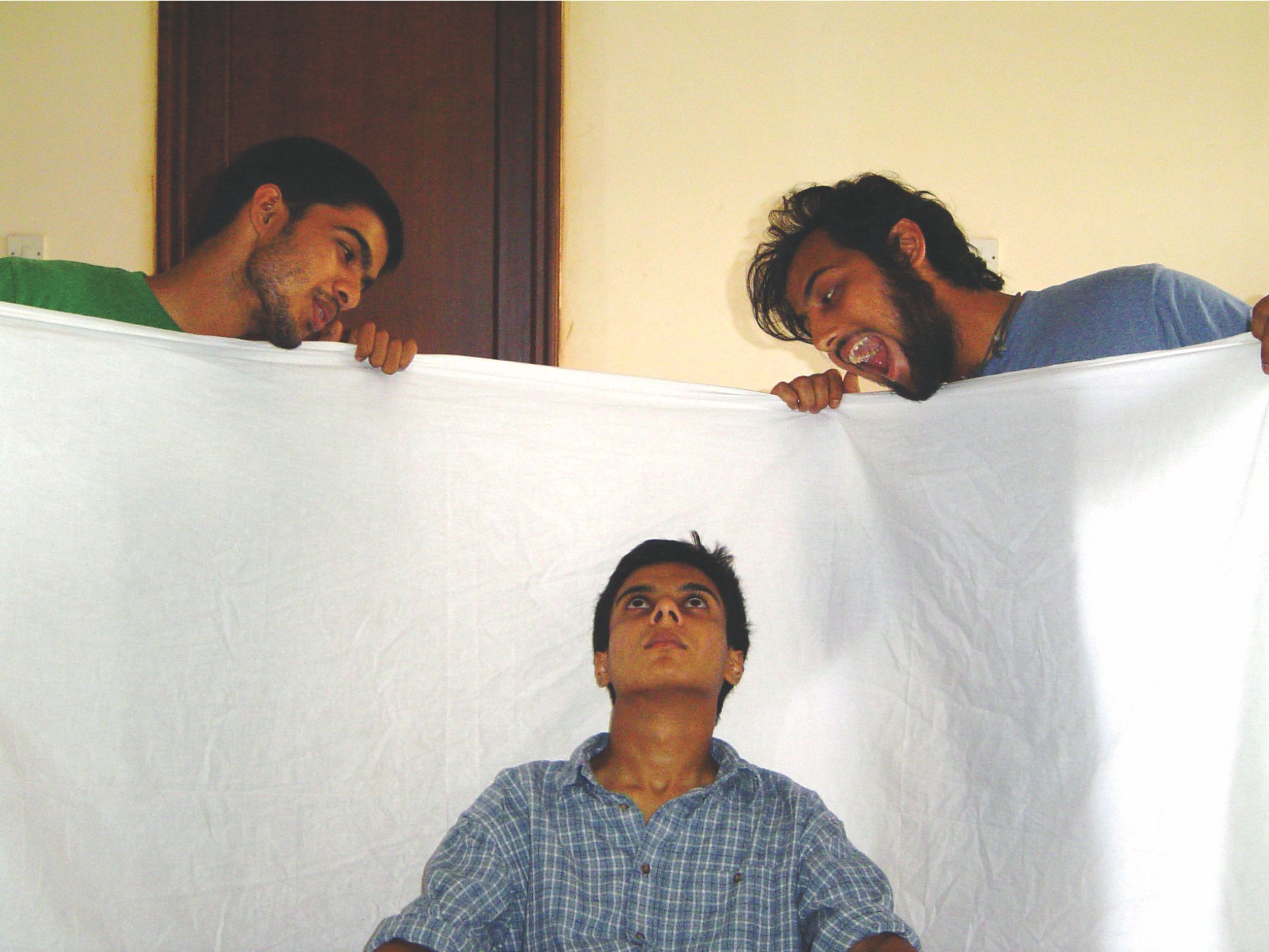
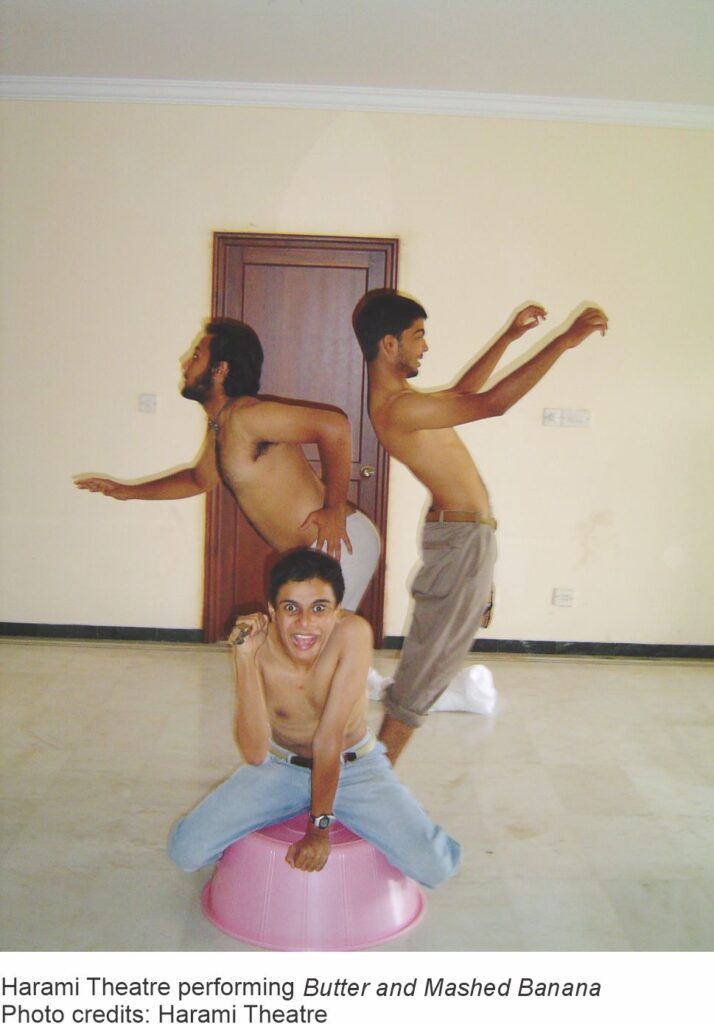
Harami Theatre’s ‘Butter and Mashed Banana’, or ‘BAMB’, has been written and directed by debutant Ajay Krishnan, and performed by him along with two friends, Nakul Krishna and Arjun Shankar—all novice actors. Despite this, the play has had an incredibly successful run in the few months since it premiered. It has been performed several times in Bangalore and Bombay, won multiple awards at two theatre festivals, and been enthusiastically received both by critics and audiences. It has had the effect of clearing the air, burning the undergrowth, making way for something entirely new and unexpected. BAMB is funny, fresh, crisp and utterly insouciant. It lacks decorum or formality. Indeed, its point is to poke fun at decorum and formality—both in theatre and in life. The play is hard to summarise though–it is really a romp whose take-off point is the general need to uphold freedom of expression.
It begins by caricaturing the unlikely union between a radical feminist with Marxist leanings and a right-wing fanatic. Their child is naturally born confused, but before we can learn more about this strange family, the infant has metamorphosed into a world-famous writer who jet-sets around the world being asked pointless questions by ignorant journalists, but who, just as quickly, gives up writing to launch his own political party in the name of truth. Warring politicians unite to oppose the newcomer and he is silenced, but not before a hilarious take on the absurdity of censorship, particularly that pertaining to the portrayal of sex.
Despite the political references in the play—to Marxists and religious fanatics, to corrupt politicians and barbaric censors—this is not really a political play at all. It lumps together all these figures and makes them appear interchangeable. They are simply bad and stupid authority figures who have no right to tell us what we should do. One does not take away from the play any idea about the politics of power (as one would from older plays like Vijay Tendulkar’s ‘Ghasiram Kotwal’). What one does take away, is something uniquely contemporary—a middle-class impatience with the idea of politics itself and a longing to break free from a language and an ethics that no longer seem to have any relevance to our day-to-day lives. And the way to perform this rupture is, quite simply, to laugh. This is why the play has the impact of a small bomb. Its motto quite simply is—let’s make fun of everything. Though somewhat adolescent in its enthusiasms, the play’s blanket irreverence works brilliantly.
So what one remembers best about the play are its one-liners and not any deeper import they may have, because they have none. For instance, a man is singing about how he wanted to make a film about love, but he is cut short by the censor barking out—’What’s that?’ It’s a woman having an orgasm, says the filmmaker timidly with reference to his scene. ‘You can’t have that, she looks too happy!’ exclaims the censor. The filmmaker resumes his song, singing on about how he wanted to make a film about Gandhi. The censor interrupts him again. ‘What’s that?’ he yells. It’s Mr. Gandhi, just when he’s been shot, says the filmmaker. ‘You can’t have that’, says the censor. ‘It looks as if he’s having an orgasm!’
Content-wise the play takes whatever that is shoddy about our public life and patches it onto a running series of gags. Stylistically too, it borrows and mixes—a few faux-bharatnatyam steps, some songs sung to the accompaniment of a guitar, the barest of props, lines delivered in everyday accents, an agility in the performance that breaks with the blocky style of most proscenium theatre, and matching this an ease with language that is possibly the most impressive thing about the play. But the most interesting about it is the characters themselves. Ajay, Nakul and Arjun don’t become the Marxist feminist or the world famous writer or the barking censor so much as mimic them. The play’s characters are not characters in full-blooded sense—they are types delineated in a few broad strokes. They vanish as quickly as they appear, and lack the depth or the gravity or the time that characters need to develop. So in a sense the three actors remain themselves throughout the play and yet they don’t.
This fascinating, liminal space is also occupied by the young actor-director-writer Pawan Kumar in a play he has written and directed himself called ‘Final Rehearsal’. ‘Final Rehearsal’ too has been performed several times in Bangalore and Bombay and been as much of a success, especially with young people, as ‘BAMB’. And as with that play, the point with ‘Final Rehearsal’ is less about offering an argument via the use of narrative or through the exploration of characters’ lives, and more about giving vent to a short burst of creative energy. The play is about an actor bent on winning a ‘best actor’ award. The story of his obsession with this award segues into the story of his life—his biography as an actor (he has gone from playing a dumb tree to Mark Antony in ‘Julius Caesar’), his relationship with his chair—the only other ‘actor’ on stage, the loss of his girlfriend to his obsession, and finally his descent into insanity and his inability to distinguish between life and theatre. This description, however, makes the play sound more coherent than it is—like ‘BAMB’ the play is actually less ‘story’ and more an improvised series of short performances strung together, most of which have little relation to the larger idea of an obsessive actor. The obsessive actor is not an identifiable person in ‘Final Rehearsal’. His history is too general to be an individual’s history, and—like the buffoons and fanatics of ‘BAMB’—he is a peg for Pawan Kumar to display his acting skills.
What one remembers best, therefore, are random scenes from the play where these skills are put to best use. For instance, there is an episode where the protagonist, waiting for work, finally has a script delivered to him. He finds out that it is about Gandhi (yes, Gandhi again) and sets about acting the father of the nation before he begins to read his lines. His demeanour is instantly transformed into that of an old man’s—he sits on the floor with his back bent, cranking his spinning wheel, then picks up the script, peers at it and croaks to Kasturba to get him his reading glasses. He mimes the wearing of the glasses and finally begins reading the script only to discover that the first line says ‘Gandhi is a fourteen year old boy’. The whole thing is a nicely subtle comment on the assumptions that actors can make about the characters they are acting. Another scene involves the elaborate miming of the protagonist’s accidentally knocking into a girl and spontaneously falling in love with her. A third is an elaborate encounter with his colleague, the chair, in which Pawan succeeds in giving the chair a bizarrely human aspect.
Both ‘BAMB’ and ‘Final Rehearsal’ appear to be about serious questions—what does being competitive really do to you, how much freedom of speech does one really have—but are in the end overtaken by the need to simply break free—to act for the pleasure of acting, to talk in one’s own voice, to share jokes, to not have to struggle into the tightly-fitting suits of characters someone else has created. This idea about the essential difficulty (perhaps even impossibility) of performing someone other than oneself also runs through ‘In Search of Hamlet’, an open-air performance by the theatre group Rafiki.
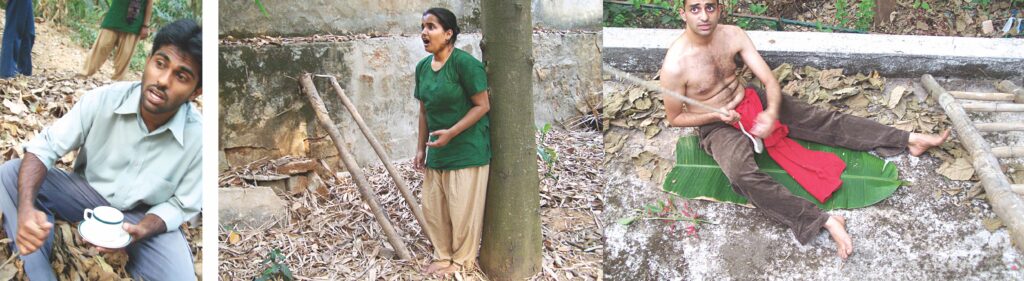
‘In Search of Hamlet’ is a series of individual acts arranged in no particular order, though the play as a whole is, ostensibly, a comment on ‘Hamlet’. The version of the performance I saw took place in a large, tree-filled garden that wraps itself around a building and yields a number of interesting spaces in which to perform. Each of the actors performed their solo piece in a separate nook of the garden and the audience moved from space to space as the play progressed. Apart from compelling each actor to relate his or her piece to a space with a distinct character (instead of the impersonal blank of an empty stage), the group’s use of an open air setting also brought the audience right up against the performers. This made the latter both more vulnerable than they would be on a stage and, at the same time, better able to take advantage of the audience’s vulnerability by looking them straight in the eye.
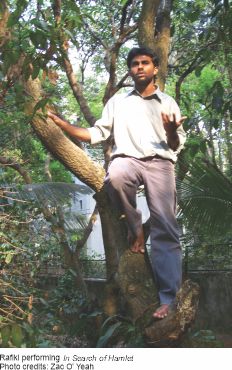
‘In Search of Hamlet’ was, like the other two performances I’ve discussed, about the actors themselves—their ideas of what is funny or tragic or profound. Interestingly, this focus on the personal turns Hamlet into a trope for irrelevance. Hamlet—both the play and the character—becomes symbolic of difficulty and foreignness right from the opening sequence which has an actor sitting astride the branch of a tree, saying—I was asked to play Hamlet, but what do I know about Hamlet except that he was a luckless brainy bastard? Many of the other pieces take up this theme in direct or indirect ways. An actor performs the opening of the famous “To be or not to be” speech, but then interrupts himself and begins to distance himself from Hamlet. The sets are being dismantled behind me, he says, by people who have no use for Hamlet. He starts talking instead, in the voice of a jaded soulless yuppie, about the power games played by motorists on Bangalore’s roads, about watching TV—two-minute images and music without melody, about being irredeemably mind-fucked and comfortably numb. He embarks on a litany of rage, swinging a whip as he raves about hating—among other things—Bush, Clinton, Bill Gates, all women and the pigs in khaki.
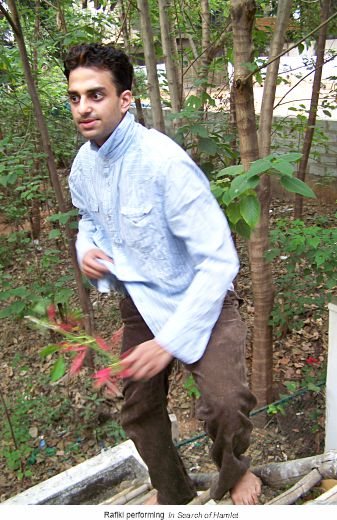
A female actor talks about the analogy between games and life. We’re constantly up against foul play—the person who sleeps with the boss is the one who gets the promotion—but in the end what one might well be fighting is one’s own ego. This sequence, even though it seems to echo Hamlet’s concerns, gives them too literal a reading and so fits in with the other pieces in really repudiating Shakespeare’s play. Another rather brilliant sequence has an actor struggling to express the words—’what you see is what you get’ and this comes closest to Hamlet in its portrayal of lucid insanity, but again it abstracts just that element of the play and does not involve any reference to Hamlet’s personal anguish or his moral dilemmas. So finally, like in ‘BAMB’ and ‘Final Rehearsal’, the actors in ‘In Search of Hamlet’ are playing themselves, or versions of themselves that they believe might be interesting in a dramatic sense.
One is less interested in the theatrical skills of all these performers (which naturally vary), as much as in the question—who are these self-referential characters that these young actors insist on playing? After the performance of the Hamlet play one of the group’s actors—Anish Victor—spoke about how he’d benefited greatly from the theatre workshop that led to the creation of the play because it helped him to express feelings and emotions that, as someone with an urban sensibility, he’d been used to blocking out. Curiously, even as the play reveals the feelings and emotions of its characters it shows up the former’s flimsiness.
Urban experience seems not to yield very much more than surfaces, and all three plays demonstrate this in different ways though none of their protagonists seem to recognize it. All three plays reveal an impatience with things that are in any significant sense outside the young metropolitan self. As a result, all three deal with emotional landscapes that are curiously ahistorical and contextless.
What is nevertheless very exciting about these new productions is their need to in some way weld the experience of acting to that of self-expression: to do away with or at least question the idea of the play as something that exists in the abstract, as something that it is the actor’s job to only lend his voice to—ventriloquist style. This move is not just counter-textual but it also counters the idea of the play as essentially driven by a linear narrative. Inevitably, there is a looseness in such attempts, but at the same time a sense of search and of fun that is compelling. All these productions are beginning to turn the gaze inward, to speak confidently in a recognisable language, to ask what it adds up to–being an English-speaking, city-bred young Indian in the twenty-first century. How far this gaze will penetrate, how a more sophisticated theatrical expression can be given to their ideas, and how these young artists will come to engage with narrative remains to be seen.
Anjum Hasan is a poet, critic and fiction writer. She is based in Bangalore and works at the India Foundation for the Arts
Till a year ago all the English language plays I’d seen in Bangalore, which like all Indian metropolises has an ever-burgeoning urban English theatre scene, were based on existing play-scripts—many of them by Indian playwrights like Girish Karnad, Mahesh Dattani, Mahesh Elkunchwar, Arjun Sajnani and Poile Sengupta. These were proscenium plays of the kind whose…