
we are the city
I dream of a city called Calvino where turning the corner of an alley, as children run out of a schoolyard, I decide what I want to do for the rest of my life. As I gaze upon a street, on whose brick paved surface millions have walked on, I hear the hum of stories. Cities are millions of stories. I see evidence of the monumentality of the city, its staggering repetition. I also see signs that the city is ephemeral, that it dissolves once it is approached. Even if there is no there there in a geography of constant iteration, I sense that where I stand: I am the city.
In Italo Calvino’s Invisible Cities, when Kublai Khan and Marco Polo exchange accounts of places, I come to understand the city as an existential theater of actions, practices, dreams and imaginations; our actions, practices, dreams and imaginations. A city is neither hell nor heaven, nor simply a mastered plan; we make cities in the shadows of our selves. We are the city.
As a theater of social action, the city “fosters art and is art.” It is in the city as theater, according to the urbanist Lewis Mumford, that humanity’s “more purposive activities are focused, and work out, through conflicting cooperative personalities, events, groups, into more significant culminations.”
One cannot proceed into the heart of a city without a mytho-poetic imagination. A city is not mere buildings, streets and spaces; it is, first and foremost, an idea in which buildings, streets and spaces play key part. In considering Dhaka as the toughest city in the world, the challenge is not one of solving its endless crises but in producing the idea of how one should live as part of a collective. People do not arrive at the gate of a city with just a pragmatic impetus; they arrive with an image of the city, with an idea.
A narrative of cities cannot be contained only by techno-functional notions around urbanization and economy. Talks of urbanization distract the discourse of cities with number games, not taking into account that a city is shaped, bit by bit, not only by policies and ordinances but imaginations and practices. Statistics do not show how a city can be designed and lived in its fullest human, social, aesthetical and ecological potential, a dynamic that is approached best by the term “urbanism”. Urban sociologist and thinker Henri Lefebvre would like us to think that a city is about material and spatial facts, and urbanism is about social relations staged there.
I dream I inhabit a city for a “total experience of life,” where the antagonism between the city and the landscape is not brutal, where the clichéd opposition between city and village has been overcome, where wide sailed boats ply in the heart of a downtown, and when the waters come from the mountains people do not escape to the roofs of their houses but embrace the bounties of the delta. And, where, in the vision of master architect Muzharul Islam, there is no question of “haves” and “have-nots”. I dream that such a Dhaka is possible.
*
As the most ancient artifact, older than the making of shrines and monuments, the city now reverberates with a greater poignancy as a human collective. New practices of the city are redefining what we take for granted as our inviolable spatial containers. The certainty and dominance of the nation-state as the unilateral spatial container of our lives are now challenged by the city.
An unprecedented urban phenomenon in a global theater is opening up a new conceptual and political scope of the city. With Venice voting recently to secede from Italy, and Hong Kong struggling with China, territorial boundaries of the nation are being redefined, and spatial obligations rearranged. The German philosopher Hans-Georg Gadamer’s argument for a “post-national constellational” as an antidote to nationism is becoming more reasonable. In his proposal for making Paris a “city of refuge” in the ancient theme of hospitality, Jacques Derrida speaks of the city as an unbridled harbor for those who arrive there despite the nation-state’s refusal.
At one level, the city as the generator of numerical gains is a principal player in the neo-liberal economic game, but at another level, it is the core of our existential being and consciousness, what Henri Lefebvre describes as the specificity of the city. Our designation of the city has to be revised, and planners have to learn how to engage with the existential quotient of the city. They do not know that yet.
Cities can be the most beautiful collective dream, as the urban wizard Jaime Lerner claims. Rejecting the notion that the city is a problem, Lerner insists that cities instead are solutions to our nature of collective existence. In transforming the Brazilian city Curitiba, Lerner as the mayor proved that the city is not defined by smog, crisis and deluge but as an exemplar of how we should live as a decent society in which the fruits of urbanism are available to all citizens. More recently, another South American city – Medellin – for long a poster child of a city gone terribly awry (drug, murder and mayhem!) has shown that meaningful changes can happen through, as Alex Warnock-Smith notes, “visionary leadership, tough politics, and experimental urban design”(Architectural Review, 2014).
If there is a puzzlement to why an art journal like Jamini should adopt the city as a theme, writers from Lewis Mumford to Henri Lefebvre have articulated the city as an art, a production. “The city,” to Lefebvre, “is an oeuvre, closer to a work of art than to a simple material product. If there is production of the city, and social relations in the city, it is a production and reproduction of human beings by human beings, rather than a production of objects.” As an oeuvre, a French word denoting an ensemble of distinctive work in art, music or literature, the city is contrasted with the “exchange” value that money and commerce generate. The city above all has “use” value such that streets and spaces, and edifices and monuments, have the preeminent purpose of being used or consumed “unproductively,” something that may not be estimated through monetary value alone.
This issue of Jamini is not only a reportage on urban works but a subtle manifesto for imagining and making a city. Whether it is narrated through an alternative “master” plan of New York City (Michael Sorkin), the green history of Philadelphia (Kate Wingert-Playdon), the urban farming revolution in Havana (Carey Clouse), conservation projects in Kolkata (Manish Chakrabarti), brilliant remedial landscape designs from China (landscape architect Kongjian Yu), eco-city plans of China (Zhongjie Lin)or a recollection of the master plan for Bangkok (Gary Hack), the collation of themes promises the making of a new urban landscape. What is also critical is that all the themes are pertinent for a wholesome transformation of Dhaka.
A choreographed transformation of Dhaka requires a new line of imaginaries and narratives. Imagination precedes inhabitation, or according to Tabassum Zaman in tracing imaginaries of the city, experiences are extended and worked upon by imagination in order to produce another construction that eventually becomes the city, becomes another Dhaka. Naeem Mohaiemen conducts a retrospective imagination of their house in Dhaka’s old Rankin Street from traces of photographs made by his father in 1953, and produces a re-construction of a vanished present.
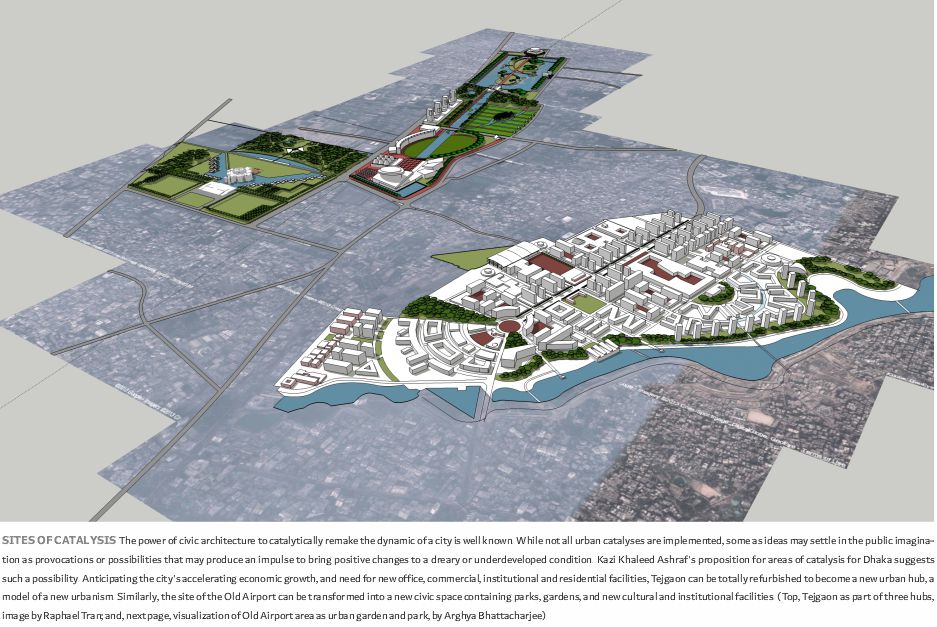
Examples from the architecture design studios of Kieran Timberlake at the University of Pennsylvania present new possibilities for developing Dhaka, from a re-countouring of the hydrological landscape to a reconstitution of wastes. Steve Kieran and James Timberlake are prominent American architects based in Philadelphia, who have for over five years adopted Dhaka as a laboratory for design research. Going farther into the deltaic landscape, a design studio at the University of Washington’s Department of Architecture in Seattle conceives a synthetic network of hydraulic passages and floatable nodes.
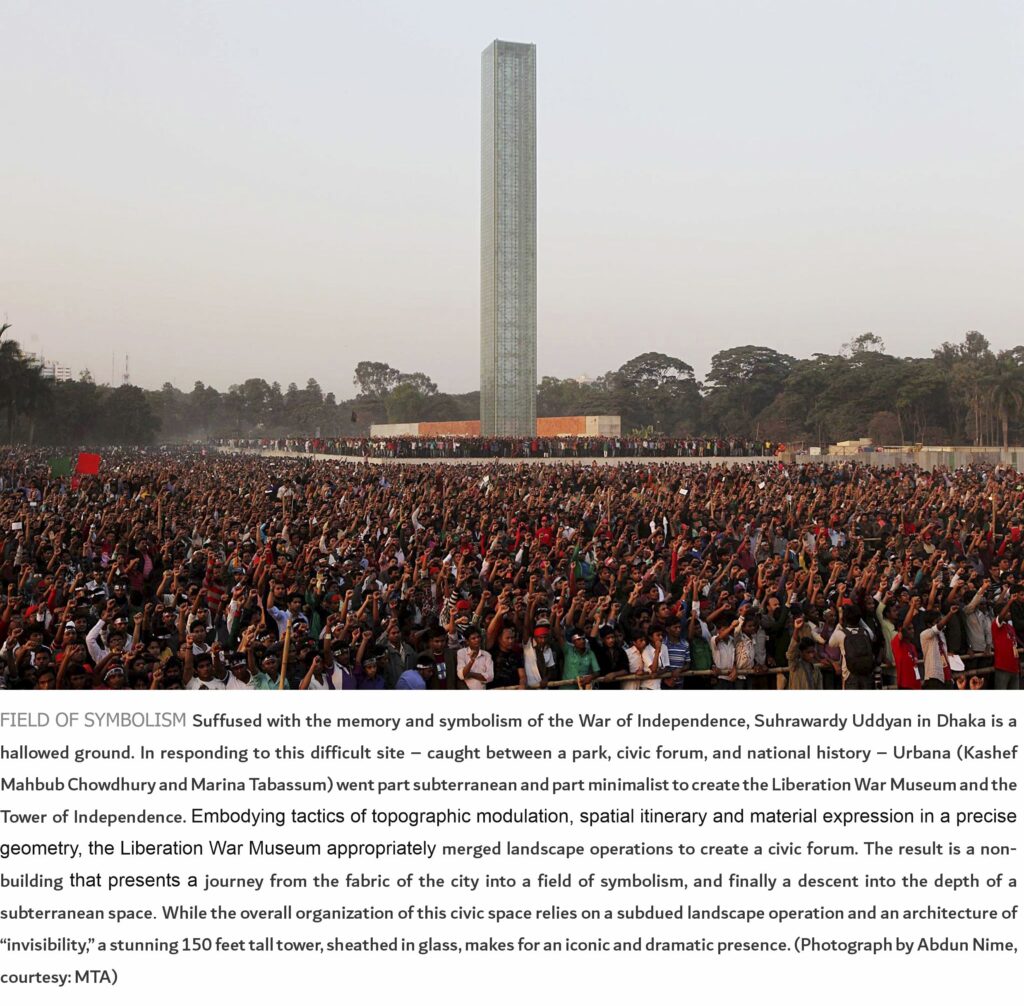
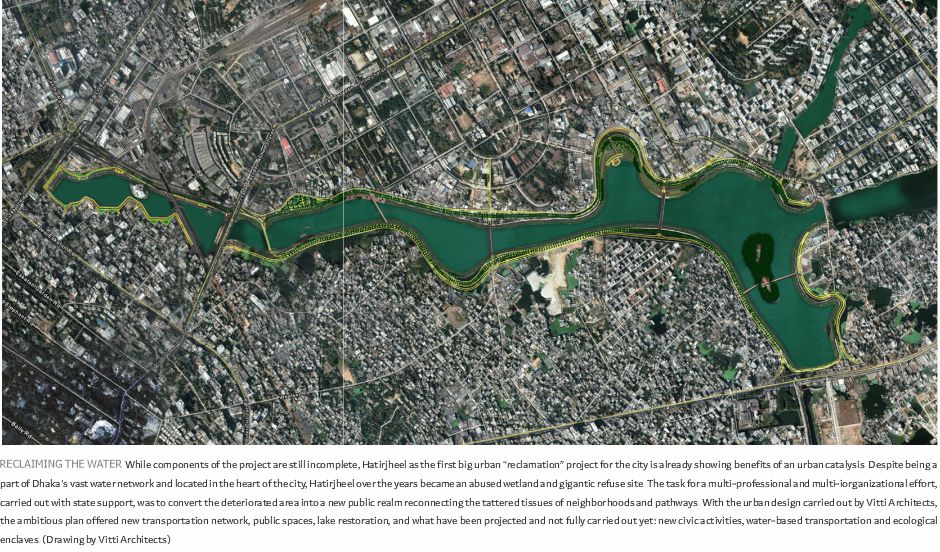
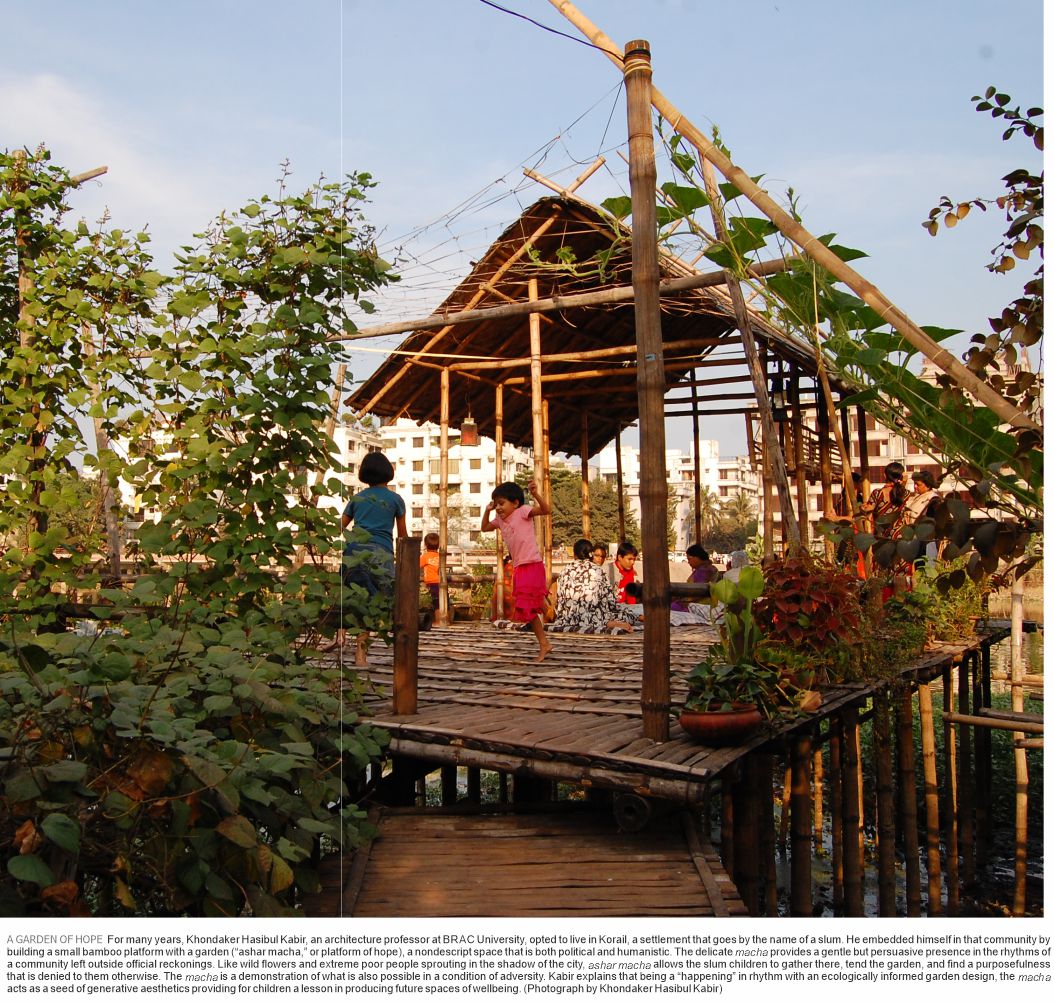
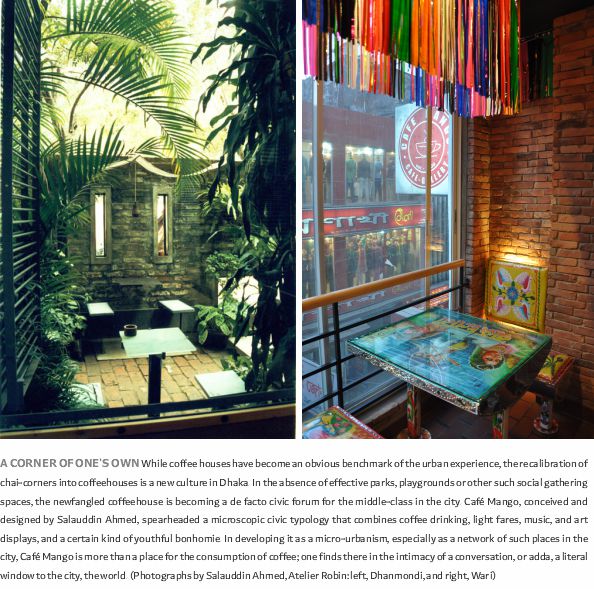
In a desirable city, heterogeneous relationships and competing claims find enduring recognition and reception. Drawing people from different economic, ethnic, social and professional categories in one space, the most critical need for a city like Dhaka is a civilized mode for addressing differences and diversities. Awash with many building enterprises in a new economy, most buildings in Dhaka remain as enclaves unsure of how to form civic precincts or connect to the public fora. What needs to be celebrated are design of spaces that engage the civic realm, from the larger-scale and monumental to micro operations, and from the planned to the spontaneous. (Examples in this articles how five degrees of such urbanism.)
Bangladesh’s urban questions cannot be all about Dhaka even if it hogs up all our investments and concentrations. To think beyond Dhaka, to engage the multitude of small towns – the mofussils – is now critical. Unmapped and untheorized, small towns are developing on a false premise: they are adopting a spurious Dhaka as a role model while abandoning their own stories. Saif Ul Haque delineates a plan for decompressing Dhaka by focusing on a network of smaller towns ringing the besieged capital city. If cities and towns are million stories, Adnan Morshed writes other stories of Chittagong.
*
As incubators of our futures, cities are not simple manifestation of social formation, but prognosis for emerging social and cultural forms. Again, whether delirious or dubious, there is a new city in the horizon whose contour remains largely unmapped. While the fabric of Euro-American cities remains mostly stable (or, in some cases, dwindling, like Detroit), migratory dynamic and predatory economics are fast changing the Asian urban landscape.
Clearly, there has been a quantum leap in the urban phenomenon of Asia. Bolstered by economic and climate migration, and administrative impetus, more people now live in cities. China is literally building 20 cities every year, and India proposes spending $20 billion in seven years for its National Urban Renewal Mission. Despite the fact that contemporary cities are responsible, according to Warnock-Smith, for “history’s greatest disparity between the wealthy and the poor,” cities are key catalysts for the future of the planet, and its transformation, but most importantly, the destiny of subsequent generations.
*
“Leave Paris and Amsterdam – go look at Atlanta, quickly and without preconceptions…” urges the canny urbanist-architect Rem Koolhaas in his note on the contemporary city (1989), in an attempt to take focus away from the usual city discourse based on classical European models. I would rephrase that and say: Leave Paris and Amsterdam – go look at Dhaka, closely and without preconceptions. Dhaka presents not simply a catastrophe for the usual reasons of urbanization but a new theorem for city-thinking.
An urbanism for Dhaka, I have argued, has to be conceptualized from the hydrological property of the delta. The theoretical challenge is this: surrounded and infiltrated by a labyrinthine and delicate network of rivers and canals, tissues of wetlands and floodplains, and organic formations of mounds and settlements, Dhaka needs a new approach to city-thinking and city-form.
A socio-political program is also aligned with the physical fabric of the city. “Cities should provide the environment for civilized life within the context of our own culture,” Muzharul Islam wrote in 1968. “The city can develop only as a part of the physical environment of the country, with the ultimate aim of abolishing all differences between the city and rural areas. The traditional relationship with nature (still existing to a certain extent in the villages of Bangladesh) should be continued in the cities.” This is not a plea from a romantic advocate or a modern incarnation of Ebnezer Howard but someone wary of configured differences between “haves” and “have-nots,” and between urban forms and rural patterns.
*
From the deluge of the late 1980s to the unforgettable tragedy of the Rana Plaza factory, Dhaka can be easily written off as an evidence of an apocalyptic city-site. Blood springs from the pillars of a garments factory, a tattered shirt is all that remain of a young man who toiled in a stitching section, a delicate foot of a young woman protrudes between slammed slabs, the sad anklet on her foot a sign of a thwarted hope. Such is the landscape of an unruly industrial globalization.
Borne of the bewildering dynamic of the Bengal delta, people for centuries have learned to live with the extremism of nature that has tested their mettle, creativity and fortitude. Dwellers of the delta, however, do not know how to live with collapsing and burning buildings, of which they do not have any collective memory or folk knowledge. This is the dark side of urban development, the conundrum of magical economic growth and consumer capitalism centered on cities.
Death in the plaza is also a consequence of Dhaka’s irresponsible planning, a result of an abysmal failure by city fathers to establish what should be built where and how. Along the way to Gazipur in the north of the city, on the riverbanks towards Naryanganj, and on the road past Savar, sand and debris cover fields of mustard and rice, and concrete and steel rods replace the vernacular of bamboo and thatch. Multi-storied buildings—six to ten-story high—hum with the music of a far-off Gap or Walmart. Freshly laid sand-beds announce the arrival of an upcoming housing society. The transformation of Dhaka and its regions, along with its physical and social landscape, has been relentless and brutal. When an agricultural milieu at the fringe of the city rapidly transforms into a hodge-podge urbanization, strange things will happen when nobody takes notice. Nalas, dobas and pukurs– the lowlands – will get filled to shore up tottering towers, without any basic recourse to safety and buildability, and petit goons with the blessings of political leaders will become crorepatis, and enter the mystical chain of globalization.
By creating one landfill after another, emaciating rivers and canals, and decimating flood-plains and agriculture, Dhaka makes for a perfect candidate for an urbanization without urbanism. But it is in this conundrum, a new narrative is being composed. Even if dubbed the worst city to live in and the toughest city in the world, we are already in an unprecedented urban dynamic. If a new and better Dhaka is possible, we have to start from here.
*
Bengalis have an ambivalent relationship with cities. Poets and writers sing the sweet songs of villages and versify the vileness of the city. Even when they live and enjoy the city, they dream of the little village through Poet Jasimuddin’s comforting image of salubrious vegetation and that untranslatable sense of being wrapped in “maya-mamata.”Apu, in Satyajit Ray’s filmic Pather Panchali, reclines wistfully in his hovel in a grimy neighborhood in Kolkata, playing the flute like a Krishna dislocated from his arboreal habitat. The psychologist Ashis Nandy talks of the troublesome oscillation between the village and the city in the course of which both emerges dystopic. Yet, the city thrives in its cantankerous ways. Thousands arrive at its shore, suffering the insufferable, and not giving up the promises of an upcoming destiny.
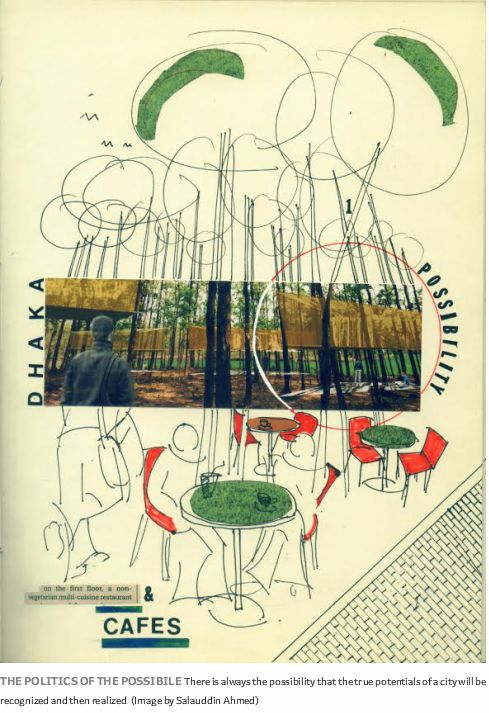
Dhaka’s primary urban crisis is one of imagination, of not being able to think of an appropriate form even when there are inspiring clues.
With spacious green spaces, majestic trees, crisscrossing canals, civilized riverbanks, boats with unfurled sails plying through the heart of the city, Dhaka can actually be the garden city and a place by the water it always was. The idea of a city as a garden is not a fantasy but an ideology of a city-form as Louis Kahn envisioned and built in his ensemble of buildings, parks, gardens, orchards and lakes. Muzharul Islam imagined “the whole country as a concentration of population in certain areas in a certain way, but even then within gardens.” He perceived Dhaka not just having a collection of large gardens but the city itself as a garden. “If you can do this [tall buildings] utilizing the highlands of Dhaka city,” he suggested, “even now, you can place here a population three times its current number, and, at the same time, keep the lowlands as lowlands, keep the water bodies, and create gardens.” (1992)
*
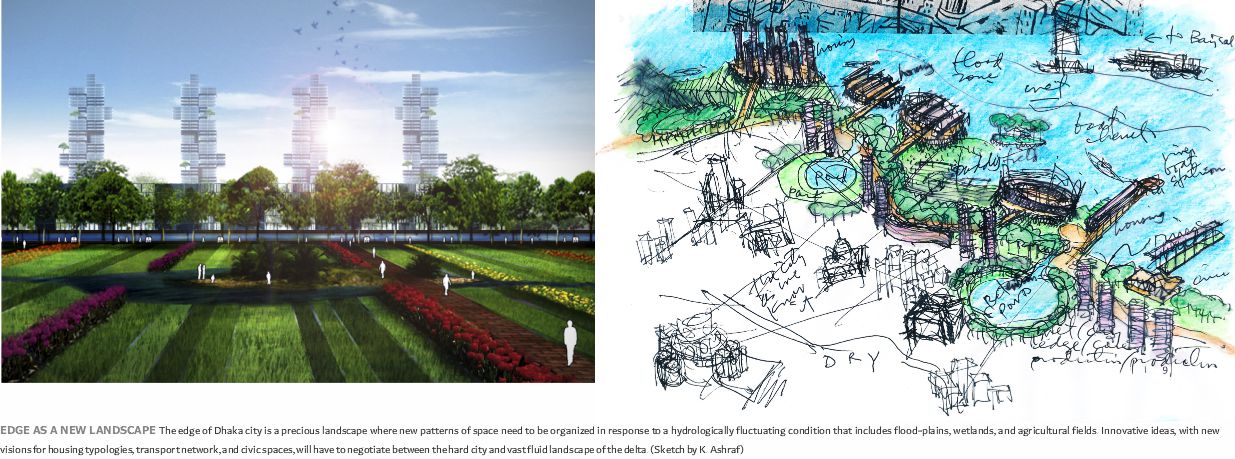
The biggest challenge in the recomposition of Dhaka lies in engaging its landscape reality – the dynamic hydrology of the delta. With an ever expanding city, the dynamic also involves an ecology of the edge.
Koolhaas also introduces the notion of the “edge” in his cartography of the contemporary city. But where the Dutch urbanist meant the fringes of the Euro-American city defined by a frazzled fabric of the post-industrial condition or the tattered terrain of suburbia, a place like Dhaka confronts the edge as the new “center”.
Most urban planners and policy-makers focus on the core city. Even when they are dealing with the edge, they see it in the image of the core. Official planning is unable to conceptualize this edge, to recognize that the edge is its own ecology, and a critical one. Without that realization it is easy to participate in the destruction of the city’s hydro-geographical landscape. An audacious vision for Dhaka has to begin from the edge in which the norm of planning of privileging the core has to be reversed.
The geography of the edge is determined by the built-city marching up to meet the “non-urban,” a magnificent but precious terrain of land-water mass made of wetlands, flood-plains, canals, and agricultural fields. The edge is where the dry meets the wet, the “developed” meets the “primitive,” and infrastructure meets the structure-less. This is also where the urbanite meets the farmer, the land grabber discovers his opportunity, and the uprooted often makes her habitation. Site/s of the biggest battle in the city, the terrain of the edge is determined by the presence and flux of water. No planning scheme will work for Dhaka if this simple equation is not recognized. It is a battle because it is in that terrain the instruments of landfill and embankments are in play. A new imagination and creativity are needed to address this phenomenon in which neither the stilted ecological ethos of DAP (Detailed Area Plan) nor the aggressive pragmatics of developers has risen to the task.
Nothing short of imagining a new landscape of city-form will offer a salvation for Dhaka. The edge conditions of Dhaka presents the possibility of re-negotiating the social and economic, as well conceptual, separation between city and its conventional anti-thesis, whether the village or agricultural plains. The edge is where new forms of space organization in response to a fluxed landscape will have to be reorganized, along with newer types of economic and social opportunities. In the meeting of an older form of the city with agricultural land-form and hydrological landscape, a new conception of a city will have to be developed that integrates urbanism, agriculture, infrastructure and flooding.
As guest-editor of the current issue of Jamini, Kazi Khaleed Ashraf stubbornly believes that imagining a new and innovative city-form is the answer to Bangladesh’s urban challenges. Ashraf is an architect, urbanist and architectural historian, and teaches at the University of Hawaii in Honolulu. Author of numerous publications, his books include: “The Hermit’s Hut: Architecture and Asceticism in India”, “An Architect in Bangladesh: Conversations with Muzharul Islam”(editor), “Designing Dhaka: A Manifesto for a Better City”, The Architectural Design volume “Made in India”, “Pundranagar to Sherebanglanagar: Architecture in Bangladesh” (with Raziul Ahsan and Saif Ul Haque).
I dream of a city called Calvino where turning the corner of an alley, as children run out of a schoolyard, I decide what I want to do for the rest of my life. As I gaze upon a street, on whose brick paved surface millions have walked on, I hear the hum of stories.…