

dhaka theatre's binodini the world by starlight
When one thinks of the history of the stage, or the cinema, it is the celebrated actors who first surface in the consciousness. And among them, I daresay, it is the women whose presence lingers, haunts us ineluctably. Sarah Siddons, Lily Langtry, Sarah Bernhardt, Greta Garbo, Marilyn Monroe. None of them yields in iconic lustrue to her male peers. The reason is no doubt that the complex social and psychological pressures they have had to deal with make of their life and art an aesthetico-existential unity all compact, bedazzlingly greater than the sum of the parts. Binodini Dasi (1863-1941) is patently of their ilk

Calcutta’s professional Bengali theatre was barely a couple of years old when the eleven-year-old Binodini was scouted out for the Great National Theatre. Female recruits for the stage in those days came invariably from the red light district, and Binodini was no exception. The comet-like trajectory of her career, however, was exceptional in its impact
Binodini was not only a natural born actor, but knew how to learn from others. Girish Ghosh–actor, producer, playwright and perhaps the most outstanding theatre personality of nineteenth century Bengal, took her under his wings, and she proved to be a keenly receptive disciple. In an autobiographical piece she acknowledges that it was because of Girish Ghosh’s training and constant guidance that she could identify herself completely with the characters she portrayed. It is worth pointing out, however, that Ghosh declared in his preface to Binodini’s memoir, ‘that for her achievement in the theatre her own qualities were more responsible than the aid of my training’ (Translated by Kironmoy Raha in his excellent study, Bengali Theatre, 2nd edition, 1993). It seems that Binodini can be regarded as a precursor of Stainslavski’s celebrated Method. Though she had no English, Binodini would listen avidly to what others had to say about famous English actors, playwrights and poets. When well-known English actors came to perform in Calcutta, she would watch them carefully, ‘and later,’ Kironmoy Raha notes ‘would have her impressions corrected and explained by her mentor Girish Ghosh.’
She did not neglect accessory skills either. Her make-up was exquisite, as contemporary critics noted; she developed her ability in this department by poring over books on the English stage and on paintings from different countries. The combination of natural talent and intelligent effort quickly paid off; she had barely turned twenty when she was variously dubbed ‘Flower of the Native Stage,’ ‘Prima Donna of the Bengal Theatre,’ ‘Moon of the Star Company,’ etc. by Calcutta’s English-language newspapers. More importantly, she received accolades from the likes of Bankim Chandra Chatterjee (she had starred in stage versions of his novels) and Edwin Arnold (of ‘Light of Asia’ fame), and ecstatic blessings from Ramakrishna who had gone to see her play the lead in Girish Ghosh’s Chaitanya Lila: a rare example of a woman in a male role. And yet, at the age of twenty-four, when she was at the height of her powers and her fame, she bade farewell to acting.
The reasons (about which we cannot be absolutely certain, though) probably have to do with a complex mix of personal and professional factors. Though she was clearly the most celebrated woman actor of her time, much sought after by producers, she had reasons to feel that she had been unfairly treated. She had been actively involved in the building of the Star Theatre. She was instrumental in obtaining the lease of the theatre’s site and in persuading her admirer Gurmukh Rai, a Rajasthani entrepreneur, to invest in the venture. Her enthusiastic commitment to the venture is best captured in her own account: ‘We were greatly enthused and happy when the construction work started. At that time we used to assemble for rehearsals at 2 or 3 o’clock in the afternoon. After the rehearsals we came to the building site. Then after most people had left I would myself carry buckets of earth and fill up the dug-up space for the pits and rear stalls. To make them work faster I would pay the labourers small sums for every extra bucket of earth they carried. I used to work like this far into the night. Everyone left by then. Only Gurmukh Babu, myself and one or two others remained’ (Translated by Kironmoy Raha in his Bengali Theatre). Gurmukh Rai, who was quite besotted with Binodini, wanted her for a lifelong mistress, if only she would give up the stage. Since she wouldn’t give up her career, one imagines that he saw his investment in the new theatre as a token of his admiration for her. Indeed, he wanted the theatre to be named the ‘B’ theatre, after Binodini, and to make her a partner in the venture, but had to give in to the opposition put up by others, including Girish Ghosh. When Gurmukh Rai withdrew from the theatre business at his mother’s insistence, he wanted to hand over his shares to Binodini, but he was thwarted again by Girish Ghosh and others, who argued that business interests didn’t go with artistic commitment. We have here an excellent example of male chauvinist bloody-mindedness. Understandably, Binodini felt cut up.
Binodini’s entanglements on the personal front caused far greater anguish. Her extant photographs, though a little faded, show a remarkably poised, comely young lady. It was only natural that she should attract suitors and aspiring lovers. When touring with the Great National Theatre in 1875 she was only twelve then Raja Gulab Singh, a wealthy Punjabi landlord, who saw her in Lahore in the hugely popular role of Radhika in a mythological play Sati Kalankini, wooed her with the promise of ‘the respectability of the married state,’ and of ‘very large sums of money’ for her mother, who had come along. To no avail, though.
She did take a lover in due course, a young blood from UP to whom she gave her heart and whose child she bore a daughter she named Shakuntala. The relationship ended in heartbreak when he married and settled into respectability. He tried to revive it later, only to be spurned. When Shakuntala died some years later, her bereft mother would be moved to write one of her most emotionally charged poems. Meanwhile, another wealthy admirer, who would wait for her after every show with a gorgeous bouquet, had taken advantage of her resentment against the men who ran the Star to persuade her to leave the stage and become his mistress. She lived with him till his death over thirty-three years later. Whereupon his son turned her out with nothing but the clothes on her back. Binodini bore her misfortune stoically and lived alone for the remaining two decades or so of her life. A young girl from the Star Theatre troupe was detailed to look after her. Binodini would occasionally visit the theatre and watch the performance from the wings. It is said that she had contracted vitiligo towards the end of her life and would only venture out all swathed in a shawl. She died in 1941, the same year as Rabindranath Tagore. I am told she isn’t mentioned anywhere in his writings. Her second lover was a distant uncle of the poet.
Though it is impossible for us to acquire a concrete sense of Binodini’s stage persona, she remains a living presence on account of her writings. Her memoir Amar Katha (‘My Story’), and serialized autobiographical articles Amar Abhinetri Jiban (‘My Life as an Actress’) together with her two collections of verse, evince a lively literary sensibility through which we can glimpse her existential travails as well as the world of, and around, the theatre of her time.
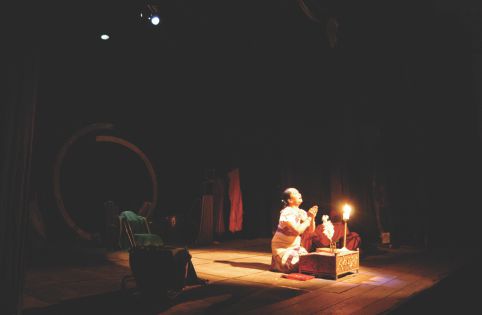
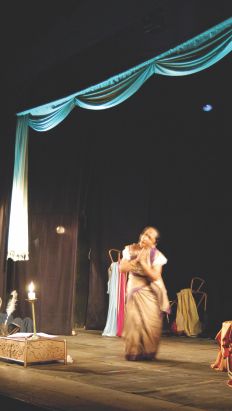
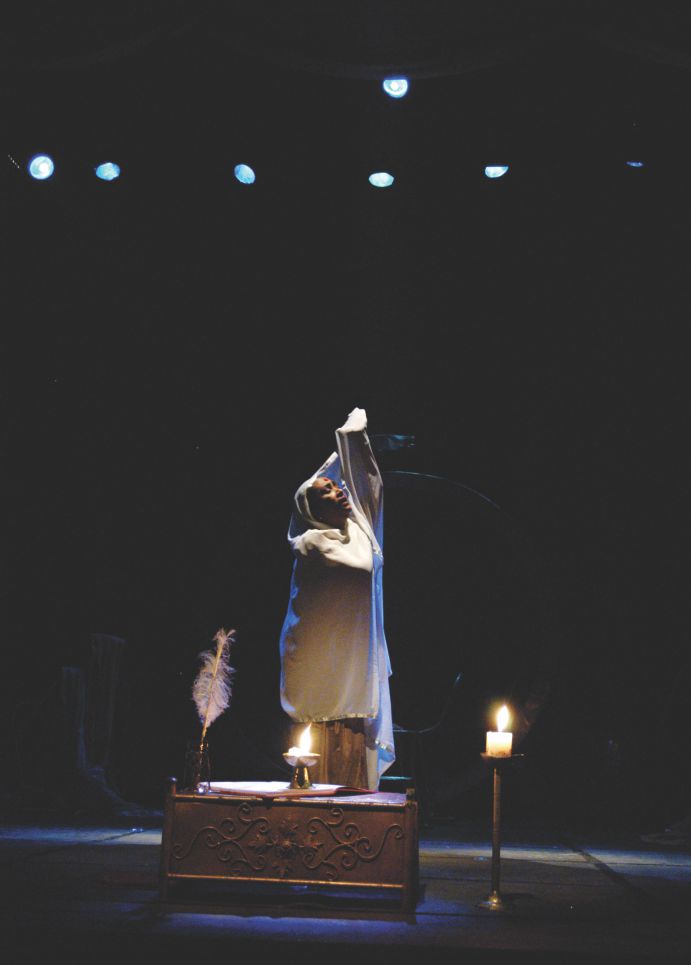
Dhaka Theatre, one of our more adventurous thespian troupes, has cleverly reincarnated Binodini in an 85-minute autobiographical play with a single actor the virtuoso Shimul Yusuf telling her life story. This is not the first time that Binodini has been made the subject of a play. We know that there is a ‘pala’ or ‘yatra’ play about her which has been performed in India. But Dhaka Theatre’s approach is very different. The background information provided in the theatre programme reveals that Dhaka Theatre had first asked Salim Al-Deen to write a play on Binodini’s life. It was Al-Deen’s suggestion that Binodini be reincarnated with the help of her own words; anything else would lack absolute authenticity. Accordingly, Simon Zakaria was commissioned to edit Binodini’s autobiographical writings to prepare a script for a solo performance. To add variety and heighten emotional colour, a few of her poems were set to music by Shimul Yusuf, and snatches from five of the eighty plays in which she had acted were incorporated with the stage Binodini enacting all the roles. In directing the play Nasiruddin Yusuf has used an effective mix of elements from physical theatre, Kabuki, and musicals. First performed on 18 February 2005, at the Mahila Samity Auditorium, Dhaka, ‘Binodini’ has by now had several dozen shows, and is destined to have a long stage life.
I have three caveats, though. First, I do not think retaining the ‘sadhu’ (formal) idiom of Binodini’s prose is a good idea. True, it enables Dhaka Theatre to claim that the play is 100% authentic Binodini, but we have to remember that the words of the autobiographical works were meant to be read or read out but not spoken. And theatre, if anything, is speech. Even nineteenth century plays, it is worth pointing out, such as Michael Madhusudan Dutt’s, were written in the ‘chalti’ (spoken) idiom. Nothing, dramatically speaking, would have been lost quite the contrary if Binodini’s ‘sadhu’ narrative had been quietly converted into a ‘chalti’ monologue.
Second, the extracts from the five plays are something of a distraction. A line or just a phrase for each play would have been enough by way of an allusion to her life on stage. The long extracts only divert our attention from Binodini’s intriguing personal narrative. Finally, the dominance of black in the set seems to be not wholly appropriate. After all, despite the anguish, Binodini had more than her share of excitement and ecstasy as well.
Shimul Yusuf has demonstrated admirable stamina in her role, and even if the strain may show at odd moments, she does succeed in carrying the audience along, from the naive excitement of landing an actor’s job at ten rupees a month when still a child, through her mature triumphs, her heartbreak, bereavement (plangently captured in a song), professional disappointments, to the melancholy apercus of her old age. Here’s one that still resonates in my inner ear, somewhat ineptly translated: ‘Even the sweetest experience can turn into gall in recollection.’ The distinctive flavour of an articulate subjectivity that we find in Binodini is no doubt an outcome of the infusion of modernity in post-Plassey India. Hers was not a lone voice either, for I recognize a spiritual kinship between her and her Urdu-speaking demi-mondaine contemporary, Umrao Jan Ada.
For those of us who take an interest in the inner workings of colonialism, Binodini’s account of the imbroglio precipitated by a performance of Neeldurpan in Lucknow is a sparkling gem. Here are a couple of paragraphs translated by Raha in Bengali Theatre:
Well, the play started. The programme note was printed in English and had a short outline of the story. At first we were uneasy and had a feeling of fear. But it disappeared as the play progressed and we started acting with enthusiasm.
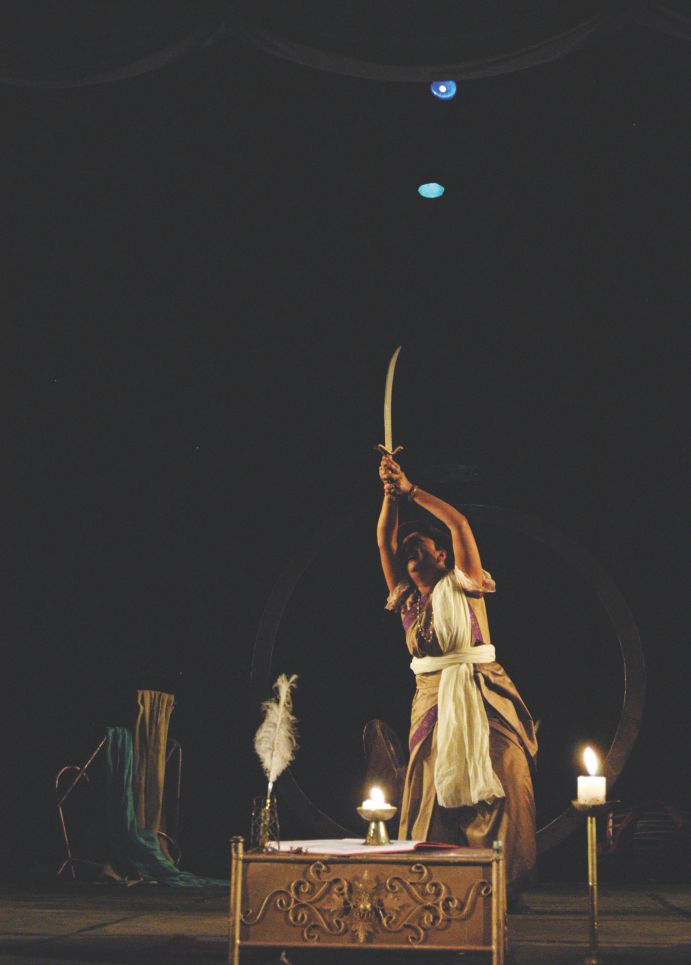
Came the scene where Rogue Sahib tortures Kshetromoni, and Kshetromoni to save herself cries out Sahib, you are my father, please let me go . . . Then Torap came and holding Rogue by the throat began kicking him. As soon as that happened there was commotion among the European spectators. They became agitated and crowded near the footlights. A few red-faced soldiers took out their swords and climbed on the stage. Others tried to hold them back. Oh, what commotion! what running about! The drop curtain was immediately pulled down. I thought, they would surely behead us.
Anyway, some of the sahibs went away but a few, still enraged, were on the stage. The Magistrate had meanwhile sent for a company of soldiers from the fort. Things calmed down when they came. Magistrate Sahib stopped the play and asked for the manager. Everyone started looking for Dharmadas Babu but he could not be found. After a lot of searching he was found sitting motionless under the stage. Kartik Pal started pulling him by the hand but he would not budge. So the assistant manager Abinash Babu went to see the Magistrate, taking Ardhendu Babu along. Magistrate Sahib said, ‘Cancel the engagements here. I am giving you police protection. Let the females leave. There will be a police guard for the night. The Europeans are greatly agitated. You better leave Lucknow.’ The women in the party then left for our boarding house. Many actors followed us. Scenes, dresses were all left behind in the custody of the police.
The exposé of the ludicrous infantilism of the sword-waving British soldiers who leapt onto the stage is enough to rid one of any lingering illusions of the psychological superiority of the colonizer. For the present writer at least, ‘Binodini’ has been both emotionally engaging and historically educative.
Kaiser Haq is a member of the Jamini editorial board
Photos: Din Muhammad Shibly
When one thinks of the history of the stage, or the cinema, it is the celebrated actors who first surface in the consciousness. And among them, I daresay, it is the women whose presence lingers, haunts us ineluctably. Sarah Siddons, Lily Langtry, Sarah Bernhardt, Greta Garbo, Marilyn Monroe. None of them yields in iconic lustrue…