
the art of alighiero boetti and donald judd craftsmanship and collective work in contemporary art
Alighiero Boetti and Donald Judd are two artists who have used external collaborators, those existing outside and not involved with the conceptual stages of preparing the artwork, in the creation of their art. They do so by using skills commonly associated with handmade crafts. Giorgio Guglielmino examines the close ties between two separate modes of expression – the craftsmanship of humble folk art and the elitist concepts of contemporary and conceptual art.
The use of craftsmanship in Western contemporary art – although it did not enjoy a vast and varied influence – is, nevertheless, present as an essential component in the works of a few important artists. Even though the end results may differ considerably, for such artists the practice of craftsmanship, in the sense of employing the collective hard work of others to create a work, has not only an aesthetic value, but also a conceptual one.
The Italian artist Alighiero Boetti and the American artist Donald Judd – though vastly different from one another – are two artists who collaborate with workers and craftsmen to create their art. In both instances, the collective or “external” effort, in relation to the original concept as envisaged by the artist, represents an intrinsic component of artistic conceptualization, of the manner in which a work is perceived and, ultimately, of the predominance of concept over form.
When Boetti and Judd’s works are compared to Marcel Duchamp’s readymade, a difference is observed. With Duchamp, one witnesses the conceptualization of a pre-existing object. The de-contextualization of the object – and thus, its removal from its natural context or from its common use (for instance, the bicycle wheel, or the bottle rack) – turns it into a work of art because the artist makes the object his own. In the case of Boetti and Judd, on the other hand, the object shaped by the craftsman or worker is created with the artists’ specific instructions and, without the original idea behind it, it would never have existed.
Alighiero Boetti (Turin 1940, Rome 1994) belonged to the Italian “Arte Povera” movement which began in Turin at the end of the 60s and came into its heyday in the 70s. While the other exponents of the movement created works (sculptures, in particular) using deliberately “strong” mediums (carbon, steel, lead) far removed from those of classical sculpture (marble, bronze, clay), Boetti has used extremely coloruful everyday elements and commissioned teams of craftsmen or specific groups of people to produce his works. In this way the artist has involved an extremely skillful number of external collaborators in his art.
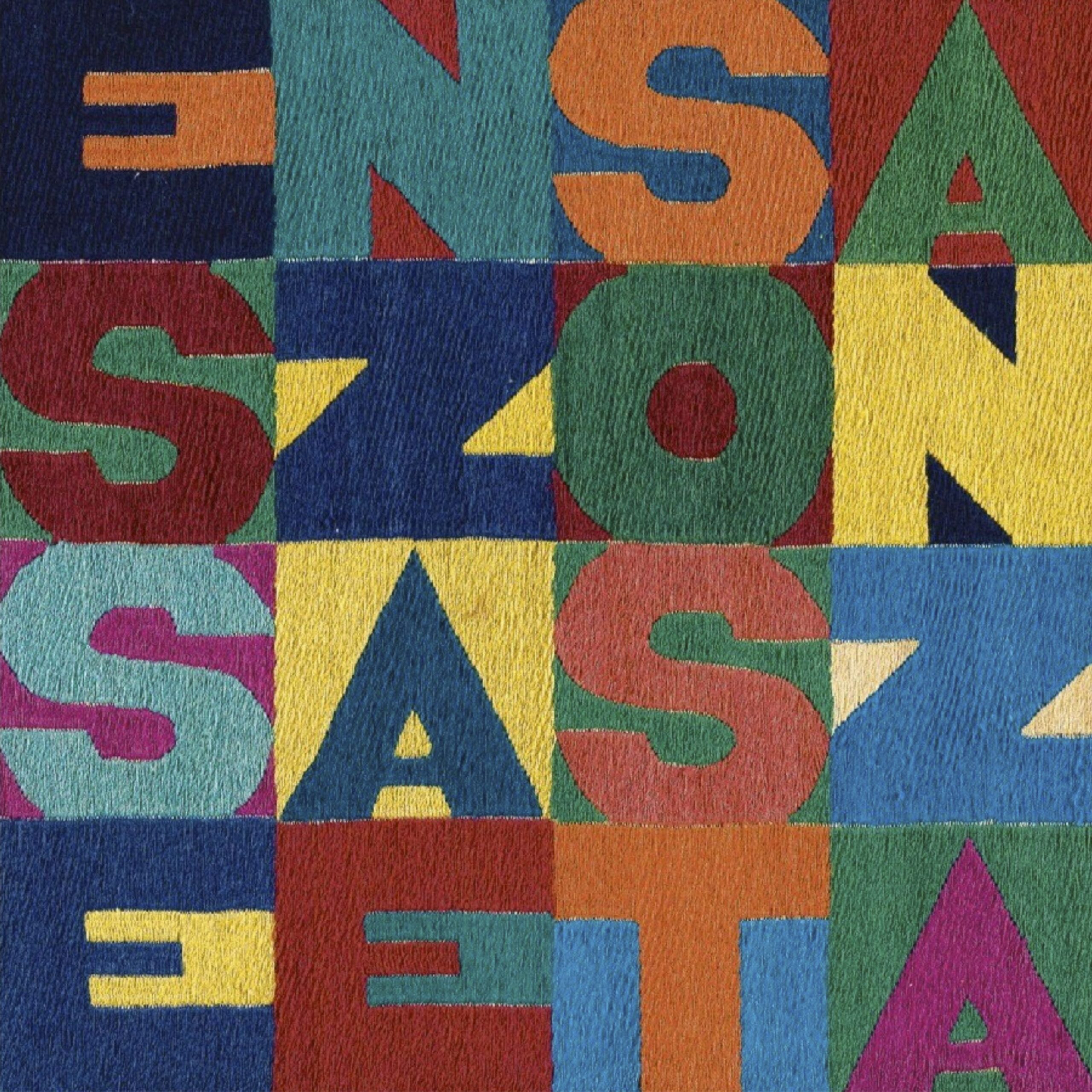
Alighiero Boetti’s best-known works are his embroideries. The artist thought of phrases made up of 16 letters (in the case of the smaller hangings), sometimes going up to 25 or even a few hundred letters, in order to fill up all the empty spaces in a square grid. He then commissioned female weavers to create embroideries that contained his sentences that were intended to be read from top to bottom, and written out in block capitals.
Some of the smaller hangings carry very simple phrases, such as IMMAGINANDO TUTTO (IMAGINING IT ALL) or CINQUE X CINQUE VENTICINQUE (FIVE TIMES FIVE IS TWENTY-FIVE). Up until the Soviet invasion of Afghanistan, Boetti commissioned Afghan women to create his tapestries and then, subsequently, shifted production to Pakistan.
In spite of the artist’s many visits to Kabul, where he also lived for a while, he inevitably commissioned works from a distance most of the time, often leaving weavers ample freedom in their choice of colour combinations. Once a phrase was chosen, the entire craftsmanship and creation process was carried out by local women who were a great distance away from the artist, not just physically but also socially and culturally. The embroideries were then shipped to Italy where artists would sign and exhibit them.
Another really well-known series of works by Boetti is Biro, named after the famous ‘Bic’ ballpoint pen. Here too, after having devised a few words or even a sentence, Boetti would hand out sheets of white paper along with a few ballpoint pens to inmates or former convicts with specific instructions on how to “write down” the words: all letters of the alphabet to the left with a comma after each of the “useful” letters. The six letters making up the word VEDERE (to see) are identified by commas on the sheet of paper covered for the most part in small vertical blue-ink strokes. An extreme example of such collaboration was obtained in the creation of one of Boetti’s later series of works with the help of students from French art colleges and the skilled craftsmanship of hundreds of Pakistani rug weavers.
In this case, Alghiero Boetti gave 100 groups of students 100 grids made up of 100 squares each. Each grid or board, ten by ten squares, had to be filled in following a given pattern: in the first grid, an initial white square was followed by all-black squares; in the second grid, two black squares were followed by all-white squares; in the third grid, the first three squares were white, the rest black, and so on. Students were given total freedom in how they chose to alternate the white and black squares. 100 completely different patterns were created by the 100 student groups involved. These patterns were subsequently reproduced on just as many tapestries. In this case, the artist simply worked an abstract idea – the alternating pattern of white and black squares – that took physical form in the imagination of the students and that was later reproduced by the craftspeople. This process was akin to the work of the artist being pared down to the bone, to the bare minimum, to the unique creative moment at the heart of the idea driving the work.
Donald Judd (Excelsior Springs 1928, New York 1994), along with Dan Flavin and Carl Andre, belong to the American Minimalist movement and is one of its major exponents. Judd’s minimalism could not be further apart from the colourful cheerfulness and light imperfections characteristic of the handwork permeating Boetti’s creations. Not surprisingly, Donald Judd preferred to use industrial materials, preferably iron and Plexiglas, to produce aesthetically cold, and perfect end products.
Judd always used skilled workers and industrial production-line factories in the creation of his works and never created a single item within the confines of his studio. Thus, even in his case, the creation of the work was entrusted to external individuals who produced the pieces by following the artist’s instructions. The artist’s lack of hands-on involvement was key to Donald Judd’s conceptual work.
It is important to point out here that the actual makers of such works, both as regards to Boetti and Judd, were not the artists’ assistants. It is different with artists like Damien Hirst, Jeff Koons, and Takashi Murakami, who in the past have transformed their studios into factories (some of them ended up employing about eighty assistants at one time), where paid full-time staff worked constantly under their supervision in creating pieces or complete works of art.
The creation of works by people from outside the art world (craftspeople in the case of Boetti, workers in that of Judd) was a crucial component in their concept of the artist’s creative moment, although it was totally separate from the actual production process.
Alighiero Boetti and Donald Judd are two artists who have used external collaborators, those existing outside and not involved with the conceptual stages of preparing the artwork, in the creation of their art. They do so by using skills commonly associated with handmade crafts. Giorgio Guglielmino examines the close ties between two separate modes of…