

romance and reality
Farida Zaman, perhaps our best known woman artist has had an important show in Dhaka. Syed Manzoorul Islam has been to this significant event
Even before she was exposed to the narrative tradition pursued by the Baroda school of artists in India (where she went for an MFA degree in early 1980s), Farida Zaman had developed her own style, which blended aspects of the abstractionist practice in vogue at the time in Bangladesh, and elements of folk narrative she had picked up from the riverine communities of her native Chandpur. She had been strongly attracted to the life of the fishermen, half of whose time was spent on the river, casting nets, negotiating the strong currents of the river Meghna, and often venturing out at night for a bigger catch. The womenfolk dried the nets and helped with sorting the fish, shooing off stray cats that waited for their own share of the fish as the children played or slept nearby.
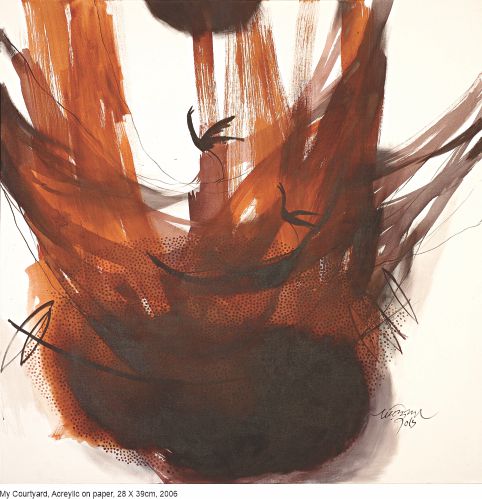
Given in such bare outlines, the story seems a routine one, devoid of passion or power. Yet a closer look reveals certain facets of the story that can be the subject of romantic musings or sociological investigation. The river in moonlight, for example, or the fish dancing in the cool depths of water, or a white stork perching on the edge of a courtyard, or a woman plying a boat as a crescent moon hangs in a corner of the sky easily suggests a romantic mood. Farida takes on these elements quite generously and paints them on her canvas. But she does not allow the viewers to forget the other side of the story: the daily struggle of the people to survive. Her women and children look thin and emaciated—a reflection of the poverty and malnutrition stalking even such peaceful communities. The fish swim happily in their watery world, oblivious of the nets that wait to close in on them. Are the fish symbolic of common people whose freedom is constantly encroached upon by various systems including the state? Do the nets represent the latter? What about the clever cat, waiting for an opportune moment to run away with its own catch? Does it also indicate, on a smaller scale, the exploitation of the poor by the wily wielders of power?
These unsettling questions however, remain mostly in the background of Farida’s paintings. These are not unimportant though and Farida doesn’t want her viewers to lose sight of them altogether. What her paintings do however, on a first encounter, is engage the viewer with an idyllic, and colourful world of clean-swept courtyards, rain-soaked countryside and contented people who dream and deal with life with courage and commitment. It’s also an aquatic world of fish, fishing nets, boats and the lapping sound of waves licking the banks. It’s the happy world of dreams, quiet contemplation and childhood memories. Farida sees it replicating the life that goes on in the larger canvas called Bangladesh.
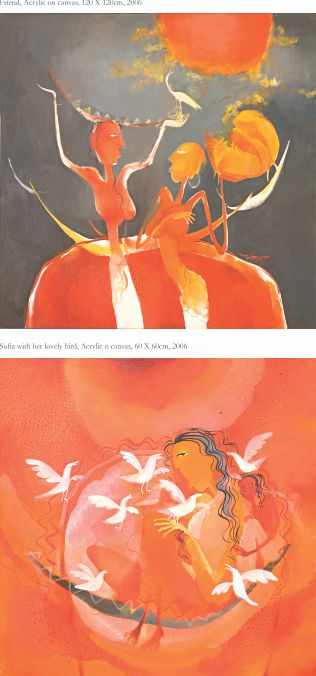
Farida Zaman’s 5th solo exhibition, My Country, My Love at the Bengal Gallery of Fine Arts (8-21 August 2006) focuses on some of the themes that recur in her work—the life of the fishermen, her nostalgia about the passing away of a glory from the world she knew and her desire to reconstruct it, the women and children whose life has been increasingly marginalized, for example. In her last solo exhibition held four years ago at Chitrak Art Gallery in Dhaka, one noticed a shift from her usual preoccupation with fish, fishing nets etc. She introduced a girl child named Sufia, who became a haunting reminder of lost childhood and the increasing marginalization of children. Yet her treatment was never loud: rather, through a colour scheme that depended mostly on juxtaposing loud colours with their different shades (she introduced moss green, which she used with remarkable abandon), Farida seemed to highlight the child’s happy moments.
In My Country, My Love, Farida has brought together most of her earlier preoccupations, but there have been some distinct developments—if not changes—too, that remind us of her power and poise as an artist. Her line drawing has become bolder and her colours have become more robust. There is also a closer and tighter assemblage of motifs and a more uncluttered use of space. She is using design elements—a throwback to her Baroda days—more freely, and her execution is assured and even masterful.
Back in her early days, Farida’s repertoire of motifs and images was limited to a few recurrent ones—fish and fishing net, for example. Yet she had been capable of striking variations with these simple objects. In the 1982 Delhi Triennale, for example, she was given an honourable mention for her six paintings on the theme of fishing. Over the years, the nets assumed different compositional qualities—their triangular or vertical and perforated forms and the curves and sweeps they evoked, for example—which she put to good use. Farida used to work in oil, which accounted for the rather dense texture of the nets. As she kept exploring the life of people in fishing communities, more motifs and images emerged. Soon, Farida’s canvas began to resonate with not just the rhythm of the life of such communities, but the elan that energizes the life of Bangladesh as a whole. In My Country, My Love, Farida has dwelt on the larger picture of the country: therefore the rain, the dreams that Sufia or the fisherwomen dream, the river scenes that are so evocative of Farida’s childhood memories of the Meghna expand both in their connotative and emotive aspects. The colours of Bangladesh now help Farida tell her story—yellow, red, and blue, crimson, deep green and brown dance with the rhythm of changing seasons—replicating the magic elements that bind people to elemental nature.
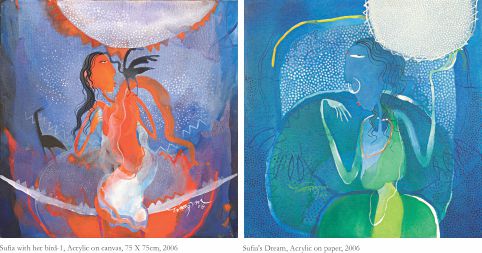
In painting the land and the people, Farida allows a degree of romanticism to enter her canvas. Once again, it is the colours that establish the romantic ambience. In most of her paintings, particularly the larger ones, different shades appear side by side, or overlap, but Farida’s use of acrylic allows for a degree of transparency, even luminosity, adding to the romantic ambience. In lieu of texture, Farida uses a series of dots that work as design elements, but also function as shimmering reflections of sun or moonlight on the river. The dots also help frame an image in spectacular outline.
Farida Zaman’s technique has shown more and more versatility as she has moved forward as an artist. She now has an insider’s assurance when dealing with the land, the river and the people she knows, and she translates this assurance into a bravura performance each time she puts her brush to canvas.
Syed Manzoorul Islam is a member of the editorial board of Jamini.
Farida Zaman, perhaps our best known woman artist has had an important show in Dhaka. Syed Manzoorul Islam has been to this significant event Even before she was exposed to the narrative tradition pursued by the Baroda school of artists in India (where she went for an MFA degree in early 1980s), Farida Zaman had…