

remembered images
The sixth solo exhibition of Rafiqun Nabi’s paintings (Bengal Gallery, Dhaka, 20 November-3 December 2006), was aptly titled Down Memory Lane—as all but a couple of the 76 works done in watercolour, acrylic, oil, mixed media, pastel, pen and ink and lithography are reminiscences of a time spent in the midst of nature, in a village whose homesteads were green to the very door, and among people at work or in repose
The paintings bring together an incessant string of associations that rise up from the artist’s well of memories and create their own patterns on the canvas. The quiet but intense life that goes on in Bangladeshi villages, the sights and sounds of each changing season and the birds and animals that are an inevitable part of any rural experience—all figure prominently in Nabi’s work. The impressions these images make on him, despite the filters of time and space through which they travel, are surprisingly fresh and graceful, often bright and clear. As if Nabi has journeyed through time without gathering any dust or grime, and arrived at his past with a fresh pair of eyes, ready to take on the scenes that he encountered as a child. And these scenes are usually peopled by men and women of various occupations—peasants, cowherds, fishermen, boatmen. Beyond these clusters of people, however, Nabi often places images that fascinated him as a young boy —a train moving at slow speed, a bridge casting its shadow on the river below, fish drying in the sun from lines of rope. The world that Nabi paints still exists, but in a much diminished manner, losing much to the concrete and asphalt of a persistent urban spread, and he feels the urgency and anxiety to reconstruct the threatened images before they are gone forever. This perhaps explains the frenzy with which, only in six months or so, Nabi did the bulk of the work.
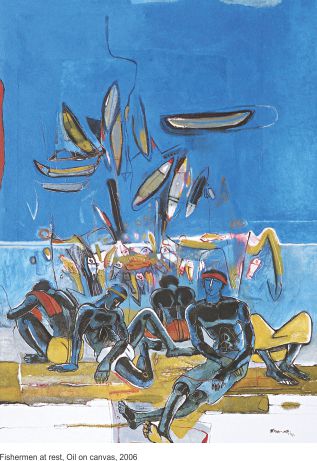
Rafiqun Nabi is a painter and printmaker of distinction, but he is equally well-known as a cartoonist. For more than three decades now, his cartoons have regularly appeared in national newspapers and magazines, lashing out at social injustice with biting satire, and a tongue and cheek humour. The cartoon series Tokai, where the street urchin Tokai (literally someone who collects scraps from the street for a living) dumbfounds the gentlefolk with his incisive and unsettlingly witty questions and comments, has been one of the most popular ever. Although the subject of an earlier solo exhibition (2004), Tokai doesn’t figure in his latest exhibition but traces of his presence are visible in the way Nabi draws his human figures, showing telling signs of deprivation and neglect. As in his cartoons, the line drawings in many of the pen and wash and charcoal pieces are sharp and powerful. Overall, however, Nabi’s depiction of the human scene is optimistic, as it is in his cartoon drawings, despite the rather gloomy social background from which they emerge. Nabi puts his faith in the social energy that drives the people forward in life, even the most marginalized ones. This is all too evident in the exhibition, especially where clusters of people are seen at work, or idling around between chores. The same is true for his cartoons.
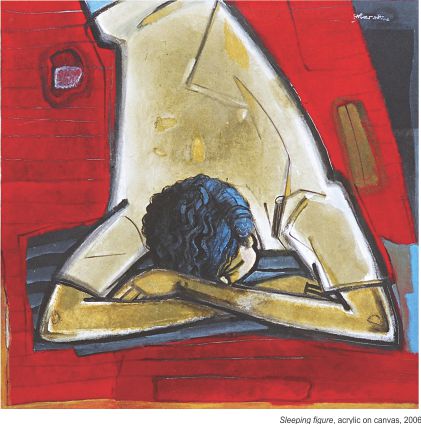
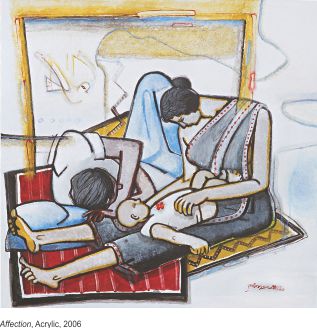
If a concern for a vanishing world where people lived in intimate contact with nature and a celebration of social energy are two important aspects of Nabi’s work, there are a few more that deserve mention. There is, for example, the narrative content of his paintings that is hard to miss. Each painting seems to tell a story—a young man catching some sleep in what appears to be an acrobatic repose (since the depiction of the figure is vertical); a family of three sharing a moment of rest, with the child lying on the mother’s lap while the father stretches out next to the sitting mother, a girl reclining in bed (probably dozing off while reading a book), a hill woman bathing, birds having a sunbath or a train on a railway bridge. These are not random snapshots, or scraps of memory without any association. These are vignettes of life stories that the artist reconstructs from lived experience. These are ultimately from the world around him, and are therefore tangible and palpable. Nabi’s remembered moments are therefore not all lost irretrievably in the maze of time — they survive both in the endless repetition of life stories that daily unfold in rural Bangladesh, appearing to collapse the barriers of time and space. What Nabi emphasizes, however, is that although the content of these stories has changed, their form remains pretty much the same. In this reassurance of continuity, for the time being at least, there is much to rejoice. Nabi’s images thus have a metamorphic and balancing quality. They are both remembered and real; the drama they play out is harsh but reassuring in the end. Nabi is both a dreamer and a man of this world. If his images have an openness of memory, these are counterbalanced by carefully stacked forms and figures from reality, firmly checking the contradictory pulls of a time past and time present.
Another aspect of Nabi’s work is an expression of the pure and simple joy of life. This is evident in the way his men and women, birds and animals, even inanimate objects such as boats are placed in intimate association with nature or against a vast field of space where a feeling of openness predominates. Many of his works in the exhibition, especially the three large oil paintings, have a cluttered surface area—there are simply too many people and objects sharing the available space—but if one observes closely, they appear distinct from one another, each inhabiting an unhurried, personalized space where they are free to do what they desire. For an eye accustomed to seeing frenzy and mad rush in crowd scenes, such separate peace seems astounding. But this is what Nabi looks for in his canvas. His crowds may give the impression of a jostling, struggling group of people from a distance, but upon close examination, each individual seems to be in control of themselves—what makes them so alike yet so separate is their essential humanity and the way they carry themselves, graceful and poised. They are individuals first, with a capacity to feel, dream, and imagine, and yes, fantasize.
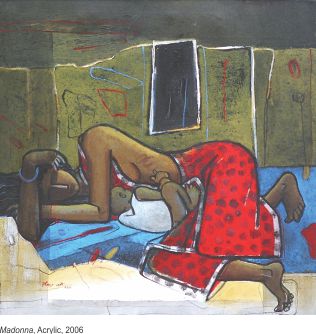
Nabi, in spite of his modernistic aspirations—manifest in his stylistic range and versatility, and his social content—does not go for surrealism or pure abstraction or any of the abstract modes widely practiced by his contemporaries. His basis is realism, although its expression often takes stylized forms, but he does make use of an element of fantasy whenever he feels like accentuating a sense of wonder, or happiness which marks out an experience.
If one is impressed by the variety of media and the range of style evident in the solo exhibition, Nabi himself admits as much. He finds it both exciting and challenging to ‘bring all these diverse media and the different techniques they entail’, as he puts it, ‘and place them on an even keel’. How does one balance, for example, the illustrative tendencies or the two dimensionality of perspective in some of his work with the rigours of the realistic mode? How does one accommodate within the technique-driven lithographic mode the soft tonality of watercolour, or an outburst of loud colours—colour, in this case, being understood as a quality of form? For an answer, one has to look at the careful way Nabi works at achieving the maximum effect of all the techniques and styles that he employs. His line drawing is robust but controlled; he often uses thick outlines and contours to mark off his figures or objects from one another (thus accentuating their separate identities). His figures are often monumental, displaying a sculptured finesse. He plays with perspective, creating optic illusions, and suggestions of depth or closeness or opacity, but at other times, allowing it to stretch to infinity, suggesting openness and freedom. This contrast is important for Nabi, as most of his paintings in this exhibition straddle two different time frames at the same time.
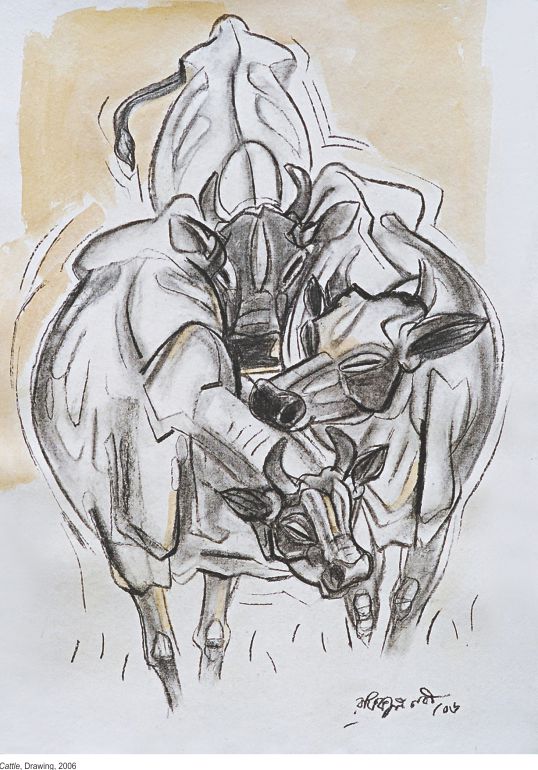
Rafiqun Nabi had his art education at the Institute of Fine Art of Dhaka University at a time when such pioneers of modern art in Bangladesh as Zainul Abedin, Shaifuddin Ahmed, Qamrul Hasan and Mohammad Kibria were teaching and actively contributing to the modern art movement—(Nabi passed out with a Bachelor’s degree in Fine Art in 1964). They have left their mark on his style, particularly the way he goes about his figuration and draws birds and animals. There is an uncanny resemblance, for example, between Nabi’s crows and those that Zainul Abedin immortalized, making them symbols of human greed and cleverness. But Nabi sees this influence more as sharing the same attitude to drawing. Like his mentor, Nabi believes in authenticity and uniqueness. A crow of today is the same as a crow of yesterday, but the way it is used in creating a mood or ambience differs from artist to artist. If Zainul’s crow is more like Ted Hughes’, Nabi’s crow is a happy creature sharing in the rhythms of life with all the other birds and animals and human beings. The crow—and animals such as the cow or the buffalo—as well as drawings of human figures point at an intertextual referencing at work in Nabi’s work.
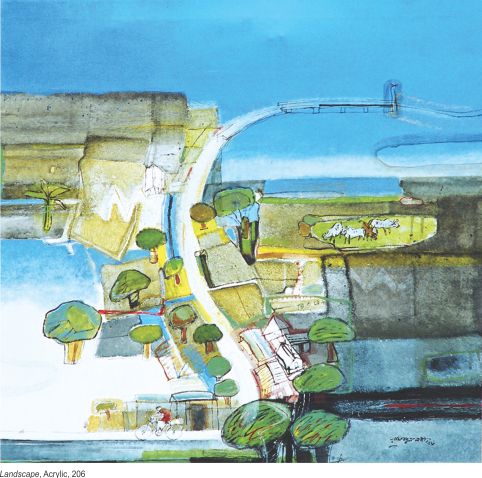
Given the nature of his work, and the intention that underlies them—which is recounting time past and blending it with time present for a celebration of life’s little joys and moments of respite from harsh reality—such intertextual referencing perhaps becomes inevitable.
Syed Manzoorul Islam is a member of the editorial board of Jamini.
The sixth solo exhibition of Rafiqun Nabi’s paintings (Bengal Gallery, Dhaka, 20 November-3 December 2006), was aptly titled Down Memory Lane—as all but a couple of the 76 works done in watercolour, acrylic, oil, mixed media, pastel, pen and ink and lithography are reminiscences of a time spent in the midst of nature, in a…