

ranabi in retrospect rafiqun nabi in 2013
In 2013, three exhibitions showing Rafiqun Nabi’s artworks once again proved how deeply committed the artist is to the land and the people. His paintings and prints evoke the fleeting as well as the eternal in our lives and landscape, as they reveal magical moments that transform our daily struggles into celebrations of life and its wonders. His cartoon comic character “Tokai”, which was also featured at one of these exhibitions, has achieved iconic status as a commentator on the incongruities and inequalities that have dominated the nation’s life.
Rafiqun Nabi was born in Chapai Nawabganj in 1943. His father was a police officer and his mother a housewife. Nabi’s parents were supportive of their son’s artistic talents and encouraged him to pursue art. He enrolled in the Bangladesh College of Arts and Crafts, (now known as the Faculty of Fine Arts at the University of Dhaka) and earned his bachelor’s degree in 1964. Here Nabi met and studied under many great masters of Bangladeshi art, including Zainul Abedin, Safiuddin Ahmed and Mohammad Kibria. During these formative years Nabi developed his signature visual style and came into his own as an artist and printmaker. He then went to Greece where he studied printmaking at the Athens School of Fine Arts. When he returned in 1976, he began the Tokai comic strip. The cheerful, bald and pot-bellied street urchin became one of the most beloved characters in Bangladeshi media and made Rafiqun Nabi, or ‘Ranabi’ as he is also known, a household name. He received numerous awards during his illustrious career, including the Bangladesh Shilpakala Academy Award in 1989, the Tri-Taranga Gold Medal in 2000 and the prestigious Ekushey Padak Award, one of the highest honours given to any Bangladeshi artist, in 1993.
His works were shown in three memorable exhibitions in 2013. The first of these was “In Touch with the Real”, a ten-day long solo exhibition which began on April 12 at the Dhaka Art Center. The works on display represented themes and motifs from Nabi’s career, including scenes with buffalos grazing in open fields and fishermen playing cards on boats moored by the shore. “In Touch with the Real” stands out from among Nabi’s oeuvre with regards to the size of each painting in the exhibit. The artist worked on large canvases for the 27 paintings on display at the exhibition, paying close attention to detail so as to render every person, animal and backdrop with unique touches. The large canvases also allowed his viewers to examine the works more closely, thereby establishing an intimate connection between the artwork and its audience. From a thematic standpoint, his decision to use these immense spaces for his paintings imbues these ordinary scenes with a sense of grandeur, as if to bring those quiet moments in our daily lives, which we might have otherwise missed or not thought twice of, to the fore.
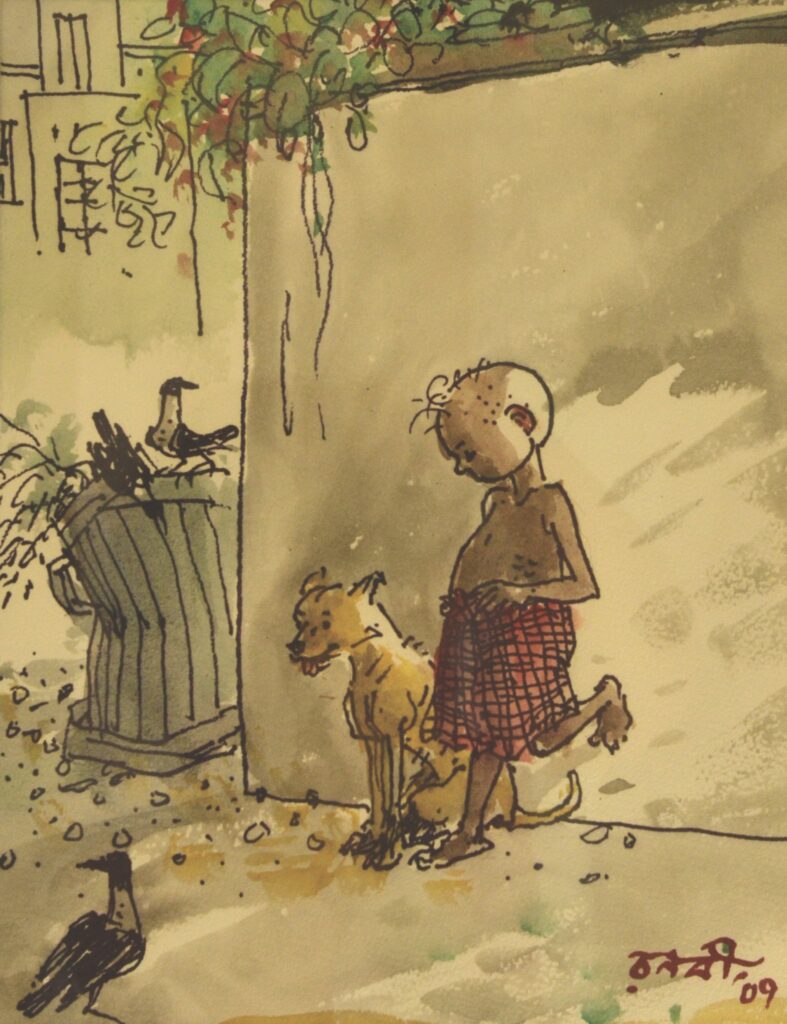
Ranabi’s Tokai comic strips and paintings were displayed at the Bengal Art Lounge as part of the “Very Graphic” group exhibition on November 26. The show featured several artists who work with comic books, animation and graphic novels. Alongside Rafiqun Nabi were Shishir Batthacharjee, Ahsan Habib, Sabyasachi Mistry and British graphic novelists Karrie Fransman and Steven Harris. It was Ranabi who many years ago laid the foundation of graphic art in Bangladesh through his Tokai comic strip. The exploits of a lunghi-clad child who sifts through garbage to survive, the titular Tokai served as a vehicle for the artist’s often scathing criticism of modern Bangladesh.

In December, the Bengal Gallery of Fine Arts hosted a thirteen-day long career retrospective exhibition of Rafiqun Nabi’s art to celebrate his 70th birthday. The event, titled “Quest for Reality”, featured 120 selected works spanning five decades of the prolific artist’s career. Begum Jahanara Abedin, widow of Zainul Abedin inaugurated the exhibition while art collector Syed Durjoy Rahman Joy, eminent artist Qayyum Chowdhury and editor of Prothom Alo Matiur Rahman attended as special guests. This collection featured Nabi’s work across multiple mediums including paintings, woodcut prints and drawings which chart his creative journey from his early paintings to his most ambitious works. A number of themes and motifs which have become synonymous with the artist during his career could be seen at this exhibition. His most frequently revisited subjects include fishermen, buffalos, birds and landscapes. Nabi rendered rural life with a style that blended elements of romanticism, impressionism and experimental realism and uses lines and vivid colours to paint scenes of unmatched beauty. In addition to his work with pastoral motifs, his nude sketches, Tokai paintings and cityscapes were exhibited as well. The intrinsic relationship between man and the natural world is one of the central themes of Nabi’s artwork. We see it mature as the decades pass and the artist develops his own visual language.
The artist’s playful style and mastery over the elements of art allows him to come up with an honest and beautiful portrayal of the everyday realities of life in Bangladesh. In Fishermen (2012), the colour blue dominates the artist’s palette in this work, a scene set on water sometime in the evening. There is no horizon separating the land from the sea, suggesting that darkness has blanketed the landscape. The day’s catch is placed at the centre of the busy frame and acts as the principle source of light in the image. Nabi expertly uses light and shadow to emphasize this aspect as the glow from the net strikes the fishermen’s dark shapes, allowing us to make out their expressions of jubilation. By acknowledging their joy at the catch in such a manner, Nabi highlights man’s dependence on nature, as a source of food, income and personal happiness. Nabi has also included scenes of urban life in these paintings. He infuses dull grey buildings with brightness and sets a cheerful tone. In Family (2013), a family of five is seen sitting in their living room. The father sits with his arms wrapped around the small child sitting on his lap while the rest of his family crowds around him. The patriarch is in the centre of the frame, protecting his youngest child while his family vies for his attention. This painting shows the closeness among members of a family and reminds us that even amidst the chaos of city life there are still tender moments to cherish.
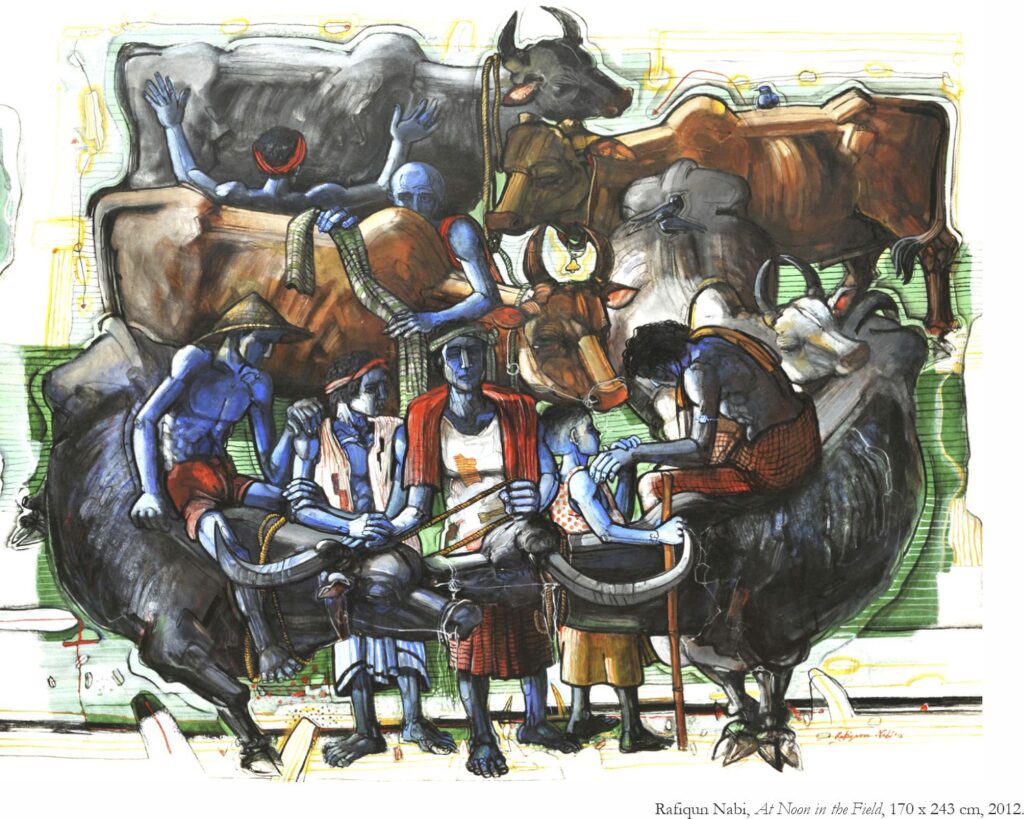
At Noon in the Field (2012), shows several cows standing in a field with their herders. The men appear to be tending to the cows, petting and washing them with pieces of cloth. Each individual face and figure in the image is expertly detailed. The men wear unique lungis, headbands and straw hats. The cows stand in distinctive poses; one wears a bell while another has a rope draped over its neck. In Fishermen at Rest (2012), we find a small group on a boat, huddled together as it winds its way down a river. A man rests his elbow on his sleeping companion and smoke hookah, the men in a small group of four play cards in the corner while one of them plays the flute. Nabi makes good use of the additional space he has with these large canvases by painting with exquisite details. In this image, we can make out some of the cards in the players’ hands and see each individual’s face as they either sleep or look around. The artist seems to be concerned with showing relationships between man, the land and nature and with each other. He shows the thematic intimacy between these elements by placing these figures in close physical proximity with one another.
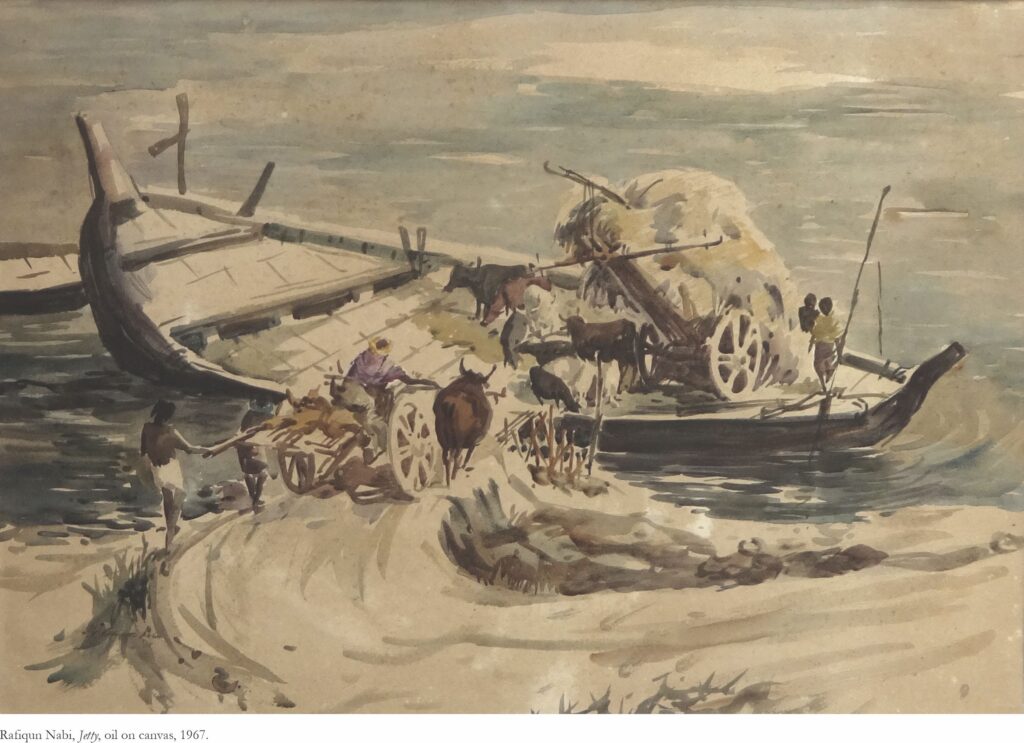
The backdrops of some of these images, crowded with human and animal forms, are full of colour but lack the level of detail present in these narrative’s central characters. Nabi compensates for this absence of scenery with his landscape paintings which show the artist’s skill in rendering the natural world on canvas. In one of these works, Sitakunda (2013) we can see a train weave its way through lush green scenery. Nabi makes use of line to add scale and depth to the brown hills in the background, and suggests a sense of movement in both the speeding locomotive and nearby trees. Sea Beach-1 (2013) presents a tranquil beach scene. Three fishermen wade through the water with nets, leaving their boats on the sandy shore. They seem to disappear into the deep blue hue of the sea. A flock of birds have gathered on a boat, watching the fishermen as they work. Nabi has featured fishermen in many of his paintings, immortalizing their everyday struggles and moments of joy. A third landscape painting, A Hill Tract Valley (2013) shows a village nestled in the mountains. Crowds of people gather in front of the busy shacks below as tall hills loom in the background. The sky is painted in a pleasing shade of yellow suggesting that the scene is set sometime during the late afternoon. Nabi’s skill with landscape infuses even the most mundane settings with a sense of life.
The artist’s optimism and humour in these exhibitions is not only a refreshing break for art lovers but also provides an intimate experience where the viewer is able to connect with the characters and narratives he has drawn. Nabi paints his expressive characters and gorgeous landscapes to remind us that the things we love about our country still affect us. Through his expressive characters and gorgeous landscapes Nabi paints a window of the placid side of Bangladesh.
In 2013, three exhibitions showing Rafiqun Nabi’s artworks once again proved how deeply committed the artist is to the land and the people. His paintings and prints evoke the fleeting as well as the eternal in our lives and landscape, as they reveal magical moments that transform our daily struggles into celebrations of life and…