

beyond the western horizon pre-colonial and post-colonial art
A number of years ago, when I was in Perth on the first leg of a trip across Australia, I was fortunate enough to be hosted by the distinguished academic, Sister Veronica Brady, a member of the order of Loreto noted for her work with and on behalf of Aboriginals. We talked about my impending flights across the continent and she told me something which, to be honest, coming from almost anyone else, would have filled me with deep scepticism.
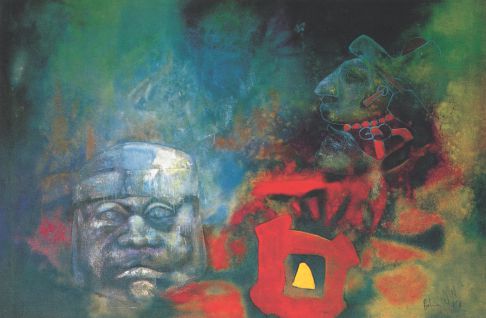
Sr. Brady said that, observed from the air, the central Australian landscape below bears an uncanny resemblance to that depicted in much traditional Aboriginal art. Viewed from a Western perspective, such art would, I suppose, be described as ‘abstract’ or ‘expressionist’, labels usually attached to art forms that void pictorial representation of any direct, referential significance, whether social, spiritual or geopolitical. From the Western point of view, such art characteristically commands attention through its formal and technical virtuosity or, if it is considered to relate outwards at all, it is often seen as an imaginative expression of aspects of the psyche of the artist, which may or may not prompt recognition in the eye of its beholder. If such art claims a relationship with a physical environment, it seldom, if ever, does so as a mirror-like reflection of an observed landscape.
So, as I say, I was sceptical and only my personal and academic respect for Veronica Brady and my knowledge that she was not only an expert on Aboriginal affairs, but also one of the most frequent of ‘frequent flyers’ -nicknamed the ‘flying nun’ because of her numerous trips to Canberra for committee service – made me consider lending serious credence to what would otherwise have seemed an extraordinary remark. Ready though I was to believe in various assertions of Aboriginal spiritual wisdom, I was not prepared to entertain the possibility that traditional Aboriginal artists could fly! During my subsequent flights there was ample opportunity to put the claim to the test and, while the evidence of the first section of landscape viewed from the air was far from compelling and then there was a long segment flying over the Great Australian Bight, a second flight over more undulating interior country confirmed what Sr. Brady had said beyond the shadow of a doubt. Sweeping layers of bright primary colours took one into a landscape that, quite simply, shattered Western preconceptions about the separation of the ‘realistic’ and the ‘abstract’, the ‘civilized’ and the ‘primitive’, the ‘secular’ and the ‘spiritual’; and it seemed clear that ‘expressionistic’ ancient Aboriginal art had managed to depict the unique interior landscape of Australia with representational accuracy, albeit presumably from a terrestrial vantage point.
Such oppositions as ‘civilized’ and ‘primitive’ are, of course, part and parcel of the binary thought-systems of many kinds of Western discourse – in this context perhaps most notably structural anthropology of the kind practised by Claude Lévi-Strauss – and the challenge afforded by an artistic practice that appeared to collapse them made me all too aware that in this instance it was my mind that was responsible for imagining such divisions in the first place. At best I could claim that I was a product of forms of Western socialization that define identity through contradistinction with alterity. Equally, it prompted the desire to ask what values are inscribed in an art that appears to see itself, completely unself-consciously, as an outcrop of the landscape? My rudimentary knowledge of the Aboriginal Creation myth of the Dreamtime provided the beginnings of an answer. Unlike Western Creation myths, the Dreamtime is considered to be simultaneously present in the present, not just an account of human origins, since the creating spirits are immanent in the landscape’s sacred sites. As Mudrooroo puts it, the Dreamtime is ‘the time of Creation that symbolizes that all life to the Aboriginal peoples is part of one interconnected system, one vast network of relationships which came into existence with the stirring of the great eternal archetypes, the spirit ancestors who emerged during the Dreamtime’ (Mudrooroo Aboriginal Mythology, London: Aquarian 1994: 52; italics in original). Particular Aboriginal ceremonies function as rites that maintain the connection with the ancestral spirits and the Dreamtime, enabling Aboriginal peoples to rekindle the spiritual energy of the period of Creation, so that analogous processes of cosmogony and transformation can take place in the present. ‘One interconnected system, one vast network of relationships’: the terms almost echo the rhetoric of contemporary globalization – and in particular the Internet – where chaos theory seems to abound: a feather falls in the Australian desert and Washington shudders. Yet the Aboriginal world-view and that of many other ‘Native’ peoples, such as the descendants of the pre-Columbian inhabitants of the Americas and the tribals of South Asia, could not be more removed in outlook from the ‘one-world’ vision of global consumer capitalism.
On the simplest level, Aboriginal art approximates towards a vision in which the West’s schizophrenic split between secular and spiritual simply does not obtain – ‘approximates towards’, because the conception of pure, pre-contact cultures is, of course, no more than a notion, a sentimentalized idealization of ‘purity’ that no longer exists and perhaps never did in the first place. At the end of his Epilogue to In a Free State, in a passage about his travels in Egypt, V.S. Naipaul looks back to pre-colonial times and reflects: ‘Perhaps that had been the only pure time, at the beginning, when the ancient artist, knowing no other land, had learned to look at his own and had seen it as complete. But [. . .] it was hard to believe that there had been such innocence. Perhaps that vision of the land, in which the Nile was only water, a blue-green chevron, had always been a fabrication, a cause for yearning, something for the tomb’ (London: André Deutsch, 1971: 255-56). Despite Naipaul’s often caustic view of non-Western societies, here he seems to encapsulate the potential for imaginative wholeness contained in originary art, while also expressing a healthy scepticism about whether such freedom from the schisms of a symbolic world-view ever existed.
So how legitimate is it to see ‘traditional’ Native perceptions as possessing a wholeness and integrity of vision unknown in the West? Wilson Harris, another Caribbean-born writer who has often been seen as Naipaul’s complementary opposite, describes the impact of the West’s arrival in the Americas as follows: ‘the mainstream of the West Indies in my estimation possesses an enormous escarpment down which it falls, and I am thinking here of the European discovery of the New World and conquest of the ancient American civilizations which were themselves related by earlier and obscure levels of conquest’ (Tradition, the Writer and Society, London and Port of Spain: New Beacon, 1967: 30-31). Again the emphasis seems right. Columbus’s advent in the New World engendered a cataclysmic rupture and yet it would be foolish to suppose an idyllic, pre-Columbian past. The evidence suggests that ‘the ancient American civilizations’ were, as Harris puts it, ‘related by earlier and obscure levels of conquest’: Montezuma is reputed to have drunk a purer kind of coffee than Europe has ever tasted, but evidence of the Aztecs’ human sacrifices makes it hard to sustain a view of them as a blissfully ignorant pre-contact people!
Again, it can be helpful to turn to the pictorial and plastic arts to see what insights they offer. The Timehri rock paintings of Guyana are one of the finest forms of pre-Columbian Amerindian art. The word ‘timehri’ means rock paintings and legend has it that the paintings are the work of an Amerindian god, Amalivaca, who visited Guyana at the time of an ancient flood, of the kind that one finds in so many of the world’s mythologies. Anthropologists have dated the paintings in historical rather than mythical time – in the Christian calendar’s fourteenth century – but this nevertheless confirms a pre-Columbian provenance and the paintings, which are particularly found near falls and rapids (elemental sites of transformation?), still seem to represent a prehistoric world-view, in that they emanate from a culture that was oblivious to the impact of Western scribal discourses, such as historiography.
The Guyanese potter, Stephanie Correia’s vase ‘Timehri Man’ draws on the paintings for its subject. Again, there are the bright primary colours that characterize Aboriginal art, in this case employed to provide an image of human unity rather than oneness with the landscape. Drawing on a motif popular in the rock paintings, the vase’s elemental matchstick figures join hands in a celebration of community and the oneness of existence. Does this represent a social reality? The evidence suggests not; that internecine warfare was rife among the various Amerindian groupings of Guyana: the Wapisianas, the Macusis, the Caribs, the Warrau and the Arawaks. Nevertheless, the ‘Timehri Man’ motif aspires to a form of union that expresses a confidence in human community and wholeness. Trying to think of a twentieth-century Western equivalent, it struck me that L.S. Lowry’s matchstick men are in some ways similar, but Lowry’s figures, dwarfed by the gasholders and factories against which they are silhouetted, are almost dehumanized in their urban landscape. In contrast, Correia’s figures – and she is of course only providing a modern interpretation of her originals – exist outside the purely secular nexus that closes down possibilities, not simply for Lowry’s subjects, but also for the painter himself.
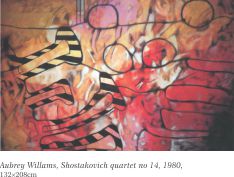
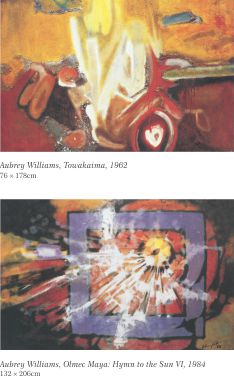
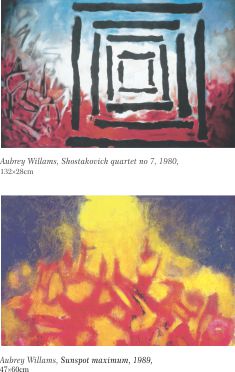
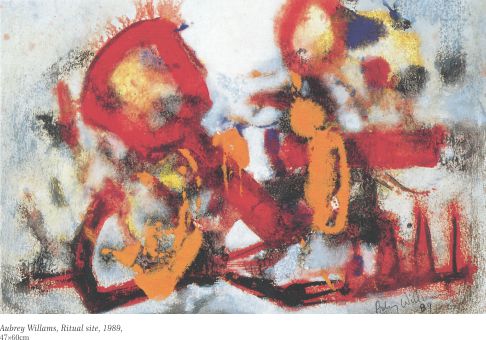
Timehri has also provided the name for Guyana’s International Airport, where another striking response to the rock paintings is on display: a large ‘Timehri’ mural, painted by Guyana’s most famous artist, the late Aubrey Williams. Williams lived among the Caribs, the Warrau and the Arawaks and his work also drew inspiration from other pre-Columbian cultures. In ‘Olmec Maya: Hymn to the Sun – VI ‘, a painting from one of his most famous sequences, he provides, like Correia, a modern-day equivalent of a pre-Columbian people’s celebration of the natural world – of light, brightness and here, most of all, the elemental life-giving power of the sun. Williams spoke on many occasions about the technical sophistication of the Maya and the conspiracy surrounding their extinction in a period of less than half a century and in the paintings the sun becomes the central icon of their world-view, an image that transcends symbolism to enforce a re-examination of Western notions of significance. In a 1967 talk, Williams expressed his concern that the ‘awful virus’ of ‘modern art’ should not ‘get a foothold in the Caribbean’, seeing it as ‘the attitude to the visual arts that automatically attaches labels to what we see when we look’ (Guyana Dreaming: The Art of Aubrey Williams, comp. Anne Walmsley, Sydney: Dangaroo Press, 1990: 15) and perhaps this, most of all, can be seen as the difference in vision between non-Western and Western art. The former characteristically speaks for itself – or at least aspires to speak for itself – for unmediated perception of the natural and human worlds, while nevertheless expressing a sense of the spiritual integrity of the cosmos; the latter characteristically seeks urgent explanations to make sense of a world riven by schisms or, in its more abstract forms, declines any possibility of an encounter with lived experience.
Both Correia and Williams attempt to build a bridge between the pre-Columbian and post-Columbian Caribbean and in so doing are inevitably more self-conscious than the ‘ancient’ artists who provide their inspiration. Yet, given the omnipresence of the West’s tentacles, the idea of a return to a pure, originary time is an impossibility and the act of bridge-building, moving along a continuum that at its ‘ancient’ pole disputes the authority of the West, is itself a powerful challenge to Western artistic hegemonies. The achievement of such a view remains an aspiration, but it is an aspiration that can provide a model for artistic practice around the world. We know the pre-colonial was riven with conflicts and yet it remains one of the most vital sources of creative energy that can be released into the post-colonial world to counteract Western dominance, now most forcefully manifest in the globalized consumer economy’s increasing stranglehold on artistic production around the world.
John Thieme is editor of the Journal of Commonwealth Literature
A number of years ago, when I was in Perth on the first leg of a trip across Australia, I was fortunate enough to be hosted by the distinguished academic, Sister Veronica Brady, a member of the order of Loreto noted for her work with and on behalf of Aboriginals. We talked about my impending…