

mind over matter
During Bangladesh’s war of liberation in 1971, Swapan Choudhury toured the fronts and the refugee camps, drawing pictures that depicted both the heroism of freedom fighters and the sufferings of refugees. The traumatic experience of the war left its mark in Swapan’s subsequent work, accounting for its expressionistic bent. His close encounter with death and destruction also made him restless and rebellious. When he returned home, and began a career as an artist, he began to search for a new style that would distinguish him from his contemporaries. It was a difficult search no doubt, and he had to go through several phases of experimentation, introspection and adjustment to evolve his own style. He first went to the folk traditions, to terracotta art, to Rabindranath Tagore (whose sharply expressionistic drawings and paintings inspired Choudhury to record his own sense of anguish and pain in animated colours and forms). He experimented with figuration, then abstraction, and mixed the two so that his canvas became suggestive, narrative and abstract at the same time. He also found inspiration in nature in its colours, forms and the lives of animals and plants. The dots and whorls of snake skins, for example, embellished many of his paintings.

Increasingly however, Swapan Choudhury’s sensitive antennas folded inward. A quiet, inward gaze began to mark his work.
The latest solo exhibition of Swapan Choudhury’s paintings, Introspection (Bengal Gallery, 22 January – 4 February, 2006), a retrospective of sorts, bears testimony to the many changes his style underwent before it settled down to an intimate and introspective mode. Outwardly romantic because of the use of a soft palette, evocative forms and subdued contours, his recent paintings reveal an inward shift towards the meditative and reflective–away from the anguished and emotional. The textured surface of his work, the embossed marks and the feeling of roughness that the handmade paper gives out, however, suggest that Swapan Choudhury’s world is not entirely pleasant or delicate. Indeed, projections of feelings and emotions (as in the Feeling series) in images of sharp, angular objects on torn and serrated paper create unease, and check any romantic rumination. Even when ‘introspection’ is his subject, Choudhury is never far from reality. He believes that abstraction, instead of hiding or rejecting reality, often express its essential characters.
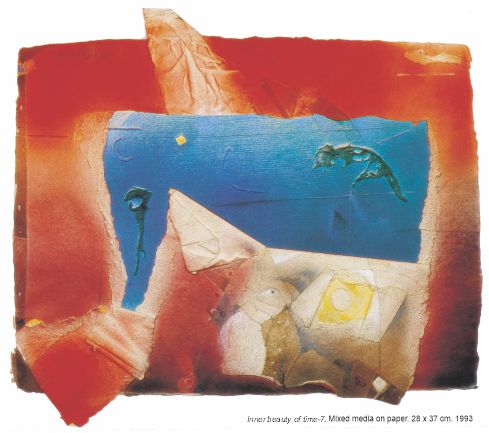
The exhibition displays Swapan Choudhury’s water colour-based mixed media work from the early 1990s to the present. This is a time when Choudhury consolidated his diverse preoccupations with art and evolved a style that would, for the time being at least, allow him to paint the inwardly opening vistas around him and relate them to the changing contours of his mind. Choudhury’s penchant for collage is aptly complemented by his skill in arranging his material to suit a particular expressive urge. It is quite rare to see an artist linking his materials, his pigments, the mounting and framing of his work synergistically with content and thought. Choudhury thus aims at a totality of effect, which, whenever he achieves it, is an experience to savour. However, if painting after painting shows the same formal arrangement and the same compositional focus, there is a danger that they might, sooner or later, repeat themselves. This indeed has happened in a few cases, particularly with a few serial works (Inner beauty of time, Feelings, for example). But once we see that with the serial works are meant to highlight a theme (a mood or a thought) from different angles, such a repetition is then excusable. It must be said though that the imagination and skill that he possesses, Swapan Choudhury should have introduced more variety in these areas. Perhaps he will do just that once he is finished with this phase of his creativity.
During Bangladesh’s war of liberation in 1971, Swapan Choudhury toured the fronts and the refugee camps, drawing pictures that depicted both the heroism of freedom fighters and the sufferings of refugees. The traumatic experience of the war left its mark in Swapan’s subsequent work, accounting for its expressionistic bent. His close encounter with death and…