
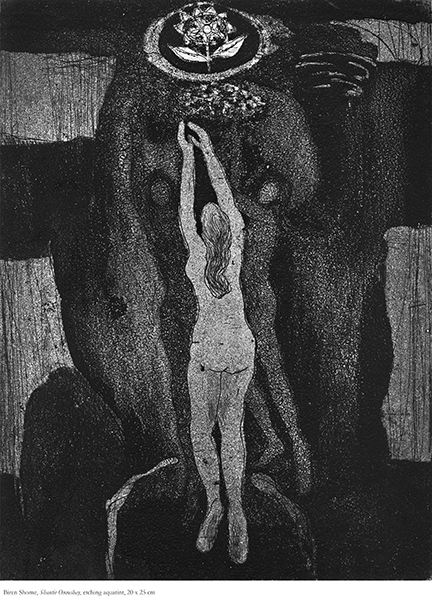
solo print exhibition dhaka art center july 24-28, 2013 man, nature and shakuntala
The concept of the tapovan is prevalent in early Sanskrit literature, particularly in the work of renowned poet and playwright Kalidasa. Abhijñānaśākuntalam or “Of Shakuntala Recognised by a Token” is considered to be his seminal work, a dramatized reimagining of the tale of Shakuntala from the Mahabharata, and features the tapovan in its first act:
“…here
Are rice grains dropped from bills of parrot chicks
Beneath the trees; and pounding-stones where sticks
A little almond-oil; and trustful deer
That do not run away as we draw near;
And river-paths that are besprinkled yet
From trickling hermit-garments, clean and wet.
Besides
The roots of trees are washed by many a stream
That breezes ruffle; And the flowers’ red gleam
Is dimmed by pious smoke; and fearless fawns
Move softly on the close-cropped forest lawns.”
- Translations of Shakuntala and Other Works (1914) by Arthur W. Ryder
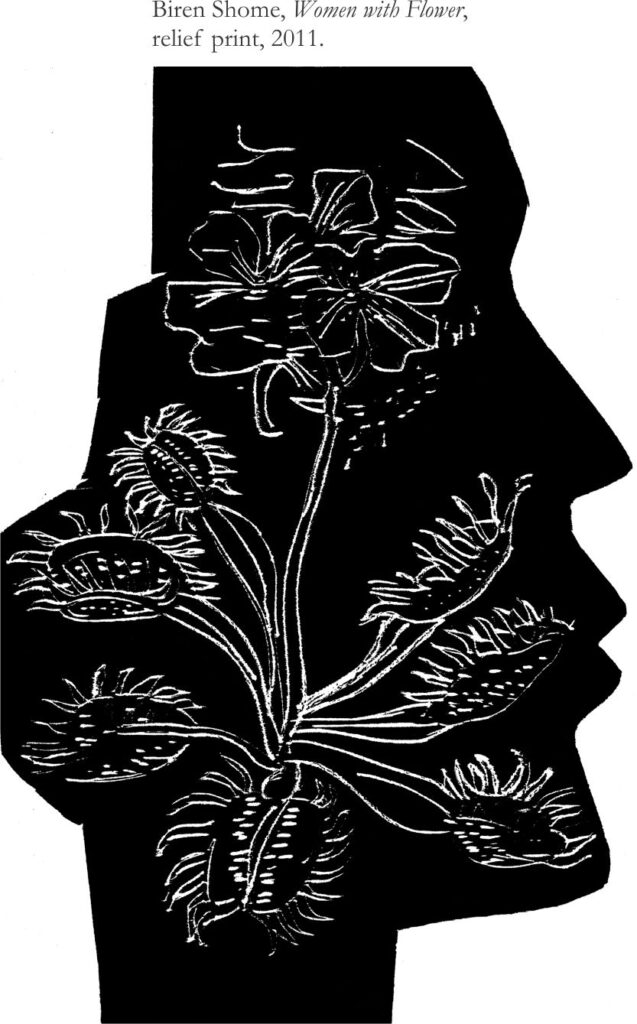
The tapovan is portrayed as a forest where man and nature live in harmonious co-existence. It was a major motif in classical Sanskrit literature but lost its prominence as time passed. In recent times, artists such as Biren Shome have tried to revive the motif in its idyllic aspects. Through his themes and symbols, Shome has tried to recreate the tapovan’s ambience in his work, exhibited during a five day solo print exhibition at the Dhaka Art Center in July.
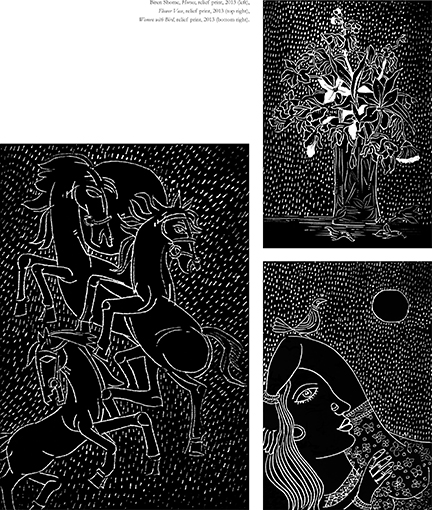
A woman lies beneath a starry night sky, gazing up at the full moon with a bird sitting on her arm. She smiles, remembering some past event or reflecting on the time gone by. Flowers in a vase wilt, its petals fall around the base. Those at the centre of the arrangement rise, their dying leaves and crooked stems reaching for the heavens above. Three horses ride together in the sky, happily dancing up towards the moon.
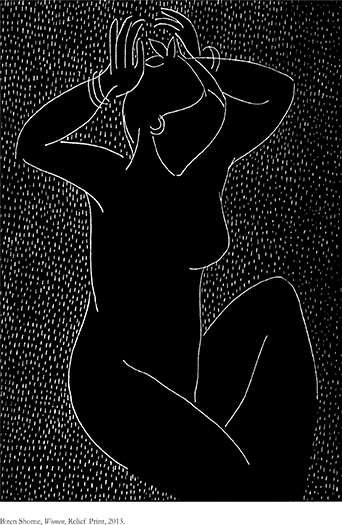
Biren Shome’s prints are striking for their detail. A keen-eyed viewer can easily make out the flowers that adorn the young woman’s dress, the muzzles around the horse’s mouths or the petals near the bottom of the glass vase. The artist’s works were made using a variety of different print-making techniques including etching, collagraph and relief work. The collection of small size prints at the exhibition were mostly black and white and featured familiar subjects from Biren Shome’s past work, including flowers, animals and women.
What is the artist trying to say by juxtaposing man and nature? Perhaps, it is his wish that man show respect to nature instead of trampling it and taking from it as he would. Or perhaps, he simply wants to show its beauty by mixing symbols from nature with the female form. The tapovan and its restorative effects on the human spirit seem to be the central element in Shome’s prints, which connects his oeuvre to those of other great artists from our region.
Kalidasa’s play reaches its climax when Shakuntala’s husband King Dushyanta finds his wife in the forest after forgetting her several years ago. He had failed to recognise her because she had lost a ring on her finger which had the power to remove a curse placed upon him. The token – that is, the ring – however finds its way back to Shakuntala and lifts the spell, reuniting husband and wife after both had suffered. It is nature that brings the two lovers back together.
The meditative quality in Biren Shome’s work serves to bring us back to our own identities as creatures, not masters, of the world around us.
The concept of the tapovan is prevalent in early Sanskrit literature, particularly in the work of renowned poet and playwright Kalidasa. Abhijñānaśākuntalam or “Of Shakuntala Recognised by a Token” is considered to be his seminal work, a dramatized reimagining of the tale of Shakuntala from the Mahabharata, and features the tapovan in its first act:…