

Loy Krathong the most colourful festival in Thailand
It is all there, just as it was in King Ramkhamhaeng’s day, the very essence of that special spirit the Thais call sa-nuak. Thirteen-century history wakes up for a night and then goes into hibernation for a year
The ceaseless pursuit of sanuk or fun in Thailand guarantees a plenitude of delightful festivals and fairs as well as solemn religious ceremonies.

The highlight of April is Songkran or Bosaki, that is to say, the celebration of the Thai New Year, which takes place between the 13th and 15th of the month, at the same time as the Bengali New Year. Songkran is a mixture of the religious and the secular, and is a festival marking the beginning of the Buddhist year. Traditional Thais observe it by going to temples, sprinkling water on Buddha images, and giving their houses a thorough cleaning. However, over the years, decidedly secular manifestations have been added to the holiday, the principal one being the freedom to throw water on anyone who happens to be passing by—an act not altogether unwelcome, if you are prepared for it, since April is the hottest month of the Thai year! Everyone is fair game for a sudden drenching, especially in Chiang Mai, where many of the old traditions are still observed. However, such carefree water throwing is uncommon in Bangkok, though a popular place near the capital is Phra Pradaeng, near the mouth of the Chao Phya River.
It is best to go to Phra Pradzeng by boat. Once there, you will see parades, boat races, and folk dances, Of course you will come back soaking wet!
November will come the best soaking wet festival we best go to parades, Phra Pradaeng, boat races, and folk dances. Once there, of course, we will come out soaking wet!
November is the best of all wet festivals in Thailand. This is when various fairs, large and small, celebrate Loy Krathong, one of the most beautiful festivals. Loy Krathong takes place on the night of the full moon of the 11th lunar month. A krathong, traditionally, is a small, lotus-shaped boat containing adults and candles, incense sticks, and often a coin. Both adults and children place these in rivers and canals to honour water spirits and, some believe, to carry away one’s sins. The best places in Bangkok to enjoy this charming festival are on the river, along Klong Saen Sap, or around the lakes at Khlong Dao Ngo and Lumpini Park. Thousands of people from all over the country also go to Chiang Mai for Loy Krathong. A way to please the water spirits, the Ping River floats through the middle of Chiang Mai, becomes a magical sight with countless krathongs, some of them huge, elaborate affairs, drifting downstream, twinkling along the dark waters.
For beauty, no Thai festival in April can compete with Loy Krathong, especially since in April one competes with Loy Krathong’s rivers and canals at their highest levels. Various celebrations in Asian countries have somewhat similar elements in honour of their water spirits who play such a significant role in their daily lives, but a story from the thirteenth century claims that Thailand’s particular form originated in the country’s first capital, Sukhothai. A lady of the court named Nang Nopamas, seeking a way to please the king, created a beautiful krathong in the shape of a lotus flower, which she then adorned with flowers, incense sticks, and a lighted candle; she set adrift this little boat, on the river that flowed near the city.

The innovation pleased the king, and Loy Krathong, literally “to float a krathong,” became a palace custom. It was largely a palace custom, with royal ladies vying to see who could produce the most elaborate one, and in the process going far beyond the simple banana-leaf boat. The reformed-minded King Mongkut spectacularly changed the festival, and the extravagant Thais sought to have it curtailed.
Meanwhile, however, the festival, extravagant Thais had taken it up, paying, no doubt, for the traditional purpose of paying homage to the spirits who watered their rice fields but also, one suspects, for the sanuk crowdsthroughout the country flock to the nearest waterside in the evening; visiting not only rivers and canals but reservoirs, sea beaches and swimming pools as well. Everyone carries a krathong and as darkness falls, the little boats are pushed out into the water, each bearing a flickering candle, three or four burning sticks of incense, and often a coin of small denomination to bring luck.

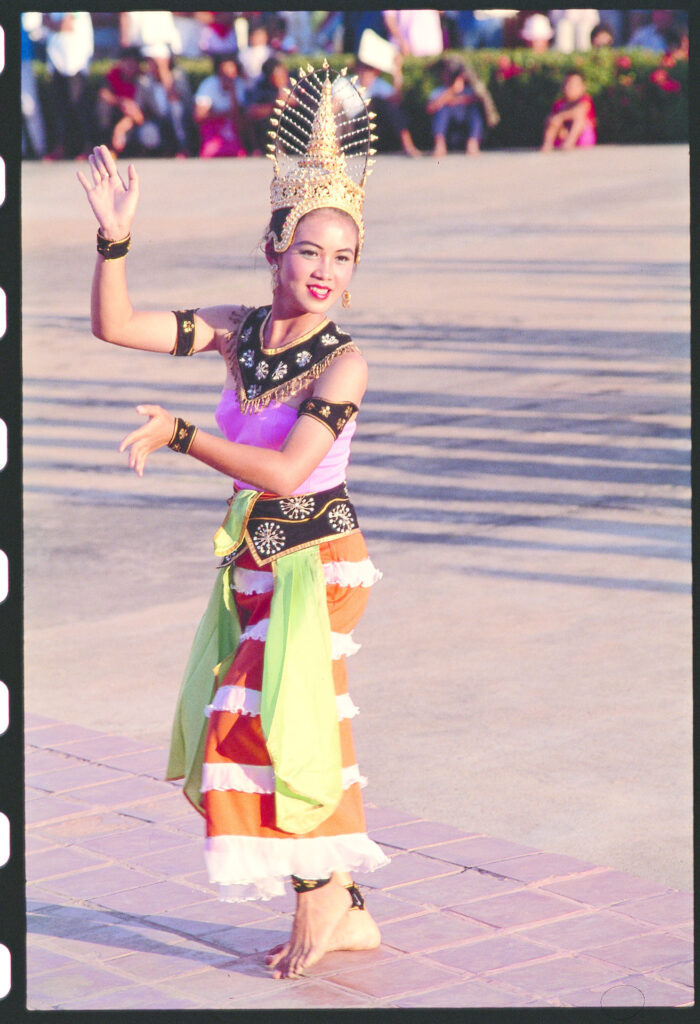
Perhaps the most delightful place to enjoy Loy Krathong is in the place where it began. The imposing remains of ancient Sukhothai—great roofless temples, soaring stupas, and monumental Buddha images—are dramatically floodlit and reflected in the broad ponds on which the old capital depended for its water supply. Girls in period costumes dance near what was once the royal palace. One of them is selected to preside over the festival as Nang Nopamas; there are elephants, too, and stalls selling snacks of all sorts, and music everywhere, especially the bouncy Loy Krathong Song, which is ideal for an impromptu ramwong demonstration. At the climax, there is an impressive display of fireworks that is colourful and noisy.
It is all there, just as it was in King Ramkhamhaeng’s day, the very essence of that special spirit the Thais call sanuk. Thirteenth century Thai history wakes up for a night and then goes into hibernation for a year.
Noazesh Ahmed is a scientist, photographer and environmental activist in Bangladesh
It is all there, just as it was in King Ramkhamhaeng’s day, the very essence of that special spirit the Thais call sa-nuak. Thirteen-century history wakes up for a night and then goes into hibernation for a year The ceaseless pursuit of sanuk or fun in Thailand guarantees a plenitude of delightful festivals and fairs…