

chobi mela
Forty-seven exhibitions, eight venues, more than 1000 photographs and 23 participating countries easily made Chobi Mela IV the largest photography festival in Asia. It all started in 2000 when the first festival of its kind in Asia was organized under the title ‘The War we Forgot’. That show featured the most significant press photographs taken over forty-five years by thirty photographers from about ten different nationalities affiliated to a dozen international news organisations
This year the festival was held from November 9 to 30 and had ‘Boundaries’ as its core theme. Over the years this festival has intertwined with the culture of Bangladesh and has gained immense popularity and acceptance from all spheres. This year the exhibitions were held at The British Council, The National Museum, Bangladesh Shilpakala Academy, Bengal Gallery, Alliance Francaise, Goethe Institut, Russian Cultural Centre and Drik Gallery, the main initiator of the festival. Since 2000, every two years the Drik Picture Library and its partners in Bangladesh and other countries have been organizing Chobi Mela. In November-December 2002 the theme was ‘Exclusion’. The theme of Chobi Mela III, held in December 2004, was ‘Resistance.’



many shades of grey
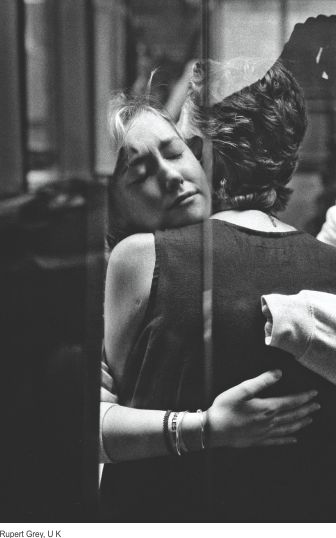
Rupert Grey is immensely eloquent and so are his photos. A lawyer by profession he is never at a loss for words, and neither is his camera at a loss for images. Rupert is a celebrity of sorts as a lawyer who works primarily in libel and copyright law and has been involved in leading cases in the field of media law. He also advises photographers and syndication agencies on all aspects of copyright law and has been involved in cases breaking new ground in the copyright field. And he has had his share of famous clientele too; recently he even represented Sharon Stone. In fact, at the Chobi Mela he gave a wonderful presentation on current privacy issues, especially media-related ones. His exhibition titled ‘Boundaries’ coincided with the overall theme of this Chobi Mela, but through his pictures he has redefined the term boundary in a far more personal sense.
The works chosen for the festival by Shahidul Alam focus on children and the final hours before high school graduation. As he so powerfully put in the foreword to his exhibition ‘For them (the children) it (leaving school) is both a rite of passage and a farewell to an enclosed existence: growing to adulthood is a process of constantly extending the boundaries of the known world.’ The pictures, however, record much more than the right of passage images and the end to an enclosed existence. At times they are deeply personal, then the rite of passage counts for little. His lens, in fact, captures children not ready for the world, youngsters desperately seeking to hold on to some semblance of childhood.
There are pictures that pick up on children not entirely focussed on leaving childhood behind. They are the brave and one might say ignorant ones; then there are children studying in a car, not giving a damn about what happens next. They are still focussed on the tangible, on exams and results. Others lie in hammocks, with the lush countryside behind them; they wear expectant smiles full of regrets and goodbyes. One picture taken from behind a glass door shows two girls hugging each other; the girl with her face to the camera has her eyes shut. One is left to wonder how much longer she will hold on to her youth, how much longer she will keep her eyes closed, and when they finally open will it take her to the end of youth or the beginning of adulthood. There is more than a fine line between those two stages in ones life; Rupert Grey has managed to capture those hours with a sense so exquisite that each picture is a story in itself, yet another landmark in those final few hours.
‘We live our lives, do whatever we do, and then we sleep. It’s as simple and ordinary as that. A few jump out windows, or drown themselves, or take pills; more die by accident; and most of us are slowly devoured by some disease, or, if we’re very fortunate, by time itself. There’s just this for consolation: an hour here or there when our lives seem, against all odds & expectations, to burst open & give us everything we’ve ever imagined, though everyone but children (and perhaps even they) know these hours will inevitably be followed by others, far darker and more difficult.’
- Michael Cunningham, The Hours
In his Pulitzer Prize winning novel The Hours, Michael Cunningham hit on the note that best sums up Rupert Grey’s exhibition. The final few hours before graduating are a microcosm of possibilities. What we do and where they take us, not even the expert and sensitive lens of Rupert Grey can tell us fully, but he does as well as anyone can to highlight those moments.



an australian epic
This year’s Chobi Mela brought together quite a few international photographers, but there were few exhibitions better than Trent Parke’s ‘Minutes to Midnight’ at Bengal. Trent Parke is a rising name in photography, and is the only Australian to be represented by the prestigious Mangum group. Indeed, he has won a slew of international awards over the past few years.
Parke here goes on a personal journey through Australia and his pictures are evidence of his findings. Now if one were to say that his exhibition has a ‘documentary’ feel, one would be wholly incorrect. In fact he has used documentary images to tell a story. He saved up for 5 years to take a journey through the heart of the Australian bush, and one of the major sources of inspiration was strangely enough an article in an Australian newspaper that said that 60% of Australians believed that 2003 would mark the end of an era for the nation. That only spurred Trent on, to delve deeper into Australia and excavate what was left even as he cast a watchful eye on what lay ahead.
The greatness of his exhibition lies in his use of fiction; he gives one the sense of both the real and surreal. Images are not exactly what they seem to be; take, for example, his picture of the Queensland outback. The picture is of a light bulb with various insects stuck on it. The picture mesmerises; one is inadvertently drawn to the picture, much like insects to light. At first one thinks of an abstract shot of the moon with insects flying around in the air, but on closer inspection the real picture emerges. This ambiguity of images is a major part of his craft. Another picture that comes to mind is the very first one on view. It is an image of bats in the sky, taken from a distance. But initially it gives the impression of a spinal column that hangs unattended in the night sky. It is a truly breathtaking image and it sets the tone for the surreal images that pop up out of nowhere in an exhibition supposedly focusing on realism.
Bats come to the fore again in another case of mistaken identity, where he photographs a large number of bats flying against white clouds. At first, this seems a rather unspectacular image of birds, but when one takes a second look, the thin translucent membrane of the bats’ wings become clearer and the photograph serves as another example of ambiguity within pictures and their meanings.
Three of Parke’s best pictures are rooted in earthy realism. ‘New Year’s Eve’ is a spectacular image of cowboys in the rain. They seemingly go about their work, not giving the rain a second thought; no doubt 2003 was not the end of an era for them. Their back-breaking work is a constant in their lives. This picture is so extraordinary because every single raindrop has been amplified and resembles almost a thousand shooting stars. The sky is eerily unearthly and that adds a unique dimension to an already dark picture. Another picture of beauty queen contestants at the annual harvest festival needs to be seen to be believed. It depicts a number of women sitting on the bonnets of their cars. The cars are lined up on a street that curves away from the centre, so that as far as the eye can see, women are sitting on their cars. The composition of the picture is brilliant, highlighting the images of the women closest to the eye, and simply multiplying that one shot over and over again until it becomes a blur. The women appear to be trophies and the melancholy of their plight radiates from the picture.


All of Trent Parke’s images are black and white as they had to be. It is only through the absence of colour that we see the skeleton of an image. He has exhibited a collection of bones and with the last of his pictures, that of his son entering this world, he has breathed life into those bones. a journey through
unseen india
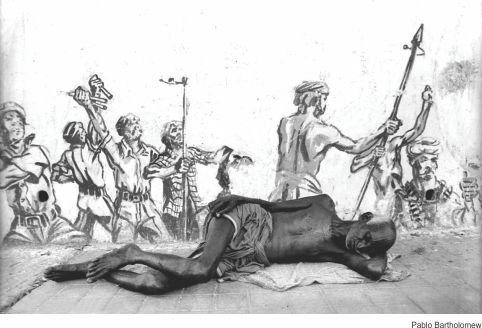
The captivating Indian photographers Pablo Bartholomew’s images are also the most famed ones. These are the series of eight photos that won the Best Picture Story at the World Press Photo Awards in New Delhi in 1976. It consists of a set of eight photographs depicting a Danish woman in a cheap Delhi hotel preparing a morphine fix for herself. In the first photo the woman, thin and sickly, is seen caressing her dog: she is seemingly lost in her own thoughts, and cocooned in her own lonely world. It is as if she takes the syringe in her hand to escape from her loneliness and depression. The focus here is on the syringe; the woman is blurred out in the background, the shot emphasising that the syringe has now slowly but surely taken over her life. She injects herself with the deadly drug and goes on to lie down on the clearly unwashed linen bedsheets on an equally unclean little hotel room. It seems like a bit of a contradiction for a foreign woman to be in such a condition in an Indian hotel room.
All of Bartholomew’s photographs may shock the urban middle class who prefer to keep their eyes away from anything that does not follow societal or religious norms. The photographer has brought to life happenings on the streets and dark alleys of the cities he grew up in—from the hippies, junkies, eunuchs and street performers in Old Delhi, to the underground opium dens and sex workers of Mumbai and finally to Calcutta where he captures the Chinese community in Tangra within his expert lens. In all the photos, the photographer is consciously trying to focus on the outcasts of society. There is a mood of soul-searching underlying all his photographs, a mood that is reflected in his introduction where he says, ‘Changes within me and around me took me into the streets in whatever city I lived in, wandering around aimlessly with my camera.’
His exhibition for this year’s Chobi Mela is of his work in the late 70s; all are in black and white and emphasize a time long gone. The picture of a smiling man standing stiffly beside his young daughter who is uncomfortably dressed in a sari and has heavy make-up, perhaps taking their first photograph together at a roadside studio, takes up the space of the same wall where the caretaker of an opium den reclines carelessly, reading a newspaper, as if to show how such different lives live next to one another.
the many faces of the river
Photographer Abir Abdullah takes us on a journey through the land of rivers, Bangladesh, depicting the many faceted life on our riverbanks from the social, political, economic and religious point of view in his 25 black and white photographs.
His photographs beautifully portray the simplicity of people whose lives are in some way intertwined with the river. A bird’s eye view breathes life into the photo of a set of fishermen’s boats moored after a long night of inactivity, waiting on the men in the early morning light to hop on board and start work. There is a contrasting picture of a young boy attempting a somersault on the water as if to show how the river can be both a source of income and a source of recreation. Another photo shows women cooking with firewood on the riverbank. Two overloaded launches are seen crossing the river, as if in an attempt to race each other to the end. Most of Abdullah’s photographs show a flurry of activity taking place in and around the river. The title of his exhibition ‘Rivers and People’ encapsulates the essence of his photographs for even where people are physically absent, there is evidence of their existence carefully laid behind to give the photos life. The most impressive photo on show is that of the early winter morning fog-covered view of the riverside. A man bends over with his pail to collect water while a small boat passes by under a barely visible bridge in the background. Even to the untrained eye, the image is captivating.
In his introductory note Abir explains his exhibition’s boundaries, ‘The river not only creates a boundary for various cultural and social events, but also creates and changes the dimension of people living around them. From trade to transport, or providing food to sight-seeing tours, rivers and boundaries remain two inseparable parts of the lives of people around them.’
Abir Abdullah has won the Mother Jones grant for his War Veterans of Bangladesh series. He has also won the Asahi Shimbun medal from the International Photographic Salon of Japan in 1996, 1997 and 1999, the silver medal from the 2nd BPS international photo contest in 1998 and Bangladesh’s Shilpakala Academy grand prize in 1998.

far from ordinary
Pathshala is the name of the photographic training school that has changed this form of art in the country. And the exhibition put up by the students of this institution does its reputation complete justice. In every piece of work the lives and livelihoods of the common people of Bangladesh are documented. An old man with wrinkled skin bearing witness to the years of toil and adversity with teeth missing from lack of care and attention still manages to flash a genuine smile for the photographer who records it very proficiently. In fact, it is the people who lead lives under very adverse situations who are at the forefront of the images. One is left to wonder, for example in one of the photographs, how a woman so fragile-looking can bear the weight of a pile of bricks so expertly on her hand. We have no doubt seen many such images in our lives but seldom have we stopped to think that they are actually worth documenting. In another photograph a young mother sitting on the side of a street is seen cuddling her young child with love that is expressed more through her eyes than through action, while an older child, perhaps hers too, looks on like a disinterested observer. It’s the joy of the very simple things in life that gives these photographs such vividness despite their black and white appearance. The elation on the faces of the fisherman dancing with the first catch of the day is surely worth a million words.
on the other side of the war
After seeing the photos taken by such the proficient hands one may perhaps be wary about the quality of photos taken by amateur Iraqi civilians. But one would be in for a surprise. When the Iraq War started in 2004, The Daylight Community Arts Foundation thought that giving disposable cameras to Iraqi civilians would lead to a more tenable point of view of the war. The result is a set of very moving images of the new stories behind the war, stories of how life goes on as usual in a war-torn country. There are no photographs of bombs exploding or tanks rolling but there is the imprint of a war that affects the lives of every citizen in some way or the other. From the image of friends flashing happy smiles in the school backyard to a family of rag pickers thoroughly at home on top of a garbage dump; these photographs portray the spirit to live on despite all odds. One of the photographs show two mischievous little boys brandishing their toy guns in a manner that is particularly moving, given the circumstances we know Iraqis are in. Another set of images captures a procession of people mourning the death of a loved one, as some of them carry a coffin on their shoulders. In another, men are seen going about their everyday occupations one of which is digging graves.
one man’s fight to overcome the boundaries
David Larson of South Africa takes the viewer on a personal journey of his father, whom he evidently admired very much. In his introductory note he describes how his father’s life had been defined by boundaries. In the 1960s he crossed racial boundaries and served among the poorest in a mission hospital despised by apartheid authorities. The neo-natal mortality had dropped from 68 per 1000 to 25 per 1000 in that hospital. Two decades on he crossed boundaries of personal ambition refusing a professorship at the largest teaching hospital. The images are predominantly of him going about his daily work looking at patients, walking down through his neighbourhood, doing an ultrasound of a pregnant mother and injecting a woman with life-saving medicine. They once again reinforce the overall impression left behind by Chobi Mela: extraordinary images of life lived by people living in boundaries, photographs that testify to the immense power of this art form to document everyday life carefully and memorably.
Hana Shams Ahmed and Nader Rahman are staff writers with the Star weekend magazine, Bangladesh
Forty-seven exhibitions, eight venues, more than 1000 photographs and 23 participating countries easily made Chobi Mela IV the largest photography festival in Asia. It all started in 2000 when the first festival of its kind in Asia was organized under the title ‘The War we Forgot’. That show featured the most significant press photographs taken…