

chittagong’s stories
“Well, here we are at last in Chittagong. I am glad we are to live here instead of Dacca. Where Dacca is a bit larger and has all the old British government buildings, it is hot and level. Chittagong is on the Karnafuli River and is a city of “A Thousand Hills.” There is always a fresh breeze from the river. The shops, native homes and old part are in the ravines and at river level, while the fine residences occupy the hills.”
Ellura, wife of Robert Kirby Winters, Chittagong, Tuesday, February 25, 1953; posted in Chittagong to establish a forest experiment station and laboratory for then East Pakistan on behalf of the United States Forest Service; (Letters from Chittagong: An American Forestry Couple’s Letters Home, 1952-54, 1992).
Chittagong’s identity politics has always been driven by various claims of “uniqueness.” The uniqueness of its geography, urban origin, local dialect, a complicated “melting-pot” racial history, multi-faith social amalgamation, history of anti-British movement, and Porto Grande global attraction through the ages, among others. Ellura Harvey Winter’s finding solace in “a thousand hills” of Chittagong—away from the tempestuous street agitation of Language Movement-era Dhaka—unwittingly partook of an enduring historical narrative that celebrated many myths of Chittagong’s distinctiveness. Uncharacteristic hilly terrain in a predominantly flat deltaic country has always been an essential part of the city’s mythology. The Chinese traveler poet Hsuan Tsang’s 7th-century depiction of the city as “a sleeping beauty emerging from mists and water” was no doubt a reference to Chittagong’s hilly idyll.
Let’s harken back to earlier times.
Legend has it that the Buddha came to a vihara or a chakrashala located in Patiya, a southern town of greater Chittagong, employing his miraculous powers for disembodied travels. According to some historians, Buddhism spread to Chittagong during the time of the Buddha himself, over twenty-six centuries ago, when Socrates was not yet born and the Parthenon had not yet been built in Athens! The presence of many viharas in the city lends credence to the suggestion that the name of Chittagong comes from chaitya (a Buddhist vihara). Some claim that a Buddhist King named Gopichandra even established his capital in Chittagong in the 10th century.
Within a century after Islamic forces under the leadership of Tariq ibn-Ziyad crossed Gibraltar in 711 CE to colonize most of the Iberian Peninsula, Arab sailors began to arrive on the shores of Chittagong. They left enduring marks in the port city’s life and local dialect. Place names, such as Alkaran (Al Qarn) and Sulak Bahor (Sulukal Bahar), demonstrate Arab influence. The use of negative before a verb in chatgaiya, Chittagong’s local dialect, is another instance of Arabic contribution to the culture of the port city.
Portuguese explorers in the sixteenth and the seventeenth centuries frequently called Chittagong the “City of Bengala.” Duarte de Barbosa, one of the earliest Portuguese writers to offer a geographical account of the African and Indian coasts in the early sixteenth century—almost a century before the Mughal subahdar Islam Khan Chishti’s arrival in Dhaka—described Chittagong as a natural attraction for traders, missionaries, and fortune-seekers from far-flung places. He noted: “[T]his sea (Bay of Bengal) is a gulf which enters towards the north and at its inner extremity there is a very great city inhabited by Moors which is called Bengala, with a very good harbor.” D. Joao de Silveira, who was reportedly the first Portuguese commander of a sea expedition to Bengal in 1517, belonged to the generation of Portuguese that had not only scurried the Moors (as the Arabs were called in Iberia) out of Portugal, but also sought to create a Portuguese Empire in the East.
Chittagong was their gateway to the East. In exchange for military and political support, the Sultan of Bengal Ghiyasuddin Mahmud Shah allowed the Portuguese in 1537 to create a settlement in Chittagong. He gave them powers to collect port tax. A Portuguese empire never materialized in Bengal, and their historic footprint slowly diminished over time. But, as Mons. R. Dalgado’s book The Influence of the Portuguese Vocabulary on the Asiatic Languages reveals, the Iberian country’s influence on Bengal, particularly the Bengali language, began to fertilize from their settlements, trading outposts, and forts in Chittagong.
This is not a place to belabor a chronological history of Chittagong, except to say that the port city’s history is richly crisscrossed by actors of all sorts: Buddhist mendicants, Hindu zamindars, Arab saints, Mughal governors, European traders, British colonialists, anti-British revolutionaries, Western development experts, wealthy industrialists, national leaders, and global entrepreneurs. When history becomes a jigsaw puzzle of people, events, places, and narratives, myths thrive!
Thus, to know Chittagong and to imagine its future, one must first learn to negotiate its stories. The city’s genius loci is found not just in its people, hills, dighis, rivers, and the sea, but also in its stories, mythos, fables, and allegories. The fantastical tales of the Buddha’s divine voyage to Chittagong or the Muslim dervish’s lighting a chati on Cheragi’r Pahar to drive away demons are as important as the city’s life-giving river, Karnafuli. In fact, these stories are phenomenologically ingrained in Chittagong’s geography. They propel how Chittagonians mentally map their city.
Many historic events that occurred in Chittagong fuel Bengal’s collective folklore. The city was a real-life theater for revolutionary sagas during the heyday of anti-British agitation. In a much mythologized political action, Master Da Surya Sen’s young comrades captured the armory of the British Raj in Dampara Police Line in 1930. The gallows in the Chittagong Central Jail, where Surya Sen was hanged, is considered an archetypal symbol of popular resistance. In 1932, a nationalist group led by the fearless Pritilata Waddedar attacked the European Club (that had mounted the infamous notice: “Dogs and Indians not allowed”) in Pahartali. Waddedar was injured in the subsequent firefight, but she refused to surrender to her oppressors, eventually committing suicide by swallowing cyanide. Bedabrata Pain’s 2012 film, Chittagong, recaptures the sentimental history of the city’s gallant fight against the British Raj.
Chittagong has other, more recent, stories, steeped in a combination of patriotism, political intrigue, and entrepreneurship. The nation’s independence was declared on the radio from Kalurghat, a sleepy outpost steps away from the Karnafuli River. The much venerated journey of modern-era microcredit began from an impoverished but now famous village named Jobra in the vicinity of the University of Chittagong. The city is home to a thriving world-class institution, the Asian University for Women. The university’s graduating class of 2014 included students from 12 countries, from Vietnam to Palestine.
But, like all stories, Chittagong’s stories have darker sides too. One of the tragic failures of Chittagong’s urban administrators and planners has been their inability to hear the city’s stories. A visit to the port city today makes one aware the mismanagement that pledges it now, and brings home the fact that when a profiteering and crony development agenda takes precedence over a city’s ecological wellbeing the result is disastrous.
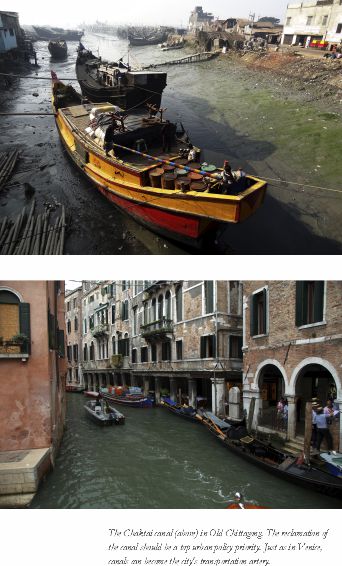
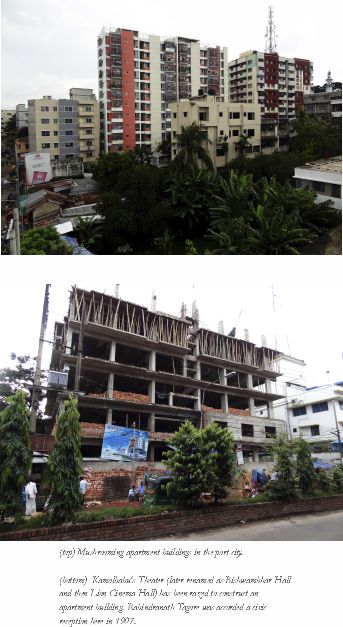
Chittagong is a chaotically expanding, environmentally challenged metropolis. Its population jumped from approximately 200,000 in the early 1950s to over 5 million in 1991 and about 7 million in 2014. The metropolitan area is home to 3.4 percent of the country’s population (Dhaka has 10%). The economic performance of the city is noticeable, contributing 11% of the country’s GDP (Dhaka has 36%). Yet, livability is an acute issue. Chittagong, like other burgeoning metropolises of developing economies, has been experiencing a laissez-faire construction boom. Real-estate development has become a key economic driver, unfortunately giving rise to a widespread culture of land-grabbing and hill-cutting. The Chittagong City Corporation and the Chittagong Development Authority are both oblivious of and complicit in these illegal and harmful activities.
The city’s western seas front – from Faujdarhat to Bhatiari and beyond – is, as the BBC (http://www.bbc.com/news/world-asia-18182706) hauntingly noted, “where the world’s ships go to die.” The ship-breaking industry’s corrosive effect on the area is no less an environmental “genocide.” Having spent six childhood years at the nearby Faujdarhat Cadet College, I have fond memories of playing football on the Faujdarhat beach and watching blue waves stir the sand. Alas, the seafront’s tranquility has been replaced by the disquieting industrial wasteland of half-cut ships and desperately poor workers. The Brazilian photographer Sebastião Salgado’s Workers: An Archaeology of the Industrial Age (1989) shows the tragic transformation of the pristine beach into a maritime graveyard and an environmental disaster. The shipbreaking industry, a hefty contributor to the national economy buttressed by a power-wielding political and business mafia, reigns with impunity. Access to the site is prohibited.
The preservation of heritage buildings is a far cry. The famous Nalapara site of Rabindranath Tagore’s civic reception in 1907, Kamolbabu’s Theater (established in 1906; later renamed Bishwambhar Hall and then Lion Cinema Hall) has been razed to create an unsightly apartment building! Nobody seemed to have noticed what kind of damage was done to the city’s stories.
I grew up in Chittagong and remember a safe and picturesque city. Donning the heavily starched green school uniform, I used to walk from home to my school, nearly three miles away, with other neighborhood kids. We would take a short-cut through the Panchlaish residential area. On our way, the gigantic, modernist building of the Chittagong Medical College Hospital (established in 1957) would appear soon on the right side against the backdrop of Mehedibagh’s dark green hills. The busy road intersection of Chawk Bazar would be next. There, we would routinely gawk at the delicious sweets and hot cakes displayed at the glass window of the famous bakery called League Store. Next to this bakery was the Gulzar Cinema, which sometimes featured obscure English films. We would endlessly discuss the stories of those films, based entirely on the gargantuan and gaudy billboards mounted on the front façade of the cinema. Within minutes, the Parade Ground—one of Chittagong’s very few remaining playgrounds—would be on our left. Shortly thereafter we would arrive at the school and quickly fall in line for the morning P.T., followed by the national anthem.
Life was simple. Kids felt a kinship with their city. The ability to walk to school every day inspired us to appreciate the city’s streets, buildings, trees, fields, and hills. There was no choking traffic congestion in front of our school, a common spectacle nowadays. During the late-morning tiffin break, there were vendors at the foot of the rolling hill on which our school was located. They would sell 25-paisa jhalmuri, to whom we would gravitate like moths!
Is this just a case of innocent, and ultimately useless, reminiscence? Cynics would claim that nostalgia is an exclusivist sentiment, zooming in on only favorable memories and airbrushing away all the blemishes. But the Chittagong of my childhood offered simple delights of urban experience. There were places to visit for recreation. The Patenga beach on the southernmost point of the city on the north side of Karnafuli was a popular weekend destination. At the Tiger Pass, more or less the geographic center of the city, the 280-foot high Battali Hill offered the highest vantage point for a 360-degree view of the city. In the west, one could see as far as the Bay of Bengal; the gentle bend of the Karnafuli would be visible in the south and east; in the north, on a clear day, one could see Chittagong’s legendary hills, running parallel to the sea. An inquisitive observer could also notice Old Chittagong in the south. Upon their arrival in the early 16th century, this is where the firingis (as the Portuguese were called) created their settlement. This area is now Firingibazar.
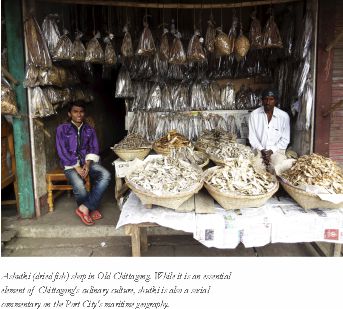
I recall many urban retreats that families would visit to get away from the hustle and bustle of the city. Among them was the Foy’s Lake, about 8 km north of the city center. It is an artificial lake created in 1924 as an English Picturesque-style park by the Assam Bengal Railway. At its inception, Foy’s Lake served the dual purpose of a reservoir to supply water to the railway colonies and a hill-water recreational park. Then there was the oasis-like7-acre War Cemetery (designed in the early 1950s) that for us was a solemn urban history “book” to learn about the devastations of World War II. This gated urban park contains755 small cenotaphs of fallen soldiers from Britain, Australia, Canada, New Zealand, India, and Netherlands—who fought on the Burma front. We viewed the War Cemetery as a verdant delight in the middle of the city.
There were many buildings that shaped our perception of the city. Window-shopping in the Chittagong New Market—an American-style shopping mall built in 1964, the first of its kind in the then East Pakistan—was a magnet for shoppers. It was even a domestic tourist attraction.We would go up and down in its escalators, a novelty in the country then. Among the 458 shops in this 4-story art-deco mall our prime destination was the air-conditioned Liberty Ice Cream Shop. We would save money in our little clay banks to buy ice cream there. On my way to the Collegiate School (established in 1836)—where I studied for less than a year—I would always look at the New Market’s architectural originality with amazement.
Across the outer stadium located at Kajir Dewri—where we played cricket—the colonial-era Circuit House (built in 1913 as a guest house for government officials) provided a lush forecourt. This patch of green was also used as an outdoor eating area for what used to be a local culinary institution: Darul Kabab. Alas, during the mid-1990s, driven by the era’s wrong-headed development plans, the site was taken over to create a garish theme park for children Near my father’s medical clinic at the commercial district of Rahmatganj was J. M. Sen Hall, built in 1920, during the pivotal days of shawdeshi andolon whichwas basically a movement for self rule. The well-known British-trained barrister and anti-colonial revolutionary, Jatindra Mohan Sengupta of Chittagong, commissioned the city’s first town hall in honor of his father, advocate Jatra Monan Sengupta. A political hotspot for anti-British meetings during the 1920s, J. M. Sen Hall later became the heart of cultural activities in Chittagong.
I recall venturing out of my father’s office to explore this basilica-style town hall’s unique wooden architecture and its shapely forecourt that was used for public gathering. Today, in the absence of any conscious preservation efforts, J. M. Sen Hall stands aloof amidst towering apartment buildings. Minutes away was Andarkilla, once the town center during the Mughal era. I used to go there to buy textbooks and stationary, while also routinely visiting a famous bakery that used to sell airplane-shaped saccharine cakes! While our sweet dreams were fulfilled in the bakery, quite literally, we remained oblivious of the three-domed Shaista Khan-era Jami mosque, built in 1669 located in the same area.
Lal Dighi was not far from there. The Dinghi is the legendary site for political speeches and the famous Abdul Jabbar’s Bolikhela (wrestling fair). We would wait all year for this historic fair, a quintessential Chittagong cultural relic from the early Muslim era. Aristocratic and wealthy Muslim Chittagonians used to traditionally employ professional wrestlers to stage Roman-style gladiatorial sports, albeit without the bloodbath. Held every year on the 12th day of Boishakh, the first month of the Bengali calendar, Bolikhela has always been a true urban affair that attracts not only wrestlers from many countries, but also artisans, potters, folk artists, traders, pita-makers, and city dwellers. If we didn’t get our 3-taka bobbing-head clay dervish doll from the Bolikhela we would be sad for days! If we did, we would laugh incessantly seeing its silly head-nodding!
Bolikhela still takes place, but its democratic, peaceful urban setting is long gone. Today, it is hard to find Lal Dighi, almost hidden by an incessant stream of people, cars, rickshaws, and shops. Chittagong is now marked by an infernal growth frenzy, as if occupying every square inch of the city with buildings means progress! The near-empty flyovers of Bahaddarhat are a tragic reminder of how urban development decisions are taken for political patronage and not for public good.
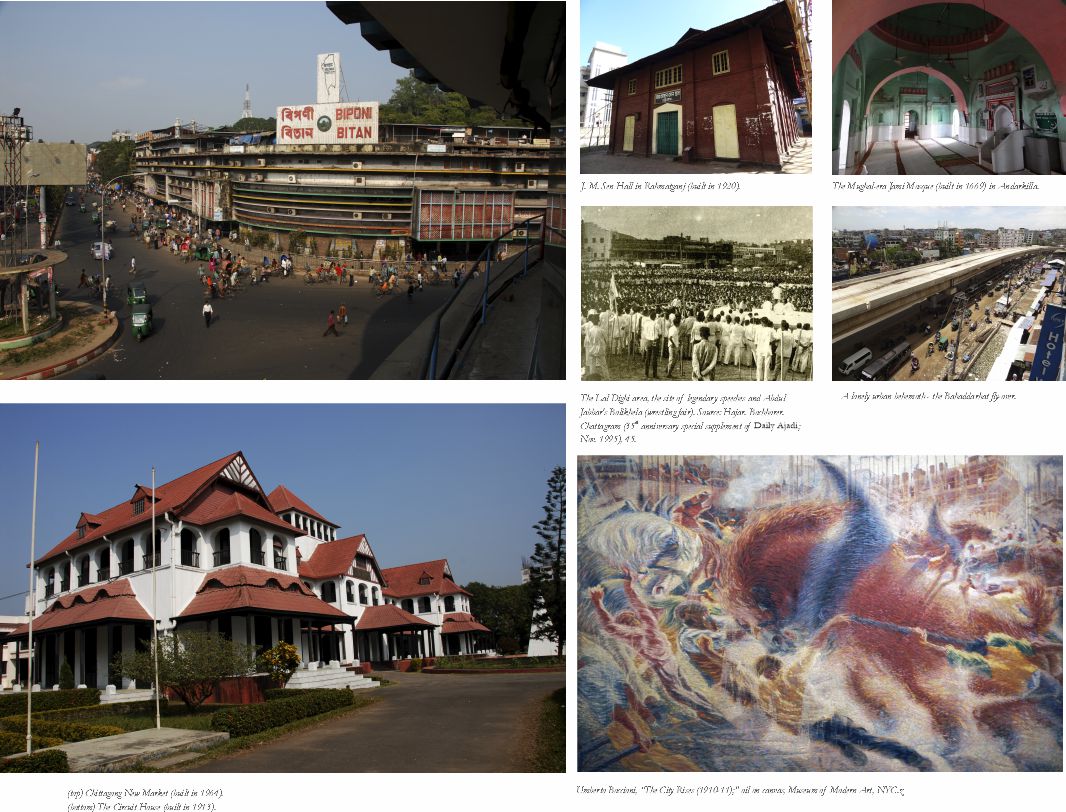
There is a broader philosophical issue to ponder. Modern city life has been a whirlwind, at least since the beginning of the 20th-century, as Umberto Boccioni’s painting, “The City Rises,” showed so presciently almost a hundred years ago.
Cities of the West—London, Paris, Vienna, New York—all have undergone the traumatic process of modernization. These cities, however, withstood the environmental impact of economic growth and prosperity by adopting appropriate planning initiatives. They made mistakes, but they eventually rectified many of their problems which protected the interest of the people.
The crucial question for the cities of Bangladesh (and other developing economies) is whether they can avoid making the same planning mistakes of western metropolises in the early stages of their modern growth and adopt the practices of ecologically balanced urbanism.
They can and they must. Chittagong too can. The first step toward this end would be to start listening to the stories that provided Chittagong its physical persona and mental universe. It is not possible to return to a simpler past, because growth is inevitable. But it is possible to design the present and the future. The city’s stories should be the guiding framework for moving forward.
Adnan Morshed is an architect, architectural historian, and urbanist. He received his Ph.D. from MIT, and is currently Associate Professor in the School of Architecture at the Catholic University of America, Washington, DC. He is the author of Oculus: A Decade of Insights into Bangladeshi Affairs (UPL) and Impossible Heights: Skyscrapers, Flight, and the Master Builder (forthcoming in Fall 2014 from the University of Minnesota Press). He serves as a director of the $1M Mellon Foundation Grant to MIT’s Global Architecture History Teaching Collaborative.
“Well, here we are at last in Chittagong. I am glad we are to live here instead of Dacca. Where Dacca is a bit larger and has all the old British government buildings, it is hot and level. Chittagong is on the Karnafuli River and is a city of “A Thousand Hills.” There is always…