
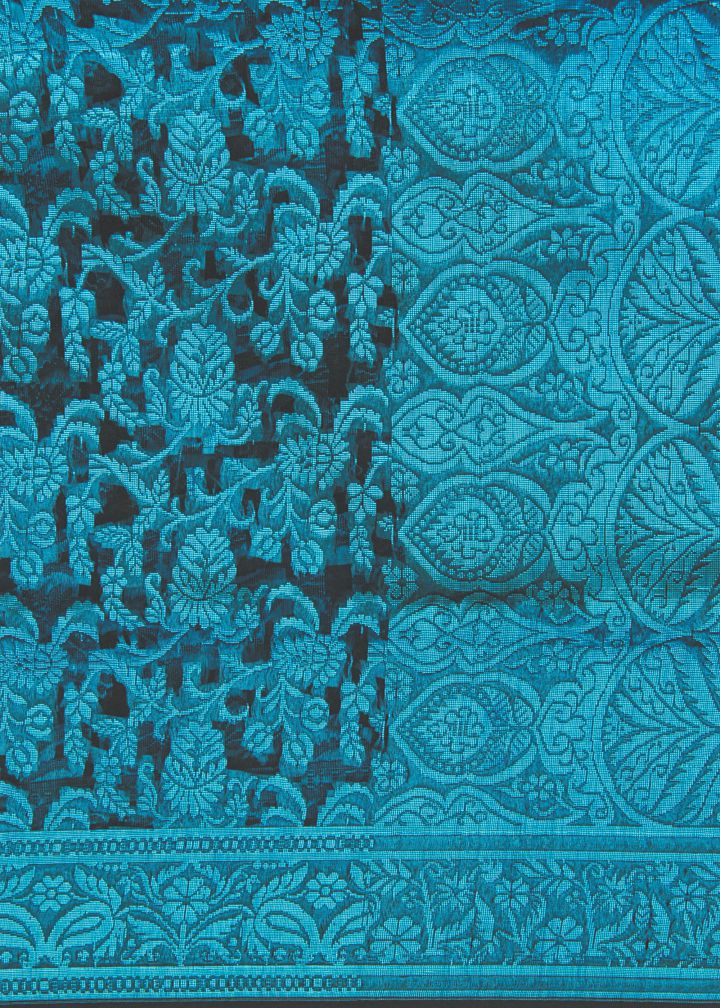
banarasi silk brocades-gem of the loom
Buddhist Art in India includes a beautiful story by Professor Albert Grunwedel, that has been translated by Agnes C. Gibson for the Archaeological Society of India in 1901. It describes the flight of Prince Siddharta from the palace and his renunciation of worldly comforts. ‘Having travelled thirty miles and seven states,’ the story tells us, ‘he reached a river whose name was Anoma, the Illustrious’. Prince Siddharta, we are told, said ‘My renunciation of the world shall be from here. My good Chandaka, take these ornaments and my noble horse and go home. Show them these and tell my father and relatives what has become of me.’ The story continues: ‘Then he thought his locks were too long and he cut them with his sword.’ Thinking again he said ‘These garments of mine made of Banarasi cloth are not suited to a monk.’ And so he exchanged them with those of a hunter passing the river bank. When Chandaka, his companion, agreed to leave, after much weeping he noticed that the horse Kanthaka had laid down and was breathing heavily and died soon after.’ The reference to ‘Banarasi cloths’ by Prince Siddharta in this famous story is one indication of the antiquity of Banarasi, the beautiful brocaded silks worn by royalty around the period 500 B.C.
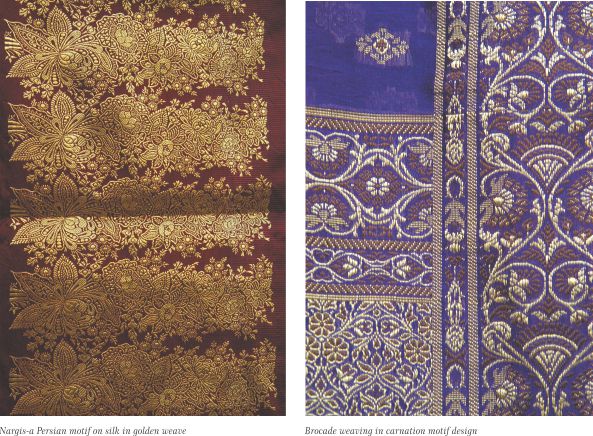
The legendary beauty of this richest of loom fabrics from Banaras, that historic city on the banks of the Jamuna, can be evidenced from this ancient narrative. There are also references further back in history to a lineage of silk-weaving called rupari (with silver threads) and Soneri (with golden threads) recorded in the Yajur Veda in approximately 1,500 B. C. We are told that women weavers called Pesaskaris wove such embellished cloth. Silk loom weaving continued till the time when Banaras-Ka-Kinkhab or silk brocades received the Persian nomenclature of ‘dream fabrics’ from their Moghul patrons. European writers wrote the word as ‘Kincob’ and described the material as the most gorgeous product of the loom. Before India’s Partition, there were several centres for the production of Banarasi silks in Ahmedabad, Aurangabad, Surat, Bhopal, Delhi, Lucknow, Murshidabad and Madras. But the real home of these exquisite looms was always Banaras. In the true Kinkhab, pure brocaded silks, there are three renowned designs: the shikargarh in which hunting scenes form the main motifs, indicating patronage of the cloth by royalty and aristocracy, the butidar or design of tiny flowers and sprigs, with or without borders, and lastly the beldar, comprising scroll patterns or vegetal creeper designs. These woven representations from nature are visible in the Ajanta frescoes of the 5th Century A.D. The woven motifs are of either gold and silver wire threads or silk threads; later cotton threads were also used.
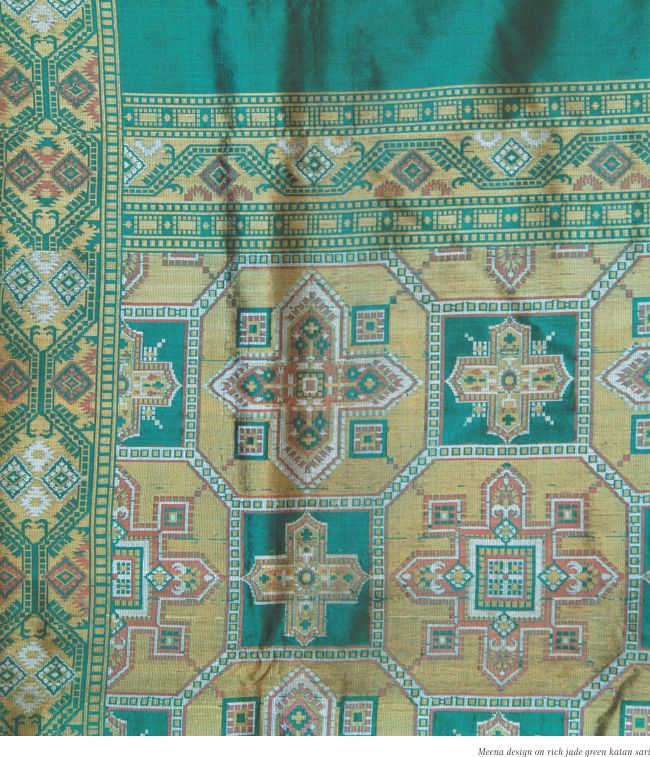
Other traditional designs include the swan motifs (Hangsha or Hamsa in Hindi) and the Kalka, the stylised cone or raw mango shape called ‘Keri’ in Hindi. Muslim patronage gave rise to further aesthetic developments and we thus find the Banaras Kinkhabs, or ‘fabric of dreams’ now presented with poetic names such as Dhup-chaon, or sun and shade, mazchar or silver ripples, bulbul chasm or nightingale’s eyes, chand-tara or moon and stars and murgala or peacock’s neck. Superior silk brocades produced for the Delhi Exhibition of 1902-03 and documented at that time describe a pattern on silks as follows: ‘Stalks and foliage of the scroll type, the flowers are composite, each floret outlined in gold’. Another exhibition piece in the diagonal style is the ‘tercha’, ‘a sari in yellow silk gauze with floral scrolls, the borders and end piece being in thick silver checkered Sheikh Mujibur Rahman who allocated land as well as funds for housing for them so that they could cultivate their craft. This is now well known as Mirpur Palli, composed of Primary Cooperative Societies under Ward No. 3 in Sectors 10, 11 and 12 Mirpur.
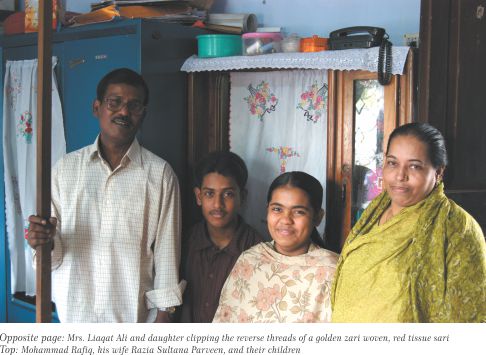
I was taken round the weaver’s village by 45 years old Mohammad Rafiq. Rafiq’s father had migrated to Dhaka in 1947 from Cholaur village on the Babatur Airport road of Banaras. Rafiq was born in 1952 and was married in 1977 to Razia Sultana Parveen, a girl of another immigrant weaver family who knows the entire weaving process well. Beginning with a couple of immigrant Urdu speaking families of Uttar Pradesh in India who packed up their looms and came to start life anew in Dhaka, Rafiq informed me that there are now 10,000 looms in Mirpur Palli.
In fact, the weaver population in Mirpur now number around hundred thousand. Indigenous Bengalis as well as the immigrants now produce Banarasi products. They can get employment as well as training in the Mirpur Banarasi Weaving Centre. Second generation migrant weavers have joined hands with locals here. Building on the rich heritage of Banaras silks, the Mirpur Banarasi Palli has been producing distinctive designs and contributing towards the ongoing fascination with Banarasis in our part of the world.
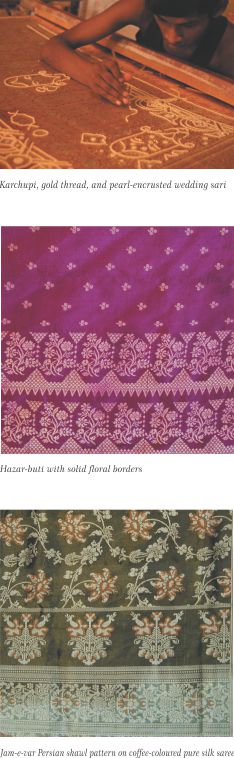
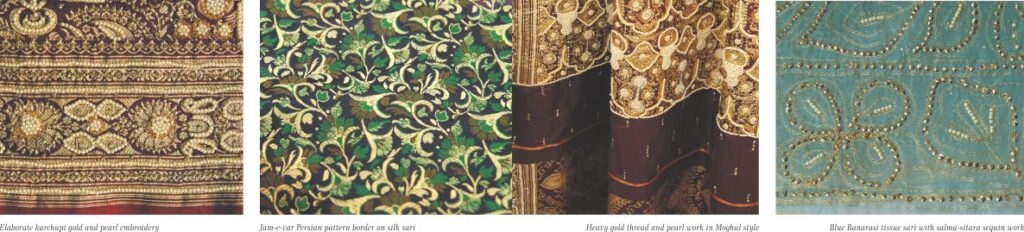
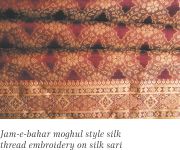
Indeed, over this half century many changes have been made in Banarasi production. Only older weavers such as 70 year-old Liaqat Ali, 60 year-old Qayyum, and 78 year-old Sanaullah Warsi remember the old design names. They explain that pure silk Banarasi saris with gold and silver thread patterns carried the old nomenclatures till the late 1970s. These were beldar (border with heavy anchol), bel-buti (border and flowers sprays), satin-buti (thicker texture cloth with scattered sprigs), Jam-e-bahar (trellis patterns), Jam-e-war (Persian shawl pattern), piping-bel (Narrow borders in geometic patterns), nargis (narcissus), tercha (diagonal designs), Gul-dasta (Flower vase motif also called Ambros, and Jangla (All-over ornamentation). The pure silk tissue Banarasi saris were originally called Organza. As time passed Bengali words came into use such as Lata-pata, Prianka, Tara-buti, followed in recent years by titles of Hollywood and Bollywood movies such as Titanic, Debdas and Ghar Ghar Ki Kahani.
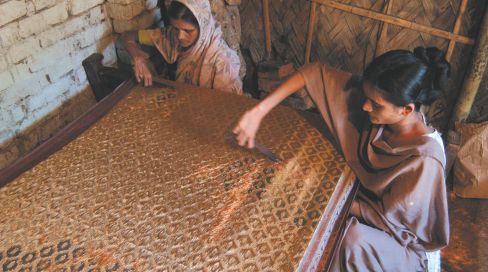
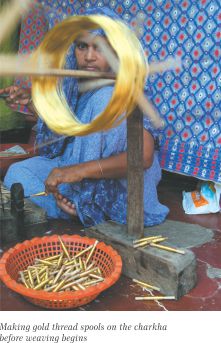
It is to Dhaka Mirpur’s credit that the weavers of Mirpur Palli were assigned to produce several exotic Banarasi sarees for Devdas, the Hindi blockbuster. The Palli is a vibrant place. Mirpur Banarasi saris and tissues produced in the humble bamboo Karkhanas or factories easily outshine the shimmering products of machines. The looms of wood, bamboo and small metal parts used here are still in the tradition of the pit-looms used hundreds of years ago. The only major change here is in the use of jacquard cards introduced after 1947.
In unbelievably small spaces, pairs of young boys sit on four or two sides of a stretcher frame which holds the tissue sari being worked over with Zardozi, in intricate gold and silver thread embroidery, or the renowned Karchupi bead and wire-thread studded cloth, or the simple Salma-sitara sequined work. The embellishing materials called ‘Chumki’, ‘moi’ and ‘dabka’ wire thread are imported from Thailand, China, Pakistan and India. A Karchupi saree takes seventeen days to be heavily worked by two small boys aged between 7 to 10 years old. The tiny apprentice boys get just Tk. 50/- a week for their labour, but once they are trained they can earn Tk 500/- on every saree. Nevertheless, the skill of their hands is nothing short of magical. Undoubtedly, only the heirs of a rich tradition can come up with such exquisite work.
In short, the Mirpur Palli weavers, distant cousins of the master craftsmen of Banaras, are working to keep their heritage alive. They speak with nostalgia of their parents’ work but they are determined to make their distinctive contribution to Bangladesh’s culture. If patronage is forthcoming the Mirpur Palli Weavers can produce Banarasi saris of the highest quality and keep up for posterity their exotic craft. The Banarasi legend lives on in Mirpur Palli to this day!
Perveen Ahmad is a craft specialist and researcher. She is also the founder member of Karika-Bangladesh Handicraft Cooperative Fabrication
Buddhist Art in India includes a beautiful story by Professor Albert Grunwedel, that has been translated by Agnes C. Gibson for the Archaeological Society of India in 1901. It describes the flight of Prince Siddharta from the palace and his renunciation of worldly comforts. ‘Having travelled thirty miles and seven states,’ the story tells us,…