

the artist who introduced modern bengal to the west
Jyotirindra Nath Tagore, one of Rabindranath’s older brothers, was the first to receive wide acclaim abroad for his artistic works when a folio of twenty-five pencil sketches by him was published in London in 1915
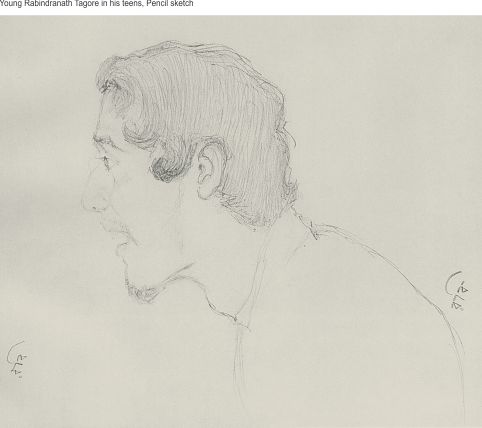
The Tagore family of Bengal had no dearth of genius or talent, particularly in the field of art and literature. Both Rabindranath Tagore and his nephew Abinandranath Tagore earned worldwide fame as painters of high excellence. However, Jyotirindra Nath Tagore, one of Rabindranath’s older brothers, was the first to receive wide acclaim abroad for his artistic works when a folio of twenty-five of his pencil sketches was published in London in 1915. These sketches received warm reviews from critics and artist, among them William W. Rothenstein, who saw these as having ‘much sensitiveness of line and sincerity in characterization.’ These drawings introduced to Britain and continental Europe a dimension of India quite different from the generally held view of a country full of heavily-attired Rajas, enchanting nautch girls, roaming tigers and ubiquitous snake charmers. His sketches were perhaps an attempt to change such perceptions. For the first time they offered the west pictorial images of the emerging modern urban society of Bengal.
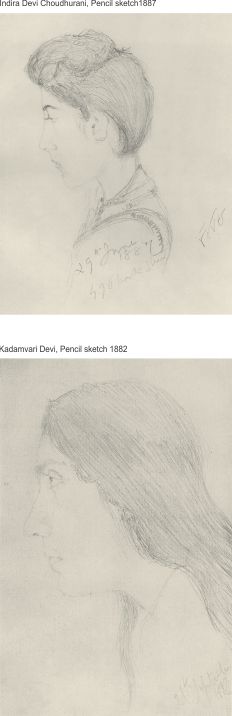
Published by Hammersmith of London with drawings reproduced by Emery Walker, the folio came out under the title Twenty-Five collotypes from the original drawings by Jyotirindra Nath Tagore. Though it showed 1914 as the year date of publication, it came out only towards the end of 1915 due to some delays in the printing process.
Excepting a short introduction by William Rothenstein, the folio had neither any text nor titles and not even a life sketch of the artist. It, however, gave the abbreviated name of some of the sitters and dates and locations where the drawings were done, thus helping us to identify some of his models, who were family members or friends such as Dijendra Nath Tagore, Gaganendra Nath Tagore, Abanindra Nath Tagore, Indria Devi, and Kadamvari Devi. From the dates inscribed in pencil on the body of the sketches it appears that most of these were done between 1880 and 1903. The absence of ordinary people in the folio does not mean that Jyotirindra Nath was a snob, for he has left us many sketches of them, e.g. labourers, domestics, sweepers and even convicted prisoners, which may be seen in the collection of the Rabindra Bharati Society. It was due to Jyotirindra Nath that we have the only existing sketches of the Baul-guru Lalon Shah, and the poet Behari Lal Chakravarti.
Though well-known in Bengal and in the the rest of India as a successful composer, popular playwright,an accomplished actor, editor, writer and translator of a large number of classic and contemporary French texts into Bengali, Jyotirindra Nath was hardly known in Britain and Europe. Unlike his younger brother Rabindranath, he had never travelled abroad. It was Rothenstein who discovered in an Indian periodical some ‘memorable drawings’ by a Bengali artist, who he soon found out was Rabindranath’s elder brother. Rothenstein requested Rabindranath to show him some more sketches of Jyotirindra Nath, adding that in his assessment Jyotirindra Nath was the best artist in India and it was unfortunate that his works were lying hidden from the gaze of connoisseurs. Jyotirindra Nath sent Rothenstein several of his sketch books. This was the beginning of a lifelong friendship and correspondence between the two which resulted in the publication of the folio in 1915 in London through Rothenstein’s efforts.
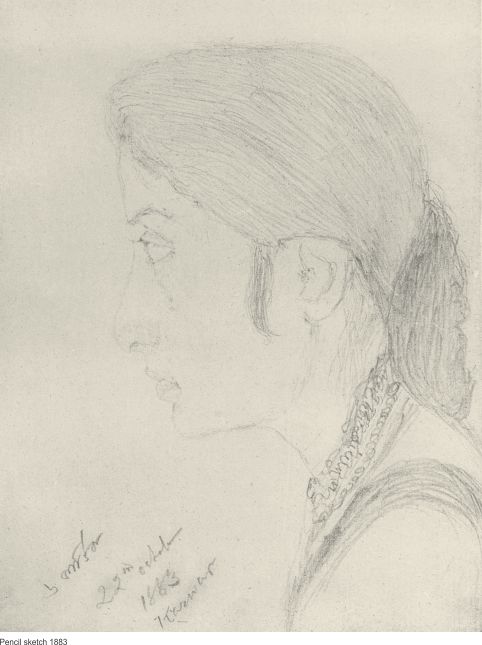
Because he shirked publicity and was shy, even Jyotirindra Nath’s memoirs do not throw much light on his artistic career. He only mentions in them that from his schooldays he had a natural talent for drawing and had the opportunity to draw sketches of a few contemporary celebrities. He regretted that most of his early works were lost due to his indifference. Later, he used to improve upon his skill by drawing the faces of the large retinue of domestics in his house. He took keen interest in the pseudo-science of phrenology, according to which the analysis of the forehead, eyes, lips, nose and shape of the head throw interesting light on the characteristics and habits of an individual. This explains why he drew few full figures and so many studies of the heads and faces of men, women and children.
Artistic circles abroad were particularly drawn to Jyotirindra Nath’s subtle and captivating portraits of Bengali ladies. Rothenstein declared that he knew of few modern portrait drawings which showed greater beauty and insight. The sketches, to quote him, ‘will give to many of us the human and intimate picture of Bengali character found in the novels of Bankim Chandra Chatterjee.’ To many critics, his drawings have qualities of concentration and sincerity which are expected from an artist but are rarely to be found in the works of an amateur. They seemed to be drawn with ease. Rothenstien’s also insightfully remarked that in Jyotirindra Nath’s sketches there was no preoccupation with western models nor an attempt to follow Moghul traditions.
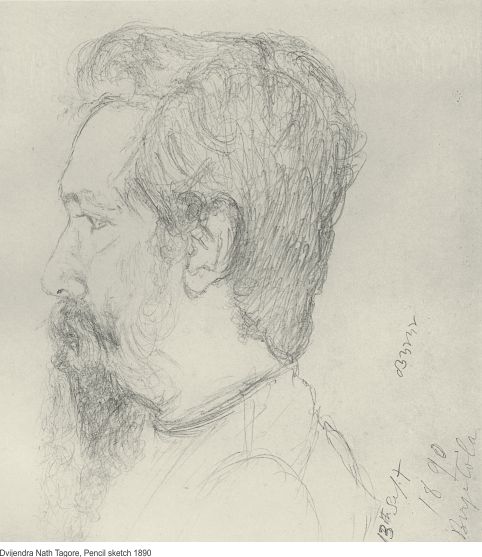
Jyotirindra Nath’s folio was limited in nature and scope as it concentrated on depicting only the men and women of the urban educated class whereas previous folios by European artists, primarily of Madame Belnos and Solvyns, were varied and diverse in the treatment of people belonging to different strata of Bengal society. In dealing with their Indian subjects, European artists were guided by theur own perspectives and viewpoints. In contrast, Jyotirindra Nath’s sketches were done by a Bengali who was the product of his environment, one able to bring into play his own perceptions, values and interpretations. His sketches conveyed the changes that had taken place in Bengali society since the days of Belnos and Solvyns. These sketches offered to Europe a glimpse of an emerging urban society in Bengal that had attained modernity after the introduction of English education and western science in Bengal during the first part of the 19th Century.
Like Jyotirindra Nath’s memoirs, his own voluminous diaries, a large number of which were subsequently destroyed by him, contained only passing references to his art, such as the dates and places of the drawings. Recently, Professor Muntassir Mamun has discovered a set of seven hitherto unpublished letters of Jyotirindra Nath in the British library. Addressed to Rothenstein and dating from 1912 to 1920, these contain Jyotirindra Nath’s assessment of his drawings and their place in the context of his own social environment. In one of these letters ( 21st April 1920, Ranchi ) Jyotirindra Nath describes these sketches as representing ‘ the work and pleasure of a lifetime’ and constituting ‘an illustrated history of our friends and acquaintances , many of whose features possess no other record.’ In another letter ( 9th October 1912, Ranchi) while commenting on his own works, Jyotirindra Nath wrote that he himself thought nothing of their artistic merit. Not having had any training in art, he felt that it was difficult for him to judge his own work. ‘ ‘This is for the first time I learned from an eminent artist like yourself that they are worth anything … and might be placed side by side with works of such eminent masters as Dante Gabriel Rosetti and Puves de Chuannes’ wrote Jyotirindra Nath.

Tall, handsome and talented, Jyotirindra Nath was the centre of all literary and cultural activities in the Tagore House at Calcutta. But after a tragic incident in the family—his wife Kadamvari’s suicide—he became a recluse on a hill top in Ranchi, far from Calcutta. He continued to be creative in different branches of art and literature, but because of his withdrawal from the cultural centre of Calcutta he slowly and steadily faded into obscurity. He died on 4th March 1925.
In her autobiography Indria Devi Choudhurani (his niece) has touched upon the last days of Jyotirindra Nath at Ranchi. She remembered him as a lonely man, with only a sister-in- law to look after him. She added that on his bedroom wall hung a pencil sketch drawn by him long ago of Kadamvari Devi, his deceased wife.
Mohboob Alam is a former ambassador and secretary to the government of Bangladesh
Jyotirindra Nath Tagore, one of Rabindranath’s older brothers, was the first to receive wide acclaim abroad for his artistic works when a folio of twenty-five pencil sketches by him was published in London in 1915 The Tagore family of Bengal had no dearth of genius or talent, particularly in the field of art and literature.…