

rickshaw art of bangladesh
Rickshaws are to Dhaka what Jeepneys are to Manila and Tuktuks are to Bangkok – eccentric forms of public transport that add colour and a certain anachronistic flavour to the city traffic. But the similarities end there, for rickshaws are manually driven, slow, and featherweight vehicles that look more like some medieval contraption than a modern-day transport.
The jinrickshaw originated in Japan in the 1870s but outlived its utility when motorized transports appeared on the scene. It found its way into other, not-so-motorized Asian cities, such as Kolkata, where it became popular with middle-class commuters craving for privacy while on the move. This two-wheeler is easy to handle, and no doubt puller-friendly. One reason for its proliferation is that once the initial investment in buying/manufacturing a rickshaw has been made, very little else needs to be done to keep it running. Also, the pullers, mostly migrants from villages looking for work, are employed at subsistence rates. Kolkata rickshaws, however, couldn’t cope with the competition offered by cheaper forms of mass transport such as trams and soon became marginalized in the city.
In Dhaka three-wheeled rickshaws first appeared in the late 1930s. According to one account, they were introduced by a local zamindar and a businessman. And these have remained, even today, a major form of communication for the millions of citizens of Dhaka. While rickshaws have disappeared from all big cities (Kolkata only has some pull-rickshaws plying a few of its streets) they have continued to flourish in Dhaka. For one thing, the absolutely flat terrain of the city and its countless alleys and lanes that are not serviced by any form of public transport have made rickshaws inevitable. For another, its citizens’ long-standing bitter-sweet relationship with the rickshaw has meant that despite periodic talk of its elimination from city-streets, it has actually become more and more conspicuous. Today, close to 100,000 rickshaws ply on Dhaka streets on any given day, often sharing the same road space with fast-moving motorcars and hurtling trucks and minibuses. And yet a rickshaw looks so fragile that one would think that even the slightest sideswipe from a predator truck would be enough to topple or upend it. Amazingly, however, rickshaws have proved to be the safest type of transport in the streets they ply on. In Dhaka, according to a newspaper report, only two rickshaws were involved in fatal accidents in 2001, while the number of people killed by trucks and minibuses was a whopping 21. This, in a town inhabited by close to eight million people!
But not everything is well with the rickshaws – not any more. Human rights groups are clamouring for an end to the ‘human exploitation’ that the rickshaws so blatantly typify. City transport planners, for their part, are demanding a total withdrawal of rickshaws from streets, calling them ‘death traps’ and ‘moving anachronisms.’ Already, a few important thoroughfares have been cleared of rickshaws, and more streets are being reserved for engine-driven vehicles. Indeed, one city official has claimed in a recent interview that rickshaws will be a thing of the past by the year 2010.
Nevertheless, not many people will probably lament the passing away of rickshaws, except, perhaps, a few hardcore romantics who will miss their two-passenger, body hugging intimacy, or admirers of slowness and the unbearable lightness of [the rickshaws’] being. One other group, too, will consider the demise of rickshaws an irreparable loss. These are the people who have been charmed by the sixty-year old art form associated with rickshaws, more formally known as rickshaw art, or rickshaw painting. Like transport painting elsewhere (Latin America, India, the Philippines) rickshaw painting in Dhaka has assumed an identity and a charm all its own. Variously described as ‘naïve,’ ‘commercial,’ or ‘urban-folk’ art, rickshaw art has developed steadily since its rather tentative appearance in the 1950s, undergoing transformations as its scope expanded, and faithfully reflecting changes in public taste over the years.
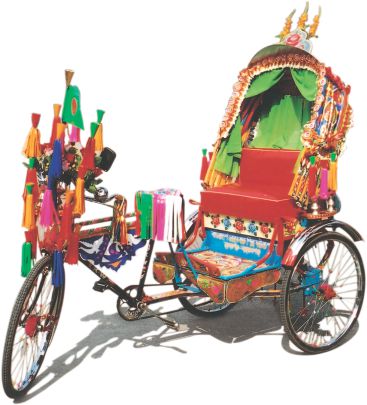
‘Moving anachronisms’ the rickshaws may be, but they are also moving picture galleries. Almost every rickshaw, except for its steel frame surface, is heavily painted over in rich, profuse designs and patterns. The seat cover and the collapsible hood, usually made of bamboo, rexin and plastic, are profusely painted. Appliqué
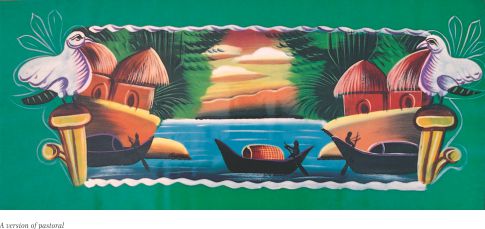
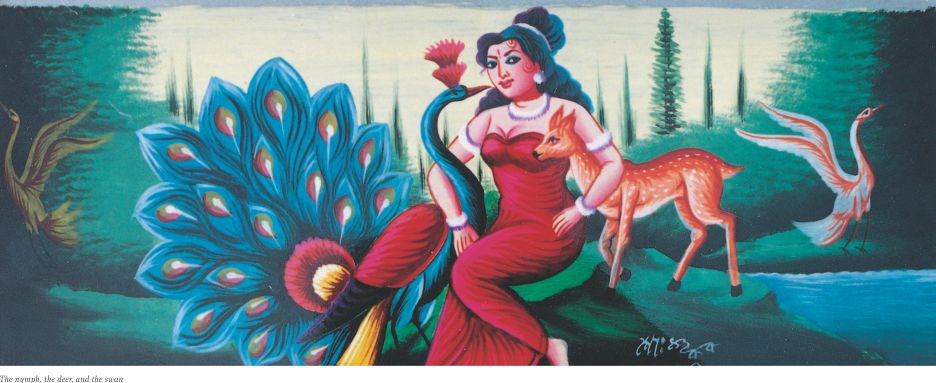
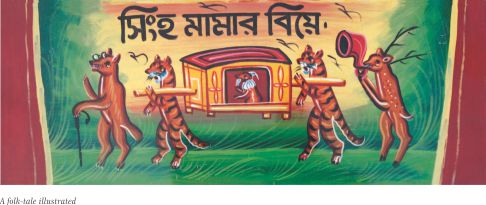
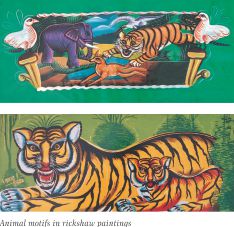
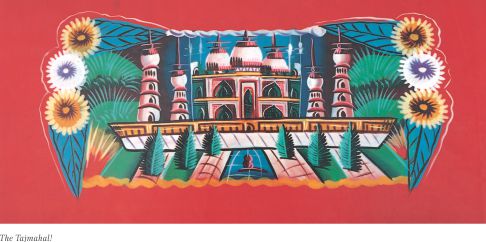
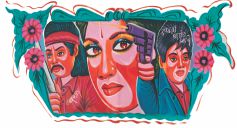
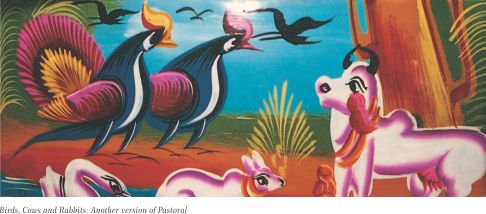
work is often done on the hood and the upper back part of the body; sometimes, painted forms and designs are thumbtacked to the body. But the most visible paint area, and the heart of rickshaw art, so to speak, is the backplate or backboard, a rectangular piece of tin plate not bigger than 45cmX 25cm in size. The backplate is secured between the two back wheels, some way above the ground, and is clearly seen even from a distance. While the rest of the rickshaw usually has floral decoration, the plate contains the main ‘art-work.’ The themes depicted therein have changed over time, reflecting changing social realities and shifts in public taste. At first the main subjects consisted of romanticized images of popular film heroes and heroines. Over the years, though, rickshaw painting has taken as its subject a wide range of themes and images: village landscapes, real life events such as the liberation war of 1971, fantastic looking gardens that appear right out of some JRR Tolkein book, postmodernist cities, animals and birds, public monuments, mythic and fairy tale figures, airliners and cruise ships (mostly foreign) and religious or devotional icons and images.
Indeed, when screen printing and lamination became affordable, even to rickshaw mistris (makers who are also often owners) of modest means, rickshaw painting took on popular images such as scenes from the movies. Today, most backplates display movie heroines, and occasionaly movie heroes, in all sorts of romantic moments. The names of the films are often emblazoned in bright letters for easy identification. Although the pictures drawn have little resemblance to the real life stars, the effort to arrive at a likeness continues, mainly because screen printing is cheaper than hand painting backplates. Unfortunately, then, the economy of mass production and consumerism has finally arrived, posing another major threat to the sixty-year old tradition of rickshaw art.
Still, the sheer game of numbers has kept rickshaw art alive. If only 10 to 20 per cent of the rickshaws today display old-fashioned, hand-painted art showing the Taj Mahal afloat on a blossoming lotus (an oft-repeated image) or a postmodern city with strangely shaped skyline and motorways, nearly 10,000 to 20,000 rickshaws are patronizing that art form! When we consider that tin-plate paintings have a display life of two to three years before they succumb to the insidious effects of oxidization, we can conclude that at least four to five thousand rickshaws will need art work every year! Not surprisingly, then, while in the 1950s only five or six rickshaw painters were at work, today their number ranges anywhere between 200 to 300. Rickshaw art, despite its homely look, is not cheap – the total decoration (including the backplate, body painting, and the tassels, ribbons and tinsels that generously adorn Dhaka rickshaws) may cost up to 20 per cent of the total production cost of the vehicle, according to experts.
Why do rickshaw owners dole out that kind of money for what is, after all, mere decoration? Do their investments in art give them a good return? Or, are they only blindly following tradition? Or, are they driven by something more profound: a desire for order, or more precisely, a desire to order things according to their wishes, to achieve a momentary stay against confusion? For answers, one has to look at the sociology of rickshaw art as well as its aesthetics. Rickshaw art in Bangladesh did not begin with the rickshaw itself for it was a later addition to its body. Early rickshaws were invariably painted in simple dark blue and red, or any such combination of primary colours. The seats were of black leather while the hoods were made of khaki waterproof material. The steel body was usually painted black. It was only in the late fifties that floral patterns began to appear on the body of rickshaws. Slightly later, rickshaws began to display artistic backpanels. The pictures on view at first were mostly idyllic rural landscapes, although film stars soon started to claim some space. Religious icons – gods and goddesses of the Hindu pantheon and shrines of Muslim saints and mosques – also became visible.
Why did rickshaw art emerge at a particular point of time? This is a question that may be answered in several ways. Firstly, rickshaws, as soon as they were introduced, became quite popular with the public, so that owners had a reasonably good turnover. This allowed them the luxury to invest a few extra rupees in decorating their rickshaws, which, after all, had to compete at that point of time with colourful tomtoms (horse-drawn carriages). In other words, rickshaws had to look attractive and distinctive enough to woo passengers away from tomtoms. Secondly, since several movie houses of Dhaka had been doing brisk business by the late fifties, movie banners were in great demand. The artists who painted these banners usually also painted rickshaws, often without incurring any new expenses. Rickshaw art, in that sense, found an early friend in Dhaka’s movie theatres.
As Dhaka sprawled as the capital of the province of East Pakistan, people from the villages were drawn to it for employment. Many of them ended up as rickshaw pullers, having failed to secure any better job. These migrants from villages must have found pulling a rickshaw painted with rural scenes emotionally satisfying and surely instantly identified themselves with the scenes. Moreover, many rickshaw garage owners must also have been drawn to the rural landscapes they had stowed away in their memories to return imaginatively to a past as often as they could.
An important aspect of early rickshaw painting was its reflection of the fact that a group with no political or economic power may nevertheless impose an order (however imaginary) on the labour-production nexus. If the community which produced the migrants (including rickshaw pullers and mistris) lacked an order (economic, social) and was, therefore, unable to protect its members (precisely the reason for their migration), then that order could be reconstructed in other terms at a distance of time and space. While reconstructing that order, the migrant group (re)discovered its power, although that power was, in reality, quite ineffectual in changing their world. In addition, the reiteration and repetition of familiar symbols and images reassured them that they still had a link with their roots that migration or even temporary separation threatened to snap.
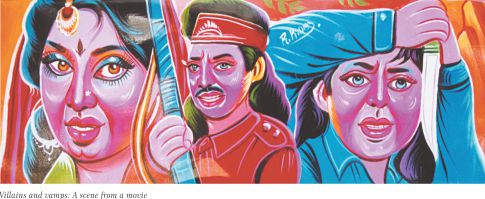
In the sixties, Dhaka’s rickshaw art began to diversify and accommodate itself even more to popular taste. Movie stars and movie scenes were added to its repertoire to cash in on the rising popularity of films. Along with rural landscapes, rickshaw backplates now began to depict cityscapes that were surprisingly neat and unpeopled, in sharp contrast to reality. Over the years, rickshaw cityscapes became more and more fantastic – even bizarre – although still retaining the early desire for order. Wasn’t this an ironic commentary on the fact that rickshaws are often blamed for the chaotic state of Dhaka’s traffic? Ironically, too, none of the backplates shows any rickshaws in the cities it projects! Could it be possible that the desire for order as manifested in the paintings was also a deep-rooted desire for social order without which no progress is possible? If there is no progress, a city will then be left dependent on man-driven, slow and clumsy transport forms like the rickshaw. Clearly, then, the aesthetic order that makes rickshaw paintings so charming is linked to a larger frame where social order is an important referent.
In a more obvious sense, a social, and sometimes political, content was marked off in many rickshaw paintings of the sixties. The decade was alive with highly charged political developments. Led by the charismatic leader Sheikh Mujibur Rahman, Bengalees had launched their movement for parity and self-rule. However, the more they agitated for their rights, the more oppressive the Pakistanis became, although the movement for autonomy had universal support. Rickshaw painters picked up the political themes of the time, painting different aspects of the movement, the Shaheed Minar (the language martyrs monument, one of the most sacred cultural-political icons) and the leaders of the drive towards independence.
A nine-month long war of liberation in 1971 led to the emergence of Bangladesh as a free nation. A new reality now greeted the people even though it was not possible to put aside the memories of torture, killing and rape that the Pakistan army perpetrated on Bengalees. These memories quickly found representation in rickshaw backplates. One image in particular of a fierce-looking Pakistani soldier pulling at a woman’s sari while she desperately tried to cling to the shreds of her dignity stirred the popular conscience in the country. At least for a brief period, post-war rickshaw art had resorted to social realism. Ironically, the Municipality, which was, and still is, the licensing authority for the rickshaws, soon clamped a ban on painting human figures on rickshaw backplates, as indeed on any other transport. The ban was not heeded by painters for long, and soon human shapes began to reappear, but not the war scenes. Those were gone for good, it turned out.
Today, rickshaw art in Dhaka has taken a truly commercial proportion. Mass produced images often taken from magazines or film posters and calendars dominate backplates. But hand-painted art is still very much on view as Dhaka rickshaws show movie stars and out-of-the-world beasts and birds; mosques and shrines; praying mothers and children; cities with fantastic skyscrapers and elevated motorways; village scenes and airplanes flying dangerously above treelines as they prepare to land. Such is the range of a rickshaw painter’s imagination!
The rickshaw painter himself, like his brother the movie banner painter (often the same person) is a quiet, behind-the-scene worker. Usually assisted by lesser hands from the same family, he uses only cheap enamel paint and watercolour or house painter’s brushes of the sizes 2-5. The thinner used is usually kerosene, and in some cases, turpentine. The backplate he works on does not give much freedom to experiment or innovate. He has to stick to some basic rules of composition.
‘The peculiar, oblong size and limited space of the backpanel,’ writes art historian Bulbon Osman,’ compel the artist to follow a centripetal format of composition. Moreover, the mobile nature of the art, and the particular choices of the clients demand clear and concentric composition so that an immediate and dramatic effect can be transmitted to the viewers’ ( ‘Contemporary Art in Bangladesh,’ a special volume of Arts and the Islamic World, London, no. 34,1999: 71).
Until recently, a client’s demand for variety was answered in various personalized ways by the few painters at work. Variety, in other words, was often produced by adding new elements while the style remained distinctly the painter’s own. Many paintings would show the same motifs and the same idiosyncrasies of the painter. If one painter liked fantastic looking birds (as a piece of specialization, perhaps) in one image, he would hardly paint regular, well-proportioned birds in another. No painter liked to come off his original image frame which marked him off, in any case, from other painters. There was thus much repetition of both images and styles in rickshaw painting for quite a while. Sunil (like most rickshaw painters, his signature consisted only of one name), the man regarded as a ‘master’ and ‘pioneer,’ was known for his rounded, romanticized human figures and idyllic village scenes where a river was always featured. R.L. Das, Alauddin and Ahmed, who followed Sunil, had their own individual styles. In terms of their use of bright primary colours, the cluttered perspectives in their work, and their avoidance of shadows, they all followed some primary rules of composition. One such rule is that images have to be distinct and bright. Bold brush strokes usually outline figures, which are centrally placed and stand clearly apart from their surroundings. Forms have to look dynamic and interactive to offset the effect of motion (some roads can be very bumpy). The more recent rickshaw painters – Anis, Akhim, Ali Noor, Quddus and others – have all contributed something new to the art. Anis is highly decorative, while Ali Noor’s paintings are sharp and life-like. He has a gradually opening perspective that one doesn’t much see in other painters.
Rickshaw art, it must be said, is exclusively male. There has been no woman painter among the 200 or so who have been painting the backplates in the last ten years. It’s no wonder that in the masculine world of rickshaw art the male gaze is dominant. This is most obvious in the paintings of women. The women are either ‘public,’ such as film heroines or exotic dancers routinely showing their cleavage; or ‘private,’ such as mothers on a prayer mat. The stereotyped figures reinforce male notions of femininity: the ‘public’ images are viewed as objects of desire, hence their exocitization, while the ‘private’ answer to comfortable notions of hierarchy, order and morality.
Rickshaw painting also promotes male power in the images of hunting and chase. A tiger pouncing on a deer, or a woman pursued by a man (he may be a lover, or a villain) have been favourite themes since the early 1970s. When it comes to extolling order, more particularly, family order, it is left to the mother figure to do so: a tiger nestling her cubs, a mother cradling her baby. Picture perfect village households will often have a mother cleaning the yard or feeding the animals. These images are a reconstruction of the male desire for order that subsumes women under its decidedly superior status and assigns them a place sanctioned by patriarchy. That the place is always a socially subordinated one is hardly noticed – indeed, such representations are meant to perpetuate male domination.
Migration, it has been suggested, is a Janus-faced process of displacement: on the one hand, it cuts off roots and separates the migrant from the land of his birth; on the other, it only reinforces his sense of belonging that he tries to satisfy by proxy, if necessary. Rickshaw paintings, done mostly by and for people displaced from their village homes by economic necessity, are often nostalgic representations of things remembered, depictions of a form of life threatened by the chaos and alienation of city life.
Rickshaw painting is certainly not a sophisticated form of art, but neither is it a naïve display of artistic inclinations. It is a public form of art where a combination of factors plays an important role – the economic status of the painter, his particular taste and training (and education, since that would in any case place him in the low percentile bracket); the taste of the clients (the mistris and the pullers); the public preference for particular images at a particular time, etc. Ultimately, rickshaw art is folk art of a kind that thrives on particular myths, symbols and icons, with a distinctive urban colouring. We may call this a form of urban folk art, with a considerable portion of popular art elements thrown in.
But whatever label we may give to rickshaw painting, one thing is certain: we will have this art form with us only for a decade or two more. Which thought makes one wonder: how many art forms are there in the history of art that have encapsulated the popular imagination so comprehensively and yet were unable to survive even for a hundred years?
Syed Manzoorul Islam is a member of the editorial board of Jamini and one of Bangladesh’s leading art critics
Rickshaws are to Dhaka what Jeepneys are to Manila and Tuktuks are to Bangkok – eccentric forms of public transport that add colour and a certain anachronistic flavour to the city traffic. But the similarities end there, for rickshaws are manually driven, slow, and featherweight vehicles that look more like some medieval contraption than a…