
shivaratri
The festival of Shivaratri celebrates the mythology of the divine linga or phallus of Lord Shiva. A local legend describes how, during ancient times, a cow used to leave her herd to go to the area now known as Pashupatinath
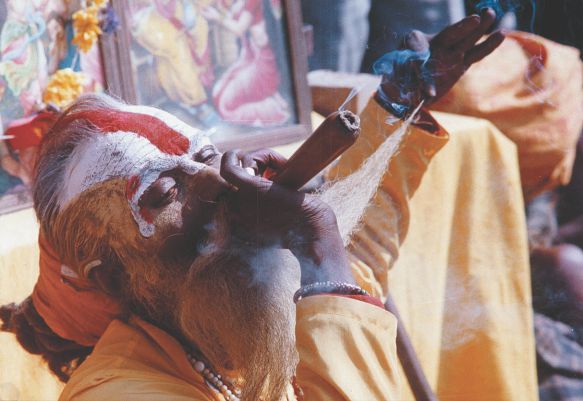
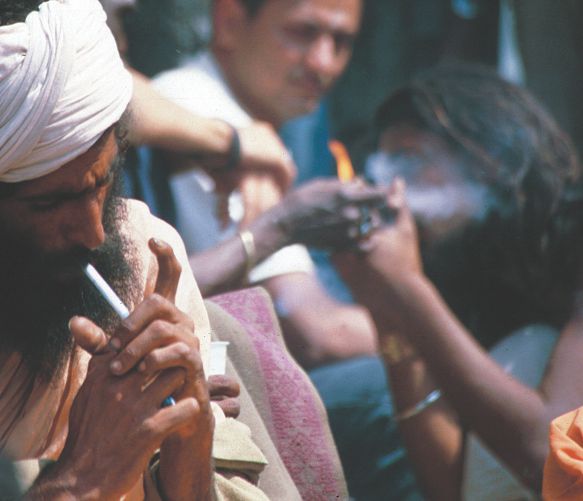
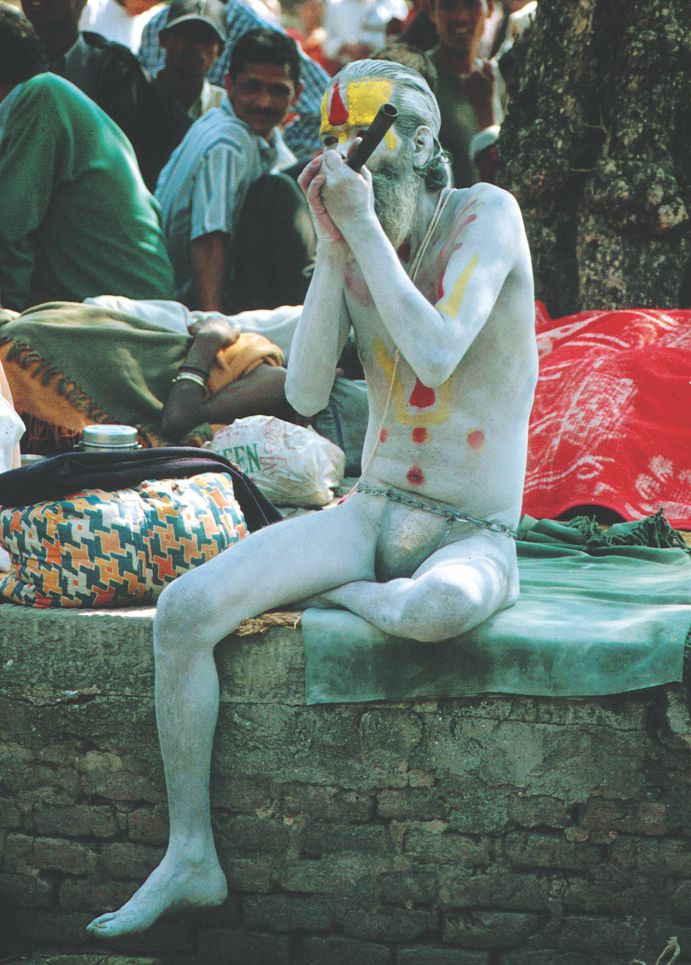
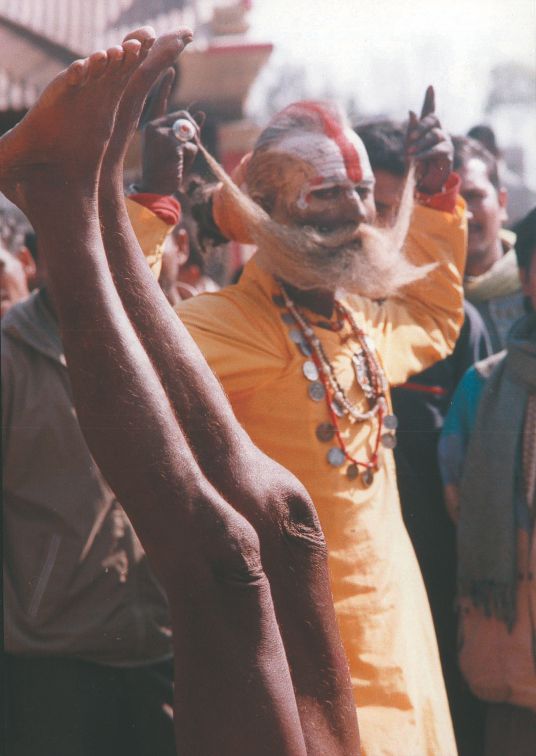
Literally the ‘Night of the Lord Shiva’, the festival of Shivaratri brings pilgrims from all over the world to the temple of Pashupatinath (another name of Lord Shiva) at Kathmandu. The first to arrive are the naked sadhus or ascetics with only a thin film of gray ash covering their bodies. They camp around the Bagmati river and in the nearby forest to smoke pot in their large chillums, and praise Shiva. Next are the buses from India bringing in thousands of devoted Shiva worshippers who often find shelter in the camps set up by local volunteers in nearby areas. People walk around the golden temple of Pashupati, singing devotional bhajans and bathing in the waters of the Bagmati even as dead bodies are cremated at Aryaghat on the other side of the river. By the time of the festival, which usually falls in February or early March, Pashupati is teeming with people. In the afternoon troops at the Tundikhel parade ground fire a gun salute to the image of Shiva. Devotees, desirous of having a darshan of his phallic image inside the golden temple, form queues that stretch all the way from the temple steps to the other side of the river. The ecstatic, teeming mass of the people around the temple can sometimes work themselves into a frenzy, and so police and local volunteers work overtime to make sure that nothing unpleasant happens.
The festival of Shivaratri celebrates the mythology of the divine linga of Lord Shiva. Once upon a time, goes a local legend, a cow used to leave her herd to go to the area now known as Pashupatinath. There she would offer her milk to an image of Shiva’s linga hidden under the ground. The legends describe how milk would automatically fall from her udders to soak the ground and bathe the underground linga. The milkman, obviously curious, dug the spot and discovered the divine stone phallus of Shiva, an image suffused with divine light. Later, the Licchavi King Supushpadeva (464-505 A.D.) built a temple at the very site where the linga was discovered. Though it was partially destroyed by Shamsuddinn Ilias, the Sultan of Bengal, in 1349 A.D., it was restored and renovated by a number of Malla kings, including Jyotir Malla in 1360 A.D, and Shivasingh Malla in the fifteenth century. The Shah kings Rajendra and Surendra Bikram in the nineteenth century, and King Tribhuvan and his son Mahendra Bikram Shah in the twentieth century ordered further renovations. It is interesting to observe that while Nepali kings are thought of as incarnations of Lord Vishnu, there has been a strong link between the gilded palaces of the Kings and the gilded temple of Pashupatinath, the home of Lord Shiva. Such an association between the palace and the temple of Shiva can be interpreted as Nepal’s cultural response to the dual pressure created by the practices of Vaishnavites and Shaivaites.
An extant mythological fragment describes a dispute between Brahma and Vishnu, the other two Gods of the Hindu trinity apart from Shiva. As is almost always the case the question was one of power. Who was the more powerful? When they could not settle the dispute they went to Lord Shiva and asked him to arbitrate. Shiva, the husband of Uma or Sati, told them to go and try to find where his phallus ended. The argument was simple. Whoever would discover the limit of the phallus would be declared the more powerful of the two, the king of the universe. And so Brahma and Vishnu tried their utmost to discover the limit of the phallus, the transcendental organ that represented the creative fertility and the cosmic laws. For years they travelled in vain. Finally it became clear to the competing Gods that their search was futile as the linga seemed to stretch indefinitely from the heavens to the nether land and even beyond. This realization humbled the two Gods while increasing the glory of Shiva who is also known as Bhole Baba, Shambhu, and Pashupatinath, or master-protector of animals.
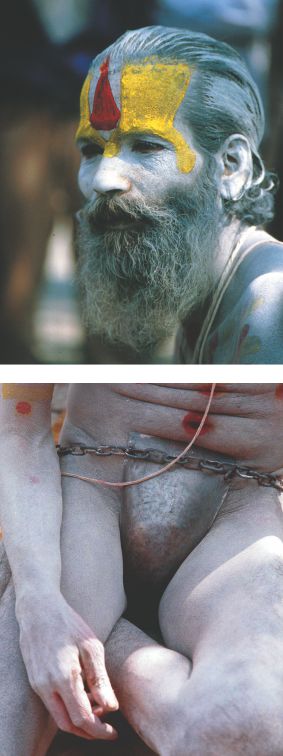
While Vishnu and Brahma can be thought of as relatively ‘civilized’ Aryan Gods representing law and order, Shiva, arguably a non-Aryan God admitted into the Aryan pantheon, represents an excess, a danger that cannot be fully assimilated into the order of things. Long haired and brooding, he walks with his neck garlanded with snakes, his body covered with ashes and his loins girded with animal skins. In his form as Bhairav, Shiva represents death and decay, and plays with the skulls of the dead in burning cremation grounds.
There are thousands of stone lingas in the area of Pahsupati. The most sacred of them, a three-foot black stone linga with the five faces of Shiva engraved upon it, is situated in the inner sanctum of the temple. All the stone lingas are based in the circular stone discs, symbolizing the yoni. Infertile women bring flowers and fruits and worship the phallus, hoping that the divine energy emanating from the linga, will bless them with children. During Shivaratri these lingas are showered with flowers and water. The flowers fall onto the ground and are trampled in mud under the feet of thousands of devotees. A mammoth gilded image of Nandi, Shiva’s loyal bull, crouches in front of the temple, witnessing the chaos of the worshipping thousands, and, as one can imagine expresses its devotion to the sacred three-foot Shivalinga inside the temple.
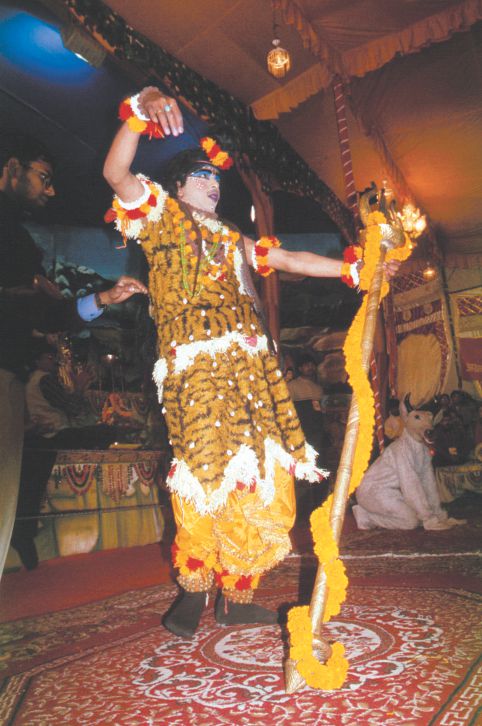
The festival of Shivaratri not only celebrates the glory of the cosmic phallus but also the dances of creation and apocalypse, the Natraj and Tandav dances of Shiva. These dances represent the plays of contradictory forces that are embodied in the figure of Shiva. While Shiva is described as a celibate yogi, he is also known as a seducer of women and as someone who haunts the funeral grounds in the company of his half-naked ghostly companions. Shiva’s Natraj dance symbolizes the mystery of creation; it represents how stars and planets and mountains and oceans emerged out of the primal chaos of the universe. At the same time, Shiva’s Tandava dance represents the disintegration of nature and the end of the world. It signifies the arrival of the primal night of the universe, a night without moon or stars or clouds or sky. Such a dance of destruction, however, can be interpreted as part of a recurring cycle. As the universe is destroyed, its debris and fragments are united through Shiva’s creative dance, the dance of Natraj; a dance that reshapes and remodels the old as it creates the world anew. Taken together, both dances break the division between the divine and the mundane and between the dancer and the dance to arrive at a non-dual unknowable centre. At the centre of the dance, thus, is a crack or a gap, an impasse, an excess that lies beyond the categories of human reason or understanding. Such an indescribable impasse or absent centre is known as ‘neti,’ and points to an understanding of divinity not through the rituals of affirmation but through the procedures of negation. Since the dance symbolizes a flux rather than a substantive being, there is nothing to lay hold upon, nothing to affirm. The only thing that one can do is to keep on saying not this, not this, till all the cobwebs, all inessential details are rejected one by one to reveal the fleeting, indeterminate essence–or perhaps one should say the non-essence–of the divine.
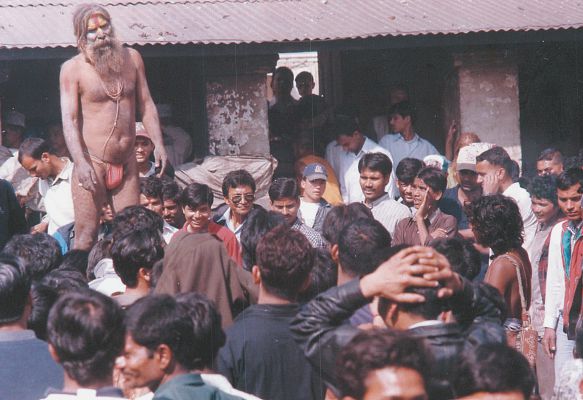
A few years back, as I was walking past the burning pyres of Aryaghat during Shivaratri, I met Bhutnath, a naked sadhu from Banares with long dreadlocks smoking marijuana. After a day of colourful celebration the crowd at Pashupati had thinned. The motorcade carrying the King and the other royal family members, who had come to pay homage to Shiva and offer him gifts, had already departed for the Narayanhiti palace. The temple was glowing with the yellow light from oil lamps and burning tapers. Campfires lighted the slopes on the other side of the Bagmati River overlooking the temple and the burning ghats, and the sound of drums and flutes reverberated through the air. Many people, including myself, however, still remained at Pashupati, huddling around the bonfires and accepting chillums from the sadhus. Those intending to keep an all night vigil were discussing philosophy and religion with the sadhus and smoking ganja. Bhutnath, whose name literally means ‘master of the ghosts,’ offered me a few puffs of the chillum as he performed some torturous yoga postures upon the ground and declared that there were only two naths, or masters, in Kathmandu. While one of them was inevitably Pashupatinath, or Lord Shiva himself, the other master was undoubtedly Bhutnath, his devotee at Aryaghat smoking pot. ‘The rest are all thieves, rascals and pretenders,’ Bhutnath said as he displayed his tumescent member to a crowd of onlookers– especially Europeans–clicking their cameras. Bhutnath’s ash smeared body, his yogic postures, and his smoking chillum imitated the figure of Shiva whom he worshipped, while his self-confessed status as a rebel and an outsider reproduced the danger or the excess that was embodied in the figure of Shiva.
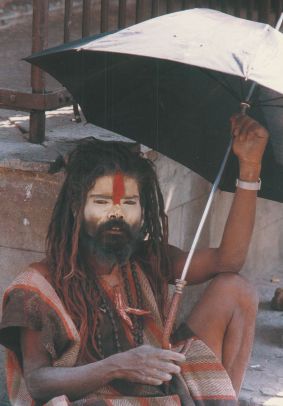
‘By smoking ganja I seek aaram, or a completely restful state,’ explained Bhutnath, ‘because truth or Ram can only be found in the midst of restful state. Think of the word aaram, don’t you see the word Ram inside the word aaram? Even Lord Ram is resting inside aaram; in other words, the god of truth is inside the word of rest and peace. By smoking pot, Shiva is telling us that it is necessary to get outside the system of work in order to experience aaram,’ Bhutnath continued. ‘Only fools, thieves, rascals, and ambitious and greedy people work all the time. All of those people are haramees. Having no conception of the divine law, they fret away their time making money, producing children and repressing the poor and the powerless. By walking among the ghosts and rejecting the traps of civilization, Shiva is refusing the social convention that judges a person in relation to the work that he or she does. Haramees disturb us aramees, the practitioner of restful aaram,’ said Bhutnath, while gazing doubtfully at me as if to ascertain if I was an aarami or a harami.
While modern culture valorizes work and divides time into discrete units so as to grade the value of labour in terms of time spent working, for Bhutnath time was repetitive and cyclic, without beginning or an end. As Shiva’s Natraj and Tandav dances mix into each other, creation and apocalypse succeed one another within a cosmic scheme in which time is undivided and unbroken. Similarly, while it is necessary to work in order to live, Bhutnath feels that work without rest and without reflexive meditation can only lead a person away from the still centre within oneself, the fountainhead of the cosmic law.
Unfortunately, however, the law of the modern world is the law of work and labour; a law that is at odds with the law of the cosmos symbolized by Shiva’s all pervasive linga. From the perspective of such a law of work Bhutanath is not an aarami but a harami. While the literal meaning of ‘harami’ indicates children born outside wedlock, its broader cultural meaning signifies all forms of lawless behavior, including vandalism, vagrancy, incest and states of unproductive leisure. By smoking ganja and refusing to do ‘productive’ work, Bhutnath had–from a worldly perspective–turned into a harami, a person who lived outside the legitimate borders of the society–one given to displaying his obscene nakedness. Rejecting the tyranny of such a law of modern civilization, however, Bhutnath–like the so-called ‘uncivilized’ God Shiva–was smoking ganja and smearing his body with ash near the burning pyres of the dead to challenge social definitions. What is considered by society as a state of restful aaram–a comfortable life spent among children and family and television and passbook–is for Bhutnath a matter of alienation and illegitimacy. As the tempo of the drums increased and the yellow light of the burning tapers created strange shadows around the banks of the Bagmati, Bhutnath chanted a mantra to praise Shiva. Then he turned to face me and said that with the blessings of Shiva all the aaramees had turned into haramees, while those who were thought of as haramees by society had tasted the true joy of cosmic aaram.
Like the God he imitated and worshipped, Bhutnath was living dangerously. As the shadows spread and the night of the Lord Shiva deepened at Pashupati, Bhutnath raised his iron trident and cried hoarsely, ‘I am ready for both life and death. Let the wish of Shiva be fulfilled.’ It seemed to me that Bhutnath’s cry was not directed towards some substantial divine presence or principle but an empty, absent non-centre, to that unknowable crack or hole in the universe that opens every time Shiva performs his dances of death and life.
Sanjeev Upreti teaches English at Tribhuban University, Kathmandu
The festival of Shivaratri celebrates the mythology of the divine linga or phallus of Lord Shiva. A local legend describes how, during ancient times, a cow used to leave her herd to go to the area now known as Pashupatinath Literally the ‘Night of the Lord Shiva’, the festival of Shivaratri brings pilgrims from all…