

A window on Tibetan Painting
No longer considered esoteric, Tibetan artists have created a niche for themselves on the international scene and are now admired for their unique take on life, culture and modernity.
Tibetan paintings draw heavily on three basic inspirations: religion, the colours, textures and tones of the local landscape, and a blend of Tibet’s traditional mores with modern art. While Tibet has been for centuries celebrated as the home of a distinctive religious art and monastic architecture, there has only recently been a surge of interest in contemporary works from Tibet. Because of Tibet’s peculiar location, Tibetan paintings came to incorporate elements drawn from different forms of Hinduism and Buddhism rooted in Tibet and Nepal, as well as from the arts of China. Tibetan art strongly retains a harmony between its past and present.
Traditional Tibetan paintings were most frequently in the form of tangkas or temple banners, usually done in brilliant colours or embroidery threads on cotton or silk and then framed by a silk or brocade border. The tangkas retained their distinctive style over centuries. The central stories of tangkas are based on religious themes. The scrolls usually have a main deity drawn in large scale in the centre. A whole set of small scenes portraying significant events related to the deity is drawn around the scroll.
The tangkas are pictorial stories and have no detailed explanatory text save a title-like note on every scroll. Although religious in spirit and content, Tibetan traditional art attaches importance to perspective and scale, to realistic details as well as symbolic representation.
Many traditional Tibetan art works are to be found in monasteries in Tibet. These art works—brilliant frescoes in monasteries, art galleries and palaces, and tangka painting scrolls—reproduce Tibetan medieval history. During the Buddha Paintings Display Festival, monasteries put up priceless gigantic Buddha painting scrolls that they are responsible for preserving.
Contemporary Tibetan artists are engaged in redefining their relation to their ancient land and its unique spiritual and cultural heritage. Contemporary art in Tibet could be said to be a quintessentially reborn art form that explores modern aspects of enlightenment and human existence, but in creative continuum with the great works of the Old Masters.
An impressive volume titled Contemporary Tibetan Painting was published to commemorate the 50th anniversary of ‘the peaceful liberation of Tibet’ in 2000. The selection consists of 94 works by painters of the Tibetan and the Naxi ethnic groups. It includes new Tibetan paintings, modern tangka scrolls, engravings, mixed media and oil paintings by artists who represent the coming together of traditional Tibetan culture and modern art. Artists who showcase contemporary trends in Tibetan paintings and are included in the commemorative selection are Bama Tashi, Tashi Tsering, Kardyi, Tsering Dorje, Galasang Tsering, Jigmei Chilai, Cewang Tashi, Sherab Gyaincain, Chigya Dawa, Nyima Tsering, Tsangchub Zhuoma and Dekyi Yangjin. Each of them creates artistically consummate works that are forthright and vigorous, uncluttered and meditative.
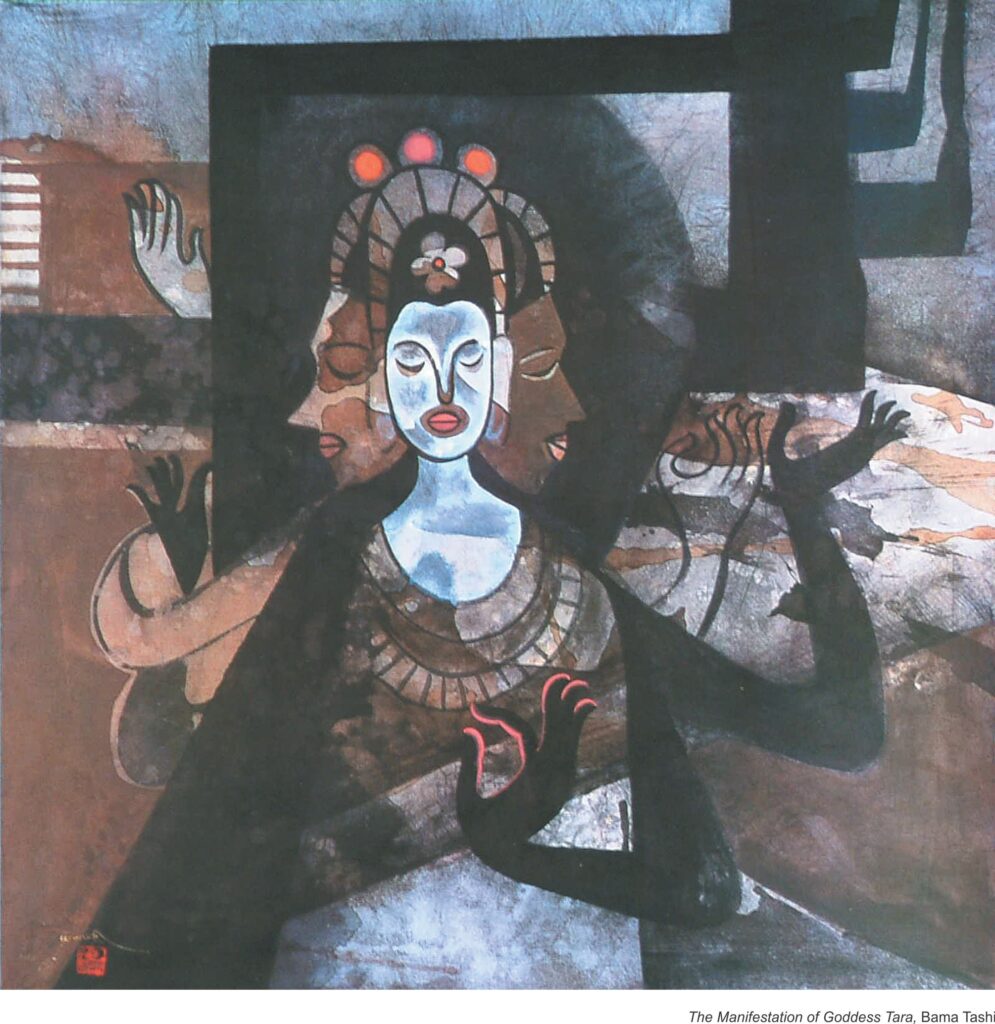
Bama Tashi , in his 1961 work entitled The Life of Lord Buddha, creates a fine blend of the ancient and the contemporary. He draws on Tibetan art traditions but introduces many innovations in his drawings. Paintings like ‘The Snake Under the Window’ (cloth painting) reflect Tashi’s fondness for ritual symbols and motifs. Delicate yet nuanced, they remind one of fresco effects. His works also utilize expressive brushwork and blotting techniques. Among Tashi’s themes are time and illusion.
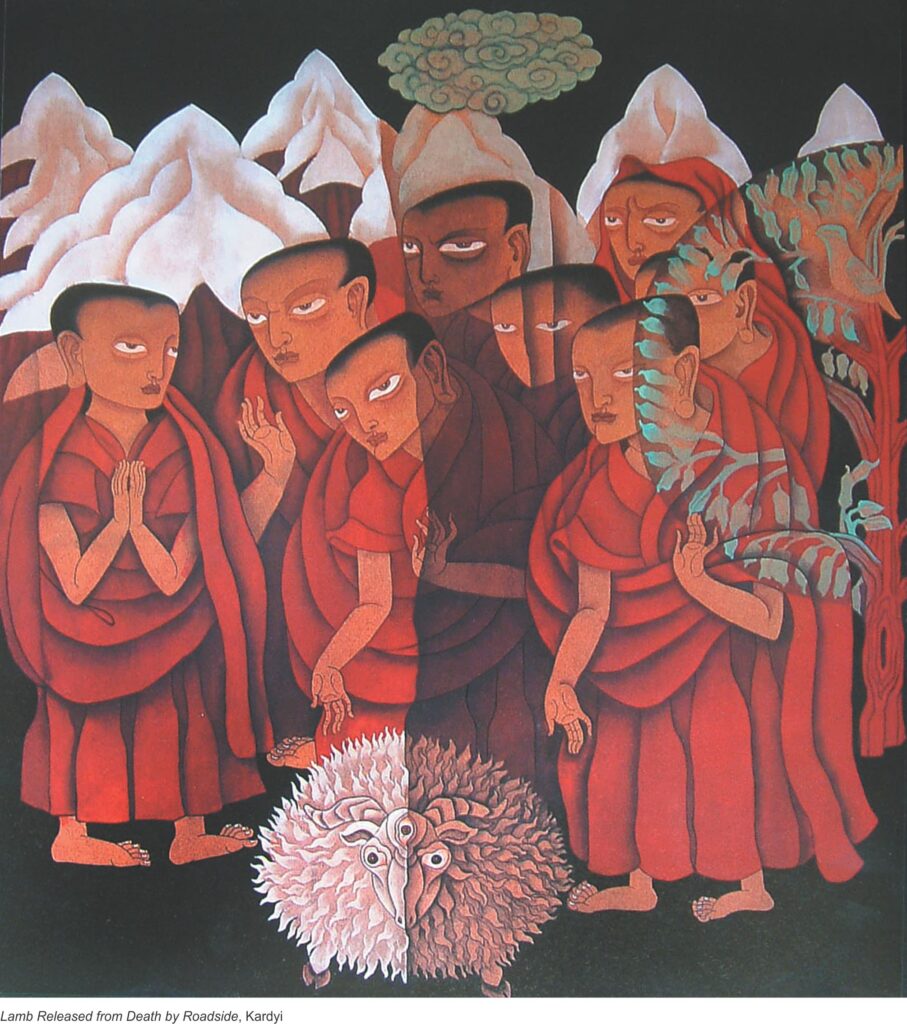
Kardyi is a faculty member of the Department of Arts, Tibet University. He favours the use of mixed media. His best works are resplendent in burnt sienna and hints of turquoise. He evokes an eerily quiet world — ‘samsara’ as he calls it. He seems to embody mystic and pastoral experiences in bold lines and with simple lithographic grace in works such as Lamb Released from Death by Roadside, Pastoral Song, Spirit Beings on Yak-Hide Raft and Crossing Samsara.
Tsering Dorje works with oil paints. Vivacious and energetic strokes painted in fiery crimson, electric green, orange, yellow and purple represent his signature style. Dorje’s Red Palace reveals a quirky play of Impressionist techniques.
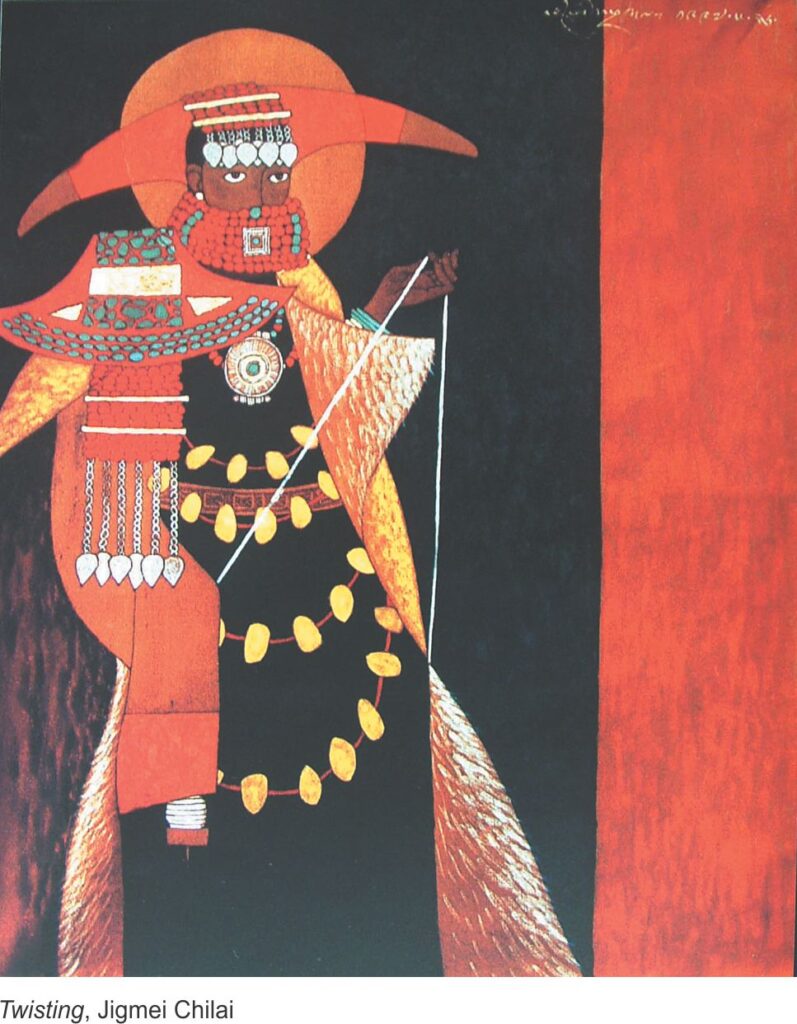
Jijmei Chilai’s cloth paintings evoke native elements. Conforming to the Tibetan colour preference for brown, ochre, orange, black and aquamarine, his best works such as Tibetan Girls and Pure Water are dramatic and suggestive, yet seem timeless.
Nyima Tsering’s New Tibetan paintings depict the inscrutable mystery of native terrains. The elements are evoked against an overwhelming backdrop. There are steep mountains, icy gales, herds of powerful animals, and deep cavernous mountains that convey an awareness of existential verities. In A Land of Legends Tsering displays a pleasing control of scale and light.
Deyki Yangjin’s paintings are sumptuous. She revels in fine elegant drawings of women, birds, flowers etc. Using a palette of rich colours in paintings like Stillness and Beautiful Shanba La, Yangjin conveys a sense of timeless beauty and spiritual harmony. Tibetan painting has been described as being grand and spiritually lofty, as is the terrain they come from. Contemporary Tibetan art is also as poised and confident as was the work that emanated from the past, bearing testimony to generations of fine Tibetan talents.
Mosud Mannan is a Bangladeshi diplomat posted in Beijing
No longer considered esoteric, Tibetan artists have created a niche for themselves on the international scene and are now admired for their unique take on life, culture and modernity. Tibetan paintings draw heavily on three basic inspirations: religion, the colours, textures and tones of the local landscape, and a blend of Tibet’s traditional mores with…