

Contemporary variations of Traditional landscape Painting in korea
Landscape painting occupies the highest position among the painting styles of Northeast Asia. Landscape painting was inspired by the idea of portraying majestic mountains, shimmering lakes, virgin forest lands and other lovely scenes from nature. Although it is often compared with Western landscape painting, Korean landscape painting, having begun several centuries earlier, has its own characteristics. Gradually developed out of Northeast Asians’ unique view of nature, Korean landscape painting eventually surpassed portrait painting or paintings using flowers and bird motifs, to become the country’s chief artistic form.
The beginning of Korean landscape art can be seen in the wall paintings of the Goguryeo tombs. In the Tomb of the Dancers, there is a painting of a hunting scene. This excellent piece of the 5th to 6th century, showing hunting and dancing, captures the vibrant and optimistic spirit of the Goguryeo people. The fresco also depicts numerous other people in twisting valleys. In the Gangseo great tumulus, amateurish texture strokes are used to depict mountains. Although it is not a painting, Baekje tiles bearing ‘mountain and river’ motifs demonstrate an improvement in terms of the use of space in landscape composition. Since there are no extant Silla landscape paintings, we do not know exactly what they may have looked like, but it can be assumed that they underwent considerable development along with other Silla art forms, and the same can be said of Goryeo art.
During the Joseon era, professional painters usually produced landscapes at the request of noble families. An Gyeon is the representative professional painter of this period. His work, A Dream Journey to the Peach Blossom Land, a masterpiece produced in three days, has a scattered yet harmonious composition, an exquisite sense of spatial expansiveness and majestic landscapes. It was strongly influenced by Kuo Hsi (1020-1090)’s Early Spring from China’s Northern Song Dynasties. One noticeable thing in the late 18th century is that painters turned to the everyday life of people, for it was during this time that both realistic landscape painting (Jin-gyeong Sansuhwa, ‘landscape painting of true view’) and genre painting (Pungsokhwa) were introduced. Although founded on the traditions of East Asia, the Jin-gyeong era in late Joseon abandoned Chinese influences, so this period was considered to be the zenith of Korean traditional art. This was not simply an outcome of the political and economic security and prosperity of the period. It was also definitely not merely a consequence of the move away from the China-centered worldview. It was an expression of subjectivity specific to the Korean people. The era is characterized by waves of modernization, the pluralization of values, the rise of the Silhak (Practical Studies) ideology, and contact with Western civilization.
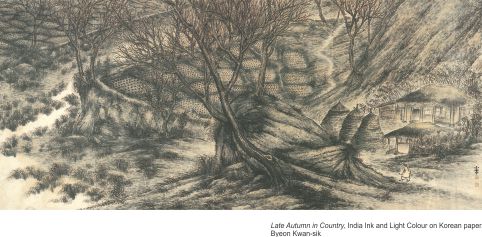
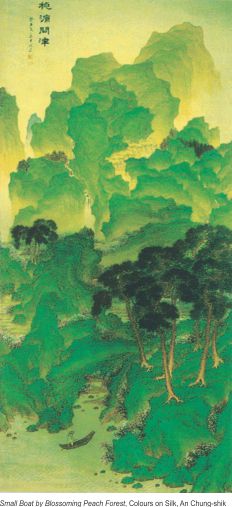
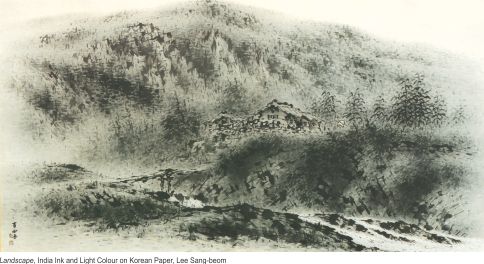
Jeong Seon (1676-1759) in particular loved to use Korea’s bare granite peaks as subject matter. His ever-changing subliminal scenery of Mt.Kumgang (Diamond Mountains) are represented with dynamic and dramatic compositions and became a symbol of the national soul. In his depictions of rocky pinnacles and mountains, he pioneered the technique of using repeated vertical lines (Picture3). His Jin-gyeong Sansuhwa exemplifies this technique of depicting the images of nature as directly witnessed by the artists. This style of rendering nature departs from the Chinese style, and better suits the Korean landscape. He thus established a unique artistic style that could be clearly distinguished from that of China. In the next period, which runs for more than 60 years from the late 19th century, realistic landscape painting styles went into decline. In their place, the Southern school’s literati style, which was centered around Kim Jeong-hui (1786-1856)’s group- the so-called Chusa school—became influential. In addition, a group of maverick artists created a style based on a new artistic sensibility, which came to be known simply as the ‘novel style.’ The influence of this style can also be seen in Small Boat by Blossoming Peach Forest by An Chung-shik (1861-1919), based on the celebrated Chinese literary piece, ‘Peach Blossom Spring of Wu-ling’ (poem of an Arcadia) by Tao Yuanming (c.365-427) of the 4th century A.D. An Chung-shik’s blue and green landscape painting technique displays the artist’s skillful use of subtle colours to create the Utopian atmosphere that is inherent in the theme. Influenced by the last two masters [An Chung-shik and Cho Seok-jin (1853-1920)] of the Joseon dynasty, the Modern Korean artists have been able to produce authentic true-view landscape painting. No Soo-hyeon (1899-1978), Byeon Gwan-sik (1899-1976) and Yi Sang-beom(1897-1972) developed a new artistic style and theory that signified the end of the realistic landscape. They painted landscapes that could be seen as representations of any scene one might encounter throughout the countryside of Korea. Rolling hills, streams, and farm houses nestled under the hills were rendered softly in ink and light colours giving the viewer a soothing, comfortable feeling. Yi Sang-beom’s ‘Landscape’ shows the new technique, namely the ‘folded-ribbon’ and the ‘axe-cut’ texture strokes. This new device, together with his use of a consistent light source, is very effective in depicting the sharp edges and surface of the rocky mountain. Also, a ‘hook’-like stroke is applied with fast repetitive movements of the brush densely or sparsely, depending on the scenery depicted.
From this time on, traditional landscape painting gave way to Western techniques, and atmospheric perspective was successfully employed. Its aim was to work towards changing and modernizing traditional landscape painting through the synthesis of Western and Eastern art. Artists adopted the Western approach of sketching from nature the native scenery, which was painted using traditional ink and the light application of pigment and conventional brushwork. Such paintings adopted the modern methods of depicting form, such as perspective and shading from Western painting, which were based on representing nature in a realistic manner. Characteristically the conventional materials and brushwork were used as descriptive tools in the paintings.
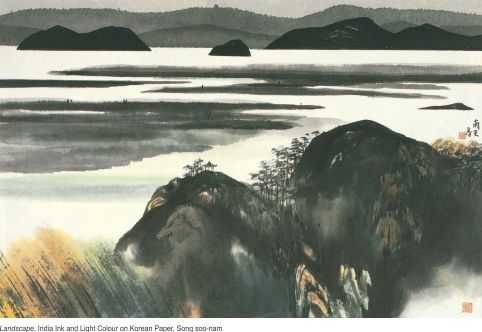
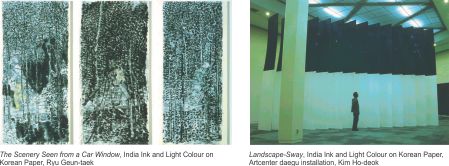
Today, few artists work in the traditional style. Most artists are experimental in their approach. They strongly feel that traditional art forms are unable to meet the demands of the new age. The general feeling that a change was needed presaged a new phase in modern Korean painting. At this time, Korean painting maintained the division of Oriental and Western styles although, by the 1990s, these two trends have become less distinct due to synthesis. The 50-year history of modern Korean painting is actually the process of the inter-relationship between these two trends, with many artists attempting to assimilate them into a modern Korean style. Challenged by such a transitional period, Kim Ho-deok (1950) developed a new style of the traditional Korean ink painting. He has been attempting to rediscover the spirit of traditional art by exploring new techniques, as in his depiction of the wind through the swaying of paper. When seen from a broad perspective, the traditional subject of nature has become a model of romantic lyricism sensed through the eyes. However, opposed to the modern view in which rationality is supreme, where nature is seen as an object for the development of civilization, nature is now viewed from the perspective of environmental aesthetics. Song Soo-nam (1938) has advocated the use of the techniques and materials of traditional black ink and colour paintings along with the traditional forms from a modern perspective. He asserts that this abstractionist trend could be found in many facets of the Korean character, such as the love of nature, preference for natural media and the minimizing of artificiality. Another good example of contemporary variations of traditional landscape painting can be found in Ryu Geun-taek’s (1965) works, e.g. The Scenery from a Window. In the 1990s, some leading painters including the above-mentioned artists zealously devoted themselves to this new style. Despite the increasing influence of Western techniques, contemporary Korean landscape artists are able to master the ideal balance between the new and traditional artistic ideas and techniques. Furthermore, through their search for ‘Korean-ness’ they are able to come closest to the mind of the Korean people by presenting them with the most familiar and comforting views of their land.
The contemporary significance of Sansuhwa (landscape painting) based on the value of harmony with nature can be found here. The world of nature has the power to heal not only human psychological wounds, but also the wounds of the earth. Furthermore, the consciousness of the symbiosis between humans and nature with its shared basis in life is emphasized as a new vision that can transcend the alienated anti-life cultural forms of industrial society and the materialist value system of modern society. Accordingly, Sansuhwa should not be limited to the realm of unworldliness, but be recognized as the central medium of a pan-naturalism that can recover and heighten the essence of life which is being contaminated by the abuses of modern industrial civilization. A future direction of development should be explored on the basis of these thoughts.
Koreans have become increasingly confident of the uniqueness of their traditional culture. At the same time Korean artists have begun to realize that their traditions have certain features of worldwide appeal. Korean painters used refined techniques and forms of expression to create modern paintings based on traditional Korean culture. In this sense, Korean painting and Korean art in general have developed at an unprecedented pace over the past few decades. In addition to these external developments, there have been a number of significant internal changes within the Korean art world. In particular, Korean artists have succeeded in capturing the spirit of traditional art while presenting it in modern terms so that it appeals to modern sensibilities.
MeeAe Lee is an art critic and curator
Landscape painting occupies the highest position among the painting styles of Northeast Asia. Landscape painting was inspired by the idea of portraying majestic mountains, shimmering lakes, virgin forest lands and other lovely scenes from nature. Although it is often compared with Western landscape painting, Korean landscape painting, having begun several centuries earlier, has its own…