
Editorial
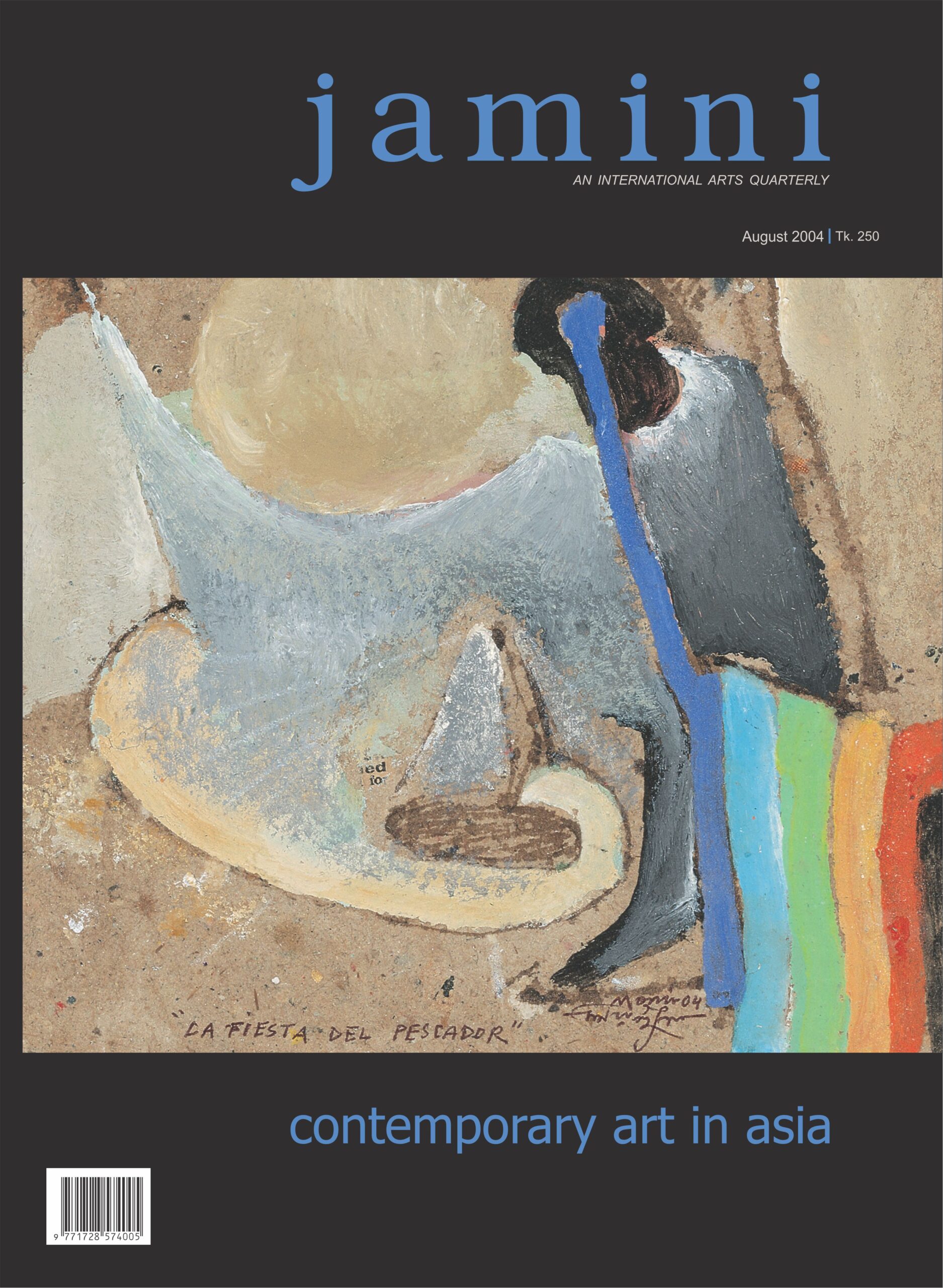
We begin with an apology for the late publication of the 4th issue of Jamini. The delay is, however, a part of our strategy for streamlining the magazine’s publication schedule. Henceforth the four issues will appear on the 1st of the following months: February, May, August and November. We will treat the February issue as a special, 160-page edition, devoted to a particular theme (starting with popular art). The rest of the issues will still have a central focus, but will have a sufficient content mix to allow us to deal with the entire spectrum of the arts.
The 4th issue was initially planned to reflect contemporary trends in the art of the Pacific and Asian countries, but we soon realized that it would be quite unwieldy if all the regions were given a representation. We decided to be selective instead, and keep the Pacific region for a future issue. South Asia, understandably, gets the larger focus, but we have extended our coverage to Singapore, South Korea and Bahrain as well. The term contemporary has also been stretched by some of our contributors, who see it not only as the here and now but also the complex reworking and repositioning of a time past by the artists of our time for making our experience of contemporaneity more meaningful. Many of our past masters appear to have a way of finding their place in our contemporary ethos. MeeAe Lee points out the relevance of traditional landscape painting to contemporary South Korean artist and shows how contemporary variations still retain the aesthetic qualities of older landscape traditions, although times have changed. In the same vein, Mosud Mannan traces the coming together of tradition and contemporary talents in Tibetan painting. In discussing contemporary art in Pakistan, Sarwat Ali also begins with an assessment of early masters who created a living tradition that contemporary artists refer back to even as they attempt to create a modernistic style.
On a slightly different note, Venka Purushothaman deals with the production of art in Singapore. Production, as is understood in common parlance, has an economic dimension, and Purushothaman begins by placing Singapore art in an economic and socio-political frame, but then goes on to include other issues such as history and nationhood. Wejdan Almannai writes on three artists in Bahrain while Sandip Sarkar and Pranabranjan Ray give us profiles of two noted Indian artists of our time–Paritosh Sen and Bikash Bhattacharjee, respectively. Ziaul Karim deals extensively with the 1990s generation of Bangladeshi artists, and Waqar Khan highlights a forgotten medium of art, painted photography, from 19th and early 20th century Bangladesh. Jamini Editorial Board member of Syed Manzoorul Islam talks at length with Monirul Islam, a major Bangladeshi artist from the 1970s who now lives in Spain. The Indian artist Gulammohammed Sheikh responds to questions put to him by the Jamini editorial board through email. This issue of Jamini has a book review section as well as art notes. There are exhibition reviews from Washington and Dhaka. These are expected to be regular features of all forthcoming issues of Jamini.
We begin with an apology for the late publication of the 4th issue of Jamini. The delay is, however, a part of our strategy for streamlining the magazine’s publication schedule. Henceforth the four issues will appear on the 1st of the following months: February, May, August and November. We will treat the February issue as…