
south african women artists images in the mirror
The years of apartheid brought not only legislated racism to South Africa, it also excluded people—particularly creative people—from access to the currents that were motivating and feeding the rest of the creative world. Feminism, Post-Modernism, Happenings, Performance Art were all strategies for art making that came to dynamic and active life between the 1950s and 1970s in the west, but South African artists remained cloistered in apartheid: unaware of what was going on in the rest of the world, and unable to experiment with the trends in contemporary art language that were burgeoning out there. It was only in the early 1990s that artists were freed from the cultural embargo that had characterised an apartheid-framed existence.
Within the sexist, racist, patriarchal society of apartheid days (1948-92), women, particularly black women became a demoralised group, neglected by the Powers That Were. There is a danger that in trying to remedy the situation one might give the previously disadvantaged too much emphasis, which would again present a skewed picture. The ideal, then, is to strike a balance, offering insights into previously neglected areas, but also examining current and contemporary issues that give South African artistic expression its flavour in a broader world context. Another key requirment is a lack of dogmatism: these artists do not uniformly fit a genre or a socio-political category or agenda. They cannot be seen to represent parallel or similar socio-economic or gender-based values, or even fall into a definite chronology. Looking at a gender rather than a time-based framework of artists remains a discursive gesture which is refreshingly open-ended.
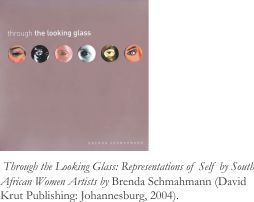
Brenda Schmahmann, Head of the Department and Professor of Fine Arts at Rhodes University, in Grahamstown, Eastern Cape, has written a concise critical study reflecting on most of these concerns. Through the Looking Glass: Representations of Self by South African Women Artists tries to meaningfully bring together issues relating to women’s self-image—resting on the notion of the looking glass—together with an ideal of fantasy. In the 19th century, Lewis Carroll offered the looking glass as an inroad to another world, an esoteric, imaginary one, rather than just a reflection of ours. Schmahmann, with a pointed interest in gender studies, takes her reader on a brief, whirlwind tour through women’s art in contemporary South Africa, through the proverbial looking glass. Part of the book is based on social commentary and the way in which contemporary and local women in the present age and in the past have been able to look at themselves, through mirrors, through the eyes of their male counterparts, through society. Yet another part of the book is based on how contemporary women perform their roles as wives, mothers, lovers, daughters, sisters and caregivers.
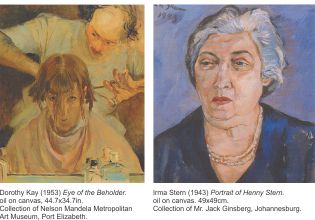
The book begins with an insightful, witty and meaningful analysis of a rather obscure work by the Eastern Cape painter Dorothy Kay, The Eye of the Beholder (1953). The painting was purchased by the King George VI Art Gallery in Port Elizabeth in 1963, the first work by a Port Elizabeth-based artist to be acquired by this institution. The curator thought that the painting was both a good representation of the artist’s work, and a rare work itself. Schmahmann’s analysis presents an intelligent play of values on the implicit understanding between a viewer, the subject matter and the artist—and the unspoken but implied gender of these three players in a work’s constitution, within a traditional modernist framework. A self-portrait of the artist as an ageing woman having her hair cut is a particularly unglamorous document of this artist in particular and of womanhood in general. Lack of glamour aside, it is a very honest representation of the self in a vulnerable state. Kay (1886-1964) was a prominent artist in South African affluent circles. Born in Ireland, she emigrated to South Africa in 1910, where she married. For much of her professional life she depended on commissions, which effectively prevented her from experimenting with self-expression.
Once the South African discourse was opened to democracy, writers like Schmahmann became empowered to see and reveal the understated subversion in many early South African women artists, and to generate new theories around them. These were not demure lady Sunday painters, subject to the whims of their husbands, for only on the surface did they fit this socially appropriate bill.
Artists who fitted most comfortably into late Modernist value-structures, including Maggie Laubser (1886-1973), Maud Sumner (1902-1985) and Irma Stern (1894-1966), are cited as being consciously but timorously transgressive. (Irma Stern is not a part of Schmahmann’s direct focus, as, while she was a prominent woman artist of this period, she never represented herself directly. While this points to low self-esteem, for one thing, it sidelines her from Schmahmann’s primary stated focus. Stern was an important figure for South African German Expressionism, as well as values surrounding Primitivism and those reflecting on South African apartheid realities, from a socially privileged and rather politically innocent perspective). These were women who enjoyed strong ties with the European continent. They were born of an affluent intelligentsia; this enabled them to travel often and draw freely from the wealth of culture that South Africa had to offer them, and to make clearly defined, although often controversial, choices in their lives and art practices. This level of transgressive bravery, as a focus on identity-based issues and testimonies, becomes something that Schmahmann hones in on in her glance through this looking glass. While it distorts a sense of chronology, it is enriched by the validity of the approach. Penny Siopis (b. 1953) thus contemplates the colonial and personal paraphernalia that have made her the white South African European woman that she is, in works in oil on canvas, like Melancholia (1986), or video works like My Lovely Day (1997). Bonnie Ntshalintshali (1967-99) does something similar, only working with painted fired ceramic and the appurtenances of the culture that touched her immediate existence. On the other hand, Ntshlintshali contemplates her identity as a black woman, and through this gesture, we, as readers, see a line of discourse that is less about a definite set of values or approach than it is about a rigorous and often brave confrontation of the elements that have made one who one is.
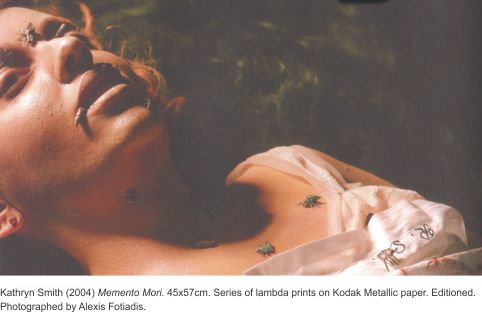
In this account of contemporary South African women artists, the reader gets the opportunity to interrogate the ideals and values which artists have chosen as their subject. These interrogations are echoed in the selected artists’ works, and yield something conceptually meaningful but sensually seductive at the same time. Kathryn Smith’s (b. 1975) ponderings on forensic pathology use Smith’s own body as a nexus for rot and decay, for crime and breaking of social behavioural barriers, in performed works, photographs and installations. Serenza Marasela (b. 1977) features in Schmahmann’s book through a series of five black and white photographs, The Waiting (1999), dealing with her own pregnancy and the felt absence of her mother, during this difficult period of her life.
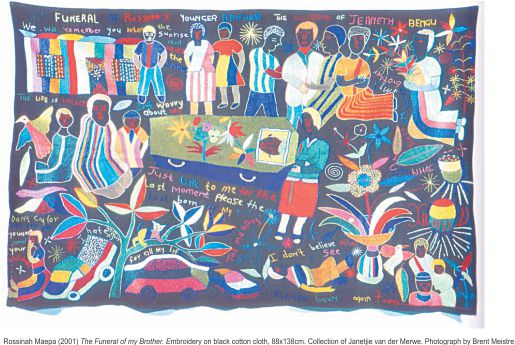
Schmahmann’s tone of writing and use of the feminist- and South African discourses in her material; her conceptual inquiries into the material, and her ability to navigate through it all with clarity, make Through the Looking Glass able to stand its own ground with dignity. The book originated as part of a project to accompany a country-wide touring exhibition, but because it is eminently readable, for lay readers as well as academics and scholars, it surpasses the limits of this project. Written with clarity and succinctness, the book makes feminist ideology palatable and meaningful for even the junior student. By the same token, the work sidesteps the pejorative categorisations of ‘feminist’. In writing with conviction about the discourses to which she subscribes in terms of gender balance and awareness, Schmahmann presents a viable and powerful case for feminist discourse, which does away with popular negativity and offers credibility in its stead. It is not, however, only getting her case across credibly that is of issue in this publication. Schmahmann breaks new ground in juxtaposing female South African creative practitioners in surprising ways. She gives academic footage to women who are young in their careers but sufficiently focused and committed to warrant this level of serious attention. She considers women working in so-called ‘craft’ traditions, that have been previously labelled as primitive or inferior to western fine art practices. Working with beads or embroidered thread, women like Rossinah Maepa (b. 1958) tell the stories of their own lives in works which have evolved within socio-political, cultural and economic frameworks. These stories are less about an established, dogmatic spectrum of what visual fine art constitutes, and more about the directness and the materiality of the gesture of representation.
Elegantly bound and containing high quality reproductions of images, as well as details and stills of works, Through the Looking Glass begs immediate comparison with other books written in this vein—such as Marion Arnold’s Women and Art in South Africa (1996: David Philip and St. Martin’s Press). With its particular focus on representation of the self by South African women artists, this book retains an individuality and focus different from that of Arnold’s, which is a broader overview, albeit rooted within gender-based concerns. Divided into four chapters, with an introduction and conclusion, Schmahmann’s physically small book embraces big issues and major artists active at the moment in South Africa—women who are dealing unflinchingly with issues specific to their gender, their sexuality, their bodies, and the patriarchy in which they exist.
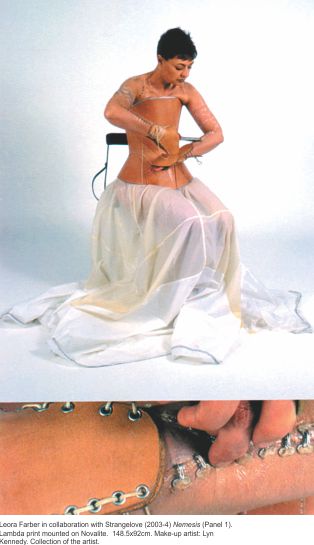
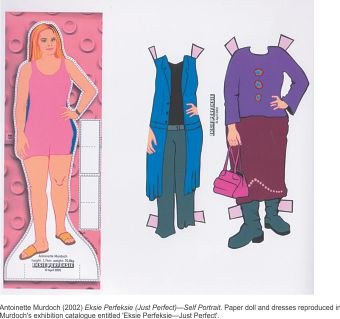
Schmahmann’s text offers four different perspectives on local women artists: ‘Self as Artist’, ‘Self and Family—Self and Locale’, ‘Self and Body’ and ‘Enactments’. Each chapter offers a discursive and sometimes unexpected grouping of artists, linked loosely by the theme of representation specified, but offering their own personalised take on this aspect of self-representation. Pamela Melliar’s (b. 1961) untitled large three-dimensional self-portrait in oil plaint, plaster and wood, lying voluptuously naked, dressed only in demure little peep-toe yellow pumps, is thus juxtaposed with Antoinette Murdoch’s (b. 1972) cut-out paper doll self-portraits, commenting on weight loss and gain, or her bridal gowns, made of tissue paper or tape measures, thereby commenting on the institution and fragility of marriage. Women confront themselves as women in a highly sensitised and personal ways, contingent on how South Africa as a melting pot made them into who they are, but also dependent richly on their womanhood. Berni Searle (b. 1964) and Leora Farber (b. 1964) use their bodies directly in performance pieces, which feed into their socio-political identity and awareness. The works have conceptual and gestural strengths and meaning, but an aesthetic simplicity which overrides the abject horror of the use of the living body as a part of the art gesture. Searle deals with her identity as a woman of very mixed parentage. Belonging to the so-called ‘Coloured’ community in Africa, because of aparthied, she was marked by an awarness of never being black enough or white enough to legitimately belong to either social faction. Farber, conversely, deals with the paraphernalia and constraints that have shaped her as a ‘European’ woman (a title applied to white people indiscriminately throughout the apartheid era). In her work Nemesis (2003-4), this shaping is literalised, and she casts her own body into the corsetry that women from the nineteenth century used, as a matter of course, in order to shape themselves appropriately. The difference lies in the abjectness of Farber’s approach. In her photographed images, she appears to be sewing the corsetry directly into her own skin.
Schmahmann’s text deals with pertinent issues specific to an artist and her work, and then moves on, juxtaposing artists to bring out unobvious levels of comparison and discrepancy. The pace of the text is also exciting and the works selected are potent examples of the issues being raised.
The chapters of through the Looking Glass are not ranged chronologically, but rather thematically. Using the broader rubric of representing the self, Schmahmann offers deep insight into how this may be done: through painting oneself in a modernist, self-conscious mode; through contemplating one’s roots, with photographs and accounts of family habits, characters and miens; through examining and representing one’s body, in traditional and non-traditional art media; and through enacting one’s selfhood in performances and body art. There are just twenty-four artists cited in this publication, and often attention is paid to just one work by each. This, however, does not hurt or compromise the power and integrity of the publication or the range and depth of the artists that form part of it.
The youngest artist cited in the book is Kathryn Smith. The recipient of the Standard Bank Young Artist Award for 2004, she represents the cusp of a new generation, and is comfortable with balancing different levels of performance, aesthetics and the aesthetics of performance, in order to tease out issues central to her identity as a human being, and as a woman. She considers issues of violation of the human body, and forensics, which discovers its secrets, but her work retains an almost modernist tendency toward extreme aesthetic sophistication.
The oldest artists cited in the book are Dorothy Kay and Maggie Laubser. Both hailing from affluent white backgrounds, they worked under the garb of ‘lady Sunday painters’ for many years, producing work that retained an aesthetic charm, without threatening too many codes of expectation, on the part of their patrons or audiences, who were predominantly male. These women dealt with their sexuality in an understated conventionally demure manner, but confronted the tools of art making with aggressive boldness and challenge. This fierce interrogation becomes patent if one looks below the surface.
Self-consciously, Schmahmann navigates through the work of women artists all over South Africa, but beginning with the work of Kay and ending with that of contemporary printmaker Christine Dixie (b. 1966), she retains a position in the Eastern Cape, where she herself moved a couple of years ago to take up her current academic appointment. It’s an interesting autobiographical slant.
Schmahmann’s book is a valuable primer of the mechanics of the art of contemporary women in South Africa. Inevitably, it will date, but it will surely also remain important as a document of discourse, theory and perspectives. The book straddles coffee table/academic monograph conventions and thus presents a provocative inroad into issues relating to South African art.
Robyn Sassen is an arts writer based in Johannesburg, South Africa.
The years of apartheid brought not only legislated racism to South Africa, it also excluded people—particularly creative people—from access to the currents that were motivating and feeding the rest of the creative world. Feminism, Post-Modernism, Happenings, Performance Art were all strategies for art making that came to dynamic and active life between the 1950s and…