

ghada amer a woman artist traversing three continents
Egyptian-French-American artist Ghada Mohamed Amer is now 41 years old. Born in Cairo, she ‘grew up in the politically charged period that followed the Six-day War,’ In 1974, at the age of eleven, Amer’s father, a diplomat, moved to France with his wife (an agronomic engineer) and four daughters, four years after the death of Abdul Nasser and four years before Anwar Sadat’s Camp David treaty with Israel. In France, Ghada Amer concentrated her efforts on trying to blend in with the French as much as possible. In 1984, at the age of twenty-one, Amer finally decided to visit Cairo, three years after the assassination of President Sadat. During the late eighties and for the next ten years she was based in Paris. She started a professional artistic career augmented by ‘small jobs to help finance her art projects.’ Her solo and group exhibitions continued first in France and Europe, then internationally. In 1996 she moved to Manhattan and settled in Harlem, which is still her base to this day, where she’s a full-time artist. Wejdan Almannai caught up with Ghada Amer at her studio in Harlem, New York

In June 2002, through the highly reputable American owned Gagosian Gallery on Heddon Street in London, I sent the artist Ghada Amer a letter of introduction asking her for an interview. I was unsure about getting a reply, least of all a prompt reply, especially after being witness to the great success of her show at Gagosian Gallery sometime earlier. It was her first solo show in London, and not only had her work caused controversy and debate, it had sold out entirely by the time I visited the gallery and for a small fortune at that.
Three days later she emailed me in Bahrain thanking me for my nice letter and expressing delight in being an Arabic woman who was interested in her work. She offered to ask her galleries in both London and New York to send me information (which they promptly did), and gave me her full address in Harlem in New York and her phone number. In a later email she graciously invited me to New York to interview her, or to Cairo in the autumn when she was planning on visiting. She was too busy to conduct an interview via email; however, I was welcome to call her for an interview.
In late September, I finally managed to get hold of her at her New York studio. I explained to Amer that I’d wish it to be a friendly informal discussion of her work and what she would like to let me know of her personal views that had a direct bearing on her artwork.
In 1995, artist Ghada Amer started a series of works titled Les Mariés, or the ‘married couples’. They are composed of embroidery and acrylic on canvas. Each measures approximately a meter and a half by a meter and a half. They are ‘real-life’ readymade photographic images taken from popular Egyptian magazines of a couple: a bride and groom on the day of the ceremony. The picture is enlarged, stenciled on the surface of the canvas, then small embroidered motifs such as pigeons, an outline of a couple hand in hand, or flowers, are strewn sparsely on top of the couples’ faces and upper torsos of the actual image. The pictures are like coloured ‘oleographs’ from the 1960’s or 1970’s, what Polish novelist Witold Gombrowicz characterizes as ‘a dead photograph from an old family album’ (Pornographia, A Novel, London, 1994). I asked the artist about Les Mariés…

Ghada Amer says, ‘I got the image of brides and grooms from Elmaw’ad magazine (a popular Egyptian magazine), or some other magazine I think. Anyway there’s loads of them and you can take them from anywhere. They are sad images—you’re right. It’s very sad. Marriage is sad. There’s no such thing as ever after. Love is while it lasts. There’s no eternal love as we’re often told, this idea of absolute happiness and bliss and romance it’s not real, it’s just not real. When I showed these images most people immediately recognized my take on them, there’s irony and humor in them. It’s the role of each [of the couple] that concerns me. Nothing is fixed really, but we are told that this is ‘it’ and you have to fit in, the role of the bride, the woman, and the role of the groom, the man. Yes, I comment even on the man, he has an assigned role, it’s not easy being a man, it’s not just the woman who has to fit. And you cannot have the role of woman without the role of the man; each role defines the other, each role exists because of the other. This idea is everywhere, everywhere, not just the Arab world; even here in the west, people want to marry, expect you to marry. There’s this romantic idea attached to it.’
‘When I visit Cairo, I feel so old. People make me feel so old, this woman who isn’t married what’s wrong with her? It’s so strange, so funny. I feel the odd one out. I always have to explain myself, my views. Sometimes I think, am I wrong? Is marriage really bad? How can I see things the way they are when others see the same thing differently? I can’t be right and all of them wrong? Maybe it’s the opposite. I don’t know… Yes, most if not all of my generation are married, but even being with a twenty-five year old there who is married and has kids, she makes you feel old, she looks at me strangely. There I’m…[looking for a word] yes, the spinster [laughs]. Oh, yes, of course I lead a full life, I have relationships and so on. Sometimes I think I would like to marry, most times no. But now I’d like to have children of my own, and I can’t have children without marriage, even though I wouldn’t mind, but a single mother would be too much for my parents, that’s the limit for them. But really, what concerns me is the model. I’m interested in the model. The stereotype, yes exactly.
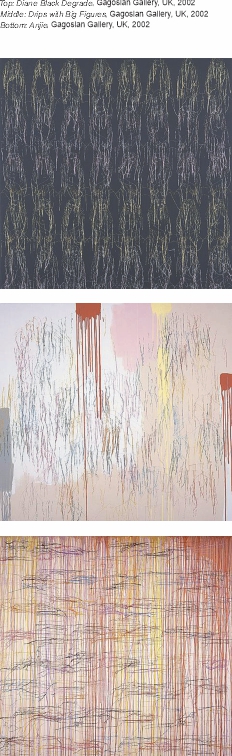
‘Yes I come from a close family. We are four sisters, no son to compete with; really, we were lucky not to have a brother between four sisters. Can you imagine the competition? It would have been entirely different from the way we were brought up if we had a brother. Only one of us is married and with children [laughs]. Most times I don’t believe in marriage. Yes, I see it as an affliction, facing the same man for twenty-five years, it truly binds your freedom. It’s a cage, yes. If it were in my hands I would abolish the institution of marriage altogether. We discuss this issue a lot in my family, especially with my father. My father is far more understanding than my mother who is much more conservative. There was a time, when she really wanted us to marry. But my father was against it. My father is a very religious man, extremely well read, he reads a lot on the philosophy of religion especially, he prays, he fasts, he’s devout. But he is very very open-minded. He reads everything written about my work and is very understanding.’
The Grid (1996, acrylic, embroidery, and gel medium on canvas) is a white expanse measuring up to two meters by two meters, has triple distanced lines coming across vertically interjecting another three coming horizontally. The end form is a geometric grid that consists of small stitched silhouettes of the same naked woman. She is seated hands behind, facing us. She is displaying her naked body.
Black Stripes (2000, acrylic, embroidery, and gel medium on canvas) is a horizontally stripped black drips and beige painting measuring approximately a meter by meter. The model is stitched facing us the viewers, legs splayed, wearing nothing but shoes with straps that are tied up to her knees. Her face is slightly turned to the left, holding what appears to look like a gun and licking it, yet her gaze is holding ours. The model is done in yellow, turquoise, black and purple thread. She is repeated twenty times, pairs of ten on either side of the painting, accentuating the heavy black drips in the center.
La Ligne (1996) is painted entirely white, measuring approximately two meters by two meters. Right across the center down comes a triple line of an embroidered naked woman repeated twenty-seven times, half reclining, her legs spread apart facing us. The women, naked, transposed from pornographic magazines, are endless in Ghada Amer’s canvases… .

Ghada Amer says, ‘It’s been inside me for a long time. A very long time…you know artwork, any artwork is very complex. You can’t just have a straight simple answer for everything. I like contradictory things. Things that you just can’t explain easily. Isn’t it the same for you? Don’t you think life is full of contradiction? My work is like that. It’s many things. Oh, yes, at first it was very difficult. I did the work and I felt so guilty. I had to hide it. Sexuality is such a taboo. Expressing sexuality is such a taboo. When I was growing up we weren’t allowed to have boyfriends. My friends at school had boyfriends and they were having fun. Well, reconciling what you are told to do and what happens outside is difficult. You are always reconciling. When I go back to Egypt, nowadays it’s becoming more and more conservative. Nowadays wearing short sleeves, a short skirt you feel pornographic, you feel exposed. I tell my mother when I see her picture from the seventies, what’s happened to you now? Why are you so different? You were having a good time then, people were free. You know what her reply is? ‘We weren’t on the right path then. People didn’t know the way to it’, but that’s… that’s… veiling from head to toe is the right path? Yes, I guess you can say, that the veil is one extreme and pornography is another.
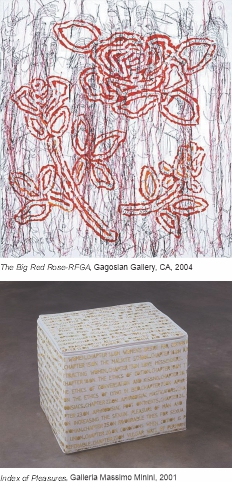
‘[when asked on the difference between the theory of pornography, and the actual in real life] Violence is hard core? But why do you say that? No, I don’t think so. Even cutting a diamond is violent, religion is violence no, religion is extreme violence, war is violence, taking someone else’s land is violence, lots of things around us are violent, so why is sexuality considered violent? There’s no hardcore or soft core. It’s all the same, pornography is one. What does squalid mean? [I explain] My paintings are not anesthetizing the vulgar at all. I completely disagree with that. Vulgarity is an essence. If you have a vulgar house it’s vulgar full stop. No amount of painting would fix it. I disagree with the idea that porn is vulgar to start with. Even in reality. You are moralizing. When you say porn is vulgar it’s your morality speaking. There’s nothing wrong with the body, with loving the body. The body is not abject. Seeing it as abject is Christian. Islam is less hard on the body, still not [that lenient], but it has a much better view on sexuality. I identify with the women in porn pictures. I think they are pleasure-givers, and pleasure-takers, and prostitutes and everything. They are women. No I don’t think them unreal. They are real to me. ‘[when asked on the function of repetition in her work] Fill the surface, yes, to fill the surface. It’s purely technical. Remember I’m not a writer. I’m a painter. I make paintings—that is my job. That’s what I love to do. That’s what I know well. When I paint, the technical aspect of the work is very important. I was so concerned with making a painting with threads. I wanted very much to take something purely feminine and make a painting of it. Embroidery for me was the feminine, the female. I wanted to make a painting out of that. At the moment I have an idea, when I go to Egypt in November, I’ll work it out there.
Wejdan Almannai is a visual artist, writer, and teaches at the University of Bahrain
Egyptian-French-American artist Ghada Mohamed Amer is now 41 years old. Born in Cairo, she ‘grew up in the politically charged period that followed the Six-day War,’ In 1974, at the age of eleven, Amer’s father, a diplomat, moved to France with his wife (an agronomic engineer) and four daughters, four years after the death of…