

ballet theatre african
African culture is rich in performance ritual. There is ethnic dance that comes with cultural costume, codes of conduct and meaning. There are dance and performance traditions linked to jazz, hip hop, kwaito—traditional music genres practiced and upheld by black folk, not only in Africa but in the west as well. The virulence of apartheid was such that it categorised these music genres and the ritual performance tradition pejoratively: classical ballet was reflected upon as being superior to these other forms of physical expression

Traditionally, and in South Africa, ballet has been the domain of little white girls. I say this, having once been a little white girl myself, and having succumbed to the indoctrination of an apartheid-tainted existence, where something as ostensibly decorative as European ballet could be part of a child’s dreams—and this was a child with no balletic talent at all. But why should whiteness and apartheid taint the picture of a little girl’s dream of being a ballerina, in a tulle tutu and satin pointe shoes? Simply because during the apartheid era, ballerinas were white in South Africa, ballets were traditional, classical and European. The unspoken agenda was extremely racist.
Dance in Africa is also complicated. African culture is rich in performance ritual. There is ethnic dance that comes with cultural costume, codes of conduct and meaning. There are dance and performance traditions linked to jazz, hip hop, kwaito—traditional music genres practiced and upheld by black folk, not only in Africa but in the west as well. The virulence of apartheid was such that it categorised these music genres and the ritual performance tradition pejoratively: classical ballet was reflected upon as being superior to these other forms of physical expression. Martin Schönberg is the initiator of Ballet Theatre Afrikan(BTA), a South African dance company which specialises in classical ballet with a very local twist. He is a pioneer who dared to do what few others would, particularly during apartheid; and not only has he developed a space on the local popular culture agenda for ballet, he’s given black ballet dancers licence to fly with their talents, discipline and hard work. The challenges have been abundant and very difficult, and the success is palpable, but sadly, often in abstract terms. Finances remain an issue, as do colloquially speaking, bums on seats, but Ballet Theatre Afrikan is here, on the popular culture agenda, and it’s here to stay.

After matriculating at the National School of Arts in Braamfontein, Johannesburg in 1980, Schönberg shot to meteoric professional prominence. In South Africa at that time, things were very conservative and ‘traditional’ with regard to the indoctrination of white culture, and the options for a young male dancer, who valued dance as an art form and not necessarily just a set of sequential exercises performed to music, were quite limited. He ‘did not feel like dancing Swan Lake all his life’, and went to study under the celebrated Russian émigré Marika Bessobravsova, with the Ballet Russe de Monte Carlo, for a year. Thereupon he auditioned for the Royal Ballet of Vlaanders in Antwerp, Belgium where he became principal male dancer and remained with them for six seasons. This exposure and the stress and discipline necessary for being a very young, very foreign, principal dancer, was terrifying for him, but also extremely rewarding. He toured the world seven times with the Royal Ballet of Vlaanders, and then joined the Zürich Opera House in Switzerland, where he remained for three additional seasons.
These ten years in Antwerp and Zürich were intense and exciting, and at the relatively tender age of 27, in 1990, he elected to return to South Africa, and retire to ‘the dark side of the stage’—the auditorium. Two years later, he began teaching ballet full-time. But this was not in emulation of the myopic traditions of the past, in South Africa. Schönberg went directly to what were then known as the ‘Model D’ schools—schools designated by the apartheid regime for black kids. It was here that he began to look for talent, and to implement curriculum possibilities in dance.
Not a political activist by nature, Schönberg was raised with a very definite sense of humanity and hospitality. It was a flippant racist remark, made by a member of the white community, that black people cannot do ballet, that spurred Schonberg with passion and fury to begin BTA. His heartfelt rejoinder to this careless and racist remark was that blacks cannot do ballet because historically they never had the privilege of exposure to its dynamics, disciplines, aesthetics and demands. It became his mission to redress this imbalance and to prove the narrow remark utterly wrong.
A relative of the Austrian composer Arnold Schoenberg (1874-1951), who originated polyphonic and 12-note music, essentially changing the nature of serious musical composition forever, Martin Schönberg also has creative perfectionism, stubbornness and self-belief in his veins. Arnold Schoenberg was persecuted by the Nazis, not only because of his Jewishness, but because his work was perceived as ‘degenerate’ or threatening to the weak mediocrity the Nazis were intent on forging in the arts. The nuance of the political context of the younger Schönberg differs from that of the older, but his ideas were equally frightening to the majority and the mediocrity.
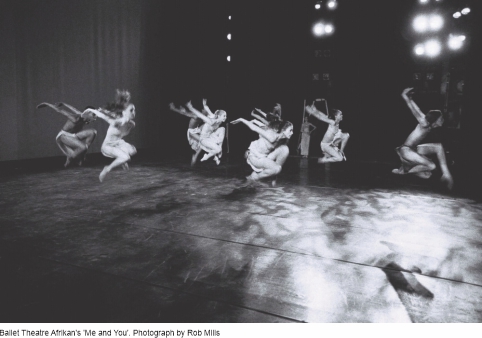
Shaking a community out of its comfort zone by steering its entertainment choices can be volatile and emotional. ‘There is a place for great ‘white’ ballets like the ‘Sleeping Beauty’ in our world, but I didn’t want to become a museum curator of ancient commonwealths’, Schönberg explained his life choices. ‘Ballet is the ultimate training and starting point for dance, but is not an end in itself. Somewhere between productions like ‘Swan Lake’ which is about the interpretation of European classics, and ‘African Footprint’ which is about commercial glitz, there is space for BTA. In a society as vast as ours, we cannot afford to discriminate against or sideline our own culture.
‘For a dance company to run with creative credibility, it needs bums on seats and backing from the community. This isn’t only through donation, but can take the form of sponsorship in kind–from computers and cleaning equipment, to rental demands and transport issues. This is a regular company. We have specialised needs as well, but in order to keep afloat, our requirements are complex and many.’ BTA was established in 1996, and already in 1997 press reviews were bemoaning not the quality of the work on show, but the emptiness of the theatres.
This may be understood on different levels, which had to do with the vast mechanics of change in place in South Africa at the time. With a democracy just over three years old, violence in the country was rife. The theatres were by and large still catering for white audiences and their established tastes, caught as they were, in transition. White theatre patrons were terrified of the internecine violence, which was touching their lives as well as those of black people in the townships. The country was in a state of instability and insecurity, and identities were ruffled and confused. There was a wave of emigration of white people from South Africa, which echoed the emigration waves that South Africa had weathered in the past. Only, these emigrants were not leaving to go into exile, or protest against apartheid. They were getting out of the country because the transition and teething problems seemed lethal. Black theatre patrons were still a fairly rare class. A black middle class had not yet emerged into mainstream culture, and while theatre tickets remained out of reach for many, the offerings on local stages were totally irrelevant to black audiences.
This situation spun more and more out of control as the years passed. In 2000, the State Theatre in Pretoria, the largest complex of stages and performance platforms, in Gauteng, which had been sponsored by the government, was ‘mothballed’ by the then minister of Arts and Culture, Dr. Ben Ngubane. Creative practitioners were outraged, the existent national ballet company was closed and dancers were retrenched. The radical move was seen as necessary: funds were being mismanaged, auditoria were generally empty. The arts were in a state of dire crisis.
Deeply cognisant of the seriousness of the situation, Schönberg and his company were not prepared to be cowed by it. In 1998, they had mounted a national travelling season of ‘Cinderella’. BTA was at that stage a youth ballet. Dancers ranged between 12 and 17 years, and were handpicked from Schönberg’s stint of teaching at the disadvantaged schools in Johannesburg. In spite of looming cultural breakdown, ‘Cinderella’ achieved unprecedented success in audience attendance and critical response, and BTA was well heralded.
‘The dancers are trained as ‘total dancers’, a critic commented, ‘With a solid foundation in classical ballet, they also do contemporary, jazz, Spanish, African, funk and national dance.’ These dance genres had been the tools which with Schönberg had begun his dance career. He commented to a journalist in 1998, ‘I always wanted to work with a cross-cultural, cross-disciplined dance company. I didn’t see dancers being trained that way, so I decided to start teaching them myself’.
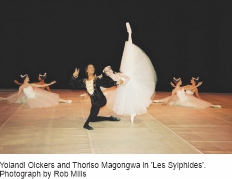
BTA is apolitical. ‘Difference is not a bad thing’, Schönberg commented, recalling with amusement how the first time one of his colleagues had referred to a Jewish dancer as such, it had taken him a moment to realise the comment was not anti-Semitic, but about difference. ‘In our company, whites are whites, blacks are blacks, Jews are Jews’, he said. Eventually, the dreaded red-letter day, 30 June 2000, arrived, and with the official closure of the State Theatre—ostensibly for a period of nine months—culture seemed to die in South Africa. BTA was the only functional dance company left in Gauteng. Marilyn Jenkins, of the Citizen, a daily newspaper, asked: ‘Does BTA have plans to form a full-time professional company to fill the vacuum created by the State Theatre Ballet Company’s demise?’ It was a question on many lips. Schönberg’s short response was yes. But the proviso was that sufficient support was forthcoming from the right quarters. At that stage, BTA had 10 students about to graduate as professionals. It had a growing and varied repertoire ‘of considerable substance, an eye for all the necessary production values and oodles of dedication and enthusiasm.’ Schönberg was adamant, though, about not focussing on a purely classical repertoire.
He believed that classical ballet skills are essentially for a well-rounded and competent dancer, but that the repertoire needs to grow cross-culturally, and an African aesthetic can be embodied within a classical balletic idiom. He did not convince everyone at the time, however, and Stanley Peskin, in the local Financial Mail of July 2000 commented, ‘BTA does remind one that dance is a potent means of exploring socio-political concerns and gender issues. But these should be articulated through vital and meaningful choreography’, which he believed was not quite yet happening.
At the same time, a different current of ballet energy was beginning to burgeon. Of the dancers who had been retrenched by the government, six refused to go away. Without the reality of funding or salaries, they bonded to form a core staff of what was to become the South African Ballet Theatre (SABT), based in Johannesburg. Born in February 2001, the SABT offers a softer and more traditional approach to ballet. Funded by various corporates including the state lottery, the SABT comprises over 30 dancers and performs the traditional European ‘white’ ballets as well as indigenous pieces of their own writing and choreography.
SABT is not directly in competition with the BTA, which caters for a very different and somewhat more adventurous audience. Given that there has been a ‘borrowing’ between the BTA and the SABT of principal dancers, there are clearly no ill feelings or levels of territorialism. Ballet is the key issue here, and giving it popular South African currency and meaning is the mission. Like Schönberg, Dirk Badenhorst, Chief Executive Officer of the SABT, and one of that core of six determined dancers in 2001, is emphatic that classical ballet training is essential for any dancer to be competently creative. Badenhorst acknowledges SABT as the only classical ballet specialist.
SABT has been responsible for fairy tale-beautiful productions of the ilk of ‘Swan Lake’, or ‘Sleeping Beauty’—European classics, written within a western set of narrative and aesthetic values. They do have a legitimate place on SA stages, Badenhorst in unison with Schönberg, argue, however, simply because the aesthetic and physical and performance perfection are important for local audiences and trainee dancers to see. The SABT also writes local productions, interpreted in a traditional ballet idiom, which offers a splendid cross cultural mix of aesthetic and artistic value. Last year’s ‘Ngi Zotha Sala Kahla Ku Sasa’ (I’ll Say Goodbye in the Morning), by Sean Bovim was one of these, as was 2001’s ‘Kopano’, a ballet which earned the SABT the nickname ‘Kopanong Span’ (Kopanong Team), when they took it to Alexandra and Mamelodi, apartheid-established black townships north of Johannesburg.

In response to the complex question of Eurocentricity, Badenhorst speaks of soccer: It’s firmly a part of local culture, but was certainly not started in Africa.
SABT has enjoyed successes locally and abroad, having collaborated recently with the Danish Royal Ballet and Canadian Ballet. In April of this year, the SABT moved to its new ‘home’ at the Civic Theatre in Johannesburg. Overlooking the inner hub of the office buildings in the central business district of the city, through its enormous floor-to-ceiling windows, this professional dance space feeds into the Inner City Development initiative, not only allowing the dancers to survey the city, but passersby in the city to see the dancers. The facility tacitly speaks of SABT’s position of officialdom in the dance fraternity. In contrast, BTA operates from a considerably more humble space in suburban Johannesburg.
Badenhorst speaks of the mission to develop an understanding of classical dance for young black audiences and dancers. The SABT is proud of its three-fold outreach programmes, in apartheid-established sub-economic black townships of Mamelodi and Alexandra to the north of Johannesburg, and Eersterus and Katlehong to the east of Johannesburg. The first aim of the outreach is to recognise dancing and choreographic talent. The second aim is to develop an audience—to teach people how to behave in a theatre, and how to understand and love the magic and the language of dance. The third is to develop people. Badenhorst comments that many aspirant dancers statistically will never make it to the professional stage. The career is taxing and strenuous, as it should be. This should not be understood as a downside, however. Dance is about discovering creative and cognitive development within the body and mind. The splendour of ballet costumes, with their satins and beads, with stage lighting, fabulous stage sets and idyllic narratives enhance one’s ability to dream. Badenhorst cited an experience with the township youngsters in SABT’s outreach programmes: ‘What do you want to become when you grow up?’ was a question put to many before they encountered the ballet, and their answers were humdrum and sad, already thwarted by grim financial realisations. After experiencing the magic of the dance, the costumes, the lighting, the music, fantasy and fantastic possibility were kindled in the projected futures of these youngsters, and almost miraculously, they could dream.
Indeed, at the times of tremendous and often scary transition, Schönberg believed, and continues to believe in dreams, but also in ‘sweat equity’. ‘If a dancer wants to perform, he or she has to work hard and attend all rehearsals. There are no token dancers here–talent is talent, regardless of skin colour.’ Tokenism and affirmative action marked not only economic decision making in South Africa, but has continued to be a bit of a scourge on all job fronts. ‘I encourage young people to find themselves. They must be exposed to society, which, as artists, they need to mimic’. The dancers were pumped up with the understanding that they need to believe in their dreams and be responsible for their own successes. These ideals might feel clichéd and romanticised in the face of political uncertainty, which for a number of the dancers was coloured by financial insecurities as well. All were from working class backgrounds; many were from single-parent homes, origins which could not comfortably embrace expensive specialist ballet shoes, or overseas trips for ballet exposure. The challenges were really stiff, but the clichés of believing in dreams and ideals, held firm. Many of those young dancers from the late 1990s and early 2000s who were founder members and pioneers, with Schönberg, of BTA, are today principal dancers who have enjoyed considerable success and experience in ballet cultures as sophisticated as that of Canada, Switzerland, Australia or France. Each has chosen to return to BTA.
During October of this year, BTA managed to squeeze in a brief season amidst the menu of popular entertainment at the Civic Theatre in Johannesburg, another establishment which weathered difficult cultural realities in the early years of democracry. While this season offered a refreshing spin on the expected, it also presented an opportunity for audiences to see some out-of-the-ordinary but beautiful dance. Vivaldi’s ‘Four Seasons’ is a popular group of concertos, composed in the 17th century. It was not composed for dancers, but Schönberg offers a contemporary, African interpretation. He works in collaboration with Christopher Kindo, who has choreographed a piece on the Kronos Quartet’s ‘Sollopa’. In performance, the works were unbelievably beautiful. Marrying this rich and almost medieval sounding symphonic poem not only to the changing seasons, but essentially the changing times of life, with African movement, aesthetic and black dancers, innovative sets and magnificent lighting arrangement, was poetic and inspiring, effectively changing an interpretation of the music itself.
And the future for BTA? With spontaneous alacrity, and in response to this question, Schönberg sketched a map on a scrap piece of paper to illustrate his projections for BTA. Complete with school programmes, a sophisticated curriculum for learners between the ages 9 and 19, and satellite studios and outreach programmes in townships, the plan is tightly organised. All going well, it promises ballet a legitimate and dignified place in our popular cultural awareness, as South Africans, be we black, white, Jewish or indifferent, be we male or female, be we talented in being able to use our bodies for dance, or not.
Robyn Sassen is an arts writer based in Johannesburg, South Africa
African culture is rich in performance ritual. There is ethnic dance that comes with cultural costume, codes of conduct and meaning. There are dance and performance traditions linked to jazz, hip hop, kwaito—traditional music genres practiced and upheld by black folk, not only in Africa but in the west as well. The virulence of apartheid…