
between the imaginary and the real the paintings of quamrul hassan
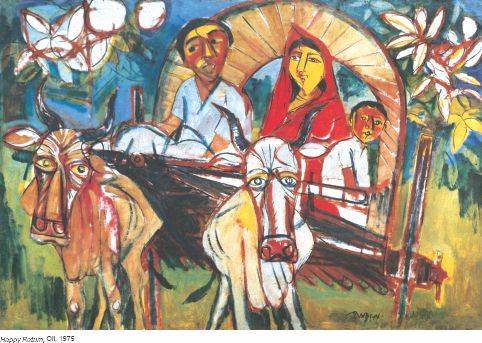
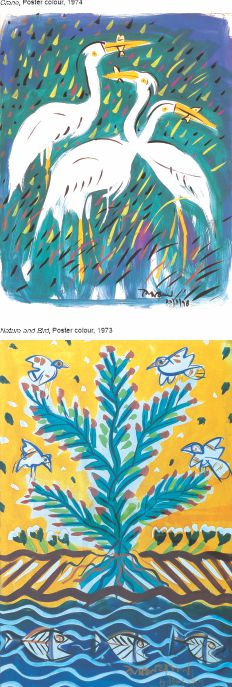
In his paintings Quamrul Hassan tries to revive an ideal Bengal of the past that would inspire the new nation’s search for identity. His pastorals—stylized projections of self-generating images of open landscape, the sky, the river, fish, birds and animals and the humdrum activities of life that contented men and women carried out in tune with elemental rhythms of nature—initiated this search
Most discussions of modern art in Bangladesh hark back to the threshold year of 1948, when the Government Institute of Art, later the Government College of Art and Craft, and now the Institute of Fine Art of Dhaka University, was set up, and a movement of sort was initiated that, in a quantum leap, put Bangladeshi art on the road to modernity. Before 1948, art in Dhaka was confined to portrait painting and conversation pieces done by commissioned artists without any formal training and commercial and studio art that lacked sophistication. There was no art school in Dhaka. Indeed, the only art school of East Bengal—the geographical territory that is today’s Bangladesh—Maheswarpasha School of Art in Khulna—was a small, non-descript one run by a dedicated artist, Shashibhushan Paul (1877-1945), and later, by his son. It did not have much impact beyond its vicinity, and remained virtually unknown, even long after 1948, to the rest of the country. But there was Calcutta (now Kolkata) with its art schools and artists and long established art traditions. And there was Shantiniketan too, which, under the guidance of Rabindranath Tagore, and the leadership of Nandalal Bose, Benodebehari Mukherjee and others, had become, like the Bauhaus, an inspirational centre of art. The Government School of Art and Craft in Calcutta sporadically admitted students from East Bengal, the most famous being Zainul Abedin, the master painter, and the man behind the move to set up the art institution in Dhaka, who also taught at the school for quite a few years before migrating to Dhaka in the aftermath of the partition of India in 1947.
That migration, in which Abedin was joined by a few artists from West Bengal—Safiuddin Ahmed and Quamrul Hassan being the more prominent ones—became the event around which the first chapter of the history of modern Bangladesh art is usually written. That history is a long and complicated one, and should await another occasion to be told. But mention must be made of the indomitable energy, dedication and drive of Abedin and his colleagues who founded an institution, a movement and a tradition—all incarnated by the institute—practically from scratch. Ten/fifteen years from its start, its graduates were training in major European and Japanese art centres in the styles and techniques of modern art, holding exhibitions in Dhaka and abroad, and winning top prizes in all-Pakistan art exhibitions.
Quamrul Hassan, who was a student of Abedin at the art school in Calcutta, was one of the early teachers of the art institute which he helped set up. When Abedin invited Qumrul to be a part of his team, he had more than the mere need of a teacher—he needed someone who could inspire the people to turn to art. It was a difficult job indeed, given the rather conservative nature of Bengali society, and a dislike, which sometimes threatened to turn into open hostility, of image making in the more orthodox section of the people. Quamrul had two advantages—he was an organizer, and he had the zeal of a revivalist. He also had a vision of art as a potent weapon in the anti-colonial struggle. And, ironically enough, the state of Pakistan, within the first few years of its existence, had unabashedly shown its intention of colonizing the eastern wing. Five years into statehood, its attempt to enforce a linguistic colonialism was successfully challenged by the people of East Bengal, although at the cost of young lives. When Pakistani rule ended in 1971, and Bangladesh emerged as a secular, democratic country, it too failed to live up to the ideals that inspired the war of independence. It quickly fell in the hands of military rulers, and anti-liberation forces who had actively collaborated with the Pakistanis in their occupation of Bangladesh and their massacre of its people. And Quamrul, once again, took up his old crusade against these forces through his activism and his art. Until the day he died, literally speaking. But more of that later.
In 1948, Quamrul, a young man of 27, had already become an accomplished painter, besides being a body builder (he was once Mr. Bengal), a Bratachari practitioner, an organizer of children’s groups, and an incorrigible dreamer. The Bratachari part was of some significance, since Qumrul’s philosophy of life was, to a great extent, influenced by this movement. Begun in 1932 in Calcutta as a movement for developing the body, the mind and the spirit through a regime of exercises, dance, and a strict adherence to its five principles—knowledge, truth, joy, labour and unity—it embraced people of all races and religions and aimed at individual and national emancipation. The founder of the movement, Gurusaday Dutt (1882-1941)—a writer, folklorist and civil servant—was an inspirational figure who found in Quamrul a natural leader, particularly of young people. Quamrul also understood the underlying message of the Bratachari movement, which was anti-colonialist in its promotion of ‘able bodies’ and ‘able minds’ to fight against injustice and social exclusion on the basis of gender, race and religion. In Dhaka, Quamrul tried to revive the movement, but the society of a newly independent nation was not an ideal support group for the activities the movement attempted to carry out. He tried once again to revive the Bratachari ethos in an independent Bangladesh through a workshop in Dhaka’s Shaheen School in 1973, but the attempt fizzled out, once again because of other emerging preoccupations of a newly independent nation. What Quamrul did successfully though, back in 1948 and thereafter, was to redeploy the cultural content of the Bratachari movement—the performance part of which was highlighted by Rai Benshe dance (literally meaning ‘solid bamboo’ dance originating in Birbhum, West Bengal), inspirational choral songs and the use of various drums, to take just a few examples—in a new and reinvigorated form in other movements he got involved in. One of these involvements came in the shape of his leadership of Mukul Fouj—a countrywide children’s organization supported by the Bengali daily Azadi. As the ‘Commander in Chief’ of this group, Quamrul attempted to mould a generation of young people with the ideals of a secular, culturally rich and diverse ‘Golden Bengal’.
In his paintings too, Quamrul tried to revive an ideal Bengal of the past that would inspire the new nation’s search for identity. His pastorals—stylized projections of self-generating images of open landscape, the sky, the river, fish, birds and animals and the humdrum activities of life that contented men and women carried out in tune with elemental rhythms of nature—initiated this search. In the early phase of his career, Quamrul had, like most artists coming out of art schools, toiled under an academic-realist tradition that many termed ‘European’ but Quamrul described as ‘Victorian’. But soon he came out of it, ascribing his freedom to two strong influences—Jamini Roy and the patua tradition. Jamini Roy had, by the 1940s, attained a permanent place in Bengal art with his powerful reworking of folk art forms and pata painting, particularly of the Kalighat type, in bold brush strokes, dynamic patterns and dazzling hues. He showed Quamrul how folk art can create a space for itself even in the midst of a modernist ethos, and that folk and modern art forms do not necessarily have to be incompatible. Indeed, Roy’s stylized figures and bold brush strokes indicate a search for solidity, and a visual perception that is harmonized with the world of objects surrounding the artist. Quamrul’s desire was to attain that dynamism and pictorial solidity.
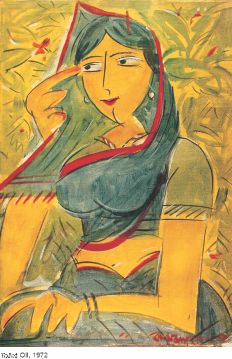
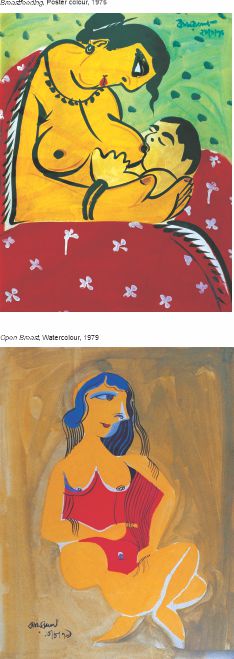
The patuas—rural artists working on cloth or canvas with paint that they made themselves from various natural sources—were both artists and performers, and were living links to traditions that date back to the middle ages and beyond. Quamrul admired their easy access to the repertoire of song, dance, music, stories and myths that people across the land shared. He was fascinated by their versatility: particularly the way they straddled the separate domains of art and utility, aesthetics and necessity, narrative and performance. In the 1946 exhibition of Muslim artists in Calcutta—the first of its kind—Quamrul’s works were in the patua tradition. It was his first ‘public’ attempt to come out of the art school bind. But realism had remained a strong pull, and he refined his skills at painting animals—skills he had acquired during what he called his ‘zoo studies’ phase to come up with his own ‘beast fables’, many showing strong political contents. But once in Dhaka, folk forms began to acquire a special meaning for him, and he decided to explore their potentiality for contemporary application. One such application was a postcolonial reconstruction of innocence that had been lost, and history that had been expropriated by colonial power structures. Indeed, as Quamrul began to paint idyllic sketches and oil and watercolour pastorals one could see that through these works Quamrul was not just revisiting some charmed landscape frozen in time, but was actively charting out an inviolable space that would help bring the viewer’s identity into focus. The space belonged to the community as much as to the nation. Another such inviolable space for Quamrul was staked out by his women—mother, wife, daughter, who were sometimes actual representations of women that he knew: his mother and her friends or visitors, for example, and sometimes imaginary women, but they all related intimately to his vision of plenty, particularly where Bengal was concerned.
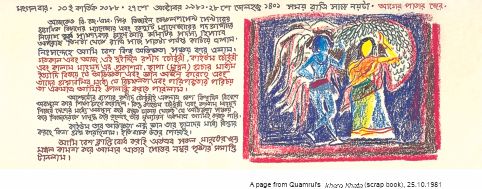
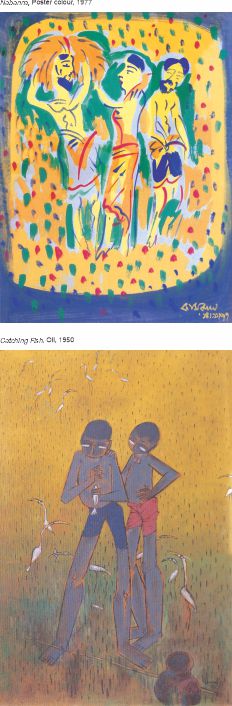
The postcolonial content of Quamrul’s art—its rejection of ‘European’ / ‘Victorian’ models and its promotion of local forms and art traditions; its contextualizing of the community’s social and political aspirations within the larger aesthetic and cultural frame, to give only a couple of examples—was matched by his involvement in the social and political movements of the time as an activist. He had all along been an active participant in protest movements against the repressive military- bureaucratic regimes of Pakistan. But street agitation was not Quamrul’s style: he wanted a more persistent and long term involvement in areas where tangible changes may lead to quality shifts in people’s perception about culture and identity. One such area that he identified was the largely unexplored region of crafts and artisanal practices of rural Bengal, a revival of which could create another inviolable space for Bengali culture. To this end, he left the art institute and joined the Bangladesh Small and Cottage Industries Corporation (EPSCIC, later BSCIC) as director of its design centre in 1960. He was obviously fired up by the vision of harnessing the rich cultural diversity of Bengal and channeling it to create a more confident Bengali identity. He explored the potentials of new year fairs (Baishakhi mela) in close-focusing that identity; went to the weavers and inspired them with new designs, so that they could come out of their isolation and feel a part of the larger community; and drew powerful figures of fishermen and farmers to project their struggle and their victory. His activism was always people-centred, always oriented towards a cultural revival, and always anti-colonial.
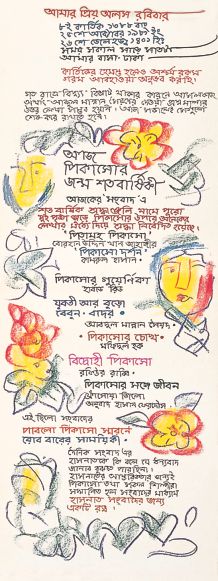
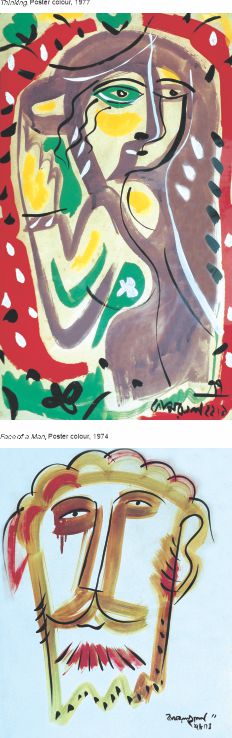
Back in the early 1950s, Quamrul took part in an exhibition—the second one, in fact, of the Dhaka Art Group of which he was a member. For the March 1953 exhibition he submitted work that were realistic but made good use of the folk style, and began to feel confident about his own abilities. He said in an interview (to Urmi Rahman: in Quamrul Hassan, ed. Abul Hasnat, Dhaka: Theatre, 1990: 115-123) that he picked up where Jamini Roy had left. This was not simply a question of continuity–Quamrul essentially doing what Roy had been doing with energy and magic—but a matter of reinterpretation, of charting new ground, and carrying out a creative dialogue with tradition while accommodating the demands of a modern time. This is what Quamrul did, and did with such commitment and gusto.
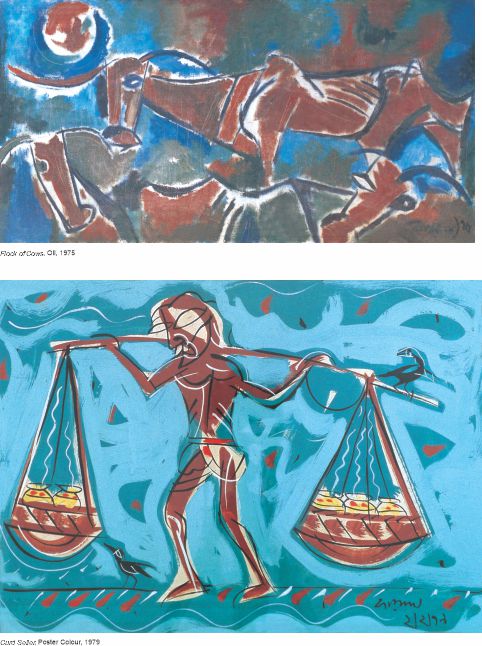
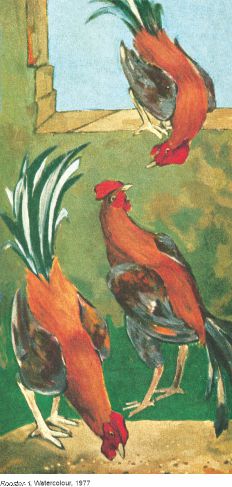
From the 1960s, as his involvement with EPSCIC’s design centre took him away from the classroom to a more dynamic space full of possibilities, Quamrul also began to paint more regularly. As both quantity and variety of his work increased, his canvas began to look more ‘experimental’ in its deployment of broken forms—which sometimes had geometrical patterns and stylized figures. This is evident in paintings like Dancing Peacock (oil, 1962) or Happy Return (oil, 1960). His drawing became more fluid, but more crowded too, and his brush strokes and contour lines somewhat staccato. He had already made his contours flexible, but they now gave the impression of uncertain enclosures, as if unable to contain these ever-expanding figures and geometric shapes. In his watercolours of the time, Quamrul avoided detail, opted for wash-like effects that introduced an element of uncertainty and fleetingness to the composition. He was a master of all the methods and mediums he employed—oil, watercolour, gouache, pastel, acrylic etching, linocut, woodcut—but it was watercolour that enabled him to record the subtle variations of mood and the gradations of light and shade and indulge his predilection for an impressionistic interplay of colour and light. When his watercolours began to show a crowded arrangement with shapes and forms that appeared to bump into each other, it indicated a restlessness of mind. And the reason for this restlessness was not far to seek—the 1960s was a time when the Bengali nation sought out a political, along with a cultural identity and was met with stiff resistance from the rulers. And there was tension in the air.
After the independence of Bangladesh, there was a time of euphoria, as people celebrated freedom and expected great things to happen. But the celebration was short lived, as political and social reality became oppressive. There was a famine in 1974, which ravaged the northwestern region of the country, and people starved on the streets. It was a man made famine, but the perpetrators were never caught, let alone punished. The faceless merchants of death however, did not get away so easily from Quamrul, who made a series of woodcuts, which he titled Image ’74. Done in incisive, sharp and sweeping lines, with images drawn from the animal and reptile worlds, these were testimonies to Quamrul’s commitment to the common people and his belief that art has a social function: that art can bring a change in the way people think about themselves and their fellow human beings. Whether Image ’74 roused people to action was a different consideration, however; but Quamrul was gratified that at least a few of his admirers raised some money to help the survivors.
Throughout the 1970s Quamrul had kept on adding to the brightness of his canvas. The colours he used were more pronounced and his likings for green, yellow and red became noticeable. At the same time, a certain minimalization was at work in the use of colour, and also in the arrangement of form. As life became difficult, as social unrest rose, his colours became louder, perhaps announcing life’s invincibility. His lifelong preoccupation with women returned. The earlier lyricism, however, was replaced by a more measured appreciation of the actuality of these women’s life. At about this time, and throughout the 1980s, one of Quamrul’s favourite preoccupations was a reworking of memory: rivers, fishermen, fishing net appeared with an uncertain intent that almost got lost in the sea of other images that he worked up. But his emphasis on memory suggested a rejection of external reality in favour of a reconstruction of it. This was nothing new with Quamrul though, as in the 1950s, he had taken recourse to memory to enliven his canvas. But that memory had a more mythical dimension then, and seemed to be drawn out of his vision of Golden Bengal.
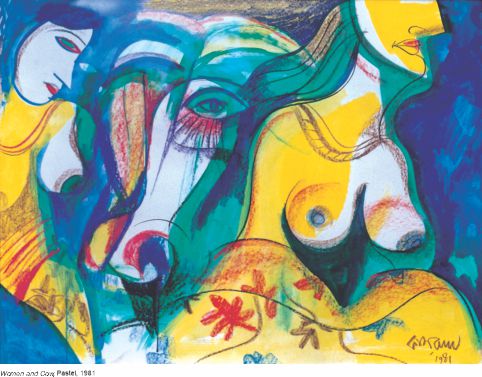
In the 1970s Quamrul also displayed a penchant for fantasy and occasionally used satire and humour to highlight his community themes. Community, for Quamrul, was a shared space which was essentially secular and cultural, where an individual linked up not only with other individuals, but also with common aspirations and common struggles. Much like S. M. Sultan—another inspired artist who projected his vision of plenty in terms of muscular human and animal figures occupying large canvases, and contented domestic scenes—but also drew pictures of their daily struggles against forces that aimed to marginalize them—Quamrul showed the dual presence of harmony and discord, contentment and unease. If his watercolours, in a general sense, showed his appreciation of the beauty and contentment that mark an aspect of rural life, his drawings, sketches, and wood/linocuts recorded the conflictual aspects of the same life. His strident and forceful use of the mediums had something to do with their essential natures. Lithograph and linocut were certainly well suited for a harsher treatment of his theme, which Quamrul did with some flair, lacing the composition with satire and irony. Although he was born and brought up in Calcutta, and lived in Dhaka from 1948 until the day he died, the city as an image did not have much attraction for him. He returned instead, again and again, to the village, and to the community that once had been synonymous with free space—a space that the colonial rulers were powerless to dominate not only because people had willed it into existence but also because of its insistence on its own way of life. The city, in contrast, was too much under colonial domination whose telltale signs were everywhere.
Quamrul’s forsaking of the city was manifest equally in the work he did to revive rural artisanal practices and aesthetic traditions. He had always been fascinated by the clay dolls and clay animals the craftsmen made in the villages and sold in fairs. The elongated neck of these dolls, their stylized facial features and their feeling of mass and volume had found their reflection in his painting, and the myriads of designs (naksha) rural craftsmen and women made to decorate utensils, textiles, and household yards also found their place in his work. But at BSCIC, Quamrul put his energy to save these designs from possible extinction through prolonged disuse. He also worked to revitalize textile designs, clay pottery, bamboo and cane work, decorated rice cakes, pith (shola) designs etc. He sincerely believed that without a return to our cultural roots, our artistic productions could only aspire to be ‘sophisticated’ but without any informing vision or power to move us to feelings of empathy. Writing about the rural art of Bengal and the need to recognize rural crafts as a form of art, Quamrul referred to the links that exist between art and life:
Like the embroidered quilts, the muslin and jamdanis [delicately designed saris, which had been produced historically in the villages of Noapara and Rupashi on the banks of the river Sitalakhya, not far from Dhaka] had, in their folds, retained a touch of the climate of this particular area in Dhaka district, the romance of the villagers, and the excitement of the love struck teenage girls (Rupashi Banglar Chalchitra, in Quamrul Hassan, ed. Abul Hasnat: 137. Translation mine). Quamrul had not even one word for the city girl in any of the articles that he had written on art.
By the late 1970s, Quamrul suffered some personal setbacks. In 1976, he separated from his wife of nearly twenty years, Mariam Begum. He began to live alone, and went through a period of depression. His private frustration added another dimension to his work, but, as it happens with artists committed to public causes, receded to the background once he got back to his vigorous work schedule. The 1980s saw Quamrul applying himself to reworking many of his earlier themes and becoming more pronounced in his criticism of political hypocrisy and social degeneration and the oppressive nature of the state. His beast fables now became more urgent and unforgiving: vultures, jackals, reptiles and predatory animals moved across his drawings and paintings like an infernal crew. One could see Quamrul’s deep hatred of the hypocrisy, duplicity and self-serving politics of the time reflected in the ferocity of these animals and birds and in the distorted manner of their presentation.
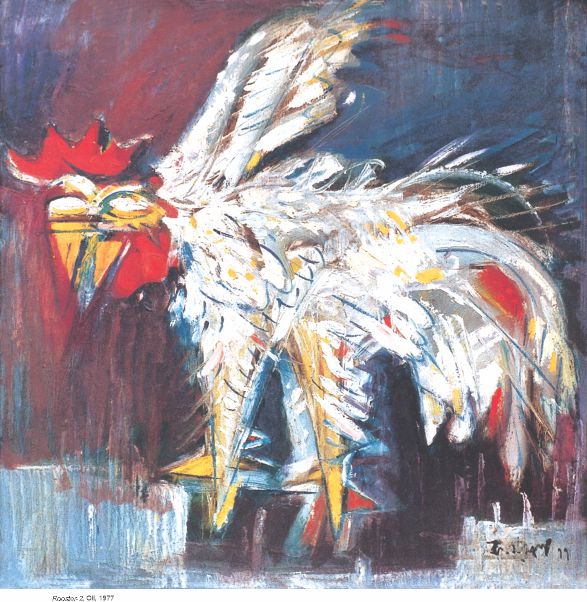
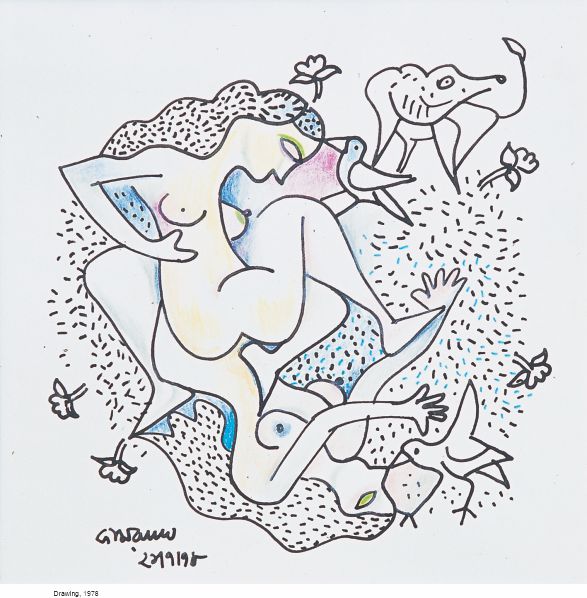
Quamrul’s drawings and sketches deserve special mention here not only because of the way he used them to express his social and political themes, but also because of their overall place in his ouvre. A lifelong preoccupation, Quamrul’s drawings and sketches also revealed his fascination with form, fantasy and the irrational. They had an improvisatory look about them (Quamrul sketched on anything—cigarette packets, the back of matchboxes, strips of paper), but their underlying strength was unmistakable. His last work was also a sketch he did while sitting on the dais from where activities of the second national poetry festival were being conducted on 2 February 1988. He gave it a title too: ‘The country is now in the grip of a shameless one of global proportions’, and the jackal in the sketch represented the autocratic, military-turned-civilian ruler of the time. Then he had a heart attack, and was taken to hospital where he breathed his last.
We recall how the posters he drew in 1971, urging the countrymen to ‘eliminate the beasts’—where the caricatured and ferocious looking face of General Yahya Khan with fangs instead of teeth represented to the whole world the essential nature of the Pakistani military regime and their murderous intention—inspired the freedom fighters. A couple of years after Quamrul drew his last sketch, the autocratic and hypocritical ruler was gone, toppled by a mass movement.
Even when painting nostalgic landscapes or dreamy looking women or domestic scenes of bliss, Quamrul never let his involvement with social and political causes and movements slacken. For him art was not just mere magic making, but an activity that could stimulate action, and, in its form and content, reflect ‘necessity’. That necessity was not mere utility, but a far deeper urge of the human heart to roam free without fear. Art in this sense to him was both an aesthetic and political act.
Syed Manzoorul Islam is a member of Jamini editorial board
In his paintings Quamrul Hassan tries to revive an ideal Bengal of the past that would inspire the new nation’s search for identity. His pastorals—stylized projections of self-generating images of open landscape, the sky, the river, fish, birds and animals and the humdrum activities of life that contented men and women carried out in tune…