
fascination comes around
“The first function of a mythology is to reconcile waking consciousness to the mysterium tremendum et fascinans of this universe as it is: the second being to render an interpretive total image of the same, as known to contemporary consciousness. Shakespeare’s definition of the function of his art, ‘to hold, as ’twere, the mirror up to nature,’ is thus equally a definition of mythology. It is the revelation to waking consciousness of the powers of its own sustaining source.”–Joseph Camphbell
Much has changed in the almost 40 years since Joseph Campbell penned his influential study of mythology The Masks of God: Creative Mythology. Not least of which is the concept of ‘waking consciousness’ itself which seems to be rapidly floundering into an entirely suspect construction. The so-called ‘mysterium tremendum’ of the universe exerts an ever-greater hold, perhaps even superceding the rational faculties of all human endeavor. When we now hold up the mirror to a nature that has been stylized into culture, what exactly do we see? Anita Dube’s art poses such a question. Her works, in a wide variety of mediums, including sculpture, photography, installations, video and printed canvases, could be called ‘anamorphoses,’ the term given to figurative pictures which appear to the naked eye as broken or fragmentary deformities and coalesce into normal human figures only when reflected in a conical mirror. It could be said that Dube is crafting special mirrors so as to un-deform reality; to allow us to view the ‘fascinans of this universe as it is.’
Campbell’s study of mythology in The Masks God mined deeply those sources found within the Indian subcontinent. Dube too allows this rich mythology to act as a mise-en-scene, a sort of background radiation for her own work. For Campbell, if mythology first functioned as reconciliation and secondly as interpretation, its third function was as the enforcement of a moral order. Dube also enforces a morality of sorts, albeit one that is polymorphous, reflexive, anti-hierarchical and, in the end, deeply hallucinatory. This is where the artist’s ‘cultural heritage’ could be invoked to, her innate attraction to the hallucinatory or psychedelic aspects which seem to animate much of India’s cultural traditions, especially its Hindu mythologies. It is precisely at this point, where the visual is generated by the cerebral and the two are one that Dube’s artistic practice hovers, and it is here that where the objects of her imagination spark into being. Here, categories such as Orient and Occident and contemporary and traditional cease to exist while individual will dissolves into a collective consciousness neither ‘waking’ nor ‘dreaming.’ (Guy Debord’s Society of the Spectacle barely applies in such a situation while Jean Baudrillard’s theory of the simulacra is trumped many times over.) If a myth is unverifiable, Dube exploits this quality so as to challenge the truth, accuracy or objective correlative of any and all.
****
For most of the past decade, Anita Dube has been exploring and elaborating her endeavors into sculpture. Despite having studied Art Criticism at the Faculty of Fine Arts, M.S. University in Baroda, her approach to making art has always been tangential, independent and untrained (though certainly never naïve in any way). Her first efforts were with carved and painted wood, a vocabulary she inherited from her peers in the Indian Radical Painters and Sculptors Association for which she became the designated spokesperson. Carved wooden objects were soon to be paired or decorated with other objects and materials and since the mid-1990s the artist has concerned herself exclusively with the found (or, more aptly, selected) and then manipulated object.
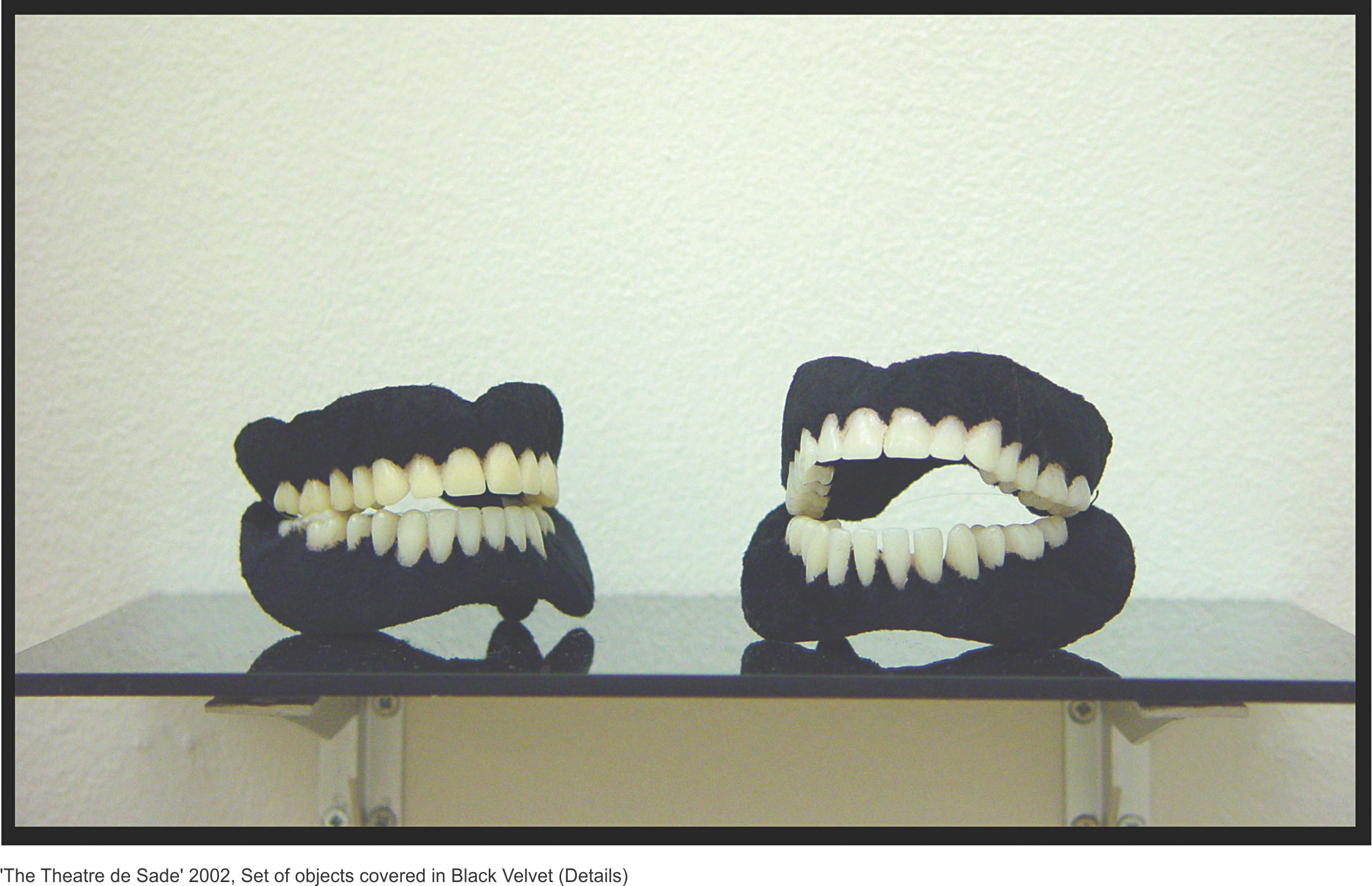
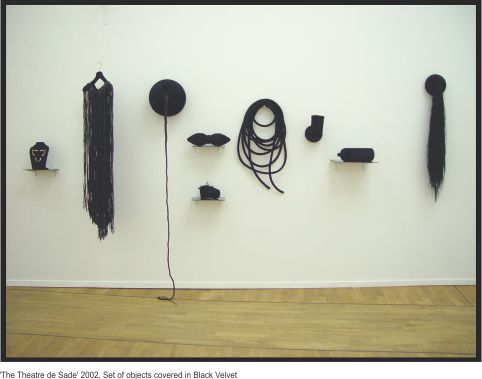
A breakthrough of sorts came in 1997 with the suite of works entitled Silence (Blood Wedding) which entailed bones from a human skeleton the artist sheathed in a skin of red velvet and liberally sprinkled with confections of beading, embroidery and lace. With this work, Dube grappled simultaneously with the contradictory histories of sculpture and humanism; cottage production and the rarified language of High Art; the festishes for beauty and detailing which often obfuscate the attempt to construct or excavate meaning. Silence (Blood Wedding) was followed by The Theatre of Sade, Dube’s meditation on the masquerade and pantomime of the infamous Marquis’ influential investigations into desire and power. A suite of objects was sheathed in black velvet, its lustrous sheen partially obscuring their original identities but also articulating their peculiar forms. Costuming and body parts, household objects and ritual devices are subsumed into one undifferentiated mass, now both flattened and extrapolated. Another suite of velvet-covered objects, this time in turquoise and entitled Shri S. Lund Kishore alias Raja Epidus, alias Chikna, provided comic accoutrements arranged along an internal logic lifted from the story of Oedipus Rex. With this, as in Silence (Blood Wedding) and The Theatre of Sade, the art object haughtily accepts its role as commodifiable ruse, both bibelot and talisman; it is self-deprecating but also transcendent. Funny that this should all seem so apropos to present-day India, where politicians contort religion to coerce the disenfranchised towards violence and film stars win public office by assuming the poses of divinity. Eschewing narrative devices, the works concoct not mythologies of their own but rather resemble super-condensed matter, like a black hole, which absorbs all possible mythologies; collapsed stars that devour all information that has come before.
(1) An invitation to participate in a group exhibition entitled ‘Wayside Deities’ led Dube to turn her attention to the primitive and animistic markers of Hindu theology which are so prominent throughout India. This was not exactly a radical departure in content, nor was it a fresh investigation for the artist; most of her work since the past decade has been dealing with concerns revolving around the concepts of bhakti, darshan, 2 2(BHAKTI: devotion; usually referring to a direct connection between man and the divine, unnecessary of mediation. Darshan: insight, way of seeing, making visible; usually referring to the visual exchange between the idol of worship and the worshipper.) ritualized fetishistic devotions and their intersections with contemporary socio-political developments. What the exhibition’s premise enabled the artist to do was to be liberated from the sole responsibility of establishing the received context for her works, ensuring a religious/political reading of them no matter what they may be. The result was a group of works (WC, Soap Dish, etc) constructed from ceramic ‘sanitary ware’ and covered info deep saffron/orange velvet, the colour immediately identified with the then-ruling Hindu Nationalist political party.
One senses that the base components of this series of sculptures, (toilets, drain-pipes and bathroom fixtures) had been beckoning to the artist for some time. So multifarious are the interweavings between ritual cleansings in all religious constructs (but especially in Hinduism) and so clearly the obsession (or lack thereof) for cleanliness manifests itself among different secularized socio-economic groups within India (but also demarcates strong barriers between public and private spaces and can glaringly spotlight a lack of civic responsibility), that an almost overwhelming number of meanings can be read into sculptures made out of sanitary fixtures. Add to this their references to Western sculpture of the 20th Century (from Duchamp’s urinal to Manzoni’s can of feces to Robert Gober’s sinks) and we have works that are certain to be top-heavy in Conceptual gestures.
One’s initial readings of these sculptures by Dube are as formal extravaganzas that are lovingly crafted and highly resolved. The sanitary fixtures, having been designed to accommodate the human form and its functions, are bodily in both curves and scale. Cloaked in deep saffron velvet, they become streamlined ciphers our gaze has trouble adhering to, their surfaces rendered into a state which hovers somewhere between animal and vegetable. Punctuated with chrome details, these most quotidian of vessels now resemble baroque armors and expand a dialogue in which form not only follows function but blossoms into decoration (the chromed nuts, bolts and brackets appear as rare jewels adorning the body of a bloodied beast or even its orchidial genitalia). As status symbols, Dube’s works are tongue-in-cheek surrogates for the excesses of haute couture, lugubrious furniture for florid lifestyles.
Yet all forms and materials carry the weight of both meanings and symbolisms, albeit ones which are constantly shifting and subject to interpretation. Speaking about her previous works, Dube has expressed the desire for her sculptures to have ‘the effulgent quality of the gods’ but also to participate in a ‘marvelous contamination via a profane intermixing with the real world.’ 3(Kamala Kapoor: “Sieve-o-Physis: An Interview with Anita Dube,” Art Asia Pacific, Issue 26, 2000; page 45.).. Prophetic, then, that she should be asked to create works under the banner of “Wayside Deities,” precisely at that point where the divine and the mundane should meet so blatantly. Dube takes it as an opportunity not only to bring the quasi-figurative, sensually-loaded markers of belief into her own (now established) lexicon of objects but to also crank up the volume of her own investigations into the insidious misuse of religion for political gain and social coercion.
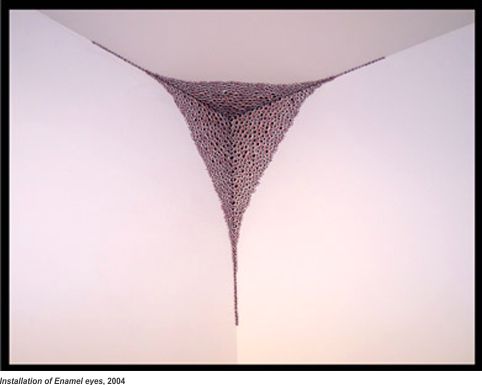
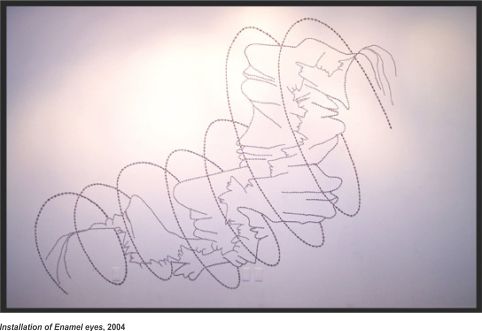
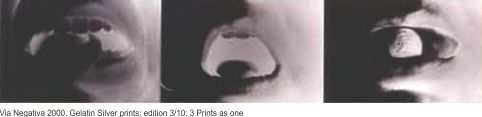
Another motif favored by Dube is the eye, untethered from any body and presented en masse. In elaborate ‘drawings’ the enamelled eyes used for religious statuary snake and seethe across the wall, sometimes making pictures or spelling out words, their range of sizes further accentuating an organic similarity to pestilent swarms or viral tides. In photographic works, the artist has affixed these eyes to her own hands and mouth in order to enact a Gnostic dance of languages unheard.
Campbell has noted that ‘the eyes in the tail plumes of the peacock suggest the opening from within of the eyes of the ground at being, to view the universe of its own body. They are the eyes (stars) of the night sky; the eyes of the immanent Eye Goddess; those eyes in the extended palms of the offered hands of the merciful Bodhisattva which may be likened to the wounds of Christ.’ 4(Campbell: The Masks of God, page 503.) Neolithic ‘Eye Idols’ found in Asia Minor might represent the disintegrating representation of the face and the loss of individual identity while serving as a connection between imaginative abstraction and mortuary rites. 5(Erich Neumann: The Great Mother, 1955; Bollingen Series / Princeton University Press.) Closer to home, Hindu mythology applies the epithet “thousand-eyed” to a number of gods and the motif of extra eyes usually takes on erotic, rather than spiritual, connotations. The goddess Indra, for example, is known as Sahasraksa (translated as “Having a Thousand Eyes”) but also as Netrayoni (“Having Eyes for Female Organs”). In another context, the thousand eyes have been sited in the middle of the sexual organs themselves. 6(Wendy Doniger: Siva: The Erotic Ascetic, 1973; Oxford University Press; page 84 & 86.)
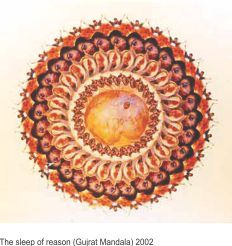
A group of works created during a residency in Oslo led Dube to investigate the photograph as a found object, both as a cipher of loss and as a marker of recognition. Images culled from news magazines of both the victims and the perpetrators of the state-sponsored riots that took place in the western Indian state of Gujarat in the spring of 2002 make up the work entitled The Sleep of Reason. Here, multiplied images unfold from the center to create a beautiful mandala surrounding the portraits of the then Prime Minister and his second in command. The work is initially seductive and alluring, only to become horrific and disturbing upon closer inspection. Dube taps into deep strains of hallucinatory prowess that animate much of traditional Hindu culture and now facilitate an insidious misuse of religious piety for social and political coercion. In another work, the artist juxtaposes old black-and-white photographs of her parents, young Indian doctors who had temporarily relocated to the Norwegian capital in the late 1950s, with the lurid color image of open-heart surgery. ‘Why Should We Die So Much Before Death’ is the axiom that binds these images together into a rebus of pain, confusion and longing. As in her four silkscreened works entitled Punctums, Dube excavates the archeology of her own family to locate a larger social purpose, and to construct both personal and collective identities.
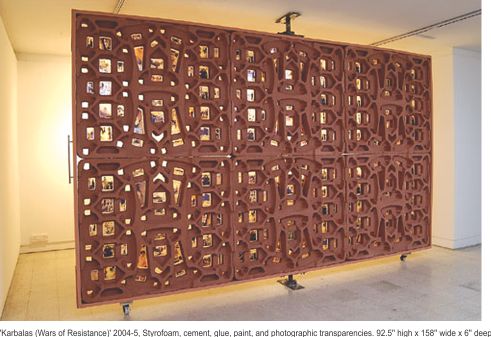
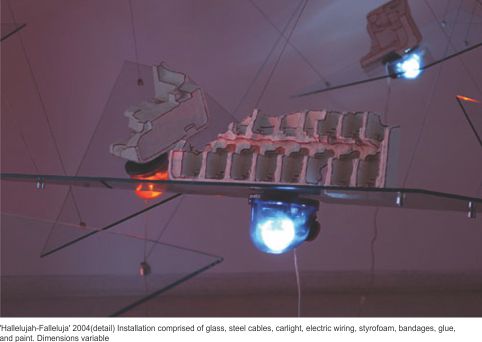
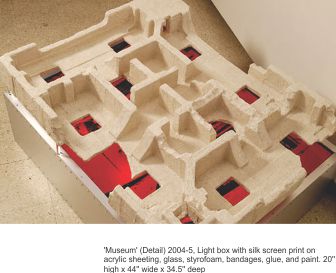
In her most recent body of works, exhibited under the umbrella title of Illegal, Dube continues to employ found photographs. Now they come from the public realm, fished from the stream of the mass media, and address the subject of the American invasion and occupation of Iraq and the subsequent resistance to these actions. Now the photograph is treated as consequential debris, shards of shrapnel excavated from the wreckage of cities, mute bits of evidence of seemingly unimaginable occurrences. In one work, Karbalas (Wars of Resistance), the artist has crafted a large rotating wall from recycled packing materials, the geometries of their forms repeated and mirrored and alluding to the pierced architectural screens found throughout the Islamic world (including India). Their apertures have been plugged with photographic transparencies of images from Iraq, some mundane, some horrific, and their back-lit colors sparkle as if decorative stained glass. An accompanying suite of small-scale sculptures takes chunks of the same packing materials and props them on to light-box pedestals. The shards of what appear as architectural details have been bandaged in white gauze, while the top surfaces of the pedestals are made from abstracted photographic images bathed in blood red. The effect is to memorialize these remnants of destructive acts, much as a common newspaper photograph of an event becomes a public monument of sorts. Dube’s larger program addresses the assault on Islamic culture and Muslim societies from both within and from outside, her statement an elegy of sorts for a grand civilization that has been humiliated by both foreign powers and homespun fanatics.
****
In the past ten years, Dube has harnessed a prodigious range of materials to create works which seem to encapsulate a psychotic interval, a point of delusion both individual and collective, a testing of perceptions about the world: antique furniture smothered in dust, clothing made of paper and used as time-clocks for laborers, lamps which illuminate only their own egg-shaped beams, the branches of a living tree wrapped with colored cord, family photographs retrieved and dissected, the flotsam and jetsam of a consumer culture at odds with its own surroundings. Her works can be interpreted as either painfully personal confessions or as a barometer for the health of the social. They often embody embarrassment, vulnerability and a certain queasiness about the world and one’s place within it leading to the catatonic, impotence, paranoia or paralysis. But to communicate something of this psychotic interval, this disturbed and disturbing rupture, is the first step of moving away from such an experience, of instigating the healing process and of constructing a symbolic knowledge through which the artist can overcome overwhelming emotions and psychological experiences. It is pertinent to remind ourselves here that both of Dube’s parents were physicians and her childhood home accommodated their diagnostic facilities or that her formal education was in art history and criticism rather than the actual production of objects. The artist brings the physician’s analytical resources to an inquiry into materials and objects and the critic’s sense of relativism towards a dialogue between the self and the world.
What much of Dube’s production and practice resembles is something akin to Tantra, the Indian phenomenon of religious synthesis that lays special emphasis on the lower-caste or left-handed (that which is traditionally reserved for actions which pollute) sects of Hinduism, the deliberate breaking of taboos and the predominance of lived experience over abstracted thought. In this, she takes cues from the faux-shamanism of Joseph Beuys, developing a vocabulary of symbols that flaunt their contradictions or deny specific artistic patrimony. Her works feel deeply at ease with a confusing complexity that is both natural and traditional in an Indian cultural context yet one that only recently has come to be identified as Post-Modern from a Western historical perspective. Just as Tantra celebrates sexual energy as a path to spiritual wisdom (unthinkable in a Judeo-Christian context), Dube seems to feel little anxiety when it comes to producing works full of abnormal fears and irrational logic. As the scholar of Tibetan Buddhism Robert Thurman has noted, ‘all Tantric symbolism is multilevel and polyvalent, so there is no one fixed meaning of this and that; rather the many interwoven correspondences that make symbols so powerful and durable in conveying intuitions that sometimes defy communication in ordinary literal speech or image.’ Power and durability, then, seem to be the goals as transmutation is celebrated for its own sake and we surrender to the bliss of communication founded on signlessness.
Peter Nagy is an artist and curator who writes frequently on the subject of contemporary art for a wide variety of publications. He is the director of Gallery Nature Morte in New Delhi
“The first function of a mythology is to reconcile waking consciousness to the mysterium tremendum et fascinans of this universe as it is: the second being to render an interpretive total image of the same, as known to contemporary consciousness. Shakespeare’s definition of the function of his art, ‘to hold, as ’twere, the mirror up…