

take four
From the pure visual pleasure of Fokhrul Islam’s cosmic landscape, Murshida Arzu Alpana’s canvas that records her sense of displacement born out of her exile, to Anwar Hossain’s photographic meditation on children and their environment to multimedia artist Fida Haq, an expatriate Bangladeshi living in Australia, the exhibition calendar in the first quarter of 2006 has been truly engaging
the transcendental tilt

Gesture and luminosity are the hallmarks of the paintings of Fokhrul Islam collected for his 15th solo exhibition at Alliance Francaise, Dhaka. All his mysteriously resonant paintings are called ‘Image.’ As usual, they are done on paper with printing ink. Perforation of paper has been an identifying element of his paintings of the last seven years or so. In this exhibition, in many a painting, swaths of black paint become the crucial vehicle of expression. They end up drowning all suggestions of geometric marks or perforation that usually dominate his composition.
As is his wont, Fokhrul displays his works in batches. It was his landscape-like imagery displayed in fours and threes that are the main attraction of this March solo exhibition.
Fokhrul started out as a ceramic artist in the early 1990s, and suddenly decided to switch to painting in the mid-1990s. Initially, he depicted unpeopled landscapes that thrived on gestural resonance. Then came a phase when he concentrated all his energy on punctures that dotted the surface of the paper. Although these works often remind one of the cosmological visions, at this stage Fokhrul’s work had become purely self-referential. Today, his attention oscillates between nature-derived imagery and purely self-referential works. However, one aspect of his work has remained unchanged: his works, as a rule, eschews depiction of the human form. He remains an abstractionist who has the tendency to draw on natural sources from time to time. His surfaces have the tendency to express his signature tableau in two different manners. They either provide a window to a landscape-like imagery giving the illusion of depth, or they propose a surface without the sense of depth. If the latter tendency puts the artist within the bracket of the abstract expressionists of the country who had begun their journey as early as in the 1950s, the former makes him a romantic who banks on the unscathed beauty of nature.
It is from within the purview of romanticism that Fokhrul’s most poignant images are brought into existence, and they are to be enjoyed solely in that context. In the preface of the catalogue for the exhibition Shovon Shome, an eminent Indian art critic, writes that ‘a painting never imitates nature.’ This is especially true of Fokhrul’s efforts as he always eschews imitation. He creates images that are autonomous, and have their own set of principles that govern their meteorology. The link that they have with the world outside is a roundabout one. And what they impart is a vigour that is born out of a passionate engagement with nature. They can never be considered renditions of actual places, as Fakhrul seeks to achieve a primordial dimension in each of his monochromatic images. It is because of this characteristic that he overlooks the tumult of the contemporary world. For him to paint is to transcend the reality that one lives in. Therefore, the mood of each work is pensive; and as for emotive force, it is contained by the formalist in him.
However, Fokhrul refuses to identify himself with other formalists of the country; he would rather be bracketed with the passionate interpreters of nature. ‘I feel that all my creations are the simplest vehicles of my passion, love and longing,’ he declares in a note that has accompanied all the catalogues printed for his solo exhibitions. As for the most recent show, it as usual, showcased works that provided pure visual pleasure.

Fokhrul’s world is an insular one and is akin to that of an ascetic. He has been producing images where social and political factors as well as mental disquiet never interrupt the ever temperate climate of his works. All his works in the March show have been put forward as pure spectacles.
His strength lies in the fact that he aims all his extrusions at augmenting the pleasure of looking. It is the sense of enhancement of the visual domain that adds to the viewers’ enthusiasm. The realization that paintings are not windows to nature but are passages to a parallel world of the artist’s own creation makes the experience more visceral.
However, over the years, his innovative abstraction has become more moderate. As he has repeatedly used his visual tactics, many a tableau seem premeditated. The vibrancy that was once so crucial an ingredient in his early works seems to have diminished somewhat, making his latest works seem like an echo of his previous creations.
Fokhrul is one of the most prolific painters of his generation but the batches of paintings he has produced have led him into a rut. What this forty-plus artist must realize is that however transcendentally inclined he is, the visual solutions that he has overused in the last few years must be avoided if he is to carve out newer paths.

The exhibition titled ‘Image’ was held from 3 to 15 March in La Gallerie, Alliance Francaise, Dhaka.
the sense of
dislocation
Everything is thrown in our face without much hesitation. Everything retains a slapdash immediacy and refers back to a reality that is the source of both anguish and audacity on the part of the artist. If the emotional colours are to be detected in the swaths of colour-heavy brush, skewed human forms as well as suggestions of urban order to be found in the repeated motifs, one is led to nostalgia, angst and demystification. These are the hues that Murshida Arzu Alpana’s world is made up of.
Alpana draws her artistic ingredients from two different worlds: one is the country she grew up, Bangladesh, and the other is Germany, the place where she has been resident for the last twelve years. Alpana aptly calls her 11th solo exhibition ‘Spagat: Living in Two Worlds.’
Though drawing plays an important role in her images, in the end it is colour relations that govern each composition. In that sense there lurks an abstract expressionist behind all that is seemingly figurative or motif-infused. In fact, a huge abstract composition titled Image in Space testifies that her métier is in handling shapes and lines. In this big mixed media work on paper, one can dwell on the fact that Alpana is able to diffuse a sense of figuration in her non-figurative works. The sheer physical engagement during the act of creation has left its imprint on this particular piece. However, she fails to repeat her success in other works. Though Image in Nature veers at a similar direction, the end result is only a mere agglomeration of brush strokes that recall the informal expressionistic works of Georg Baselitz, the German Neo-expressionist. Though the work retains the free spirit with which Alpana usually takes on shapes and figures, what it lacks is a force to govern the actions that finally leads to the creation of a particular image.
Alpana’s spirit reigns supreme when it comes to the use of colour. She is sometimes obtrusive and occasionally temperate. However, in the resultant compositions colour is never given prominence over form. Her imagery remains bound by shapes and drawings that contribute to the inner dynamics of her work. Adolph Gotlieb’s espousal of the ‘simple expression of the complex thought’ sees its application in Alpana’s expressionistic works that are comprised mostly of mixed media on paper. There are a number of silk screen prints on view that date back to the mid 1990s. These depict dehumanized figures and faces.
Human forms are scattered across many of Alpana’s works. They seem to override gravitational pull and roam about as if they are eager to express their individuality. However, it is through portraiture in few of her works that she effectively examines the place of the individual in the modern world. There is no mysticism about the world that Alpana’s individuals live in: it is turbulent and unsympathetic to one’s aspirations. Exception occurs only when the artist gives in to an overwhelming feeling of nostalgia. An example is the piece titled My Windows to the East and the West, where an idyllic scene, representative of Bangladesh, is revealed through a window.

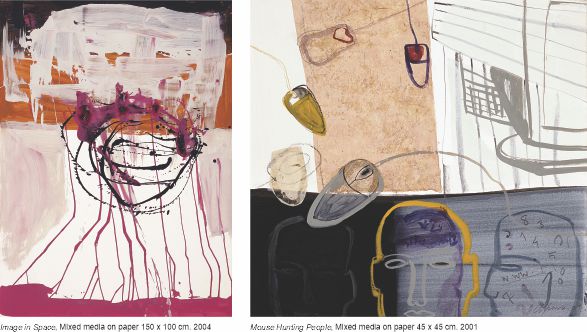
Barring a few exceptions, most of Alpana’s work bring into play a sense of displacement born out of her exile. To look at Alpana’s figurative and the non-figurative proposition is to realise that the works are not only about feeling but also about knowing. The knowledge that reality is adverse and the individual’s destiny is being marred by depredation is one aspect that the artist harps on in most of her images. The wide-open eye that is the mark of many a portraiture— both small and big—perhaps refers to the witness who devours all, but is unable to do much. As such, tranquility has been postponed in Alpana’s world; most of the works put forward this very message by way of gestural rendition of a recognised reality.
The exhibition was held from 16 to 28 February 2006 at the Bengal Gallery of Fine Arts. immersed in the personal
In the last five years or so Anwar Hossain, a leading photographer of the country, has become more self-indulgent. Initially, it was the intrusion of his own hand into the frame of the picture that strove to bring into play the ‘self’ in what could otherwise be referred to as still-life; then came a flurry of images that zeroed in on his own family members. The recent exhibition titled Lilas-Bangla, which brings into view glimpses of the children of Bangladesh alongside photographs of Hossain’s two sons, is for the most part a meditation on children and their environment.
‘I’m no longer just Anwar Hossain, I’m Anwar Hossain with a family, and this is reflected in the exhibition,’ the veteran photographer declares. Clearly, after becoming a father Hossain views children from a paternal perspective.


His children, Akash (8) and Meghdoot (5), have become his inspiration. Hossain has untiringly recorded their lives and in his recent show he juxtaposes them with his photographs of Bangladeshi children, taken in the last thirty-five years or so. Each photograph captures a moment in the life of his two children and has been paired with matching or contrasting photographs of the children of Bangladesh.
The photographs of Hossain’s own children were taken in Les Lilas—a district near Paris in France, ‘which is not bigger than Dhanmondi.’ As for the photographs of Bangladeshi children, they are culled from diverse collections. From a mother reaching out to her toddler on a river bank to a disabled child sitting all alone in front of the Shahid Minar—the monument for the language martyrs—to children busy helping their parents in carrying canes or goading goats, the list is unending. While the photographs of Bangladeshi children provide a window on our rural society, the bulk of the work that records Hossain’s own children is made up of the kind of snapshots that usually adorn family albums. The images depict mundane every-day happenings and are informal in their approach.
It is the formal beauty in things and the naturalness of the humans that used to be the basic focus of Hossain’s photographs. These won the hearts of viewers over the years. The other important factor in his work has been the juxtaposition of particularly unassuming images against other related or divergent images that lend the composition a sense of the surreal. This later ploy has made a few of the photographs of Hossain’s sons striking. In one such image Akash is seen under an umbrella in front of a billboard showing a huge lion sporting a sunglass, its gaping mouth revealing two of its saber teeth in its lower jaw. While the image of the lion recalls the narcissistic world of fashion and advertisement, the face of the child under the umbrella provides an overwhelming sense of innocence. This playful juxtaposition of two contrasting images in one picture enables the photographer to make an oblique statement on present-day reality and its power to encroach on the most private space of the individual—the mind. It is in such pictures that Hossain uses the camera as a tool to respond to the world in which he now lives. It is in such occasions that his passion for humanity finds a proper conduit.
Hossain believes that photography is a way of coming to terms with one’s most intimate feelings. As such, a photographer’s role is not limited to producing visual notations on favourite subjects; rather it extends into the private domain. It is this personal passion that still drives the fifty-plus Hossain.
The exhibition titled Lilas-Bangla was held from 16 to 29 March at La Gallerie, Alliance Farancaise, Dhaka.
uncanny stories and pleasant patterns

Fida Haq has got stories to tell—stories that are at odds with our every day experiences. The most telling of the story-telling images of this artist are photographs accompanied by text. Haq, an expatriate Bangladeshi living in Australia for the last 13 years, entered the domain of art only three years ago. His art is interactive and uses photography, and computer graphics, as well as video and text. However, this is just one side of his creativity; the other just side is quite traditional. He makes patterns with discarded drink cans and packets.
If the handmade patterns bring to the fore a sense of unity and harmony, the photographic and computer generated images amount to a comment on modern living. By way of producing Dadaist imagery through his photographs, Fida engages himself critically with the world he lives in. As for the patterns, they exteriorize the aestheticist streak in him. Moreover, they enable him to connect with the deep-seated traditions of his own land and its people.
In the exhibition titled ‘Of Angels and Chariots’ that opened in the Bengal Gallery of Fine Arts, Fida offers drama of two kinds. On the one hand, he depicts the innate beauty of traditional patterns, and on the other he provides Bangladeshi viewers with glimpses of a world that is a parody of the actual one. It is from the latter tendency that he sheds critical light on human habits by transforming them into actors in an absurdist drama of his own concoction. The series that does so consists of photographs of mostly sari-clad women in tiger masks.
If strangeness is the preponderant emotion this artist expresses in his photographs, the themes test the intellectual ability of viewers to decode the ciphers in his stories. At the initial stage, his images make one realize that his themes hinge on human habits such as watching television, brushing teeth, and roaming around beautiful places. After spending a few minutes with them, it dawns on us that they all examine the loss of the sense of ‘self’ in a rapidly changing world.
All the humans are masked and expose their psyche not by being who they are but by being actors in a play conceived by the artist. If the play is a skit designed to poke fun at human habits, the psychological effect on viewers is complex; it directs their attention to the question of the self and its place in the world. The characters’ disguise is a means of expressing what lies within the themes; they also highlight national identity; the women wear colourful saris and men are shown in panjabis as if to reinforce the fact that they are Bangalis.

In the series where women pose amidst nature, the artist takes his cues from imagery that we encounter on a daily basis in rickshaw paintings. The sari-clad women in The TV Arrives and The Lion Speaks on TV or in Scene One by the Watering Hole and Away from Water on Strange Rock hint at pretension to aesthetic ardour.
The most poignant narrative is put forward in the series titled Animals Brush Teeth in Front of River/Mirror. The accompanying text helps locate the gist of all that goes on in most Fida images; and this particular series is no exception. The artist writes that ‘the act of brushing teeth afford us those precious moment of self-scrutiny—our awareness of self brought to the attention if not heightened by our reflection on the mirror.’ The photographs are like glimpses from a failed advertising campaign. They are borderline images—too kitschy to be of any use. In the postmodern idiom these are images that provoke the viewers and lead them to an ever higher plane of self-awareness. To quote the artist’s own word, most of these images ‘afford the viewers a moment of self-scrutiny.’
If the series of masked women and men are based on kitsch, the series called All We Need is Some Tension follows modern day adverts. It depicts the pre-Christmas race riots that took place in 2005 in Australia. In the accompanying text the artist reflects on how politicians keep their ratings high by keeping racial tension alive. The photographs are like large hoarding put up as advertisements for canned food or drinks. Each piece shows profiles of representatives of two different races. With one profile up-side-down the images include a computer generated banana and a cucumber and drink being sucked by both faces in subsequent pieces.

If Fida taps our deeper psychological need and leads one to reexamine oneself by forcing one to witness strange goings on in the series that dotes on kitsch, in the rest of the works he expresses himself in a rather offhand way. No playful take on identity or self, no critical examination of the social being are brought to bear on the pieces of the series titled All We Need is Some Tension. Not even the ambitious BangBangOzBang!, which is 250 cm wide, where he throws in emblematic images of Bangladesh and Australia, has the same effect on the psyche of viewers as does the series that shows women in tiger masks.
As for the patterns which he proposes as the means to relate to a long-standing Bangladeshi tradition, the artist feels that they have a place in the postmodern idiom. For him the patterns of a particular tradition encapsulate the deeply engrained psychological tendencies of a populace. He wants to unlock the mystery of that collective psyche through his take on Mughal patterns as well as the designs that adorn the rickshaws of Bangladesh.
Fida’s fantastic imagery and floral motifs are two facets of one world. Though they remain far apart as they contemplate two separate idioms of art, they tap into the same collective psyche. If through patters he brings into view the collective passion of a populace, it is through kitsch-like imagery that he addresses our collective fear and misgivings.
The exhibition was held from March 27 to April 7 in the Bengal Gallery of Fine Arts.
Mustafa Zaman is a senior staff writer with the Star Weekend Magazine, Bangladesh
From the pure visual pleasure of Fokhrul Islam’s cosmic landscape, Murshida Arzu Alpana’s canvas that records her sense of displacement born out of her exile, to Anwar Hossain’s photographic meditation on children and their environment to multimedia artist Fida Haq, an expatriate Bangladeshi living in Australia, the exhibition calendar in the first quarter of 2006…