
patriarchal constructs and gender bias in the performing arts theatre and dramatic arts in pakistan
This paper will deal specifically with the contribution the Tehrik-e-Niswan Cultural Action Group has made to the Women’s Right’s movement in Pakistan. As artists we need to be conscious of what we are trying to do; but while endeavouring to attain self-awareness as artists, we should also communicate our findings to society. On the other hand, intellectuals must put away arbitrary theories and opt for genuine and spontaneous responses to works of art
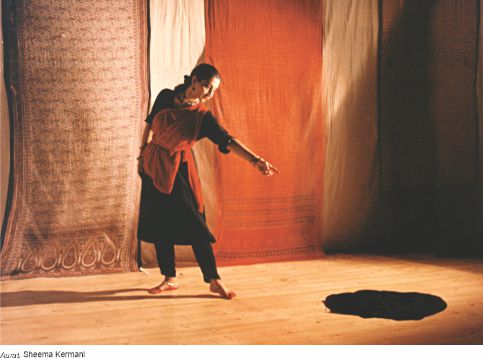
We artists believe that culture– the arts and creative media in general–present opportunities for the promotion of human rights and provide occasions for forging unity amongst all oppressed people. Dance, music, visual and performing arts transcend language barriers and serve as incredible means of communication and bonding.
It must be noted that those people who come to watch cultural programmes may not necessarily subscribe to the ideas and objectives of the Right’s and Peace movement and therefore the whole concept of raising awareness and bringing people together through cultural inputs is an important one. These activities achieve far more than ‘getting the message across.’ They initiate a dialogue with participants, encouraging them to engage with issues in a far deeper way than other methods.
We feel that it is important for all of us to understand that there is no politics without art.
Art is not only for entertainment—unless we integrate it into our politics, our politics will not move forward.
Culture is a bonding force between people and it can help our identity formation.
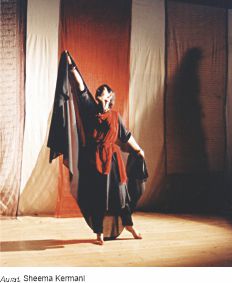
The arts reflect the creative urges society as a whole. It is through the arts that people express themselves, attain a sense of collective identity, and are able to reflect on their problems. The arts elevate the mind and soul to a higher level and eradicate pettiness and coarseness. They bring people together and lead to harmony and cohesion. They counter violence and aggressive attitudes and make people to reflect and think, thus unleashing the creative energies of people.
Tehrik-e-Niswan, literally meaning women’s movement, was formed in 1980. Its main aim is to try and integrate art and politics with special emphasis on women’s rights. In a society where there is conflict, art, if it is truthful, must also reflect conflict and decay. It must show the world as changeable. And help to change it. Whenever Tehrik sets out to produce a work of art, dance or drama, this world outlook, this ideology, and a highly conscious rational process is kept in mind.
The very first production of Tehrik-e-Niswan in 1980 was an adaptation of Safdar Hashmi’s play Aurat. This play consists of short vignettes on the lives of women from different classes in different situations. Tehrik has staged over 400 performances of this particular play and it is always received enthusiastically. It has had as much success with low-income communities as with middle-class audiences. Not much has had to be changed from the original play except for minor references to religious ceremonial practices. Tehrik did make one major change though. The original script starts off by describing the roles women are given by society. Safdar wrote his opening scene thus:
Woman: I am a mother,
I am a sister,
I am a wife,
I am a daughter,
I am a woman.
Tehrik has altered this a bit since from its very inception it has striven to articulate a feminist and humanist ideology. Our ambition is not only to represent reality but also to shape it. We felt that this is surely how a decadent society defines a woman although a woman is more than the roles society gives her. She is a human being first and then a wife, mother etc. So our opening scene is as follows:
Man1: She is a mother
Man 2: She is a daughter
Man3 She is a sister
Man 4: She is a wife
Woman: I am a human being.
It is men who define these roles for a woman. Women would never do the same for themselves. No man will define himself as a father, brother, husband etc. So the woman has to protest. She has to say that she is a human being first and then a woman.
This is what art can do! Art can raise us up from a fragmented state and give us the vision of a whole, integrated being. It can enable us to comprehend reality and not only help us to bear reality but increases one’s determination to make it more human and more worthy of humankind.
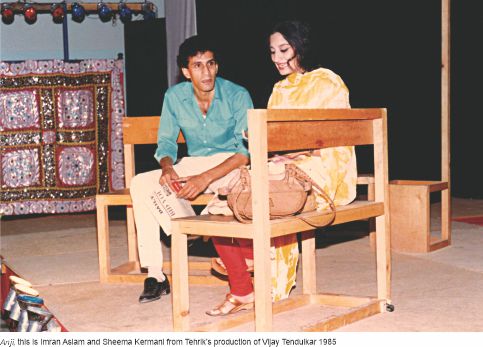
In 1985 Tehrik came across a script by Vijay Tendulkar, a contemporary Marathi playwright. This was Anji—short for Anjali Sharma in India and Arjumand Ara in Pakistan, a young, single, working woman who sets out on a journey to find a husband for herself. We happily found that the perils for a single working woman were exactly the same in India as in Pakistan. This play was written in the modern ‘Tamasha’ style with live musicians and song and dance sequences. I met Vijay Tendulkar in 1994 and he was very delighted to learn that his play had not only been performed and appreciated but had also many successful reruns in Pakistan.
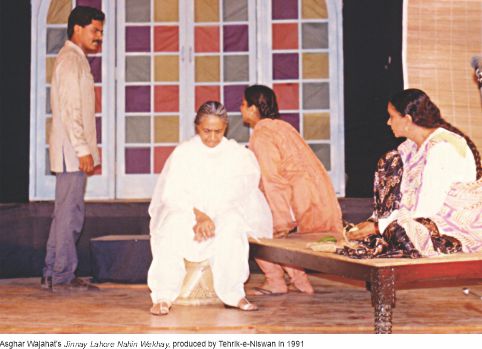
In 1988 I spent some time with Habib Tanvir and his Chatissgarh troupe. Habib was working on an anti-communal play ‘Jinnay Lahore Nahin Vekhya’ written by Asghar Wajahat. I spent many days observing his rehearsals and many evenings discussing the aesthetics of theatre with him and with Monica Habib. In 1991 Tehrik-e-Niswan adapted the play with the writer’s permission. It is set in Lahore immediately after the partition of the sub-continent. The main protagonist is an old Hindu woman who refuses to leave her haveli, which has been declared evacuee property. The play is basically designed to promote religious harmony and tolerance.
We in Pakistan still have to get the NOC, a ‘No Objection Certificate’ from the local government authorities for all public performances; and to get the NOC the script has to pass through the censors of the Ministry of Information. Jinnay Lahore Nahin Vekhya did not pass the censors; they had two objections to it:
1. A good Hindu may not be the main character.
2. A Maulvi may not be murdered.
Without a NOC, the play could not have public performances—i.e. we could not sell tickets, hold performances at public places and could not advertise. So we had to resort to subversive means to stage it. But art is inherently subversive because art tells the truth. The play was performed in the premises of the Goethe Institut, Karachi, to packed houses for over a week. It received much publicity. What is banned becomes controversial. Both Habib Tanvir and Asghar Wajahat were invited by Tehrik but were refused visas.
These are some of the interventions that Tehrik-e-Niswan have initiated. They are an example of how Pakistani culture and Indian culture share similarities and it is these similarities that we need to celebrate. I am proud to belong to a multilingual, multidenominational, multiracial country. I cherish the fact that we have a great many languages, religious denominations, literatures, traditions of music and dance and great many distinct cultural traditions within us. There is something very comforting and deeply humane about a country so heterogeneous. When I was studying in Karachi I had four Parsi girls, three Hindus and five Christians in my class. Now you find mostly Muslims—all others are leaving the country! It is the very suppression of others that has been the greatest tragedy of Pakistan and if we can revive our links with what we have lost we may be able to survive.
One is always amazed to discover the various elements that have become part of traditions and culture. I have always believed that it is not religion alone that creates different cultures! In fact, living in Pakistan one has for the last so many years been told that dance is not part of our culture and that it is part of Indian culture; by calling it Indian culture they obviously imply that it is part of Hindu life and not Muslim life! My experience in the field of performing arts has reaffirmed my belief that it is not religion but patriarchy that determines the status of women and the status of artists in our part of the world.
In our society artists are in general looked down upon, but female artists are considered of no value at all. In the performing arts women are presented in two ways; one is the ‘family woman’ who is considered pure, chaste, loyal and obedient, and the other is the ‘professional artist’ who is considered no less than a prostitute. My experience and meetings with female performing artists in India tells me that the same is true in India.
I have often been told by many of my female students, ‘my father says dance is against our religion.’ Is it? No! It is not religion that is the determining factor; it is patriarchy and gender bias that does not allow us to dance.
Gender bias exists in the whole of South Asia, not only for dancers but also for the musicians. Gangubai Hangal, a much-respected female classical vocalist once said, ‘If a male musician is a Muslim, he becomes an Ustad, if a Hindu he is a Pundit, but women like Kesarbai and Gangubai and Akhtaribai always remain Bais.’
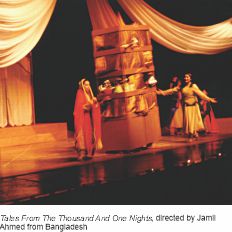
Tehrik’s production of Aik Hazar Aur Aik Theen Ratain was invited to the Nandikar Festival in Kolkata in December 1998. It was the first Pakistani play to be sponsored by ICCR and shown at Kolkata, Kamani Auditorium, Delhi and also at Lucknow. The play is adapted from stories taken from the classic A Thousand and One Nights. The main character Scheherazade transforms an inhuman chauvinist male Prince Shahriyar into a compassionate and wise human being, through the art of story-telling. Dr Syed Jamil Ahmed from Bangladesh was invited by Tehrik to direct the play:
‘.. When Tehrik-e-Niswan in Karachi invited me to direct a play with them, I was interested because in 1971 I had fought against the state machinery of Pakistan in the war of liberation. I had never been to Pakistan before. What would it be like for theatre practitioners to meet across political boundaries and the bitterness of history?..As I walked or drove through the streets in Karachi, ..a city of ‘macho’ males with hungry eyes to lap up any woman on the street—because there were hardly any—except in the news-stands where almost all the magazines contained cover photographs of women in various seductive poses—some engaged modestly in the art while the others were quite frank. So, this is what a woman generally is in Pakistan. Any better in Dhaka or Delhi or Bombay? Obviously not…’
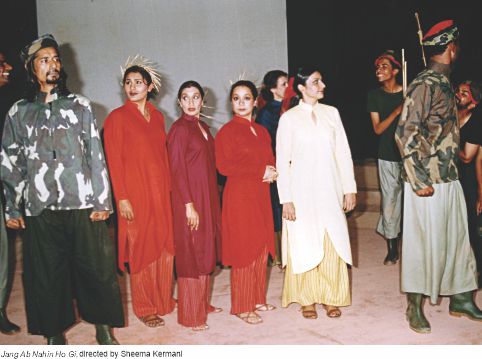
Tehrik-e-Niswan’s Jang Ab Nahin Ho Gi, is based on Aristophanes’ Greek classic Lysistrata, written in 411B.C. Lysistrata is one of the most remarkable ‘Peace’ plays in world literature and today, nearly 2500 years later, it still has amazing relevance for people all over the world. The Urdu version Jang An Nahin Ho Gi has been skillfully adapted and translated for Tehrik by the well-known writer Fehmida Riaz. Although they gained their independence through a joint struggle against foreign colonial rule, two tribes, the Khaebani and the Phool Machhi, are kept in a constant state of strife by their chauvinistic rulers. Pained and disgusted by the state of affairs in this patriarchal set-up, the women of both of the warring tribes unite to bring about a change by refusing the men their (so-called) conjugal rights. To render the men completely helpless, they also manage to gain control of the state coffers. The war machinery, thus, comes to a grinding halt and the menfolk finally are made to see reason.
For me this is a feminist play as well as an anti-war play. The comic element highlights a dire situation—the destructive nature of war is an extension of the destructive nature of patriarchy! To treat a situation as serious as war in a comic way is difficult – but then comedy has long been recognized as a very powerful tool by which to make a comment on society and on characters in society. In the Greek original, Lysistrata is a far-sighted and wise woman who decides to find a way to end war. I felt that to end wars is what all women want; it is not simply the wish of an individual woman but of a collective will—therefore I introduced Gulbahar, Gulabo and Gulnar as the three women who together persuade the rest of the women of the two tribes to take an oath that will force their men to give up wars.
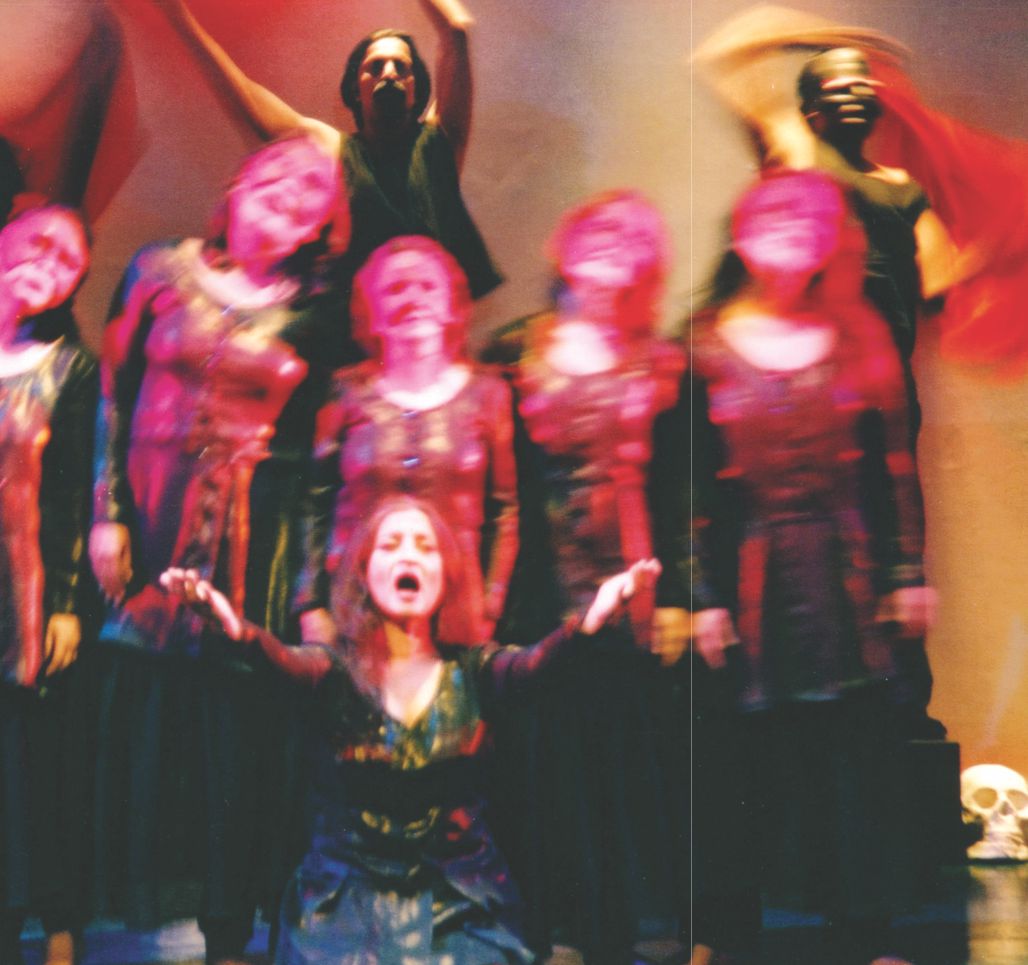
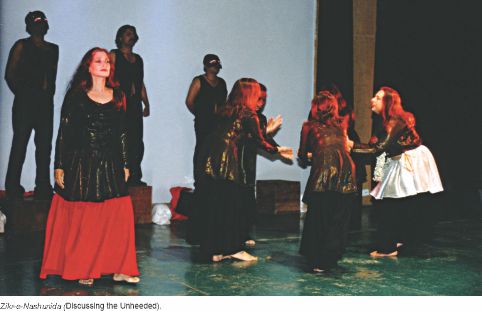
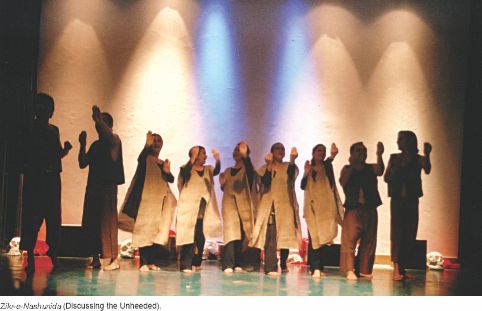
Zikr e Nashunida'(Discussing the Unheeded) deals with the aftermath of war, its effects on human lives, communities and civilisations. It opens as a seminar on peace in progress. An art exhibition and a theatre performance had taken place on the first day of the seminar. On the second day of the seminar, the actors, appearing as participants of the seminar, remember/recall/relive, what they had witnessed at the theatre performance. The play presents narratives of repeated incidents throughout history and lead the audience into the much-spoken-but-not-often-listened-to narratives of war. Prasanna Ramaswamy came from Madras in 2004 and then in 2005 to Karachi to direct the play for Tehrik-e-Niswan. Almost all her work speaks about the unspoken trail of war:
‘The discourse of the play brings forth the image and voice of the female strength which embodies and sustains life despite the continuous onslaught of destructive activities by the power mongers.
Media has reduced the true trauma of war to “events” and the benumbed consumption process sets aside the tragedies of the people, dislocation of communities and destruction of the environment. The reality of the crimes, oppression, cruelty and inhumanness are garbed in the shimmer of martyrdom, medals, patriotism and the notion of the nation state, while those who suffer plunder, loot rape, loss of dignity.. are reduced to mere data.
The process which brought together the two geographically separated sensibilities on a platform to examine and exchange ideas to invent an idiom and aesthetic cohesive, to speak about a shared philosophy of life, was one more occasion of reassurance.’
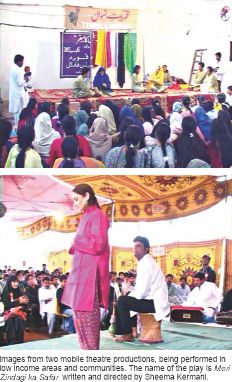
I have only mentioned a few of our productions but an important aspect of our work is our Mobile Theatre. Through this we perform plays made in the Street Theatre genre in low-income areas for people who never come to cities to watch plays in auditoriums. These plays are on issues of human rights and have been written to raise awareness and to provoke the audience to think and begin a dialogue on subject that are not talked about.
Our belief is that sustainable change needs the performing arts to thrive and endure. Surely, we have been able to demonstrate through our work that cultural activity can be a powerful tool to increase awareness, encourage debate, and even alter our lives.
Sheema Kermani is a theatre practitioner from Karachi, Pakistan and the founder of Tehrik-e-Niswan cultural action group. She is a classical dancer and has directed and acted in stage plays as well as on television
This paper will deal specifically with the contribution the Tehrik-e-Niswan Cultural Action Group has made to the Women’s Right’s movement in Pakistan. As artists we need to be conscious of what we are trying to do; but while endeavouring to attain self-awareness as artists, we should also communicate our findings to society. On the other…