

hossein valamanesh art, displacement, and sufi wit
This is an age of diasporas. Populations wash around the earth, leaving bodies in crevasses, dreams in rockpools. No wonder that ‘identity’ has become a shibboleth of postcolonial discourse. But identity with what? Where and when has anything been truly self-same?

Artists in exile–if exile it is–may be wiser than ideologues, and imagination may save us—for a day or a year—from the killing fields of politics. Of course, we no longer know what imagination really is. Could it be madness, could it be memory? Blake, Wordsworth, Coleridge gave us their Romantic accounts, which we view with an envious and distrustful eye. Their sublime accounts persist in modern philosophy. Thus Gaston Bachelard, for one, thinks of imagination as the flame burning at the summit of mind, ‘the reign of the metaphor of metaphor.’
Metaphor, rooted in the Greek verb to transfer, to carry across, suits us here. Metaphor, motion, migrancy, displacement–these are, Shakespeare might say, of imagination compact. For displacement occurs across boundaries of nations as well as art: the art of Hossein Valamanesh, say. Identity? Here it is, displaced in forms, colours, textures, in artifices of enigmatic clarity and spiritual force, playful and political in the same blink of an eye.
*
Born in Teheran in 1949, of Azerbaijani parents, he spent his boyhood in the remote, sand-blown, ochre-washed town of Kash, in the mountainous province of Sistan-e-Baluchestan. The Shah’s infamous secret police, SAVAK, practiced, then, modernization by torture. In 1960, the family returned to Teheran. Valamanesh studied at the prestigious School of Fine Art, and in the evening took acting classes with the theatre director, Bijan Mofid—elements of performance coolly affect his art. In 1973, Valamanesh emigrated to Australia, first to Perth, then to Adelaide, where he and his wife, Angela, a ceramic artist, now reside.

In 2001, a friend, Ian North, introduced me to Valamanesh’s work in Adelaide; I succumbed to its spell. It is not an Islamic spell, though both of us share an interest in Sufism, that banana peel on which all formal religions slip. It is not the spell of the uncanny, which some Surrealists cast. The art of Valamanish drew me to itself because it projects spiritual repose, a numinous, unwilled quality, like light from some faraway, burned-out star. Because his objects both recall and release their histories to the void. Because his works are not argumentative, not solemn, not conceptual in the sense that they depend on some idea, verbally explained. The artifacts of Valamanesh inhabit their context, push out toward the viewer from a particular place, yes; but their plastic and visual and formal values, unlike so much postmodern art, wholly suffice. In short—I say this quite unabashedly—they are objects of beauty, dialogical beauty, engaged in sundry conversations between identity and imagination, past and present, Iran and Australia, natural elements and Pythagorean geometries.
*
One assertive piece, an exception, shows a plum-coloured Persian carpet spread on the earth in a mallee clearing; a fire of pyramidal sticks, Aboriginal fashion, burns at the centre; a photo of the event is taken. The carpet, with its burnt hole, now black velvet cloth, was then displayed in a spotless gallery, under the photo of the live event, the carpet on fire. The piece, titled Longing belonging (1997) , may seem didactic, like another, called Recent arrival (1988), suggesting the enigma of immigration. Yet Longing moves us, beyond cultural interpellation, with its irreducible mystery, as if Zoroaster had drifted into a Dreaming, and totem animals had broken out in Farsi tongues of fire.
Flames burn and flicker in many works of Valamanesh, like the purifying light of Ahura Mazda or the Sufi Fire of Love. Jalaludin Rumi, a favourite of the artist, writes:
A candle is made to become entirely flame.
In that annihilating moment
it has no shadow.
It is nothing but a tongue of light….
Another of Valamanesh’s favorite poets is Fariduddin Attar. In his twelfth-century masterpiece, The Conference of Birds, an allegory of spiritual quest for God–in Sufism, God lives within, without, everywhere–the speaker addresses a goldfinch thus:
…May your fire
Be an external sign of fierce desire.
Whatever happens, burn in those bright flames….
At last, made perfect by Reality,
You will be gone, and only God will be.
These, among other Sufi motifs, spark works like Untitled (1999), the charred, leafless branches of a lavender bush, with a candle-like flame burning at the bole of the inverted tree; or Untitled kettle (1994) , a black, matte kettle containing a flame that burns upward toward the handle.

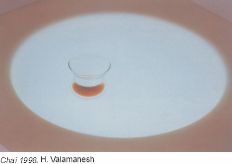
Fire gives light, but light without fire gives the clearest sense of the lambent presence of this art, a presence, I repeat, threatening to dissolve suddenly into nothing—the Farsi word for ‘nothing’ becomes an image in certain works, like the black mystic square hanging in my study at home. One of the simplest, most hypnotic, of Valamanesh’s pieces is Chai, as close as I could get (1998). I saw it at Ian and Mirna North’s home, months after the Art Gallery of South Australia exhibition, splendidly curated by Sarah Thomas in 2001, had closed. Ian describes it graphically in the catalogue:
Visitors approach Chai as I did for the first time, attracted by the light that emanates from the top. In a pool of light a strange, orange-brown form magically hovers. It is mesmerising beyond the three seconds which most contemporary art offers. Only on careful inspection does one realise the work comprises a glass cup of tea—chai—floating, just, in a bowl of water in the top of the plinth in which it is embedded, and illuminated from underneath. Simple. But no one picks it straight off….
The domestic aura of this object, its tranquil transubstantiations, so to speak, evoke for me, as do so many objects that Valamanesh exquisitely crafts, the last, luminous days of Ovid in David Malouf’s An Imaginary Life, his self-dispossession in humility, his surrender to the final metamorphosis. And why not? Sufis, though associated with Islam, think of their practice as the antic truth immanent in every creed, in every way of life. They may enjoy mutual recognition in silence, or with some esoteric pun, but still share, deeper than any doctrine, an innate feeling. Robert Graves describes it thus in his Introduction to Idries Shah’s The Sufis: ‘To be “in the world, but not of it,” free from ambition, greed, intellectual pride, blind obedience to custom, or awe of persons higher in rank–that is the Sufi’s ideal.’ A Sufi, then, might be a Quaker, Kabbalist, Zen Master–adept all at perplexity and paradox–or might be Ovid, Malouf, Valamanesh.
*
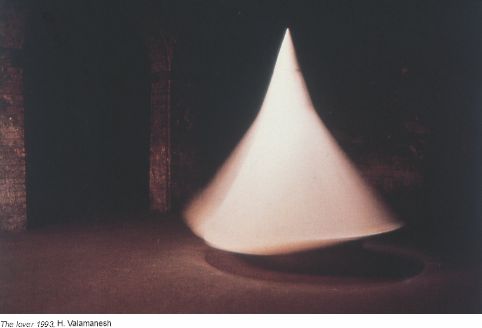
But let us not turn the artist into a Mutassawif (he who strives to be a Sufi) or dervish, though Valamanesh himself constructed, in The lover circles his own heart (1993)—white cloth draped around a rotor—the semblance of a whirling dervish. This artist has many sides, creates in diverse materials, reworks the fragments of his and our identity in vari-coloured forms. Fire, foliage, sand, bark, a shirt, a blank book, a ceramic bowl, a tapered ladder, a map of Switzerland, a flooded bronze boat serving as a fountain, human shadows and outlines, the artist’s own thumbprint enlarged and engraved in the earth, so much else besides—all suffer transmutations of meaning, the mocking ‘transmigrations of Proteus.’
We know, for instance, that the experience of Valamanesh, working with Aborigines at Papunya and Warburton in 1974, proved critical to his self-understanding as artist, migrant, man. Trope meets topos; metaphor maps place. And so, from the dot and pebble paintings that Valamanesh learned to make in the Western Desert, he can later construct Dot paintings with tablets (2001), using, instead of pebbles, various multi-coloured pills—Warfarin, Anginine, Zocor—remedies for heart and circulatory diseases. In one visual pun, in one figurative leap, two cultures converge even as they continue to criticize one another; two collective identities flow like oil in water. But the artist’s interest here is not primarily political, something, say, like escaping techno-consumption; it is an interest in materials, how they link areas of our experience, delimit historical periods or zones of the earth, how they reveal their noetic qualities in the very grain of their substance.
*
Issues of identity do pervade Valamanesh’s art—subject to the law of Proteus. They can concern individual identity, and so relate intimately to the body, as we have seen them do in Malouf’s 12 Edmondstone Street. Hence Valamanesh’s fingerprints, palm imprints, torso outlines, and photographs of his head from the back, in assorted pieces of corporal self-projections. Hence, too, more allegorically perhaps, works that merely hint the body, as in Growing up (1989) , showing a flat, cut-out, beige bust, mounted on a rustic ladder, pointing toward a blue ceramic bowl on the ground. The bust casts no painted shadow, only the ladder does, proof enough that both material and immaterial identities acquiesce in the entrapments of history, in private illusions and personal needs. Elsewhere, human silhouettes, outlined in rope, wood, paper, paint, or words, query the very notion of selfhood. Query? That is theory. Instead, Valamanesh presents us, in Untitled (1995), with a neatly folded shirt, crafted of dun and russet lotus leaves, from which emanates a human shadow made of words in Arabic script. The words repeat, in jumbled form, a love poem by the Sufi, Faridudin Attar: ‘I tear my shirt with every breath for the extent of joy and ecstasy of being in love; now he has become all my being and I am only a shirt.’

The issues of personal identity also engage communal identities, art fit for public places. Between the Hyatt and the ASER Complex in Adelaide, on a handsome esplanade of the Torrens, is a sculpture of several sandstone, bluestone, granite, and wood pieces, a subdued medley of hues, titled Knocking from the inside (1989) . A broken plinth, a fractured column, stairs leading up to a split human silhouette, another concave silhouette carved out of a recumbent slab, spare, cryptic geometries on the pavement, and an inscription of Rumi, constitute the ensemble:
I have lived on the lip of insanity
wanting to know reasons,
knocking on the door. It opens.
I’ve been knocking from the inside!.
I’ve walked through and around this sculpture many times, sometimes casually, sometimes rapt. The structure opens itself to skies, trees, walking paths, even to the walls of high rises around it, yet draws the viewer to an absence within itself, paradoxically, to a psychic centre. You can think of all the lines of exclusion or discrimination, in Australia and the world; you can think of diasporas, displacements, splintered selves; you can think of Marxist alienation, in all its dead and live variations. But something else resides in this space, alluding to all these–our broken estate, our pathos of limits–yet hinting their final irrelevance. Hinting, perhaps, the final irrelevance of art. The Near Ones (epithet for Sufis) would understand.
*
There is no conclusion, no epitome, to Valamaneh’s art. But the spectacle of white ladders, scattered in a Japanese beech forest, titled In memory of snow (2000) , can serve as coda. The ladders climb between the trees, pointing to the canopy at different angles, pointing at what? Wood to wood, in the woods, but not of the wood; feet sunk deep in the earth, sides standing free; without function or use; all similar, each different; the entire installation provisional, temporary, take it away and the forest returns. Like the ‘newly-broken’ columns of Knocking from the inside, these ladders play with time. Like other artifacts of Valamanesh—mock ruins, reversing the direction of decay, as Paul Carter has shrewdly observed—these ladders address transcendence in the idiom of the day. Ladders are everywhere, in Japan, Australia, Bangladesh, Iran.
But artists—not just Picasso—develop. So does Valamanesh. Some of his most recent work seems to favour repeated patterns in a public space, like ladders or drum-like structures. It is what I call Serial Art: identical or slightly varied objects and forms, arranged in an artistic force field. Their interplay creates perceptual tensions and subliminal messages that a single work can rarely reproduce. (Some of Morandi’s work with bottles previsions this tendency, which emerges mainly in the postmodern era.) It is as if artists were answering Walter Benjamin’s famous essay, ‘The Work of Art in the Age of Mechanical Reproduction,’ with subtle reproductions of their own.
But it may be best to give Valamanesh the penultimate word on his own work. This is what he says in a letter to me:
New directions? If it was Rumi, he would say, “My direction is of no direction, my home is of no place….’ Looking at what I have been making lately, it seems that the Farsi text is appearing stronger, some writings on bread with saffron, also a work with Angela [Valamanesh] which is an unreadable language ( ‘Lines from the Forest’), made from branches…. I am looking forward to extending the possibility of text both in a readable and unreadable manner. But as you know, I am always concerned with the materiality of the objects and the processes which bring them to life.
*
Identity, you say? I would rather make a place for Falstaff in our age and take his rogue’s counsel, on some days, in matters of Church and State. At any rate, when Hossein Valamanesh insists on recognition as an Australian, though he and others may recognize his Iranian filiations, I take him at his word. Origins prove nothing, indeed, especially for adepts at crossing boundaries. In Valamanesh, this is a gift of poesis, a playful largesse of spirit, a way of catching crosswinds of planetary change.
Ihab Hassan is Emeritus Vilas Research Professor of English and Comparative Literature at the University of Wisconsin, Milwaukee. He is the author of fourteen books, among them Radical Innocence, The Literature of Silence, Paracriticisms, and The Postmodern Turn.
This is an age of diasporas. Populations wash around the earth, leaving bodies in crevasses, dreams in rockpools. No wonder that ‘identity’ has become a shibboleth of postcolonial discourse. But identity with what? Where and when has anything been truly self-same? Artists in exile–if exile it is–may be wiser than ideologues, and imagination may save…